Religion
Mostafa Malekian's Lecture on the Musts and Must-Nots of Shams Tabrizi
In his exposition of Shams Tabrizi's thought, Mostafa Malekian identifies the first step toward a relationship with God as the 'perception of need'—a state in which one sees oneself as nothing and one's possessions as belonging to another. For Shams, love of God arises solely from this feeling of need.
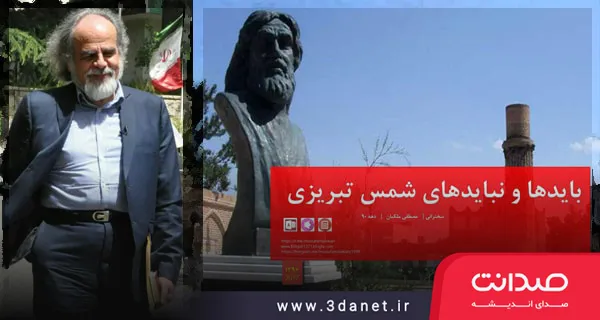
Audio and text of Mostafa Malekian's lecture titled The Musts and Must-Nots of Shams Tabrizi (Shams Tabrizi's Deontological System)
1_ Need
When we say the first step in the human being's relationship with God is need, it may be meaningless to most of us—what does need mean, and it might also seem strange to accept that the first step in the relationship with God is need and that we should bring our need to God's court?! Shams does not explicitly say what need means, but in the Maqalat there are many indications and signs that need is a state of perception in a person, in which that perceptual state perceives that he himself is nothing, and in that perceptual state perceives that none of the so-called possessions, those alleged possessions, are truly his. Whether possessions belonging to the category of knowledge or possessions belonging to the category of ability. We have possessions of knowledge and power, theoretical and practical. Need means that a person perceives—and not feigns (neither to himself nor to others)—and has truly reached the point that I am a collection of non-possessions, of want and need. I have no possessions at all (not, of course, in the sense of a self-pitying affliction where the person says, 'I have possessions!' nor in the sense that you refuse to accept that you have intelligence, refuse to accept that you have the power of memory, speed of transmission, wealth, beauty, and the like, but rather in the sense that you perceive that everything you supposedly have is not really yours and you are not their owner). If you feel this way, correspondingly and correlatively, a kind of feeling of dependence on another arises within you. Whenever you feel that something you have is not yours, you feel neediness toward the one who gave you that thing. You feel dependence and attachment. Shams attached great importance to this point. As long as we feel we have possessions and that these possessions (wealth, power, knowledge, beauty, fame, popularity, properties, students, spouse, etc.) are ours, we are full, and in Rumi's expression, as long as we are full, no pleasant sound comes out of us, like a reed flute that must be completely empty for a pleasant sound to come out of it. Shams emphasizes need and says we must be wholly need, feeling that the only thing we have is need. In Shams's view, God has everything except need; we have nothing except need. And when we bring a gift to someone who lacks that thing and they are pleased, we too should bring the gift of need to God, because the only thing God lacks is need; therefore, we must bring the gift of need to God. Of course, this is a verbal similarity. Does the perception of need truly require a metaphysical and philosophical presupposition or not?! We do not see such a thing in Shams's Maqalat, but many have said that if the perception of need is to arise in someone, it must have a metaphysical presupposition. I will explain this metaphysical presupposition with the example of a thread. Imagine you have a thread of immense length, with which we can do whatever we wish. We tie a knot in this thread. Five meters further along, we tie seven knots on this thread. Ten meters further along, at a point on the same thread, we tie fifty knots on top of each other, and suppose we continue in this manner, tying different knots at various intervals along the thread. One knot in one place, three knots on top of each other in another, five knots in another, and so on. There is no doubt that the points that appear on this thread differ greatly from one another in terms of size and function. For example, where we have tied one knot, this knot can pass through the eye of a needle, but where we have tied fifty knots on top of each other, this knot cannot pass through the eye of a needle. We apparently attribute these various functions to the knots. But if we look closely, we see that these functions belong to the thread. If the knots look at themselves, they say, 'I have this function, and you have that function.' If one day we decide to untie these knots, then we see that all these functions belonged to the thread. This knot has no capacity of its own; its capacity is related to the number of knots in the thread. So if a certain capability emerges from this lady or that gentleman, from me or from you, each of us is a knot in this existence, and how many knots I happen to be tied into—which shapes me—was not in my hands. Because of these knots, for example, I have a strong memory and you have a stronger one; I have intelligence and you have stronger intelligence; an ugliness has been produced in me, a beauty in you, and so on. The functions are various. These functions belong to one thing. Beauty, ugliness, harshness, kindness, and everything we see in the world must be attributed to that same thread. The metaphor of the thread is used more in Christian mysticism. Our predecessors more often used the metaphor of the wave. They said there is a small wave in the sea that, when we are swimming, moves us a little. Another wave, when it strikes our waist, carries us fifty meters further away.
یک موج هم وقتی به یک قایق بخورد واژگونش میکند و موج دیگر اقیانوس پیما را می تواند خرد کند. موج ها اگر بهم نگاه کنند می گویند عرضه تو کجاست فقط توانستی فردی که شنا میکند را کمی حرکت دهی، من کشتی و اقیانوس پیما را خرد کردم. این قدرت کجا آن قدرت کجا؟! اما اگر از کف دریا به این موجها نگاه کنیم میبینیم که این کارهای کم یا بیش، درشت یا ریز و خرد یا کلان را آب انجام می دهد. آب وقتی یک جور خیزآبه میگیرد اسمش میشود موج کوچک و همان آب، جور دیگر خیزآبه بگیرد اسمش میشود موج بزرگ. همه این هنرها و عیب ها را باید به پای آب نوشت. موج ها وقتی از اصل مشترکشان غفلت کنند به خودشان نسبت می دهند. اگر موج ها به اصل مشترکشان توجه کنند چیزی به خودشان نسبت نمی دهند. آدم وقتی ادراک نیاز می کند که بفهمد یک اصل مشترکی در همه آدمیان و در همه موجودات هست که تمام هنرها و عیب ها را باید به پای او نوشت. تمام قدرت ها را باید به پای او نوشت. تمام علم ها را باید به پای او نوشت. تمام جمال ها و تمام خیرها، همه معرفت ها وهمه چیز را باید به پای او نوشت. این دید مابعدالطبیعی در مقالات شمس و آثار مولوی چندان واضح نیست. ابن عربی به وحدت وجود تاکید دارد. وحدت وجود به معنای اینکه کل هستی را یک موجود پُر کرده است. درعالم هستی فقط یک موجود تاثیر میتواند بگذارد و دخل و تصرف می تواند بکند و آن هم الله است. به تعبیر دینی الله و تعبیرعرفانی وجود سرّ، وجود محض و هر تعبیر دیگری که بکنیم. ظاهرا بنظر می آید بدون فهم مدعای مابعدالطبیعی آن ادراک بر کسی حاصل نیاید، اگرچه من بعید نمی دانم که سنخ های روانی نادره مصداقی وجود داشته باشند که اینها بدون اینکه نظرگاه مابعدالطبیعی هم داشته باشند، به اقتضای سنخ روانی شان از اول خودشان را هیچ می بینند. از اول برای خودشان هیچ دارایی استقلالی قائل نیستند. البته این به معنا نیست که ما واقعیت ها را انکار کنیم بلکه به این معناست که واقعیت ها را از یک منظر دیگر تفسیرکنیم.2. Love of God:
Shams believes that whoever adopts a posture of need toward God, love for God arises within them. Love for God arises solely and exclusively through the perception of need. Someone who does not perceive and feel a need for God will never have love for God settle in their heart and will not become a lover of God. Therefore, the second stage is that we must become lovers. Hafez says, become a lover, O heart. We must find love for God. In my opinion, one of the most difficult questions in mysticism is this: when they say we should find love for God, what does that mean? We understand what love for another human being means, we also understand love for another human being and its difference from friendship, we also understand love for another human being and love for ideals; that is, at one time I am in love with you as a human being, at another time I am in love with truth, I am in love with the good, I am in love with justice. We understand the differences between these. But what does love for God mean? When they say someone is a lover of God, in what sense? The only thing that can be clearly stated is the negative aspect of this issue. That is, one can say what love for God is not. But to then want to say what it is, that is difficult. What is love for God not? It is very clear. God is an infinite being. Every being we see around us is finite. Therefore, every being we see around us is not God. So, love for any being we see around us is not, in reality, love for God. This is the negative aspect. When I love wealth, riches, knowledge, and whatever belongs to me, that thing is not God, and because that thing is not God, I am not loving God in that thing; I am loving a specific thing. This is the negative aspect. In other words, when we say love for God, it means love for something that has no other, because it is infinite. Every infinite thing has no other. All beings around us are finite, and because they are finite, they have an other. This human being is other than that human being, and that human being is other than this one. Therefore, love for God means not having love for any specific being, insofar as it is a specific being. Whether that specific being is a human, an animal, a plant, or an inanimate object. Whether it is an ideal or anything else. Shams repeats that love for God means do not be self-regarding. Do not be a lover of self. This is the negative aspect. Is the negative aspect sufficient? If you perform an action and then, when you reflect upon yourself, you see that you did not do this action for the sake of acquiring wealth, power, status and position, social standing, fame, or popularity, can you then say that you did this action for the sake of God or not?! Doing something for God, or being a lover of God, requires as a necessary condition that we not be a lover of anything else, but it is not a sufficient condition. It requires something additional. Is the mere fact that I am not attached to any limited, finite, specific being that has an other sufficient for me to say I am a lover of God, or are these unloved things a necessary condition for love of God but not a sufficient condition, requiring something additional as well? I think it is a very, very difficult discussion in mysticism, and I do not think a definitive answer can be given to it, but at the same time, there is a series of things that can be extracted and inferred from Shams's statements, which I will present to you. In several places, Shams says that God-worship is contrary to and the opposite of self-worship. If God-worship can be taken to mean love for God, then according to this statement, one can say that love for God means not having love for oneself, because the self is also one of those finite beings. This is the best example for a person to find love for God by not having love for themselves. Why? Because it is certain that if a person is to have love for other than God, they are more susceptible than anything else to love for themselves. The indicator is that we must not have love for ourselves, because if I am to love finite beings, the first candidate for this love of mine is myself; in addition to this, another argument can be made, which is that love for any other finite being can also stem from love for myself. Therefore, it is meaningful when they say you have love for God to first say do not have love for yourselves, and it is meaningful and has logic, yet despite all this, one is still not satisfied with this statement. Sometimes Shams speaks in a way as if love for God means non-attachment. The very thing Buddha said. Buddha did not take love to mean attachment and believed that attachment and clinging are contrary to love. He said love, but do not have attachment and clinging to beings. Sometimes Shams speaks in a way that seems to have Platonic examples in mind. The essence of Plato's speech is that what religions and faiths call God is the embodiment of three ideals: Truth (veracity), the Good (goodness), and Beauty (loveliness). When Shams says love God, it is as if he wants to say be a lover of Truth, the Good, and Beauty. Cultivate within yourself a fascination for these three.
In Shams’s view, both lover and beloved are transient and go beneath the soil, so he means to say: be a lover of a being that does not die. Thus there is a being whose life is enduring and everlasting and always exists; one must fall in love with that being. In my opinion, we must here pay attention to this point: when we fall in love with God, with a being that does not die, we as lovers will die; our beloved does not die, but when I, the lover, die, what use is this love anymore? Religions and creeds say that the difference between a good and a bad person becomes clear after death. Both have an afterlife. Both Ali and Muawiya. But Ali ibn Abi Talib has a good afterlife and Muawiya has a bad afterlife. Among the Abrahamic religions, a large portion of Christians do not hold this belief. They do not say that both the good and the wicked are transferred to an afterlife. They say only the good have an afterlife. The wicked die with their death and are annihilated. There is a verse in the Quran that says We have appointed the afterlife only for the good. When we are lovers of God, we do not die. So both the lover of God and the beloved, who is God, have an eternal life. In my opinion, a person feels love for God when they imagine God as a human-like being and weep for Him, bring their needs to His court, and coax Him, and...
3_ Becoming like God:
In Shams's view, we must become like God, meaning we must become as similar to God as possible. In Shams's view, when the attributes and actions of God are depicted in the Quran and prophetic traditions, it is not for the sake of information; it is so that we know how we ought to become. When the Quran and prophetic traditions provide us with God's identity card, it is so that we know in which direction we must move. For example, when Shams says, "I possess both kindness and wrath, and am therefore closer to God than Rumi, who possesses only kindness," it means one must become like God, for God possesses both kindness and wrath. In Shams's view, the more love for God takes shape within us, the more our likeness to God increases. If we look at it from a humanistic perspective, a being that is all kindness is better than a being that possesses both kindness and wrath.
4_ Recommending having a guardian, a spiritual guide, and a masterThe need to be taken to God, to fall in love with God, and to become like God—the perfecting form of these is achieved only through guardianship (wilāya). That is, we must seek a guardian. In Sufism, they speak of the master (shaykh), the spiritual guide (murshid), the elder (pīr). You might say, "I can live an ethical life and have no need for a spiritual guide." From Shams's perspective, we must find a guardian, a master, and a spiritual guide for ourselves. Shams's ethics is an ethics for the elect. One of the most complex discussions in Sufism is: what does the master do with a person? Why must I have a master? Why must I have an elder? Several important questions exist here. The first point is: what needs of the disciple does the elder actually fulfill? That is, for what needs do we turn to the elder? Why must the elder necessarily be alive? Why doesn't the elder write a book, like a manual of practical laws, stating that this is the way of life, and we then act upon it? What is the difference between a living elder and a dead elder? While the Sufis emphatically stress having a living elder for guidance and supervision, so that the disciple traverses the stages of the spiritual journey under their watch, they also believe that those who have journeyed without an elder have also reached the goal under the radiance, blessing, or ray of an elder's existence. If Uways reached a station without an elder, an elder somewhere provided him with unseen assistance. If, when we lack an outward elder, an unseen elder—an elder whose very existence we are unaware of—sets our affairs in order, then what need is there for a living elder? Does the elder foster our growth solely through the teaching and training they provide us, or are they also a channel for a series of divine graces? Shams and Rumi held that the existence of the master, in addition to teaching and training us, also conveys divine grace to us and is a mediator and guide on the path toward God. If the master is this important, what ways exist to distinguish a true master from a false master? In my opinion, although the issue of the elder is of great importance and much emphasis has been placed on distinguishing a good elder from a bad one, a precise methodology for making this distinction has not been provided; yet it is constantly repeated that we must beware of the ogres along this path. In the thought of Shams and Rumi, you will reach nowhere without an elder. You must have a living elder who both teaches and trains you and becomes a channel for divine graces that reach you through them.
5_ Following the masterThe disciple must follow the master. Shams would say of great figures like Sheikh al-Ishraq, Muhyiddin Ibn Arabi, and the like that their problem was that they were not people of following. Shams and Rumi place the greatest emphasis on following and the greatest censure on imitation. I know of no mystics in our own culture who, like Shams and Rumi, have so condemned imitation and so stressed that you must follow your master. What is the difference between imitation and following? In my view, it is a complex discussion. In brief, there is one thing: following definitely pertains to the verbal commands of the master. That is, if a master says do such-and-such and do not do such-and-such, and be such-and-such and do not be such-and-such, these must be accepted. This command and prohibition is the clear instance of following. Imitation means that whatever the master does, the disciple does too. In Rumi's view, when Abraham goes into the fire and the fire becomes a rose garden, we cannot imitate him, because if we go into the fire, we will burn. We must distinguish three types of command and prohibition. For example, a doctor tells me to raise my hand; I raise my hand. He tells me to lower my hand; I lower my hand. Clearly, here he has commanded me to a voluntary act. At another time, he tells me to fly to the rooftop opposite and sit there; here he has commanded me to a compulsory act that is not within my power or ability. At yet another time, he tells me to lose seven kilos. Here the command is voluntary in one respect and compulsory in another. If I am to lose weight at that very moment, I do not have the ability, so it is compulsory; but if he gives me time, firstly, and teaches me a method, secondly, it is voluntary. The one who went into the fire in imitation of Abraham and burned thought this was a voluntary command; he should have taken a set of instructions from Abraham so that after a while he could go into the fire like him and not burn. We can perform some acts of following provided we do not imitate our master at that very moment. We must take a set of instructions from the master so that after a while we too can act like him. In the works of Shams and Rumi, in my view, the boundary between imitation and following is not known. This statement of Shams, that one must not imitate, brings him close to what the existentialists call authentic life, that is, a life based on one's own perceptions. Shams says belief by imitation and denial by imitation are a source of corruption.
6_ Acting upon what we knowShams and Rumi say: Act. Do not think that increasing your knowledge will get you anywhere. What gets you somewhere is doing. Shams constantly says: Do something. Shams says if you read a thousand treatises, it is of no use. Shams believes that what one knows must be done and carried out. In Jung's terms, spiritual chemistry. If we learn chemistry and only write our knowledge in our notebooks and do not enter the laboratory, what use is our knowing chemistry? We must act upon what we know. Instead of investigation, realize.
7_ Wisdom, what is it to me?
Shams believes in "wisdom, what is it to me?" If something relates to your action, it relates to you; but if something does not relate to your action, it does not relate to you. "Wisdom, what is it to me?" has two meanings: first, whatever they say—God has such-and-such attribute, Jesus was such-and-such, Moses was such-and-such, etc.—say: What is it to me? Stop being a spectator. You must become an actor yourself. Second, whatever anyone teaches you, ask: Can I derive a practical rule from this? I am looking for practical rules. That is, I seek the message behind every utterance only in practical rules. Whatever anyone says, ask: From this collection of your words, do I find something that tells me to do or not do something? To be this way or not be that way? If no practical rule emerges from the words, abandon the words. Non-beneficial knowledge and harmful knowledge are knowledge from which no practical rule is obtained.
8_ Do not spend your time on irremediable sufferings.
There are two kinds of pain and suffering: one is remediable pain and suffering, and the other is irremediable pain and suffering. Irremediable pain and suffering, that is, the tragic aspects of life, meaning the pain and suffering that lies dormant in the nature of life. It cannot be eliminated. If it can be eliminated, then address it: how, to what extent, and for whom should I eliminate it? If we do something about the tragic aspects of life, we have, in reality, merely destroyed our lifetime and the set of possibilities given to us within the vessel of life. Therefore, in Shams's view, distinguishing remediable pain and suffering from irremediable pain and suffering is very important.
9_ For your own perfection, make use of every religion and creed.
Do not confine yourself to any single religion or creed. Accept whatever is reasonable, from whichever creed it may be. I must sense what is beneficial for my body, for my mind, for my psyche, and for my soul (my nafs and my rūḥ). I must see what is beneficial and what is pseudo-beneficial. Beware lest I am given the pseudo-beneficial instead of the beneficial. If you perceive that something is beneficial, do not look at its history and geography. Be a seeker of truth, wherever it may be. One who is in love with truth, beauty, and goodness will pursue these three wherever they are. Shams, in some instances, gives examples of jurisprudential sects, theological sects, and even religious sects, and says, 'Whatever good I see, I welcome it.'
10_ Emphasis on virtue ethics
The emphasis of Shams and Rumi is on this: do not focus on what the act itself was in what you do. Nor focus on the effects and consequences that follow from this act. Focus on the motive with which you perform this act. Neither the act is important, nor the result; rather, the agent is important. That is, the ethics of Shams and Rumi is neither deontological nor consequentialist. For example, they consider samāʿ obligatory for some, permissible for others, and forbidden for yet others. Why? Because what matters is the intention with which one performs samāʿ. Shams and Rumi believed in virtue ethics, meaning that when a person performs an act, they should not think about its effects and results; they must see with what intention they are performing that act.
11_ Negation of the pleasure principle
Shams believes that for individuals to organize their lives for greater pleasure is the greatest error. His reason for this is that he says, whoever derives more pleasure in life, their regret at the time of death is greater. For example, the dying of a person who is very wealthy differs from the dying of someone who has fewer possessions. The wealthy person dies with regret for the wealth and possessions they have, but the person who has little wealth surrenders their life more easily.
12_ Discerning the right actionShams says, if you want to know whether the action you are performing is right or wrong, see whether you would be willing for your soul to be taken while performing that action. If you have no fear of your soul being taken during that action, it means you are doing the right thing; but if, during an action, when Azrael comes, you say, 'Do not take my soul so that I may engage in another task,' it means you are not engaged in the right action.
13_ The limitedness of our perception and understandingShams believes we should understand that the universe is greater than our intellect. That is, there are things in the world that I do not perceive and understand. The fact that I cannot understand and perceive certain things does not mean they do not exist; we must
be mindful of this matter.
14_ The pursuit of knowledge
Shams emphasizes that for our spiritual progress, learning certain sciences is necessary. From the science of 'qīl wa qāl'—in today's terms, academic learning—we must learn some things; and a knowledge that comes to us is the expansion of the inner self, whereby our inner self gradually opens, and in this state, we see things that cannot be contained in the 'qīl wa qāl' of the school. The former is a necessary condition for progress, and the latter is the result of progress. When we progress spiritually, the eye of our heart opens to truths whose existence we could not discern through the science of the school.
15_ Letting go of money
Shams believes that for the first step on the spiritual path, one must let go of money. In Shams's time, money and bridge were both called 'pūl.' So the meaning was that you must let go of 'pūl' (money) in order to also cross the 'pūl' (bridge). In practice, until a person lets go of their money, they cannot let go of other things either.
16_ Shams believes that love must be confined solely to God.
We must love only God. Love, in the precise sense of the word, must be directed only toward God. Instead of saying "love human beings," Shams says "have goodwill toward them," and sometimes uses the term compassion. Goodwill in the sense that I bring near to you whatever is in your best interest and keep away from you whatever is not in your best interest, even if it is not to your liking.
17_ The Violence of Love
No mystic emphasizes the violence of love as much as Shams. He says, "Whomever I love, I treat with violence." Because the more we love someone, the more we think about what is in the best interest of their life, not what pleases them. Like a father's compassion for his child, which may involve doing things that appear harsh but are in the child's best interest.
18_ Indifference to People's Value Judgments
Shams advises us to be indifferent to people's value judgments. Some people are very anxious to know what others say about them. Some are anxious about how others think about them, and for others, knowing the feelings and emotions of others toward them is important. Shams deters us from all three of these and believes: I fulfill my moral duty, which is benevolence toward people, and their value judgments, speech, thoughts, feelings, and emotions toward me are of no importance to me.
19_ Estrangement from People
Shams sometimes behaved in ways that made people scatter from around him because he did not want people to make a god out of him and have eyes staring at him.
20_ Reducing Association with Ordinary People
Shams emphasizes that anyone who wants to follow the majority of people is misguided. Shams does not care about people's negative beliefs, negative feelings and emotions, and negative speech toward him. The natural result of this behavior is that association with people decreases. Shams says, "Go in the direction of reducing your association with ordinary human beings, because nothing good emanates from ordinary human beings." Therefore, associate with people to the extent that you can serve them and improve their condition.
21_ Utilitarianism in Social RelationsIncrease your association with the friends of God, the men of God, the people of the heart, and the people of inner truth as much as you can. That is, a great utilitarianism in social relations. Wherever the benefit is little, cut off social association, and wherever the benefit is greater, increase social association. Shams says, "My whole life is worth having met Rumi." For Shams, companionship with the friends of God is very important because he believes that through the radiance emanating from companionship with them, we become better. Rumi, in the first book and from the middle of the story of the Slave Girl and the King, refers to the spiritual master. Rumi and Shams's emphasis on companionship with the friends of God is important for three reasons. The first reason is to model their speech and deeds. The second is that companionship with the men of God instills a series of psychological goods in us. In companionship with the men of God, our hopefulness, tranquility, and feeling of joy increase. The third reason is that in companionship with the men of God, a series of spiritual goods are given to us.
22_ The Recommendation to Be a Lover, Not a Beloved
In Shams's view, in life we should seek to be the seeker, not the sought. Shams and Rumi believe that people who want to be the beloved become wretched. We must learn the art of falling in love, not the art of being the beloved. That is, instead of trying to charm so that you love me, I should love you. Shams's recommendation is to be a lover, not a beloved. People who strive more to love others also become the beloved, and people who strive to be the beloved lose the love of others more.
23_ Cutting Off Hope from Everyone
When Shams says "I am a stranger," it means we must sever all hope from others and not hang our own cloak on the coat rack of others. Because others are not perfect in knowledge, power, or will and are deficient, we become disappointed. One must place hope in someone who knows what a person wants, secondly can solve the problem, and thirdly wants to give that thing to the person.
24_ When you want to help someone, help according to their understanding.
If you help someone beyond their understanding, they will not realize that you are helping them. For your help to another to be effective, you must first elevate their understanding so they can comprehend your help.
25_ Discerning who is inclined to listen and who is inclined to speak
Shams and Rumi advise us that whenever you encounter someone, see whether they are inclined to listen or inclined to speak. If they are inclined to listen, speak; and if they are inclined to speak, listen. Do not speak with someone who is not inclined to listen.
26_ Having pretensions
Shams has many pretensions about himself and expresses them. Shams says that union with Rumi does not make me glad, and separation from Rumi does not make me sorrowful. In the book Sepahsalar, it is recounted: One day we were sitting in a garden. Rumi had stretched his feet into the stream to cool them. One of the companions said, "I wish Shams were alive so we could be in his presence." Rumi said, "How can you say this in the presence of one from every hair of whom a thousand Shams are hanging?"
Mostafa Malekian's Points in the Q&A Section
The Concept of Individuation:
Individuation is said to occur when a person acts solely based on their own reason and moral conscience and not on anything else; here we say we have an individuated person. The individuated person uses the knowledge of others, the thinking power of others, and the experiences of others, but weighs all of these with the scales of their own reason and moral conscience. For example, if an individuated person wants to buy a house and seeks advice from ten people and hears the differing opinions of these ten people, ultimately they weigh all these opinions with their own reason and moral conscience and act accordingly. Therefore, individuation means acting based on one's own understanding and discernment. The understanding and discernment of the individuated person in theoretical matters is through reason, and in practical matters, through moral conscience.
Can an individuated person follow or obey?
If the reason and moral conscience of the individuated person dictates that in a certain domain, in a certain field, and on a specific subject and issue, someone is more knowledgeable than them, and because of this dictate of their reason and moral conscience, they place themselves at the disposal of that individual, then they are an individuated person and have followed them. Like an individuated person going to a doctor, because their reason and moral conscience, on the whole, tells them that this doctor is more knowledgeable than them in this specific domain (knowledge is a necessary and important condition, but not a sufficient one), and this causes the individuated person to place their body at the doctor's disposal and follow them, and this does not contradict their individuation. Individuation conflicts with following when the individuated person has not discerned the superiority of another over themselves through their own reason and moral conscience, and has been influenced by others, has been susceptible to suggestion and indoctrination, and has imitated. For example, when an individuated person is asked, "Why have you placed yourself at the disposal of that particular doctor?" and they say, "Many people have placed themselves at the disposal of that particular doctor," here the individuated person has no theoretical or practical reasoning.
Can an individuated person have a romantic relationship with someone else? Can two individuated human beings be in love with each other?
I believe that true love is realized only and exclusively when both parties are individuated. Suppose x and y are lover and beloved, and x is in a position to cut away pieces of y’s being, and y is in a position to cut away pieces of x’s being; then in reality x does not love y, but loves y minus those pieces, and y does not love x, but loves x minus those pieces. Love is real when the lover loves the beloved with all that they are—this does not, of course, mean that the lover does not try to remedy any error, flaw, or defect they see in the beloved. As long as the lover has not been able to remedy the beloved’s flaw and defect, their entire effort is directed toward remedying it, but until they achieve this aim, they love the beloved just as they are; like a father whose child is weak in mathematics: the father strives to bring his child’s mathematics to the desired level and may even resort to harshness in this pursuit, yet as long as the child’s mathematics has not reached the desired level, he loves the child in the very state they are in. There is no contradiction in loving someone in whatever state they are while at the same time striving for their perfection. The loves we usually have for one another are not like this; typically the lover says to the beloved, “I love you if you abandon n number of your beliefs, snip away several of your feelings and emotions, and forgo several of your desires, and also refrain from saying certain things and doing certain things!” This is not love. Love means doing good to someone without calculation and desiring their flourishing. When individuation is lost, love is lost too. Kahlil Gibran, in his book The Prophet, addressing young spouses, wrote: “Walk beside one another, but lean not upon one another.”
The moment I ask the other party to censor themselves or else lose my affection and love, it means I am in love with myself. In other words, when I try to make the other party resemble me, and if they do not resemble me they will not be drawn to me, this means I do not love them; I love myself. Someone truly loves another when they say, “Even if you remain exactly as you are, I love you.” Therefore, in my view, individuation does not contradict love; on the contrary, the absence of individuation contradicts love. But there is one point, and that is that when we speak of love, we usually mean erotic love. In the Persian word eshgh (love), the erotic aspect (sexual instinct) predominates. There is no moral ugliness in a person loving someone because of the sexual instinct, but it is not love.
We have three types of love. There is no problem with my being fond of someone because of the sexual instinct—that is, the fondness itself is not a problem; fondness is not a voluntary matter to carry moral ugliness. Some of the actions and reactions I display as a result of this fondness may fall under moral judgments. In erotic love—which we mistakenly call love but is in fact friendship—individuation is not preserved. Because in erotic love, if the beloved refuses physical contact, whether their esteem rises in the lover’s eyes or not, the lover becomes vexed with them, since the lover loves the beloved only on the condition of having physical contact with them.
True love is what Baba Taher spoke of:
I’ll go, I’ll pass beyond this world, I’ll go / I’ll go beyond Cathay and beyond China, farther still I’ll go
I’ll go and ask the pilgrims of the Hajj / “Does this distance suffice, or farther still shall I go?”
Because the lover desires the beloved’s contentment, even if the beloved’s contentment lies in the lover’s distance; in true love, the beloved’s contentment is the condition.
Shams’s Position in the Maqalat on Following:
Shams holds three positions. First, that following is a necessary condition and sometimes a sufficient condition for perfection, and that Shaykh al-Ishraq, Muhyi al-Din Ibn Arabi, and the like fell into perdition because they did not follow—meaning one must necessarily follow. Second, it seems that following someone is a necessary condition, and there is no harm if other followings are set aside; Shams said, “I follow only the Prophet.” And third, that Shams sometimes does not even follow the Prophet.
I do not grasp Shams’s precise view, because on the one hand he says Muhyi al-Din Ibn Arabi was not in a state of following and criticizes him, and elsewhere he says, “If I am to imitate, then at least I imitate the Quran,” and in yet another place he says, “I place my reins only in the hand of Muhammad—though he, too, must not be too strict.”
I have discussed this at length with Dr. Movahed as well, and I am not convinced whether obedience is ultimately a necessary condition and whether one must necessarily be obedient, and if one must, what does it mean? Shams says, I did not find fault with the Prophet's words except in this saying: 'The world is the believer's prison.' I see a rose garden, not a prison. This means not accepting the Prophet's words. Shams, who says one must not object to the master and must not find fault with the guide, why does he himself object to the Prophet in this saying? I do not understand, in the exposition of this great philosopher, the difference between obedience and adherence versus imitation.
Need belongs to the category of perception, but desire belongs to the category of feelings, emotions, and passions. That is, I perceive my own insignificance, or I perceive my own poverty, or I perceive my own ignorance, or I perceive my own powerlessness. These perceptions are needs. Need belongs to the category of perception. Need pertains to the cognitive and perceptual domain of the human being. When this perception arises, that which I lack is not outside of two states; for example, I perceive that I lack x and I say, how good it is that I lack x, so here no desire is at play. Another time, I perceive that I lack x and I say, why do I lack x? I was friends with Mr. Behjat's son many years ago; at that time, he said he asked his father for financial help and told his father (Mr. Behjat), 'Sir, I have nothing and I am also fifty thousand tomans in debt.' His father said, 'It is good that you are fifty thousand tomans in debt; I do not even have that!' After a person understands a lack, they might say, I have understood the lack of a desirable thing, and desire arises within them, and another time, they understand the lack of an undesirable thing, and no desire arises within them.
Desire belongs to the category of feelings, emotions, and passions. Wish also pertains to this same domain but differs from desire. Will also differs from desire. Will is the wanting of an action; for example, I want to go to my home. Going home is an action, and I want to go to my home. I want to eat dinner; I have willed something called eating dinner. When a person's wanting attaches to an action, like going home, like eating dinner, it is called will. But if the wanting does not attach to an action and attaches to a state, for example, I want the air in my room to become cooler; becoming cooler is not an action, it is a state. Or I want not to grow old; not growing old is not an action, it is a state. Or I wish I were more learned than this; these are not actions; here we call it desire. Therefore, the difference between will and desire is that will always attaches to an action that the individual, by performing it, actualizes the will, and desire attaches to a state or condition. I say, I wish there were no war; war is not an action, it is a state. I wish there were peace; peace is a state. Do not confuse will with desire. Will always attaches to an action; I say I want to do such-and-such an action. But desire attaches to a state, and states are of two kinds: first, states that, when I desire them, seem attainable at the moment of desiring; and second, states that, when I desire them, while I am desiring them, seem unattainable. The first is called desire, and the second is called wish.
Therefore, wish means a longing that is, as a rule, unattainable. And this is one of the principles of the teachings of Shams and Rumi. Shams, in one place, says something similar to what Muhyiddin Ibn Arabi also says in one of his treatises: that until you wish for the impossible, you are not a monotheist; you must wish for the impossible. Similar to Kierkegaard's statement. Muhyiddin Ibn Arabi has a small treatise about two points, saying he wrote this treatise to convey these two points: one, that until you want the impossible, you are not a monotheist, because until you want the impossible, you still do not know that everything is in God's hands. Someone truly accepts that everything is in God's hands who wants the impossible. Shams and Rumi are like this, though not as explicitly as Muhyiddin Ibn Arabi stated; they truly say that we must want even the impossible. Contrary to Hafez, who said, 'Beware, lest you shake the ring of fortune's impossibility,' Shams and Rumi say one must shake the ring of fortune's impossibility, just like Kierkegaard and some Christian theologians, even Saint Augustine, who said that until you ask God for an impossibility, it is clear you do not consider God very powerful! Because as long as a person asks God for possible things, they consider God a great human being, and nothing more. Wish means wanting something that, at the time of wanting it, is impossible; sometimes, at the time of wanting, it is impossible, and when, because of this wanting, we take actions, we see that, as it happens, it was not impossible after all.
Approach to Jurisprudence and Sharia:
Rumi and Shams consider adherence to Sharia necessary and emphasize it, yet, incidentally, there are statements to the contrary in their words. For example, in the first book of the Masnavi, Rumi says that bringing a gift is for expressing friendship. Once friendship is proven, you no longer bring gifts. On the first, second, third, fourth, fifth meeting, you bring a gift to say that you truly love someone, because friendship cannot be shown, and naturally, one brings a gift as a token of friendship. And elsewhere in the first book, Rumi says that once friendship is established, bringing a gift is insipid. Rumi, in the middle towards the end of the first book, in twenty-four lines, demonstrates there that Sharia is for those whose friendship has been proven; they should not bring gifts, because Sharia is a gift we perform to express our friendship with God. It is the same with Shams. In his behavior, as reported during this period, he strictly forbade wine-drinking. He considered the veil obligatory. It is mentioned in Shams' Discourses that Shams' wife did not veil herself from Rumi. In my opinion, our mystics could not speak their hearts about Sharia, which is a mistake; they should have spoken their hearts. For three reasons, they did not speak their hearts and behaved evasively. Many mystics, like Rumi and Shams, when we first encounter them, emphasize adherence to Sharia greatly. Shams says that if someone is not committed to Sharia, he is not fit to be a spiritual master, yet at the same time, we see transgressions in them. I myself feel more that our mystics were more in agreement with that part of Sharia that concerns the direct relationship of man with God, such as prayer, fasting, reading the Quran, dhikr, litanies, and the like. But regarding that part of Sharia that pertains to human relationships with other humans, not the relationship of man with God, it seems to me they were lenient and did not consider it necessary. In any case, I cannot reconcile the positions of Shams and Rumi, because both views exist in their perspectives.
Mystics did not speak their hearts about Sharia for three reasons:
One was out of conservatism towards the jurists. Second, expediency; the mystics felt that Sharia is a good preliminary step for many people to reach a higher station, so why take this preliminary step away from them?! For example, praying is a practice of concentration for them. Fasting is a practice of self-restraint for them. Third, sometimes the mystics became a little cautious in the face of the greatness of the Prophet of Islam and the religious elders. For instance, they would say that Muhammad, peace be upon him, with all his greatness, prayed and fasted until his last day; perhaps we do not realize that we think one can refrain from praying and fasting, meaning the spiritual dominance of the Prophet was influential for them.
Mysticism is divided into five categories. One classification of mystics is into those who start from the sacred text and cultivate it within themselves, and those who start freely on their own and may arrive at some of the contents of the sacred text. Shams says in the Discourses that those who, before encountering the Quran, find what is in the Quran easy and smooth for them, and do not encounter exaggeration or strange, wondrous speech, and it confirms that these people understand the Quran well; they have had a passage to the Quran before the Quran, and then they deal with the written Quran.
How can we say on the one hand that we believe in the unity of existence, and on the other hand say we must not love existent beings? If we believe in the unity of existence, all existent beings are God, provided we do not consider the limit of each one's existence. In my view, the best analogy for the theory of the unity of existence, contrary to the analogies that have arisen in our culture, is the analogy of the tree. The world is a tree. The world has a trunk, branches, roots, leaves, buds, fruit, blossoms, and so on. There is no doubt that if we disregard this leaf and that leaf, that branch and this branch, this trunk and that root, that plant and that bud, no tree remains; yet at the same time, a blossom cannot claim to be the tree. A blossom is not the tree. If we eliminate the trunk, roots, leaves, and so on, then of course there is no doubt that no tree remains, but one must not conclude from this that each of these is the tree, for if they were the tree, the rest of the tree's parts would be non-tree. Therefore, when we become attached to a particular being, it is like when we become attached to a blossom as a blossom. In the Maqalat it is said that if the man coming from afar is God, then the donkey he is riding is also God. If we say, 'I love this being, this beautiful, well-proportioned, perfect lady or gentleman, because they are God,' then a hunchbacked, ugly, misshapen person will also say, 'I too am God.' Why can we not have the same love for the hunchback that we have for the beautiful person? Because we have seen the latter within its own particular limits. If we are to love everyone because they are God, we must also love the hunchback of Notre Dame. But we do not love him, because we do not see him in his totality. We see him with his particular limits. One of the Buddhist mystics has a book whose title means Thorn and Flower. In fact, in this book he wants to teach us a mechanism by which we can truly see everything as a part of God, not from the perspective of ugly and beautiful. We are not like that, and we cannot be like that.
Servitude:
If we are all parts of God, then what does servitude mean? In my view, if we hold a conception of the unity of existence, servitude is meaningless. The theory of the unity of existence is only for realizing one's own partness in relation to the whole. Servitude in its religious and denominational sense is meaningless to me. If someone's metaphysical theory is creation, then their ethical theory becomes worship. But if someone's metaphysical theory is the unity of existence instead of creation, then it becomes awareness and love. Servitude no longer has meaning; it is meaningless to say that someone is the servant of another. We are all parts that together make up the whole, that is, they make up God. I cannot understand this, and it seems to me that the likes of the late Maleki Tabrizi, who said that while we are all God we have servitude and He has lordship—I do not accept this.
Shams and Rumi
It seems that before meeting Shams, Rumi had metaphysical and existential frustrations. I can never imagine that a man is riding a horse, a dervish asks him a question, and without having any prior problem, a single question suddenly changes him. The question Shams asked Rumi—how many others heard this question! Why were they not moved? We imagine that the transformations that occur within us are revolutionary, meaning in a single moment. For example, we say Fudayl ibn Iyad was about to go thieving, and as he was about to throw himself from the rooftop into the courtyard, he heard someone reciting the Quran: "Has the time not yet come for humans to humble themselves before God?" He said, "Yes, yes." Look, I think many thieves have heard a verse of the Quran, but why Iyad?! It is true that his external physics was that of a thief, but beforehand he had reached a state of metaphysical and existential frustration, and we only see the final moment. Abu Dharr had a similar situation; Abu Dharr was a thief and a highwayman and changed upon meeting the Prophet. But this same Abu Dharr later told the Prophet that in the Age of Ignorance he did three things, which the Prophet confirmed. He said, one, I did not rob the caravans of the poor and stole from the caravans of the rich. Second, I did not lie. Third, I loved the night and would seclude myself in the night. We overlook these things and only see his meeting with the Prophet. Things were happening inside Abu Dharr. He had existential questions, suddenly encountered the Prophet, and was transformed. Children think the water in a kettle boils in an instant; they do not know that for a quarter of an hour, the water temperature was rising bit by bit, bit by bit, and when it boils with a bubbling sound, we only see that moment. I think the same is true about Rumi. Before meeting Shams, he had pomp and circumstance, was a jurist, theologian, and exegete of the Quran, but he had existential needs and was searching for a path of liberation. Therefore, I do not accept that it was only the meeting with Shams in that moment and a single question: "Was Bayazid's station higher or the Prophet's?" Many heard this question, but it did not bother them in the slightest. Another point is that in these meetings, what Shams does with Rumi is something that today is called psychological counseling through psychoanalysis, like Jungian methods, not psychoanalytic ones like Freud. That is, it seems Shams told Rumi where the flaw in his work lay, and after he saw the crux of his problem, he fell in love with Shams; meaning, when his problem was solved by Shams's hand, he fell in love with him. A French scholar of mysticism wrote an article about the meeting of Shams and Rumi and cleverly found evidence and indications from the sayings of Shams and Rumi that a psychotherapy session took place between them, and Rumi gradually, when he saw Shams could untie his complexes, then became fascinated by him.
Does Shams believe in the Unity of Being or in a personal, anthropomorphic God?
In my view, we must either believe in a personal, anthropomorphic God, or in a personal, non-anthropomorphic God, or in an impersonal God. One must hold to one of these three conceptions. In my view, these three conceptions cannot be combined and are logically impossible. Because there is a contradiction between personal and impersonal. On the other hand, there is also a contradiction between anthropomorphic and non-anthropomorphic. Muhyiddin Ibn Arabi was the first to propose a theory called the Five Divine Presences, in which he sought to say that these three conceptions do not contradict each other, and he added two more conceptions to them. He said one can have five conceptions of God, and God is all five of them. The Five Divine Presences means God has five planes: in one plane, He is beyond personality and impersonality. In one plane, He is impersonal. In one plane, He is personal and non-anthropomorphic. In one plane, He is personal and anthropomorphic. In one plane, He is personal, anthropomorphic, mineral-like, plant-like, animal-like, and everything-like. These are called the Five Divine Presences, and according to Ibn Arabi, all of these can be combined. Mr. Motahhari said the greatest theory presented in the history of human thought and culture is this theory. In my view, it is an important theory, but Muhyiddin Ibn Arabi could not prove it. Both Shams and Rumi believed in the Unity of Being and in a personal, anthropomorphic God, and in their view, these two do not contradict each other. Of course, in my view, there is a contradiction between these two and they cannot be combined.
There are verses in the Quran that indicate the impersonality of God, such as "He is the First and the Last, the Outward and the Inward..."
A personal but inhuman God, like "There is nothing like unto Him," where God is personal, meaning one being among the beings of the world, but is inhuman. In the vast majority of verses, however, God is personal and human-like, such as God having wrath, taking revenge, and so on...
.
.
Audio of Mostafa Malekian's lecture titled The Musts and Must-Nots of Shams Tabrizi
PDF file of Mostafa Malekian's lecture titled The Musts and Must-Nots of Shams Tabrizi
.
.
The 26 Musts and Must-Nots of Shams Tabrizi
The Deontic System of Shams Tabrizi
Mostafa Malekian
.
.


Discussion5 comments
با سلام و تقدیم احترام یک دنیا سپاس برای قرار دادن صوت سخنرانی استاد. نورباران باشید ?❤️
آقای مصطفی اتفاقا عرفان و عارفان مسلمان امتیازش این است که سطح افق دید و جهان بینی آنها وسیع تر از سایر دینداران از جمله فقها و شریعت بوده و در مواردی با آنها در تضاد است . حال شما می خواهید مبنای درست و غلط بودن سخنان عرفا را روایات و شریعت فقها قرار دهید که خود عارفان مسلمان آن را قبول نداشته و بعضا باورهای آنها با آن در تضاد است . عارفان اگر شریعت و فقه فقیهان را قبول داشتند که می رفتند فقیه می شدند نه این که با فقها درگیر شده و اختلاف داشته باشند و مثل حافظ مرتب به آنها متلک و کنایه بزنند . اصلا جهان بینی فقها و عارفان با هم متفاوت و در مواردی متعارض است آن وقت شما می خواهید عرفان را زیر نظر نظر و تابع فقه و شریعت و روایات کنید ؟!
یک خط را بیرون مکشید و overgeneralization می کنید.
ورود به مباحث دیوان شمس جناب مولوی مثل ورود به مباحث فتوحات مکیه جنابابن عربی نیاز به آگاهی و شناخت فقهی و قوت شریعت مداری دارد، وگرنه همچون آقای ملکیان به جای تقویت عشق و محبت الهی و امامان معصوم علیهم السلام و انگیزه تعبد و مراقبت های باطنی و سلوک صحیح قرآنی، بیشتر به سمت تئوریزه شدن الحاد و دوری از خدا و عصیان خواهد رفت! تشخیص درست و غلط بودن سخنان مولوی و محی الدین با آیات و روایات نیاز به شریعت شناسی و فقاهت و جامعیت منقول و معقول دارد.
باتشکر از جناب استاد ملکیان عزیز, از بیاناتشان بهره مند شدم. چند تا نکته به نظرم رسید در نظام شناخت شناسی شمس 1/ نیاز فکر کنم هنگامی که هر موجودی مخصوصاً انسان , از درون حس کند که او(فقیربالذات) است و به (غنی بالذات) محتاج است ,, حسِ نیاز در او پرورش پیدا می کند . یعنی انسان با تمام وجودش این حسٍ نیاز را ادراک می کند ,, حسی که از جنسِ ماده نیست که امور مادی آنرا برطرف کند بلکه یک حس معنوی و ماورایی است که فراتر از ماده است. مثلا در مثال (موج و دریا) خیلی خوب این حسِ نیاز پدیدار می شود. موج (فقیربالذات ) است و در مقابلش دریا (غنی بالذات) است. موج برای موج بودن به وجودِ دریا محتاج است و این را فقط موج هنگامیکه موج است,, حس می کند ولی هنگامیکه وارد دریا می شود دیگر قسمتی از دریا شده و این حسِ نیاز خیلی کمرنگ تر شده است ولی باز هم موج" محتاج" دریاست, زیرا هنوز موج است و دریا نشده است. 2/ ( عشق به خداوند) نیاز به عشق ,, حال چه عشق زمینی باشد و یا عشق به خداوند بر اساس( نیاز درونی) است. انسان وقتی حس نیاز پیدا کند ,, این حس نیاز به "غیر و دیگری" موجب می شود که حسِ عشق در انسان پدیدار بشود. ممکن است این حس نیاز انسان به یک موجودِ غیر انسانی باشد و یا یک موجود انسانی . در واقع فقر و نیازی که در وجودِ انسان بوجود می آید,, موجب بوجود آمدن (عشق ) می شود. مثلا خداوند که خودش( غنی بالذات) است نمی تواند عاشق بندگانش باشد بلکه او بندگانش را دوست دارد ولی عاشقِ موجوداتش نیست, زیرا عاشق همیشه محتاج معشوق است . در واقع یک رابطه (علت و معلول) بین "عاشق و معشوق" بوجود می آید. معشوق علتِ عاشق است و عاشق معلولِ معشوق. عاشق محدود به( وجود و ماهیت) است و معشوق فقط( وجود) است,,ماهیت در معشوقِ حقیقی راه ندارد . چون به محضِ ماهیت دچار حد می شود و معشوق بودن خودش را از دست می دهد و آنهنگام خودش به( عاشق) بدل می شود. خدا (علت تامه و وجودِ مطلق بدون ماهیت ) است و همیشه در مقام معشوق می ماند .. در قرآن کریم آمده است : یحبّهم و یحبّونه. در اینجا "حب و دوستی " آمده و نه عشق. فقط یکجا در قرآن کریم (أَشَدُّ حُبًّا لِلَّهِ) استفاده شده که انسان است که عاشق خدا می شود. (حرکت حُبّی) 3/شیبه شدن به خداوند در اینجا مقام ""تشبیه و تنزیه ""مطرح می شود که یکی از اصول و مبانی توحیدی است. (صفات ایجابی) خداوند موجب "تشبیه" می شود. وقتی انسان می خواهد خدا را بفهمد با صفاتش می فهمد و در اینجا یک خدای انسانوار تصویر می شود ,, خدایی که شبیه انسان صفاتی دارد. اما (صفات سلبی) موجب " تنزیه" می شود. اینجا بحث (سلب و ایجاب) بوجود می آید. نه سلبِ سلب ونه ایجابِ ایجاب .. جناب استاد ملکیان عزیز فرمودند در نگاه اومانیستی لطف بهتر از قهر است. به نظرم در اینجا این اشکال پیش می آید که تشبیه بیش از حد را موجب می شود,, که کمی خطرناک است! در واقع حلاج به نوعی به "تشبیه" رسید که فریاد(أنا الحق) زد. شمس هم" تشبیه" را دارد و هم" تنزیه" ولی در مولانا" تشبیه" پررنگ تر از "تنزیه" است و در شمس "تنزیه" پررنگ تر از" تشبیه "است. به نظرم یکی از بزرگترین علل( شطحیات عارفان) همین است که در مقام "تشبیه" قرار می گیرند و شروع می کنند به شطحیات گفتن. مثلا شما این شطحیات را هرگز در پیامبران اللهی نمی بینید,, در صورتیکه پیامبران به مراتب از عارفان در مرتبه وجودی بالاتر قرار می گیرند. چرا؟ برای اینکه پیامبران" تشبیه و تنزیه" در وجودشان کاملاً در تعادل به سر می برد, یعنی یکی بر دیگری فزونی ندارد. که دچار شطحیات شوند. 4/در مورد رابطه مرید و مرادی و تابعیت به نظرم در اینجا" مراد درونی" و "مراد بیرونی" مطرح می شود. مثلا رابطه بین خضر نبی و حضرت موسی هم می تواند درونی باشد و هم بیرونی . هنگامیکه خضر به صورتِ پیر و مراد درونی در درون وجود حضرت موسی ظاهر می شود ,, در واقع به نوعی انشاء نفس موسی , (خضر نبی) است . ولی هنگامیکه خود خداوند بی واسطه با حضرت موسی سخن می گوید ,, اینجاست که خود موسی , خودش را "هفتادهزار موسی" می بیند. یعنی خودِ حضرت موسی( انشاء نفس) می کند ,, بدون هیچ پیر و مرادی. 5/ در مورد اینکه آیا باور به خدای (وحدت وجود ) با باور به خدای متشخص انسان وار تناقض دارد یا خیر؟ به نظرم خیر. زیرا اگر عارفانی مانند شمس و مولانا به صورت مرید و مراد, بتوانند در ""تشبیه و تنزیه "" تعادل در وجودشان بوجود آورند هیچ تناقضی بوجود نمی آید. هم, لیس کمثله شئ (خدای وحدت وجود) را به نوعی ادراک می کنند و هم خدای متشخص را . زیرا عارف بعد از گذر از( فنای در صفات و افعال تشبیهی و تنزیهی ) به (فنای در ذات) می رسد . همان مقام فنای در لیس کمثله شي که ( فنای در ذات) می باشد.. 6/ در مورد اینکه فرمودید : من معتقدم که عشق واقعی فقط و فقط وقتی محقق میشود که طرفین( متفرد) باشند. به نظرم این جمله جنابعالی در مورد عشق و محبت زمینی مصداق دارد ,, اما در مورد عشق به خداوند که عشق حقیقی است ,, "تفرد " جایی و محلی از اعراب ندارد. چرا؟ زیرا در عشق بنده به خدا , که عاشق فقیر بالذات و معشوق غنی بالذات است ,, اگر (تفرد) مطرح شود , در نتیجه : یا هر دو باید فقیربالذات باشند و یا هر دو غنی بالذات باشند. که تفرد بودن خودشان را بتوانند حفظ کنند. که در این صورت ممکن نیست؟ زیرا دیگر رابطه بنده و خدا از میان می رود. و حتی در( فنای در ذات) رابطه بین انسان و خدا محفوظ است,, که اگر محفوظ نباشد انسان , (خدا )شده است و این به نوعی کفر محسوب می شود..