Philosophy
On the Craft of Philosophical Research and Writing — Amir Saemi
In his talk “On the Craft of Philosophical Research and Writing,” Amir Saemi begins with the question of what makes research genuinely philosophical. From identifying a problem and formulating a claim to addressing objections, engaging with the literature, writing clearly, and avoiding plagiarism, he sets out an interconnected set of standards for philosophical research and writing.
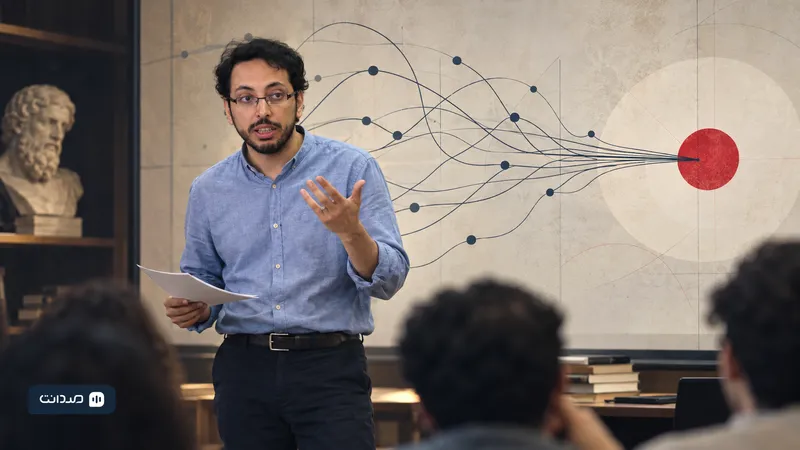

Amir Saemi
ارائهدهندهFor Dr. Amir Saemi, philosophical research does not begin by amassing the names of philosophers and reporting their views; it begins by identifying a problem that genuinely needs to be solved and then formulating a clear, defensible claim about it. This was the central theme of his talk, “On the Craft of Philosophical Research and Writing”—a talk that the speaker himself modestly described as “a bunch of advice,” but which in practice offered a compact and coherent set of standards for philosophical research and writing: from choosing a problem and developing a thesis to engaging with the literature, responding to objections, writing in Persian, and avoiding plagiarism.
Saemi began by criticizing a familiar pattern in thesis titles: “On topic A according to B.” In his view, adding a philosopher’s name to a topic is not a good way to delimit a project. If a research question is properly formulated, it will naturally establish its own boundaries; and if the aim of philosophy is to discover the truth or solve a problem, there is no reason to restrict oneself from the outset to a single thinker. He did, however, distinguish philosophical research from work in the history of philosophy: when the aim is to understand a thinker’s view accurately within its own historical and linguistic context, focusing on that thinker makes sense. But with a contemporary problem, where authors’ works and positions are current and accessible, making “so-and-so philosopher’s view” the focus of the project often replaces a genuine problem with a vaguely defined topic.
A Problem, Not Merely a Topic
This distinction led to the most important piece of advice in the talk: “Have a problem.” Saemi stressed that not every topic is a problem. A problem arises where there is a tension between two seemingly plausible judgments, or between an intuition and its implications. To clarify the point, he referred to examples such as the problem of free will and the possibility of reconciling faith and doubt: philosophical research begins when we can show what, precisely, is difficult, inconsistent, or unresolved.
For this reason, writing that “in this study I examine the value of human beings and the issue of killing” does not yet amount to a philosophical thesis. Such a sentence merely announces a very broad area of discussion without making clear what the author intends to establish or reject. As a contrast, Saemi offered the example of a claim that those subjected to oppression have a duty to resist it. The importance of this example lies not only in its content: the claim is specific, normative, and contestable, so the reader can see why one should ask whether it is true and what reasons support it.
The Author’s Voice and the Measured Boldness of a Claim
The next step is to have a “voice” in the text. Saemi warned that in many theses, the author’s voice disappears beneath a mass of reports and summaries of other people’s views. Researchers must distinguish between reporting the views of others and stating their own position, and they should not be afraid to make that position explicit. In his view, using the first-person singular in philosophical writing, when it helps clarify where the claim comes from, is not only acceptable but sometimes necessary: “I argue that...” is more precise than hiding responsibility for a claim behind vague, agentless formulations.
A claim may be positive or negative; it may defend a theory or show that a theory fails in a particular domain. But Saemi simultaneously emphasized two cautions: do not assume that your opponent is stupid, and do not tilt at “windmills.” A good claim should respond to a real opposing position, not to a simplified and defenseless version of a theory. Sweeping generalizations and unsupported claims should likewise be avoided. A researcher’s boldness does not lie in making grandiose claims; it lies in advancing something specific, contestable, and consequential with a clear argument.
Objections Are Part of the Text, Not an Intrusion
On this view, a large part of writing an article consists in responding to possible objections. Saemi suggested that from the outset, an author should imagine a hypothetical reader: someone who understands Persian, does not necessarily know the article’s terminology, but is perceptive and capable of raising objections. The author should explain the problem so that this reader can understand it, and then anticipate serious objections and answer them before the reader raises them.
This does not mean that an article should pre-emptively address every minor or imaginary objection. Saemi emphasized proportionality: an objection should be genuine and significant, and the response to it should remain in the service of the main argument. Even so, if an author cannot understand why others have not been persuaded by their answer to the problem, they have not yet reached the depth of the debate. In philosophy, understanding an opponent’s argument is not merely a matter of conversational etiquette; it is part of testing one’s own claim.
The Introduction: A Map of the Article and an Honest Case for Its Importance
One of the practical parts of the talk concerned the article’s introduction. Saemi said that the first things an editor or reviewer asks when reading an introduction are: What is the problem? What is the author’s claim? And why is this problem worth reading about? An article that cannot demonstrate the importance of its question may be set aside before it ever reaches specialist review. The introduction should therefore both map out the argument and establish why it matters—not through exaggeration, but by explaining which larger debate or significant consequence the question bears on.
In this connection, he invoked Chekhov’s famous advice: everything that appears in a text should play a role in advancing the story. If you have put “a gun on the wall” in the first chapter, it must go off later. The implication for philosophical writing is clear: every historical discussion, definition, quotation, or subsidiary section should serve the central conclusion and argument. An article on the trolley problem need not begin with Socrates. Remote starting points, irrelevant historical surveys, and piling into the text everything the author has read often lead it away from its destination.
Saemi paired this recommendation with another principle: “Fewer commitments, less to defend,” as well as “Fewer commitments, a more attractive claim.” The fewer broad assumptions and theories an article must commit itself to in order to advance its claim, the lighter its burden of defense and the wider the range of readers who can accept it. This is not an invitation to make the discussion superficial, but a recommendation to find the most precise and least costly formulation of the claim.
The Literature: An Anchor for Personal Concern
A good problem, however, is not developed in a vacuum. Saemi had a concise formulation for the relationship between personal concern and the literature: “Personal concern without the literature is unanchored; the literature without personal concern is shallow.” Researchers must connect their problem to an ongoing conversation; otherwise, they will not know where others stand, what answers have already been offered, or exactly what their own claim adds to the debate. At the same time, simply choosing a fashionable problem in the literature, without finding it genuinely puzzling oneself, is unlikely to produce work of much depth.
To enter the literature on a given debate, he recommended resources such as the Stanford Encyclopedia of Philosophy, Oxford Bibliographies, Philosophy Compass, PhilPapers, established journals, and more recent articles. This recommendation accompanied another warning: do not take “a lot has already been written on this problem” too seriously. An extensive literature is neither a reason to abandon a problem nor a license to repeat the same path. Knowing the literature both prevents researchers from reinventing the wheel and enables them to locate precisely where a claim belongs and how it might contribute something new.
Saemi also offered a complementary piece of advice about learning: do not approach learning with an “agenda.” Philosophy students should not read every problem solely through the lens of their current project and dismiss it as useless if they see no immediate connection. Reading introductory books in the main branches of philosophy—from philosophy of mind and epistemology to metaphysics, ethics, and politics—is necessary for understanding the problems themselves. Familiarity with other problems can later make it possible to see structural similarities and new paths, even when their immediate application is not apparent at the time of reading.
Writing in Persian, Practice, and the Responsibility to Understand
Another part of the talk concerned the language of writing. Saemi’s maxim was simple: “Write so that Persian speakers can understand you.” If a technical term is necessary, it should be accompanied by a clear explanation in Persian; paragraphing and word repetition should be handled deliberately; and the main route to better writing is sustained reading and writing. In his view, the inherent difficulty of a philosophical problem is no license for obscure writing. If we cannot explain a problem to an intelligent reader unfamiliar with the terminology, perhaps we ourselves do not yet understand it well enough.
His suggested exercises were thoroughly practical: writing a few hundred words about why a problem matters, summarizing the argument of an article, recasting its main argument in the form of an introduction and conclusion, and writing about an objection to that argument. These are not one-off exercises; they should become daily or weekly habits. Alongside them, students should actively remedy gaps in their own education rather than attributing them to shortcomings in the curriculum.
Plagiarism: Citation Is No Substitute for Thinking
The talk concluded with plagiarism, a topic Saemi regarded as particularly important in Persian-language writing. Plagiarism is not limited to copying an entire article. Direct copying, superficial changes to examples or names within someone else’s argumentative structure, using another writer’s sentence structures or a substantial portion of a paragraph’s wording, and improper citation can all be forms of plagiarism. He focused in particular on “free translation” without quotation marks: if a translation remains very close to the original text, even providing a citation does not remove the need to mark it as a quotation.
But the right solution is not simply to add quotation marks. Researchers must understand a text and then be able to explain it in their own language and structure. A genuine restatement based on understanding, accompanied by proper citation, is different from a free translation that remains close to the original wording. Here the ethical and epistemic points converge: the researcher’s responsibility is not to produce a “better” sentence than the original author’s, but to demonstrate that they have understood the author’s claim and argument and can make their own relation to it clear.
Saemi’s concluding point was that philosophical writing is not merely a formal skill. Good writing emerges from a combination of several qualities: sensitivity to problems, the courage to make a claim, humility in the face of objections, engagement with the literature, economy of structure, clarity of expression, and honesty in using the work of others. His “bunch of advice” ultimately amounted to a coherent picture of the philosophical researcher: someone who neither merely talks about philosophers nor simply produces text, but tries to solve a real problem within a real conversation, in clear language and with full responsibility.


Discussion0 comments
No comments yet; let yours be the first voice.