Life and Thought
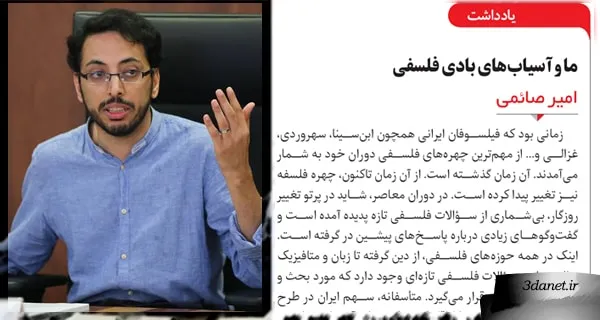
Amir Saemi is an Iranian analytic philosopher and associate professor of philosophy at the Institute for Research in Fundamental Sciences (IPM), School of Analytic Philosophy. His research focuses mainly on moral philosophy, practical rationality, and philosophy of religion, and he is the author of the book Morality and Revelation in Islamic Thought and Beyond.
Amir Saemi, an Iranian analytic philosopher, is an associate professor of philosophy at the School of Analytic Philosophy of the Institute for Research in Fundamental Sciences (IPM) and a lecturer in philosophy at Rutgers University. He received his PhD in analytic philosophy in 2013 from the University of California, Santa Barbara, where he wrote his dissertation on practical rationality. Before turning seriously to philosophy, he also earned a doctorate in electrical engineering, specializing in telecommunications, and conducted research in the field of multi-antenna systems.
Saemi's main areas of research are moral philosophy, practical rationality, philosophy of action, philosophy of mind, and moral psychology. He has also published research in epistemology, philosophy of religion, and Islamic philosophy. His academic profile notes that his work has appeared in leading philosophy journals such as Ethics, Analysis, The Philosophical Quarterly, Canadian Journal of Philosophy, and Analytic Philosophy.
Saemi is among the philosophers who build bridges between analytic moral philosophy and certain issues in Islamic theology and philosophy of religion. In 2024, his book titled Morality and Revelation in Islamic Thought and Beyond was published by Oxford University Press; a work that addresses the relationship between morality, revelation, the problem of evil, and Islamic theology.
Saemi's intellectual work can be summarized in several axes: practical rationality, intention and action, normative ethics, philosophy of action, self-knowledge, moral psychology, philosophy of religion, and the relationship between morality and revelation. In his works, questions such as "Is a moral action always accompanied by a good intention?", "What is the role of intention in the permissibility of an act?", "Can otherworldly happiness be morally problematic?", and "What is the role of luck in religious salvation?" are prominent.
Bibliography
Writings and transcribed lectures12 titles
“Ethics and Revelation in Islamic Thought and Beyond”
"Hume's Objection to the Argument from Design Based on the Existence of Evil and Skeptical Theism"
"The Problem of Salvific Luck in Islamic Theology"
"The Doctrine of Double Effect and the Intention Principle"
"The Morally Difficult Notion of Heaven"
"Targeting Human Shields"
"Self-knowledge and the Guise of the Good"
"The Form of Practical Knowledge and Implicit Cognition: A Critique of Kantian Constructivism"
"Aiming at the Good"
"The Guise of the Good and the Problem of Over-Intellectualism"
"On John Laird's 'Value and Obligation'"
"Intention and Permissibility"