Literature
Poet of Suffering: 'The Sufferings of Qeysar in the Palace of His Loneliness,' as Narrated by Mostafa Malekian
Malekian holds that knowing others depends on emotions, and identifies 'suffering' as the most prominent concept in the works of Qeysar Aminpour; he therefore calls him the 'poet of suffering' and enumerates pains such as the lack of existential integrity and the debasement of aspirations.
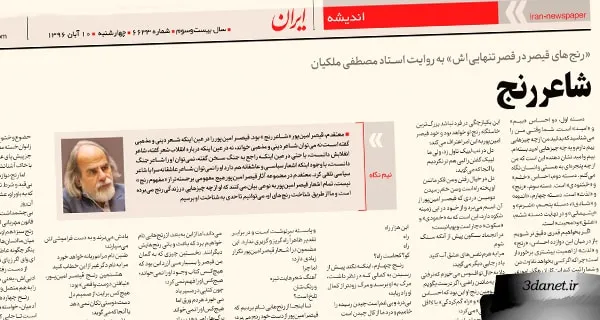
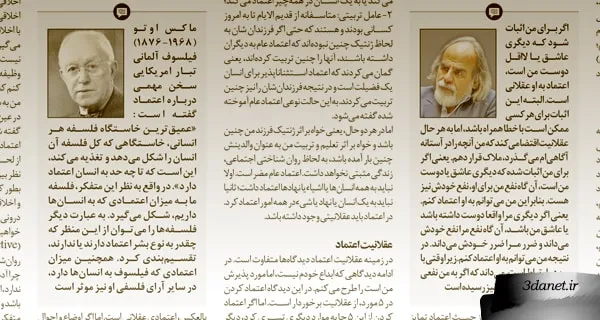
One of the challenges of knowing an individual in the disciplines of philosophy and psychology is determining which part of a person's being we should examine so that, if we come to know that part well, we have in fact attained knowledge of them. Since ancient times, this issue has been a point of contention among the sages of history. In this discourse, I intend to mention some points that certain philosophers and psychologists raise for knowing an individual. (Although I myself am more sympathetic to the psychologists' perspective.) Can we refer to a person's "speech" and "actions" to know them? There is no doubt that a person's speech and actions cannot convey the entirety of their personality and character; even a person's inner beliefs are not a good criterion in this regard. Among philosophers, "David Hume," and among psychologists, "William James," believe that to know individuals, one must know their "feelings" and "emotions"; for the core of every person's personality and character is their feelings and emotions. Psychology, among the totality of human feelings and emotions, enumerates close to 90 feelings and emotions, of which 12 feelings and emotions are more significant and are divided into six categories: The first category consists of the two feelings of "fear" and "hope." You know me when you know what things I fear and what things I have set my hopes on. Fear and hope indicate through which window I look at existence and humanity. The second category is the feeling of "anger" and "contentment." The third is "suffering" and "pleasure." The fourth category is "sorrow" and "joy," the fifth is "shame" and "regret," and finally, the sixth category is "love" and "affection." If we wish to be a bit more precise, among these twelve feelings, "suffering" and "pleasure" hold greater importance; for if someone wants to register the difference between you and me, this is realized through the matters that cause us "suffering" and the matters that bring us "pleasure." This approach holds true for every person, even when we encounter a thinker, artist, or poet. Based on this categorization, I believe Qeysar Aminpour was a "poet of suffering." Although Qeysar Aminpour composed religious poetry, he cannot be called a religious poet; although he wrote poetry about the revolution, he cannot be considered a poet of the revolution; or even though he spoke about war, he cannot be deemed a war poet. Despite having political and romantic poems, he cannot be regarded as a romantic or political poet. I believe that in the collected works of Qeysar Aminpour, no concept is more prominent than the "concept of suffering." All of Qeysar Aminpour's poems, in a way, express what things in life caused him suffering, and through knowing his sufferings, we can, to some extent, come to know him. In my examination of Qeysar's poems, I saw the objects of his suffering in 19 components. I believe the first thing from which Qeysar Aminpour suffered was "lacking existential integrity"; in other words, he did not see alignment among his speech, actions, beliefs, and feelings and emotions; it was as if he faced a kind of duality, triplicity, and n-plicity. This condition is referred to in today's psychology as "existential integrity," meaning that if this integrity is absent in an individual, it will be the greatest source of their suffering, and Qeysar Aminpour himself confesses to this; The heart blistered in the fervor of "Labbaik," but we Did not even moisten a lip to say Labbaik Or where he says: The heart dreams of going, and I think of staying He is seasoned for the road, and I am raw in arriving The second pain that Qeysar Aminpour names and of which he complains in himself is that he is afflicted with "lethargy" and "silence" and is not dynamic; In the freezing of stillness, before I turn to stone, Melt me with the warmth of love's breaths Or elsewhere he says: O heart, I pity you that you did not go, You are content to stay, if I speak truly His third suffering was that he felt "lost" and "path-lost" or at least "path-unfound"; Amidst this world of path upon path, This thousand paths, The path, The path, Where? Where is the path? The fourth suffering: lest death reach him before attaining the perfection he envisioned, and death overtake him sooner than his perfection; Picking the ripe is without pain and sorrow, We are raw, and our pain is from picking the unripe His fifth suffering was that he is bound hand and foot by fate and seemingly has no way of escape or choice before destiny. This theme is repeated often in Qeysar Aminpour's poems; But why Are the melodies of your poems dark And their color Bitter? Up to this point, we have named sufferings from which Qeysar Aminpour suffered at his own hands; that is, he considered himself the cause and agent of these sufferings, but from here on, we will name sufferings whose cause and agent are others.
The first thing that, I believe, greatly pained Qeysar was that no one read the book of his existence; no one understood him;
like a book in the wind’s path
its pages turn every moment, yet
no one reads him
he gives the leaves to the wind
His seventh suffering was that others forget him and consign him to oblivion;
the resonance of my name will be eaten by termites
call me by a name other than this
Qeysar Aminpour’s eighth suffering was “not finding a true friend”;
no one, from the bottom of their heart,
waves a hand of friendship to you
or where he says:
the palace of loneliness and friendlessness is enough for me
The ninth suffering, which was in fact the source of his pain, is that he did not see authentic life in others; that is, life according to one’s own reason and moral conscience, not the life others expect us to have. Aminpour himself led an authentic life in this regard and naturally suffered from seeing borrowed, inauthentic lives in people;
in this age, no one is themselves
no one is themselves for even a single breath
His tenth suffering was people’s failure to preserve their self-respect, such that they bow their heads before every lowly person, kiss the hand of every lowly person, fall at the feet of every lowly person, and do not know what a precious being resides within them;
the day when the hand of entreaty is short
the day when begging is a sin
or where he says:
the day when on doors
they write in a simple script:
“Entry of the bowed neck only, forbidden”
and he believes that we always encounter others with a bowed neck.
His eleventh suffering was that people kneel before anyone, fall to the ground, kiss the earth, even though this should only be done before the Beloved; that is, he believed that humility and submission must arise from love;
knees weary and proud
become acquainted with the dust
nowhere but at the feet of love
But the twelfth suffering: that people’s love is not unconditional, whereas, in his belief, love has no conditions or stipulations
that day
the disinterestedness of a smile
is the law of kindness
His thirteenth suffering was the departure of affection from among us human beings;
see how affection slips away
alas, if you sit idly by, woe to us!
the loss of affection in its literary sense, meaning everything that connects and binds us human beings to one another.
The fourteenth suffering is the debasement of people, their desires, aspirations, and goals, to the point where they content themselves with the ordinary things of life and do not take flight.
I am weary of such hearts
more commonplace than thorns and chaff
The fifteenth suffering: that people have lost quality and only look at quantities, to the extent that even reason uses quantities to evaluate qualities;
the day when they do not speak
of the price of feeling
like clothing
But the sixteenth suffering: that people are severely afflicted by poverty;
the day when
the divine nature
does not sleep under the feet of passersby on the pavement,
and does not dream of fresh bread
Qeysar’s seventeenth suffering, however, was the lack of human freedom;
a fly, wherever it is, is nothing but a fly
but an eagle is not itself in its cage
The eighteenth characteristic: that instead of “transgressing boundaries,” people “set boundaries.” Instead of crossing the boundaries others have set for them, they themselves begin to set new boundaries;
that day
the wall of the “short school” garden
they only
draw a hedge of imagination
in the far margin of the garden
which can be easily jumped over
But Qeysar Aminpour’s final suffering is the existence of enmity, violence, and war;
sleep yawns
in the mouths of machine guns
and the old boots of a soldier
become knotted with cobwebs
in the corner of old museums
I believe that these are the 19 sufferings that Qeysar Aminpour alluded to in his poems, and through this realm of his emotions, one can come a little closer to knowing him.
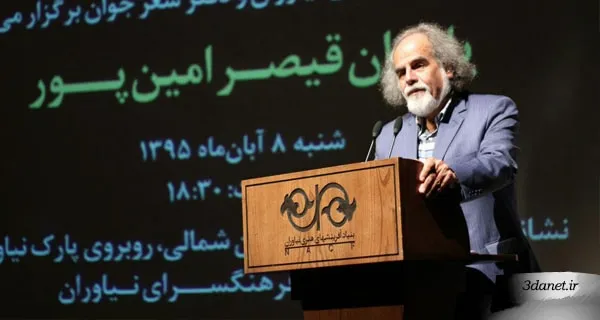
* The present text is an edited and summarized version by “Iran” newspaper of a lecture by Professor Mostafa Malekian, professor of philosophy and researcher of ethics, titled “The Sufferings of Young Qeysar in the Palace of His Loneliness,” delivered on October 29, at the tenth anniversary of Qeysar Aminpour’s passing, at the Shahr-e Ketab Institute.
A Glance I believe Qeysar Aminpour was a “poet of suffering.” Although Qeysar Aminpour composed religious poetry, he cannot be called a religious poet; nor, despite having written poetry about the revolution, can he be considered a poet of the revolution; nor even, despite having spoken about the war, can he be deemed a war poet. Despite having political and romantic poems as well, he cannot be regarded as a romantic poet or a political poet. I believe that in the collected works of Qeysar Aminpour, no concept is more prominent than the “concept of suffering.” All of Qeysar Aminpour’s poems, in one way or another, express what things in life caused him to suffer, and through understanding his sufferings, we can, to some extent, come to know him.
.
.
Audio of this lecture
PDF file of the above text in Iran newspaper
.
.
Poet of Suffering
“The Sufferings of Qeysar in the Palace of His Loneliness,” as Narrated by Mostafa Malekian
Unveiling of the book “This Song Does Not Smell of Bread”
Tenth anniversary of the passing of Qeysar Aminpour
Shahr-e Ketab - October 29, 2017
Text source: Iran newspaper - November 1, 2017
.
.




Discussion1 comments
درود بر استاد ملکیان (فیلسوف اخلاق ارزشمند) و چه زیبا گفت (قیصر امین پور بزرگوار): بی درد و بی غم است چیدن رسیده را خامیم و درد ما از کال چیدن است یادش گرامی باد...