Philosophy
Trust, According to Mostafa Malekian, Is the Greatest Capital We Have Lost
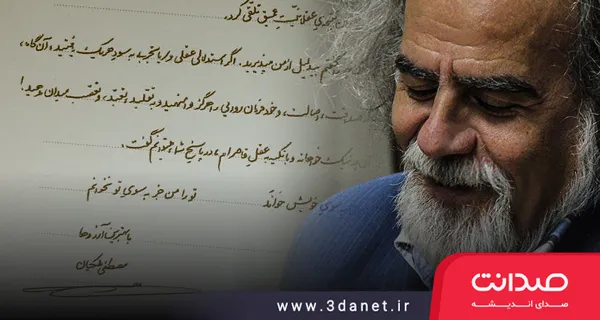
Mostafa Malekian considers trust the greatest absence in social relations and, by distinguishing between trust and trustworthiness, stresses that while being trustworthy is a moral duty, trusting others is not always rational.
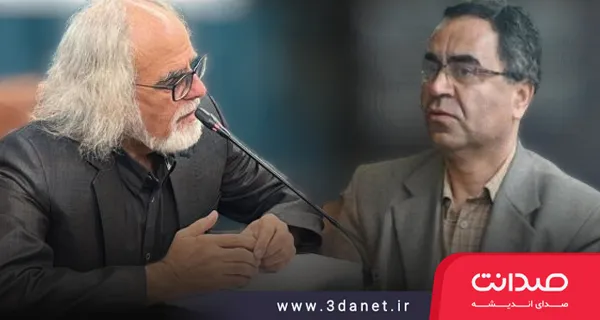
Mohsen Azmoudeh | Trust is the greatest absentee in our social relations these days. This is the essence of Mostafa Malekian's remarks in the following talk. Of course, awareness and acknowledgment of this statement may not be so hidden from others. We all unfortunately witness how, in the smallest and largest relationships, trust has been lost, and individuals and institutions view and treat one another with suspicion, and honesty and candor are rarely seen in exchanges. In this talk, Malekian did not, of course, speak about the causes and factors behind the loss of this social capital, but he did speak about the rationality of trust and enumerated cases in which trusting is rational and therefore ethical. With his well-known analytical-philosophical approach, he examined trust from the perspective of social psychology and listed cases in which trusting is rational, emphasizing that in other cases, trusting, while it may be psychologically and internally effective, is externally harmful and therefore not rational. What you are reading is the revised and edited account of his speech at the annual Dialogue gathering in the Ivan-e Shams Hall, held on the afternoon of Saturday, February 22, organized by the Dialogue Forum of the Imam Musa Sadr Charitable Institutions Association.
***
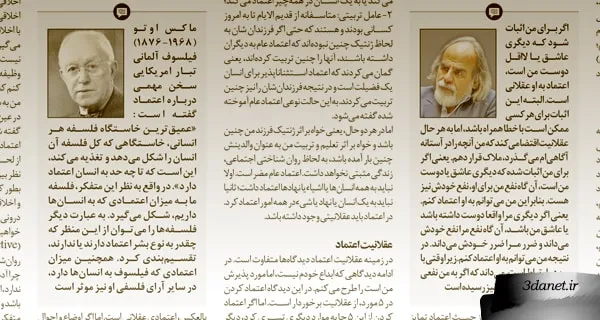
The current discussion concerns trust from an ethical perspective. Unfortunately, trust, like many other social matters, is not given attention in our society. Whereas trust has been discussed since ancient times in all corners of the world. Max Otto (1876–1968), the German-born American philosopher, said something important about trust: "The deepest source of every human being's philosophy, the source that shapes and nourishes that person's entire philosophy, is the extent to which they trust human beings." In fact, according to this thinker, our philosophy is shaped by the degree of trust we have in human beings. In other words, philosophies can be categorized from the perspective of how much or how little they trust humankind. Furthermore, the degree of trust a philosopher has in human beings also influences their other philosophical views. Although this interpretation may seem somewhat exaggerated, it is wise. Our entire thinking about the world and humanity is nourished by the extent to which we trust humankind. The quantity (how much) and quality (how) of this trust then shape and strengthen our other philosophical views and opinions.
Trust and Trustworthiness
First and foremost, a distinction must be made between trust and trustworthiness, because every human being is ethically obligated to live in such a way that they are trustworthy. However, not every human being has an ethical duty to trust. That is, just as I, as a human being, am ethically obligated to be honest, humble, and fair, to return what is entrusted to me, to fulfill my promises, and to be compassionate towards human beings, I am also obligated to live in such a way that I am trustworthy and others can trust me. This means it is the ethical duty of every human being, alongside their other ethical duties, to be trustworthy, that is, to conduct themselves and have their totality of speech and behavior in such a way that others can trust them. Therefore, being trustworthy is the ethical duty of every human being.
But do human beings have an ethical duty to trust others? Apparently not. That is, it is not the case that trusting others, like trustworthiness, is the ethical duty of every human being, and it is not at all established that our ethical duty is to trust others. Therefore, my trusting you must be separated from your trusting me. Each of us has an ethical duty to live in such a way that others can trust us. But we are not always ethically obligated to trust others. Consequently, trust is different from trustability or trustworthiness. The latter (trustworthiness) is the ethical duty of every individual, but the former (trust) is a matter of debate, and it must be determined in which cases we should trust and in which cases we should not, from an ethical standpoint. With this distinction in mind, let us note that the current discussion is about trust, not about trustworthiness.
The Object of Trust
Trust, in terms of its object (i.e., trust in what), is also the subject of various discussions. Here, a major distinction must be drawn between trust in oneself and trust in others. That is, morally speaking, I sometimes need and have a duty to trust myself. In other words, every person has a moral duty to trust themselves in certain cases (not in all cases). Sometimes, the object of trust is not myself, but another (someone or some entity other than me). When the object of trust is an entity other than me (i.e., I must trust another), that other is itself divided into three types: 1- Sometimes the other that is the object of trust is a person, for example, another human being; 2- Sometimes the object of trust is an object, for example, we must trust in the sturdiness of a chair in order to sit on it; 3- Sometimes the object of trust is an institution (an institutional reality), for example, we sometimes trust the institution of education.
The Limits of Trust
In any case, we trust in certain instances; whether in ourselves or in another. That other is also either another person, another object, or an institution. But in what does trust take place? This discussion concerns the limits of trust. I might trust something in you and not trust something else in you; for example, I might trust your honesty but not trust your generosity. Therefore, it is not necessary that if I trust something in you, I must trust everything about you. For instance, I might trust an individual's trustworthiness in financial matters, but not trust their humility. Thus, the limits of trust must be specified, and it must be determined in what I trust myself, another person, an object, or a social institution. For example, I might trust that another has sold me a sturdy and high-quality product, but I do not trust that I bought it at a fair price. Therefore, the limit of trust is important, and it must be specified in what and to what extent we should trust ourselves or another; in other words, one should not assume that because we trusted ourselves or another at point X, we must necessarily trust them at point Y or Z as well.
The Benefits of Trust for the Trustor
Why do we need trust? In other words, what benefit does trusting another bring to me, the trustor? Put differently, if we do not trust ourselves, another person, a thing, or an institution, where does our life's functioning become impaired? In other words, the necessity of trust for getting through life is also important. That is, what benefit or benefits accrue from trusting? Are the benefits of trust greater than its harms? Most importantly, are the benefits of trust so great that it can be considered a necessity? Something is considered necessary when its benefits outweigh its harms.
It must also be determined whether trust is necessarily a two-way affair or not. That is, when I trust another, must they necessarily also trust me? In other words, is trust, in the parlance of intellectuals, a dialectical matter, and in my terms, a reciprocal matter, or can it be a one-sided phenomenon? On each of the above topics, moral philosophers and social psychologists have offered differing opinions and views.
General Trust
Trust, as stated, has three components: 1- the trustor; 2- the entity that is trusted; 3- the extent to which the trustor trusts the other entity. Psychologically, there are people who are either born or raised in such a way that, among the three components of trust, the second and third components are of little importance to them. That is, there are people for whom, for one of two reasons, the second or third condition does not matter much. For instance, they trust everyone and do not differentiate between individuals, objects, and institutions in terms of trust. It is as if the second condition—that one trusts some and does not trust others—is not a focus of their attention, and their trust is general and without exception. Likewise, for some, the third condition is unimportant; that is, if they trust an individual in matter X, they also trust that individual in all other matters, as if the third condition does not matter to them. They do not pay attention to the fact that if one must trust an individual in one matter, it is not necessary to trust that individual in other matters as well. For example, when they trust an individual's knowledge, it is as if they also trust their honesty, and so on. Yet we have no reason to believe that if someone is logical, they are necessarily honest as well. It is not even necessary that a knowledgeable person also possesses the power of thought. One might be able to trust an individual's knowledge but not their power of thought, or one might be able to trust someone's power of thought but not their knowledge. Just as I might trust another's memory but not their IQ. Conversely, I might trust another's IQ but not their memory. But there are people who seem not to consider this third condition of trusting. That is, if they trust an individual in one thing, they trust them in everything else as well.
General Trust Is Harmful
From the perspective of social psychology, forgetting the second and third conditions of trust—that is, either trusting everything, everyone, and every institution, or trusting a single individual, object, or institution in everything about that individual, object, or institution—is detrimental and harmful. Consequently, fathers and mothers are advised not to raise their children this way. Of course, two factors cause children to be brought up in this manner: 1- Genetic factor: It is possible that my child, because they are my child or my spouse's child, is genetically predisposed to have general and unconditional trust in others, or to trust a specific person in everything. This state is called "dispositional" trust, meaning the trust an individual is born with genetically and dispositionally, trusting all humans or trusting one human in everything; 2- Educational factor: Unfortunately, from ancient times to the present day, there have been and are those who, even if their children were not genetically predisposed to have general trust in others, raised them to be so. That is, they thought that unconditional trust is a virtue for a human being, and consequently, they raised their children this way. This state is called a type of learned general trust.
But in either case, whether my child is like this due to genetics or has been brought up this way due to my teaching and upbringing as their parent, from a social psychological perspective, they will not have a positive life. General trust is harmful. Firstly, one should not trust all humans, objects, or institutions; secondly, one should not trust a single human, institution, or object in all matters. There must be a rationality in trust.
The Rationality of Trust
Views differ on the rationality of trust. I will now outline a view that is not my own invention, but one I accept. According to this view, trusting is rational in five cases. But if trust extends beyond these five to other cases, then trust is devoid of rationality, and consequently, those who have general trust in all human beings, institutions, or things, or total trust in a single human being, thing, or institution in all its dimensions, have stepped outside these five domains. In other words, if the other is one of the five individuals that follow, my trust in them is rational, meaning first, it is not only not harmful to me but beneficial, and second, it is not harmful to the other who is trusted and will possibly be beneficial as well.
1- The other is my lover or friend
If it is proven to me that the other is my lover or at least my friend, trusting them is rational. Of course, this proof can be accompanied by error for anyone, but in any case, rationality dictates that I take what passes the threshold of my awareness as the criterion. That is, if it has been proven to me that the other is my lover or friend, then my benefit is also their own benefit. Therefore, I can trust them. That is, if the other truly loves me or is in love with me, then they consider my benefit their own benefit and my loss their own loss. Consequently, I can trust them. Because when they are in relation with me, they know that if a benefit reaches me, it is as if it has reached themselves, because I am their beloved, and vice versa. Consequently, in these cases, one can trust the other individual. That is, the trust that a person places in their lover or friend, meaning someone proven to them to be their lover or friend, is rational.
2- The other whose interests share the same fate as my interests
For example, when I have boarded an airplane with another person, while they are neither my lover nor my friend, the fact that we both reach the destination safely is in the interest of both of us. Here, I can trust them in the matter of transportation by airplane, and not in everything, because here both I and they have a common interest in traveling by airplane. If circumstances arise for me and another in which we share the same fate in terms of benefit and loss, then my trust in them, and vice versa, is rational trust. But if the circumstances are such that one can imagine the other benefiting while I suffer loss, or vice versa, in this state, my trust in the other is not rational.
3- The other whom we have ascertained to be a moral human being
If I ascertain that the other possesses the minimum threshold of being moral, then my trust in them is rational. You might say that in this case, it is possible that I have made a mistake in ascertaining the other's morality. Of course, this is possible, but my trust in the other is still rational, because for a belief to be rational, the truth of the belief is not necessary. If I become certain that the other is moral, even if it later turns out that I was mistaken, my trust in them is rational as long as I am certain of their morality. That is, in this case, I attribute to the other a kind of threshold moral characteristic or minimal morality. In this case, my trust in them is rational.
The first, second, and third cases represent strong rationality in trust. But trust in the next two cases is not as strong as in the previous ones, although it is still rational.
4- The other who holds a position, office, job, or post, and I am their client, and I know that there is some form of supervision over their work
This type of trust is called trust arising from monitoring, meaning I know that what another person does as a legal entity is monitored, and there are people who monitor, in a thoroughly positive manner, how he treats clients. When I go to an office, the official I have approached is neither my friend, nor is his benefit or harm to me apparent, nor do I have any knowledge of his ethical conduct; but if it has been established for me that his activity as an office employee is monitored, then my trust in him is rational. However, if I know that there is no monitoring of the correctness of that employee's actions, or that there is monitoring in the opposite direction—that is, they have asked him to harass clients—then trusting him is foolishness. In other words, although we are in dire need of trust, this trust must not reach the level of stupidity. Of course, the rationality of trust in this fourth form is not as great as in the first three cases.
5. The other who has not betrayed us so far
In this case, too, one can trust the other person. That is, trusting the other who, up to the present moment, has not violated my rights, interests, and boundaries is rational. Of course, rationality in this form of trust has the lowest degree among the cases mentioned, because the first time someone betrays us is the first time, and that means they have not betrayed us before. The first lie an individual tells us is the first lie, and its meaning is only that they have not told us a lie before. The mere fact that a person has not lied to us up to now is no reason that they will not lie to us from now on. Simply put, one can never deduce a person's future with certainty from their past. Of course, the probability that a person who has not betrayed us for 20 years will betray us after this is low, but it is certainly not zero, and there is no certainty. One can never conclude a person's future solely from their past. Therefore, if I have not wronged you up to now, it is not devoid of rationality for you to trust me, but this is the lowest level of rationality, and one should not be certain.
The Rationality and Morality of Trust
From the sum of what has been said, it follows that, firstly, one should not trust everyone. Only fools and the foolish trust everyone; secondly, if we trust a person, thing, or institution in a specific matter, we should not necessarily trust them in all matters. For example, we trust in our parents' benevolence toward us, but this is no reason to trust their knowledge about us; thirdly, from the past of a person, thing, or institution, one cannot deduce its future. It is possible that I have not embezzled people's property up to now, but from tomorrow morning I might start embezzling. These are the 5 cases of the rationality of trust. Of course, as was said, this view is not the consensus of all moral philosophers, but I myself believe in these 5 cases and hold that as we move from the first case to the subsequent ones, the degree of this rationality decreases.
If we accept the rationality of trust in the 5 cases mentioned and agree that our morality must not stray from our rationality, then we conclude that trust is moral only in the 5 cases mentioned, and in other cases, trusting others is also not moral. That is, if we accept that rationality must be aligned and harmonious with morality, then we conclude that in cases other than these 5, not only is trust not rational, it is also not moral. Consequently, being trustworthy is my moral duty; I must always behave in such a way that you can trust me, but my trusting you is moral only in the 5 cases mentioned.
While this rationality and morality of trust were stated, the clear point is that those whose capacity for trust exceeds these 5 stages may have a better life inwardly, but outwardly they will certainly have worse lives. Generally speaking, if we trust another beyond the 5 cases that rationality and morality dictate, we will be in a better state subjectively, but objectively we will be in a worse state. From the perspective of social psychology, it becomes clear from this why people trust in situations where trust lacks rationality and morality, because they want their psyche to be at ease and they hand over the reins of their affairs to the brain of some political figure, or some thinker, or statesman, and so on. This inner comfort weakens a person in the rationality and morality of trust.
The reason I emphasize this point is that, in my opinion, the greatest damage our society has suffered in recent decades is that trust has been lost. I am completely firm and resolute on this point that the greatest capital we have lost in the last forty years is trust. We do not trust the ruling political power, the ruling political regime does not trust us, and we do not trust each other, and the lack of this social capital has inflicted and will inflict the greatest loss on our society. At the same time, I believe that the rationality and morality of trust must be considered. We must not trust in such a way that the person we trust says, what fools there are! The foolishness and idiocy that exists in some people's trust is solely due to not observing the conditions of trusting. Let us also note that besides the morality of trusting in the 5 mentioned cases, being trustworthy ourselves is a duty for all of us. From the combination of these two, it follows that it is our moral duty to trust those who are capable of being trusted.
.
.
Download the PDF file of this text from Etemad newspaper
.
.
Trust, According to Mostafa Malekian
The Greatest Capital We Have Lost
Published in: Etemad Newspaper / Thought Page / 97.12.06
Source: Zamane-ye Barkhord Channel
.
.

Discussion0 comments
No comments yet; let yours be the first voice.