Religion
Session: “The Qur’an: Word of God or the Prophet’s Dream?” with Yahya Yasrebi and Khalil Ghanbari (2)
Khalil Ghanbari expounded Abdolkarim Soroush's theory of the 'narrator of prophetic dreams,' while Yahya Yathribi, citing the Quran's 'clarity and explicitness,' critiqued the interpretation of its language as that of dreams.
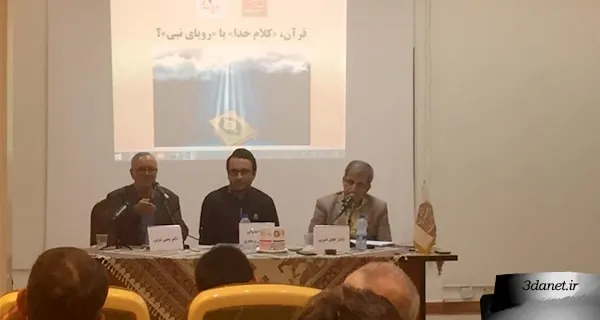
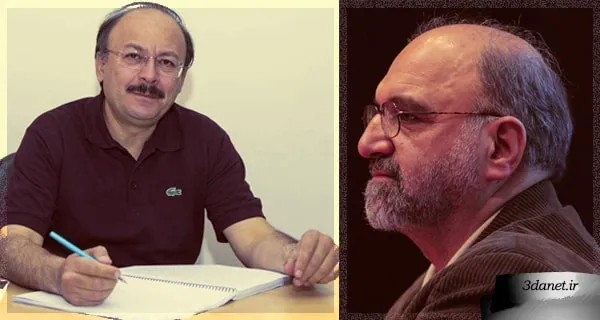
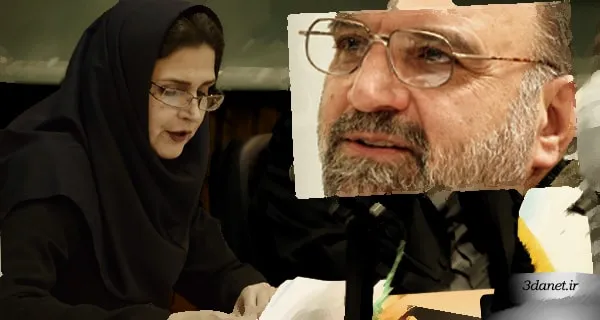
The second session of the Andisheh Group of the “Andisheh va Qalam Association,” titled “The Qur’an: Word of God or the Prophet’s Dream?”, was held on Wednesday, July 13, with the presence of Dr. Seyyed Yahya Yasrebi, retired professor of Islamic Philosophy and Theology at Allameh Tabataba’i University, and Dr. Khalil Ghanbari, professor in the Department of Non-Abrahamic Religions at the University of Religions and Denominations and member of the Qom Qur’anic Debates Association, at the House of Humanities Thinkers.
Acknowledging the Existence of Contradictions in Qur’anic Verses within the Dream-Theory of the Qur’an
Khalil Ghanbari, a faculty member at the University of Religions and Denominations, in the first part of his speech at this session, elaborated on the theory of “Muhammad (PBUH): Narrator of Prophetic Dreams.” In a portion of his remarks, he said: I cannot sympathize with either the proponents or the opponents of the theory of prophetic dreams, but I believe that to critique this theory, we must have a correct understanding of it, and in my opinion, neither the opponents nor the proponents have had a correct understanding of it so far. He added: Dr. Soroush declares in his theory that scholars of religion and theologians had concluded that religious propositions contain contradictions. In religious and mystical culture, we also have propositions that attribute a predicate to a subject called God, and at the same time, we have propositions that negate that same predicate from the subject. In other words, apophatic theology and cataphatic theology stand face to face and create contradictory propositions. Ghanbari also referred to the history of the theory of contradiction in religious propositions and said: This discussion has a precedent among Western philosophers, even in the modern period, but Dr. Soroush’s answer and solution for resolving this dilemma is novel and new. For example, Walter Stace, the English philosopher, in “Time and Eternity,” quotes David Hume saying that the old question of Epicurus remains unanswered: Is God willing to prevent evil but not able? If so, we must say that God is impotent. The next question is: Is He able but not willing to prevent evil? Here we must say that God is malevolent. And finally, is God both able and willing to prevent evil? Here we must ask: what is the origin of “evil”? Stace uses this discussion and proposes in his book “Time and Eternity” that religious propositions are contradictory, and from there, he ultimately enters into the discussion of apophatic and cataphatic theology. From one perspective, the summary of Dr. Soroush’s theory is along these same lines. He continued: Dr. Soroush demonstrates that when religious scholars seek to understand the religious text, they encounter a contradictory understanding. That is, they encounter propositions that are incapable of resolving their own contradictions. In other words, he states that scholars of religious sciences are caught in an inescapable interpretive predicament.
Soroush’s Solution for Resolving Contradiction in Religious Propositions
In another part of his remarks, this faculty member at the University of Religions and Denominations in Qom referred to the solutions proposed by Western philosophers to resolve the problem of contradiction in religious propositions, and then to Abdolkarim Soroush’s idea for resolving this contradiction, stating: In the West, three solutions have been offered for resolving the contradictions in religious propositions. In the first solution, thinkers explained that because interpreters of religious texts have assumed religious propositions to be “cognitive,” they have therefore encountered contradictory propositions when confronting the text. When we do not consider religious propositions to be “cognitive,” all contradictions are automatically resolved. Ghanbari added: The second solution states that contradictory propositions are unreasonable only when we are dealing with the world of multiplicity. In the world of unity, contradictory propositions are not considered a flaw. In short, this answer says that religious propositions are cognitive propositions, but contradictory cognitive propositions are unreasonable and unacceptable only in the world of multiplicity, and as rational human beings we cannot accept this category of propositions and must set them aside. However, when we enter the world of unity, contradiction poses no problem; logic is for the world of multiplicity, but the world of unity is not the world of logic, so there is no problem if we encounter contradictory propositions in a religious text. In the third solution, presented by the English philosopher John Hick, it is proposed that religious propositions which apparently refer to the Ultimate Reality do not in fact describe the real world. The propositions we have assumed as affirmative and negative, and as apophatic and cataphatic, do not truly refer to the real world and the Ultimate Reality; rather, these propositions are the product of the phenomenal encounter of religious scholars, the faithful, and believers with the Ultimate Reality. Thus, these reflect the mentality and mental structure of the human being during religious and mystical experience, and reflect the human mental structure more than God and the Ultimate Reality; therefore, this experience manifests itself in one way in Eastern culture and emerges in another way in Western culture; not, of course, in the sense that there are two realities, but rather the Ultimate Reality is one, and it is the diverse and varied structures of human beings in encountering the Ultimate Reality that gives rise to multiple experiences. This member of the Qom Quranic Debates Association then described Abdolkarim Soroush’s idea for resolving contradiction in religious propositions as novel, and explained it as follows: Dr. Soroush has reread the problem of contradiction in religious propositions anew and offers a new solution. In his belief, in each of the three stated solutions, religious language has been considered the “language of wakefulness.” He does not accept this matter and states that if we wish to have no fear of contradiction in religious propositions, we must consider its language to be the language of sleep and dreams, because the language of dreams can be contradictory and acceptable. The language of wakefulness can also be contradictory, but in that case it is no longer acceptable and indicates a flaw and defect within it.
The Language of the Qur’an is Clear and Manifest
Seyyed Yahya Yasrebi, also in this session, referring to his friendly relationship with Abdolkarim Soroush, Mohammad Mojtahed Shabestari, and Mostafa Malekian, as well as the incorrect method of Iranian intellectuals in explaining religious sciences, said: Before the proposal of the theory “Muhammad (PBUH): Narrator of Prophetic Dreams,” I had not written anything about the intellectual framework of intellectuals such as Abdolkarim Soroush, Mostafa Malekian, Mohammad Mojtahed Shabestari, and others of this sort, but sometimes speech reaches a stage of absurdity where one does not know what to do. He added: Let us suppose there are a thousand contradictions in the Holy Qur’an; now, if we say the Qur’an is a dream-book, will these problems be solved? One of the problems of Christianity against which Martin Luther rose up was that they said no one except the Pope and the Church could understand the Holy Scripture, whereas the Qur’an said its language is a clear and manifest language. Moreover, the Qur’an repeatedly speaks of the clarity and lucidity of God’s word and its universal comprehensibility; now, how can its language be considered the language of sleep and dreams? The clarity of the Qur’an’s verses is such that understanding them does not even require the Prophet or the Infallible Imams (AS), but the language of sleep and dreams is not universally comprehensible. If the Prophet had seen the Qur’an in a dream, then why did he himself never once refer to it? The author of the book “Practical Mysticism in Islam,” continuing, pointed to the existence of verses in the Qur’an that indicate God’s explicit speech: The Prophet of Islam repeatedly indicated that he speaks to people in a clear language, and the verses he presents to the people are, in fact, the words of God that Gabriel reveals to him. Many verses in the Qur’an also attest to its illumination. Given these descriptions, it is unclear why we should consider the Prophet’s speech a “dream-book” and seek a dream interpreter for its interpretation. Of course, in this context, the dream interpreter is also unclear, and it emerges from Dr. Soroush’s words that throughout history, only he has the qualification for this dream interpretation and the interpretation of the Prophet’s dreams and visions.
Our intellectuals have only engaged in oppositional discourse
In another part of his remarks, Yasrebi described the performance of Iranian intellectuals over the past 150 years as tragic and said: Several centuries ago, a group emerged as intellectuals in the West whose intellectual system and work led to the transformation of Aristotelian physics into Newtonian physics and the emergence of issues such as human rights and democracy. In contrast, the behavior of Iranian intellectuals in these past 150 years has been very deplorable. The author of the book The Tragic Affair of Intellectualism in Iran continued: The so-called intellectual work of Iranian intellectuals over these years has led to an increase in superstitions among the general public. The absence of thought among us Iranians is the most important reason for the failure of intellectuals. Issues such as civil society came into being through the intellectual work of people like Jean-Jacques Rousseau and Charles de Montesquieu; in contrast, Iranian intellectuals tried to bring about constitutionalism with two ridiculous weapons, namely "fatwa" and "rifle," and the "will" of the general public had no place in it. Yasrebi further considered the main task of Iranian intellectuals to be opposition to existing political currents and stated: Western intellectuals brought their backward society of their time to their modern and progressive society of today. What have Iranian intellectuals done in these past 150 years besides opposing the clergy and the mullahs? If the clergy had not opposed them, their words would not have been heard at all. Now that 30 years have passed since Dr. Soroush proposed the theory of "The Theoretical Contraction and Expansion of Sharia," what change has occurred from a methodological perspective in Islamic studies? This retired faculty member of the Philosophy Department at Allameh Tabataba'i University considered the roots of the theory of "Muhammad (PBUH): The Narrator of Prophetic Dreams" to lie in the theories of Western thinkers and continued: There were things in the Western holy book that would make a roasted chicken laugh and contradicted science. Western intellectuals, after extensive studies, arrived at strange and bizarre contradictions in the sacred texts, including the Old and New Testaments. For this reason, they also stated that, for example, the Gospels are not revealed words that came from God, but rather humans created them. That is why the Gospels are named after individuals. In other words, the Gospel "of John" and the Gospel "of Matthew" are the words of John and Matthew, not the word of God. But the Qur'an does not have these problems, and Soroush is creating problems for it. Iranian intellectuals like Dr. Soroush, by adopting this theory, have also stated that the Qur'an is also a human creation. He also did not consider "Muhammad (PBUH): The Narrator of Prophetic Dreams" to be at the level of a theory and said: A theory usually has three important characteristics; "it solves a problem," "it has its own rational justification and appropriate reasoning," and "it opens a new path for future generations." But this theory neither solves a problem nor has reasons, and even if we assume everyone accepts it, it opens no path for the future. The verb "Qul" (say) appears several times in the Qur'an. In confronting this issue, Soroush cites poets who also mention their own names in their poems and address themselves, such as "Sa'di, a man of good name never dies...". While it was the custom of poets to mention their name at the end of the poem. I say that the dreams of the prophets are a part of revelation, but not all of revelation is a dream.
Two Scientific Aspects of Abdolkarim Soroush
Continuing the session, Khalil Ghanbari responded to the objections raised by Seyyed Yahya Yasrebi against the theory of “Muhammad (PBUH): The Narrator of Prophetic Dreams” as follows: In the logic of understanding this theory, one must distinguish between two important aspects of the scholarly persona of its proponent. Soroush is, on the one hand, a modern theologian, and I emphasize this second aspect of his persona, to which the theory of prophetic dreams pertains—an aspect that theologians, insofar as they are theologians, should not enter into—which is that of being a philosopher of religious sciences. He added: The theory of “Muhammad (PBUH): The Narrator of Prophetic Dreams” is not a theological statement, and Dr. Soroush has presented this theory from the standpoint of a philosopher of religious sciences. Many of the critiques leveled against this theory stem from a confusion between these two aspects of Dr. Soroush’s scholarly persona, and not from a correct understanding of it. Dr. Soroush himself spent 40 years transitioning from a theologian to a philosopher of religious sciences. Ghanbari also considered Abdolkarim Soroush’s writings and published books to follow a logical trajectory based on his intellectual system, and said: This thinker’s books are also divided into two categories based on these two aspects of his persona. In the first category, he is initially a philosopher of natural sciences in books such as “What is Science? What is Philosophy?” In these books, the important discussion is raised that philosophical propositions cannot be explained by philosophy, nor can scientific propositions be interpreted with the help of science. In this book, Soroush is a second-order philosopher who has offered neither a physical theory nor a metaphysical one. This faculty member at the University of Religions and Denominations in Qom added: Later, Soroush emerges as a philosopher of social sciences. That is, he has again come to scrutinize the intellectual products of scholars. Soroush does not do the work of a historian; rather, he looks at history as a domain of knowledge and has a second-order perspective on it. But books such as “The Uprising and Revolution of the Mahdi” or “The Philosophy of History” by Morteza Motahhari are works with a first-order perspective. Likewise, in the book “Tafarruj-e Sun‘” (A Stroll in Creation), he discusses and examines the humanities and looks at the humanities as a domain of knowledge. In the book “Lessons in the Philosophy of Social Science,” Soroush is a philosopher of social sciences and seeks to answer the question: Are the propositions of the social sciences empirical or non-empirical? Are they falsifiable or non-falsifiable?
The Theorist of Prophetic Dreams as a Philosopher of Religious Sciences
In another part of his remarks, elaborating on the second aspect of Abdolkarim Soroush’s scholarly persona, Ghanbari said: In the last two decades, Dr. Soroush has entered a new domain of thought and states that one can also speak of the nature of the religious sciences and consider the science of religion as a new epistemological field. This stage of Soroush’s intellectual system begins with the book The Theoretical Contraction and Expansion of the Sharia, in which he seeks to arrive at his own specific methodology in the science of theology and to speak about the theology that theologians and the divines have engaged in. In the book The Expansion of the Prophetic Experience, too, Soroush is not a divine standing against other divines; rather, the nature of his discourse is not of the same kind as the speech of divines and theologians. In this regard, the theory of “Muhammad (PBUH): The Narrator of Prophetic Dreams” should also be considered the product of the thought of a philosopher of the religious sciences, not a scholar of the science of theology. Let us not forget that in the philosophy of the religious sciences, we do not enter into the truth or falsehood of religious claims, so as to be considered an atheist or an infidel.
He continued: Therefore, Dr. Soroush does not imitate thinkers such as Karl Barth, Friedrich Schleiermacher, and Meister Eckhart, who critiqued the Bible, because these thinkers are all theologians, and Soroush occupies the position of a philosopher of theology. His theory should be compared with the intellectual work of thinkers like Imre Lakatos, the Hungarian philosopher who presented the methodology of scientific research programs. In the very last line of the sixth article in the series “Muhammad (PBUH): The Narrator of Prophetic Dreams,” he himself writes that he is a philosopher of the religious sciences and seeks to offer a method for interpreting the text, not to engage in the act of interpreting the text. In other words, Dr. Soroush arrives at a discussion of the philosophy of the religious sciences through his experiences in reflecting on the philosophy of the social sciences and so on.
At the end of this part of his remarks, Ghanbari also pointed to the relationship between the theory of prophetic dreams and the religious sciences: Before this theory was proposed, the religious sciences were a field for two approaches: “interpretation-oriented” (ta’wil) and “literalist.” That is, when religious scholars encounter the sacred text, they either adopt an interpretation-oriented approach, like the Mu’tazilites, or a literalist approach, like the Ash’arites. But in this theory, Dr. Soroush proposes a third approach called “expression-oriented” (ta’bir), which does not necessarily mean it is correct. In the very last line of the first article in the series “Muhammad (PBUH): The Narrator of Prophetic Dreams,” he writes that in this theory, he has made a paradigm shift from interpretation (tafsir) to esoteric interpretation (ta’wil) and arrived at the “expression-oriented” (ta’bir) approach.
The Incompatibility of Prophetic Dreams with the Qur’anic Text
Yahya Yasrebi, in response to Ghanbari’s critiques, pointed to the dense language of Abdolkarim Soroush’s theory and said: I do not agree with these discussions, and this is a sign that there is nothing to say. The right word is that which is expressed simply, understood simply, and whose result is also determined simply.
He added: Dr. Soroush’s discourse in the book What is Science, What is Philosophy? is a direct borrowing from the theories of Allameh Tabatabai. In his critique of Marxist thought, which claimed their own philosophy of history was scientific while your philosophy of history is idealistic, Allameh said that science has nothing to do with philosophy. This theory is open to criticism. For example, can one not understand physics yet arrive at a correct understanding of metaphysics? In the Qur’an, too, God has indicated that one can reach theology—that is, metaphysics—through the course of the world—that is, physics.
The Qur’an itself, in verse 51 of Surah Ash-Shura (وَمَا كَانَ لِبَشَرٍ أَنْ يُكَلِّمَهُ اللَّهُ إِلَّا وَحْيًا أَوْ مِنْ وَرَاءِ حِجَابٍ أَوْ يُرْسِلَ رَسُولًا فَيُوحِيَ بِإِذْنِهِ مَا يَشَاءُ ۚ إِنَّهُ عَلِيٌّ حَكِيمٌ), has stated what revelation is. If someone says that the Qur’an has lied, I will listen to their evidence, and if I have an answer, I will give it; otherwise, I will accept their word. But if someone says the Prophet is truthful and honest, and at the same time says that revelation is a dream and a vision, while the Prophet has said it is the word of God, this is unacceptable and has nothing to do with being a philosopher or not. All the companions of the Prophet and the people over the past 14 centuries have also considered the Qur’an to be revelation.
The Transformation of the Core Presupposition in Prophetic Dreams
Ghanbari continued the session by responding to Yasrebi’s objection as follows: In “The Theoretical Contraction and Expansion of the Sharia,” Soroush argues that religious scholars have shaped the religious sciences, and one of their presuppositions has been that religious language is scientific language in the general sense of the word (not Scientific). That is, to understand religion, we must understand its philosophy. Just as sociologists like Dr. Ali Shariati examined religious propositions with sociological theories. Bazargan, too, was constructing a theology and adopting a mode of thought in which religious language is scientific language. This approach is evident in his works such as “Wind and Rain in the Qur’an.” Allameh Tabatabai, being influenced by Mulla Sadra, also tried to understand religion from the perspective of a metaphysician. Bazargan, Shariati, and Tabatabai are all opposed to one another, but all three play on the same field, where the language of religion is the language of science. Noting this point, Soroush made a recommendation: if you want to have robust and contemporary religious sciences, you must set aside this outdated human knowledge and embrace modern religious knowledge. In other words, if you accept scientific language, you must turn to modern sciences and shift from Ibn Khaldunian sociology to Weberian sociology. But another presupposition of “The Theoretical Contraction and Expansion of the Sharia” is the distinction between religion and religious knowledge. However, when he enters “The Expansion of the Prophetic Experience,” he adopts a new presupposition: that the Prophet is the author of the religious text and God is the author of the Prophet. Therefore, when you hold this presupposition, religious language is no longer scientific language but rather ordinary language. That is, if there are verses in the Qur’an on the subject of astronomy, an astronomer cannot extract a scientific theory from them. But a transformation has occurred in the prophetic dreams. In Lakatos’s terms, in the past there were auxiliary hypotheses that changed, but the core theory remained constant. That is, the language of religion was the language of wakefulness. But from this stage, Soroush presents a new research program. That is, he replaces the previous core theory with a new core theory.
Comparing the Influence of Iranian and Western Intellectuals
Yasrebi, in concluding his remarks at the end, also said: Today’s intellectuals dump an avalanche of material on people’s heads, and in the end, nothing comes of it for the people. When we present something under the title of a theory, its outcome must also be clear. If these theories yield results even a hundred years from now, I will change my name! Western intellectuals, firstly, moved from tradition to modernity over the course of a century, and secondly, those who were not religious secularized society; meaning that people would no longer go to the church to meet their needs and solve their problems, but would go to scientists. In the world, Protestants broke structures and reformed half of their religion. The structural deconstructions of Mujtahid Shabestari are very good, but something that is not deeply rooted will not endure in the future. In my book “Autocracy and Culture,” I have shown that autocracy has become a culture in our society, and we only want everyone to be subordinate to us. After the speeches concluded, a question-and-answer session with the audience was also held.
.
.
Download the audio of the session “The Qur’an: Word of God or the Prophet’s Dream? (2)”
Download from Server 1 | Download from Server 2
.
.
The second session of the Thought Group of the “Association of Thought and Pen,” titled “The Qur’an: Word of God or the Prophet’s Dream?”, was held on Wednesday, July 13, with the presence of Dr. Seyyed Yahya Yasrebi, retired professor of Islamic Philosophy and Theology at Allameh Tabatabai University, and Dr. Khalil Ghanbari, professor in the Department of Non-Abrahamic Religions at the University of Religions and Denominations and member of the Qom Qur’anic Debates Association, at the House of Humanities Thinkers.
.
.
Related Content:
Session: “The Qur’an: Word of God or the Prophet’s Dream?” with Jafar Nekounam and Khalil Ghanbari (1)
.
.
Discussion14 comments
آقای یثربی که می گویند زبان قرآن روشن است پس منشا این همه تفسیر متفاوت از کجاست که داعشیان مدعی هستند که براساس قرآن شیعه راکافر می داند و شیعیان هم با تفسیر خود از قرآن داعشی هارا بدعت گذار می دانند آقای یثربی که ادعای عقلانیت و علم دارد حکایت های تورات و انجیل را کودکانه و مسخره می داند باید بدانند که خود قرآن هم در فضای فکری عبری و سامی ظهور کرده و تحت تاثیر این فضا بسیاری از افسانه های عبرانی به قرآن هم منتقل شده مانند طوفان نوح و یا خلق جهان در 6 روز و یا داستان آدم و حوا شما که ادعای عقلانیت دارید داستان نابودی لشکر فیل سوار ابرحه توسط پرستوها را که به وسیله دانه های ریگ فیل ها را می کشدند چگونه تفسیر میکنید
زبان قران روشن است برای کسی که قران را باور دارد کسانیکه قران را قبول ندارن بحث کردن در این مورد بیهوده است
آقاي يثربي فرموده اند :"روشنی آیات قرآن به گونهای است که برای فهم آن نیازی به پیغمبر و ائمه معصومین (ع) هم نیست،" ايشان ظاهرا تفاسير مختلف را مطالعه نكرده يا در حافظه ندارد اين همه اختلاف ميان مفسران از كجا بوجود آمده از روشني ؟در كتاب معناي متن حامد ابوزيد از سيوطي نقل مي كند كه گفته بجز آيه مربوط به ازدواج بامحارم در مورد تفسير هيچ آيه ديگري اتفاق نظر وجود ندارد نه فقط تفسير حتي اگر ايشان ترجمه هاي مختلف در كنار هم مطالعه كنند متوجه اختلاف بسياري خواهند شد
شناخت درجات مختلف دارد.درک معنای اجمالی اغلب ایات روشن و واضح است. با بررسی دقیقتر قران علوم ومعارف درسطوح بالا تر بدست می ایدوالبته لازم است به معلمین واقعی قران یعنی بر گزیدگان خدا که معصومین علیهم السلام هستند مراجعه نماییم .این معرفت دقیقتر نیاز به تخصص دارد. اینها عظمت قران را می رساند. باوجود این امکان شناخت ومعرفت اجمالی فراهم شده است و حجت بر همه تمام است.
با سلام بنظرم آقای دکتر یثربی لحن صحبتشون برای مناظره مناسب نیست.در جاهایی بطور کلی افکار روشنفکران دینی مثل سروش و شبستری و... رو بی اساس و زودگذر و بی فایده می داند.و برای رد نظریات سروش به روشهای غیر علمی و حتی غیر اخلاقی متوسل می شود ضمن اینکه خود نظریه ایشان را هم با تمسخر عوامانه و بدور از روش شناسی منطقی تبیین و توضیح می نماید
بنام خدا باسلام به گردانندگان صدانت احتراما میخواستم بدانم چگونه میشود مقاله به سایت شماار سال نمود ودر ضمن ایا اقای ملکیان نیزاز صاحبان سایت هستندممنون
سلام و درود راه ارتباط با ما: info3danet@gmail.com آقای ملکیان ارتباطی با سایت ندارند
بنام خدا جادوگران که در کار سحر وساحری وتسخیر اجنه می باشند اگرچه در دنیای امروز بدلیل داشتن سیستم کنترل واطلاعات افراد درسیستم های اطلاعاتی بمراتب بهتر میتوانند اثربگذارند ولی علت تاثیرگذاری سحر وجادوی جادوگران داشتن نقطه ضعف شخصیتی افراد است چون سیستمهایی اطلاعاتی نقطه ضعف افراد را دارند بسیار موثرترند پس اولا باید نقطه ضعف نداشت دوم باید پی برد که گمراهی انسان از امتحانات الهی دلیلش سحر نیست بلکه سحر فقط عاملی است که نقاط ضعف افراد برملا می نماید باطن ها اشکار می شود مثلا کسی که دزد منابع علمی دیگران است گرچه سحر بسیار موثراست اما وادمی را کور کر مینماید اما ادمی اگر خود راخوب بشناسد به کارهای زشت دشت نمی زند پس سحر عاملی است که نقاط ضعف خودرا هرانسانی بشناسد واعمال ونیات ونقاط ضعف خود را برطرف نماید البته بااستعانت ازدرگاه الهی وخودرا فقط فقط فقط فقط فقط فقط فقط برای خداوند وخشنودی خداوند خالص نمودن وتسلیم خداوند بودن وبه او توکل کردن.،متاسفانه اینجانب در مسیر مبارزه باجادوگران وشیادان تنها هستم و از قران ازخداوند پرسیدم :خدا یا تنهایم وهیچکس حتی یک نفر مرا یاری نمی نماید خداوند فرمود :ابراهیم یک امت بود . اذربهرام
پسخ به دکتر قنبری ودکتر سروش 1- درقران کریم تناقضی وجود ندارد که به ادعای دکتر قنبری حل ان نیاز به ادعا های دکتر سروش داشته باشد. پاسخ به شبهات سروش در مورد قران در http://www.sebt.me امده است. 2- خلق انسان ودادن اختیار به او خیر است . دکتر قنبری معنای اختیار را نادیده گرفته و اعمال شر بعضی از افراد را به خدا نسبت می دهد.واضح است که انسان بدون اختیار مفهومی ندارد. انصافا درکجای این مو ضوع تناقض است که تلاش میکنید انرا بعنوان تناقض قران معرفی نمایید.
پاسخ های اقای سبط بسیار بسیار ضغیف و به راحتی قابل رد هستند.
دکتر یثربی به چه دلیلی استاد ملکیان و دکتر سروش را در یک منظومه ی فکری قرار میدهد. اگر ایشان دقت می گردند میدیدند که استاد ملکیان سالهاست که نقد روشنفکری دینی را میکنند. این وقت نشان میدهد که ایشان اصلا به مباحث مطرح شده در فضای فکری ایران توجه ندارند.
لطفا فایل صوتی
بنام خدا باسلام اگر حوزه علمیه داوطلب دعوت از اقای دکتر سروش شود ومسئولیت این دعوت ومناظره ها رابعهده گیرد بسیار عالی است بشرط اینکه سیاستمدارانی مانند اقای روحانی خودرا بانی ندانندو به اسم خود تمام ننمایند وبرای خودش یاهر سیاستمداری مطلقا تمام نشود وباید از قبل رسما اعلام شودهیچ ارتباطی به این اقایان که نام بردم وسایر سیاستمداران مطلقا ندارد والا بجز فتنه ومکر هیچ چیز نیست .اینجانب نظرم راگفتم وعقب نشینی نمی نمایم
بنام خدا باسلام به جناب اقای قنبری :بله جناب دکتر سروش درکتاب درسهایی درفلسفه علم الاجتماع که چاپ اول ان سال۱۳۷۴ است وهم اکنون درکتابخانه اینجانب است اورده است؛ تایید-ابطالconformation-refutaionازشرایط نظریه بوداگر نقدی وجودداردنقدمتوجه نظریه خواهدبودنه متوجه متعلق نظریه یعنی عالم خارج درانجاصدق کذب نظریه وقتی اشکارمیشودکه باعالم خارج یعنی با متعلق نظریه سنجیده شودونظریه درصورت یافتن مطابقت تاییدودرصورت مغایرت ابطال گردد امادرهرمنوتیک صدق وکذب یعنی مطابقت با واقع معنی ندارد .بسیارازجناب اقای قنبری سپاسگزارم که چنین نشستی بدون ناسزا وسخنان ناپسندبه دکتر سروش شرکت جستند.امیداست با دعوت سریع الوقوع از جناب اقای دکتر سروش فصلی مهم اغاز گردد فقط به اسم سیاستمداران که بانی این هستند تمام نشودمثل اقای روحانی وبقیه وگرنه دام راهی است برای استفاده از دکتر سروش و نباید از چاه به چاله افتاد.انشاالله