Philosophy
Shiraz, City of Rindi and Tolerance: A Report on the Narenjcast Conversation with Kaveh Behbahani
Shiraz can be known through Hafez and Saadi, through rindi and tolerance, through the enjoyment of life and the art of conversation. In this piece, we read a report on the Narenjcast conversation with Kaveh Behbahani, a conversation about the ideas that, over time, shape the soul of a city and leave their mark on the way its inhabitants live.
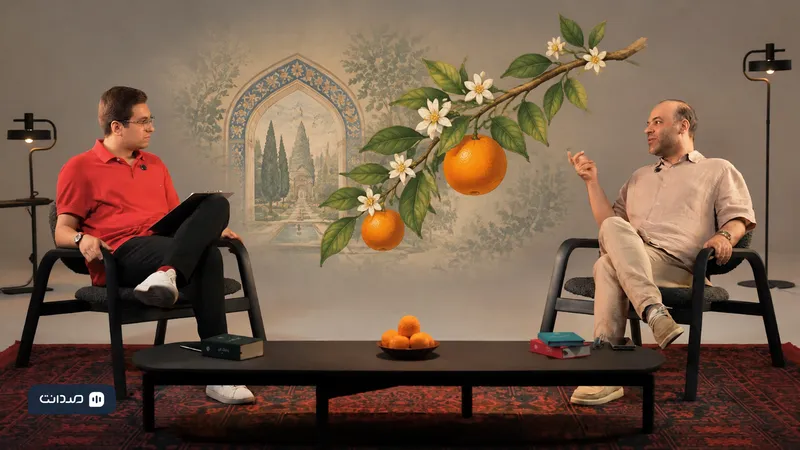

Kaveh Behbahani
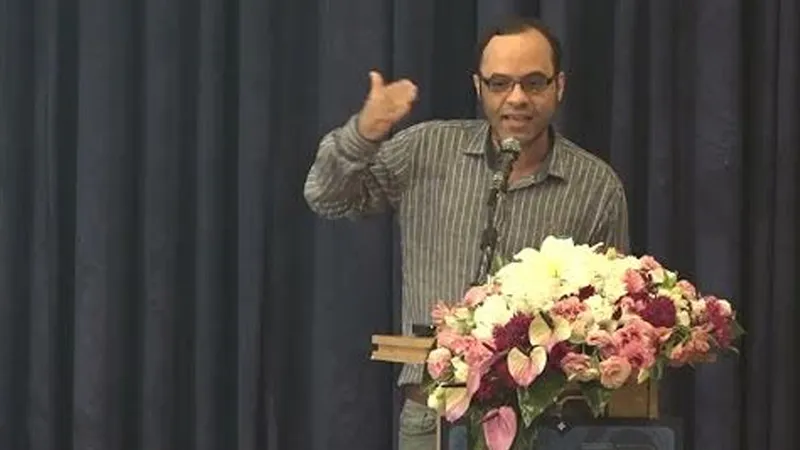
میهمان برنامه“Narenjcast” tells the story of Shiraz in the voices of those who have lived it, recounting tales of the city's people, memories and corners. The second episode of the programme's first season is devoted to a conversation with Kaveh Behbahani.[1] Behbahani, born in 1979, is a translator, writer, lecturer and researcher in contemporary philosophy. His work is mostly in the history of ideas, ethics and aesthetics, and he has also played a part in popularising philosophy for general readers. Aristotle, Hafez, Hume, Nietzsche, Wittgenstein, Rawls, Habermas and Searle are among the thinkers who have influenced him. His works include the book “From Ethical Inquiry to Aesthetics.”
The conversation turns on the question of whether there is a city with philosophy at its foundation, and what idea Shiraz holds within itself if we look at it philosophically. In reply, Behbahani describes Shiraz as a city built from archetypes drawn from Hafez and Saadi: acceptance of the other, enjoyment of this world, easygoingness and conversation.
The City That Makes Us
In Behbahani's view, everyone is a philosopher in a sense, since everyone asks where we come from and where we are going, but that does not mean everyone is a good philosopher. Every city, too, is built on a set of ideas and, in his phrase, has a “syntax” or grammar, though not all of these ideas are philosophical in the strict sense. The relationship between a city and its inhabitants runs both ways: we build the city on the basis of an idea, but the city also takes up residence in us and shapes us.
To make the point tangible, he divides cities into the geometric and the organic. He cites Saint Petersburg, a city one of Russia's Peters built with meticulous, geometric architecture to rival the cities of Europe. In “Notes from Underground,” Dostoevsky speaks of its inhabitants as though they were living inside a geometry book. Behbahani explains this in neuropsychological terms: the emotional part of the brain goes hungry in such a city and craves nature and organic texture. This is why the residents of geometric cities flee on holiday to somewhere like the Caspian north. In his view, Shiraz is not yet a wholly geometric city, and organic texture can still be seen in its garden-city spaces. He also recalls Italo Calvino's novel “Invisible Cities,” which, in the form of short tales, speaks of the effect of cities on the human psyche.
Hafez, Saadi and the Archetype of Rindi
Part of the collective consciousness of Shirazis comes from Hafez and Saadi, two poets who, in Behbahani's phrase, are so important that they have planted a particular taste and a particular intellectual and linguistic design in our collective unconscious. He counts himself among those who, if asked “Hafez or Saadi?”, answer Hafez, though he notes that Hafez is indebted to Saadi. If we take these two away from Shiraz, Shiraz is still there, but it lacks a great deal, just as if we remove Dostoevsky, Tolstoy and Chekhov from Russia, Russia remains a geography, but the archetypes and ideas that have shaped us are damaged.
His central concept is “rindi,” which is Hafez's invention and is not found in Saadi. In classical literature, “rind” was at first the word for rogues and ruffians; thus in Bayhaqi's History, when Hasanak the vizier was being hanged, a band of rinds were paid in silver to hurl stones and clods at him. Later, in a quatrain attributed to Khayyam, we meet the rind who is neither infidel nor Muslim, neither seeking the world nor religion; someone who clings hard to nothing. Hafez sets this figure against the zahed, the ascetic: one who has settled for the first layer of religion, clings rigidly to a set of beliefs, is dour and sees nothing but faults. The rind, by contrast, is not fanatical and knows that this world has secrets he may never grasp; he does not carry the truth in his pocket.
Behbahani admits that one cannot grab someone by the collar and say, you are the rind Hafez speaks of, but he sees this rindi in the city in the form of a spirit of tolerance, one that is seen less in many other cities. As he puts it, if the authorities and official platforms leave people alone, they live side by side whatever their looks, outlook, religion or irreligion, and put up with one another. Shiraz today also has cultural plurality; in the Vakil Bazaar you hear Turkic, Luri and other dialects side by side. Saadi, too, advised the ruler of his day to be kind to strangers and travellers, because a traveller earns a city a good name, and a land where a stranger is wronged does not last long.
Divination and Universal Wisdom
The host asks why Shirazis still consult Hafez by divination for their most important decisions. Behbahani understands divination in two ways. The bad understanding is that Hafez tells us about the future of a relationship or a business, something no book can deliver. The good understanding is that literature and art give us knowledge, and of a universal kind, that is, true for all times and places. When Hafez calls this world “mean,” he recalls a piece of wisdom: that it takes back whatever it has given you, be it beauty, learning, wealth or good parents. For this reason, opening the Divan of Hafez can be therapeutic and soothing.
To explain, he points to the cognitive-behavioural approach in psychology: a triangle with thoughts as one side, emotions as another and behaviour as the third. In classical literature emotions were called “passivities,” because they come to us and we do not go to them. We cannot turn depression into joy at the press of a button, but if we change thought or behaviour, the emotion changes too. A verse of Hafez can suddenly change the atmosphere. The Stoics did the same; in his personal notes Marcus Aurelius reminds himself that he will meet ill-tempered people and that this is their ignorance, so he should not become their plaything. Hafez too says to ignore the envious man's slander. Behbahani says he constantly keeps private company with the verses and sometimes, after years, discovers a new layer of meaning.
Here he singles out the role of Master Shajarian, who, by setting Saadi's and Hafez's poetry to music, rewrote the way we turn to them and took them to another league. According to him, Hafez himself was also a musician, as one of his verses is made entirely of musical terms, and elsewhere he plays with the terminology of medicine and astronomy, showing his mastery of the learning of his age.
This-Worldliness and the Tradition of Food
The first tradition the host raises is food and cuisine in Shiraz: why are taste, aroma and scent so important to Shirazis? Behbahani seeks the answer in a tradition of thought. In a mystical tradition that has also seeped into our religion and mysticism, this world is junk and second-rate, and the real world is elsewhere. The root of this outlook goes back to Plato , who held this world to be imperfect and impermanent and rated another world, the world of rational concepts, as better. In the literature of the Semitic religions that other world became “paradise,” and the body was deemed bad and the soul good. Behbahani also explains psychologically that the root of this outlook is perfectionism. He does not consider the dominant discourse of the age, that is, war, disease and early death, to be without effect on its emergence, and he says there was not necessarily any conspiracy behind it.
In such a framework, food and taste have no value. Rumi looks on food with contempt and calls the body a “dunghill.” Hafez and Saadi stand at the opposite pole, and for them this world is authentic. Behbahani refers to the anecdote attributed to Saadi in which he and several fellow travellers go to visit an elderly acquaintance, a wayfarer on the Sufi path, in the land of Rum; the old man recites dhikr from night till morning and brings no food, only kisses. One of the companions, playing on the words “kiss” and “provision,” says that for a dervish provision is better than a kiss. In his reading, this is a kind of humorous critique of Rumi's view of the body and food. Hafez, too, pays little heed to the paradise promised beyond death: “Since today I gain paradise in cash, why should I believe the zahed's promise of tomorrow?” Rumi's beloved is in the heavens, but the beloved of Saadi and Hafez is this very flesh-and-blood person of this world. Even in his own juristic game, Hafez declares wine forbidden, but only where there is no companion or friend. It is from this outlook, in Behbahani's view, that eating and drinking, playing with flavours and taste are taken seriously in Shiraz. He laments that the “Shiraz wine” brand is alive in the world's bars, yet no benefit is drawn from it in tourism.
Saadi and the Patricide Against Him
Behbahani adds a point about Saadi. During the Mongol invasion, Saadi of Shiraz did not take the road of war but entered by way of peace and the payment of tribute, so that the city would remain safe and a cultural atmosphere could be built and a body of thought formed that would live on for centuries; even the series “Sarbedaran” shows him as a sycophant. According to Behbahani, many Iranian intellectuals, from Shariati and Al-e Ahmad to Shamlou, have had a “patricidal” quarrel with Saadi and have even accused him of promoting lies, because he said a expedient lie is better than a truth that stirs up strife; a line Behbahani considers very wise.
The Tradition of Conversation and Its Crisis
The host regards Shiraz as a city of conversation and asks why this tradition has faded. Behbahani recalls his youth, when they would go to the house of Fereydoun Tavalloli, one of the first-rank poets, and after his death his wife continued the literary gatherings, where many poets assembled. In his view, Shiraz has plenty of first-rate poets, both classical and modern, but they are seen only dimly in the shadow of Hafez and Saadi.
On the present, he speaks of a “national crisis of conversation”: the atmosphere instantly becomes polarised, and the two ends of the pole do not converse but engage in verbal violence and conflict. Behbahani, part of whose work concerns speech acts, notes that one of the things we do with language is to make it a substitute for the club, the whip and the gun. The aim of conversation is to reach shared understanding, and verbal violence repels us from one another. In his view Hafez, Saadi and other poets have built an intellectual universe in which it is possible to converse and find shared presuppositions. The challenge is how to hear the logic of others, even without accepting it, and to see the world through their eyes, without clawing at their faces with words.
To the host's other question, why in Iran the vehicle for conveying thought has been the word and poetry rather than painting or cinema, he replies that the Greeks called the word “logos,” which is at once thought, speech and the root of “logic.” Plato was on poor terms with poetry and rhapsodes and held that poetry lacks cognitive value, but Behbahani disagrees with him and holds that art has cognitive value. In our culture poetry has carried intellectual elements and prose has had its own aesthetics, from Bayhaqi and the Golestan to Asrar al-Tawhid. He considers it possible that Islam's opposition to figural depiction and sculpture also played a part. Even so, in cinema and the novel there are figures such as Beyzai, Kiarostami and Hedayat who have managed to converse with the world.
The Tradition of Easygoingness
The host asks about the tradition of easygoingness in Shiraz. Behbahani distinguishes three meanings. First, easiness in problem-solving, that is, reducing a complex problem to its parts, for which he finds support in a verse of Hafez: “How will your mind ever receive the inscription of grace, alas, unless you make a blank page of the scattered sheets.” Second, passing lightly over matters that loom large for others, the spirit of “the world is hard on those who are hard on it,” which in his view comes from the this-worldly, Stoic wisdom of Hafez and Saadi: reality cannot be changed, but our interpretation of it can. The world is a tragedy, not a comedy; in the end it kills everyone, so don't be hard on yourself. Third, the humorous cliché of Shirazi laziness, which is an exaggeration; though in literature too, Hafez and Saadi have played with the word “action” and with idleness.
Shiraz and the World: City Brand and Hospitality
Behbahani says Shiraz is no place for agriculture, because it has no water, and no place for industry, because it brings pollution; Shiraz is a city of tourism and hospitality. Its intellectual underpinnings are not only Hafez and Saadi; Sheikh Ruzbehan and Mulla Sadra were also in this city. He speaks with regret of the tomb of Sheikh Ruzbehan, whose condition is unworthy of him, while in Denmark Kierkegaard's house has been turned into a tourist destination. Hafez and Saadi are also known in the world. Nietzsche, who philosophised with a hammer and heaped abuse on everyone, would praise Hafez when he came to him. Goethe wrote the “West-Eastern Divan” inspired by Hafez, and in France people gave Saadi's name to their children; for example, Sadi Carnot, the famous thermodynamicist.
He quotes Ali Emtiaz as saying that Shiraz is a city of retirees, like Vienna; a place where people work elsewhere and then have a house in Shiraz from which their new life begins. In Behbahani's experience, philosopher friends who have come to Shiraz, especially at the Hafezieh, said they would like to stay right here. Shiraz penetrates one's being so gently that it has no sharp edge, unlike Tehran, which harms one spiritually. He also criticises high-rise construction in Shiraz, because the city lies between two mountain ranges and its view should be visible from everywhere, and the destruction of the Qasrdasht gardens, which were the city's lungs. In his view the centre prevents the city's potential from flourishing; Shiraz does not need support, it only wants the obstacles removed, which is what philosophers call “negative liberty.” He points to the guesthouses and boutiques in the old fabric that hold within them Zand, Qajar and Pahlavi houses, and to the Shiraz Arts Festival that used to be held in the past.
City of the Past or City of the Future?
Behbahani criticises the restaurants' monopoly over the city: as if the only place where one can hear music and eat is a restaurant. He reminds us that Shiraz has more than seven hundred music schools, a striking figure for a city of this population, and that the street should acquire a “soundscape” through musicians, like the kids in Istanbul's Taksim Square who make rhythm with two sticks and a bucket. He sees the obstacle to this as a kind of oil-tainted mentality of governance that thinks all money must come from there and does not know that people can create wealth. Hafez had made the same critique: “Where is the sermon's chant, and where the music of the rebab?”
On whether Shiraz is a city of the past or the future, he says the linear division of past, present and future is to some extent artificial, since we carry the burden of past traditions on our shoulders. Rome is a “palimpsest,” in which one can read, layer by layer, the declined civilisations. Behbahani defends modernity and urban renewal and says that some fabrics are our historical identity and must not be touched, while others are without identity; he cites Zand Street, where walking is not very inviting, unlike Eram Street. He wishes that we might live in smart cities, but not like Dubai; Shiraz must have a future of its own.
He likens the past to a pair of glasses made of the raw wood of culture, dialect and archetypes. It is with these glasses that we look at the future. The person without identity is one who throws away his own glasses and puts on Paris's glasses.
A Walk Through the Hafezieh
At the end he is asked to close his eyes and take us to a place in Shiraz. Behbahani describes a space with distinctive paving and a few steps up, a gate that opens onto tall cypresses, a building of unique design that sets a dervish's cap atop its columns, and the tomb of a great thinker. Behind it lie other poets such as Mehdi Hamidi Shirazi. Shajarian's voice resounds there and the scent of bitter-orange blossom and all manner of plants wafts through the air. He speaks of a study that regards the sound of water as a lost instrument in Shajarian's music and considers the sound of the Hafezieh fountains to be effective in this setting. This experience has to be lived, just as one cannot describe the taste of a dish one has not eaten.
In one sentence, Behbahani regards Shiraz as a city built with these archetypes: we must not be so naive as to think we have reached absolute truth and must guide others. Shiraz is a city open to all thoughts, ideas and tastes, and good taste in it means both cultivating one's own palate and welcoming the different tastes of others.
[1]The Narenjcast conversation with Kaveh Behbahani, season one, episode two; video on YouTube:







Discussion0 comments
No comments yet; let yours be the first voice.