Religion
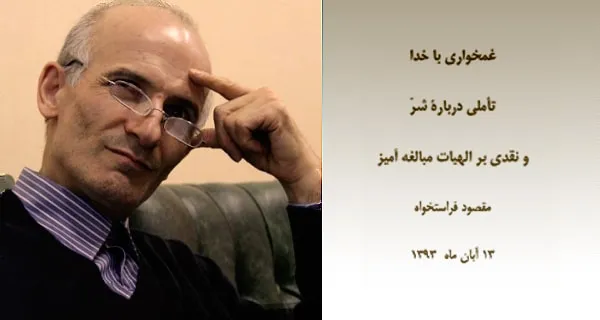
Sorrowing with God: A Reflection on Evil and a Critique of Exaggerated Theology
The existence of evil poses a formidable question to the divine, one against which theological theodicies often prove feeble. By critiquing an exaggerated theology, the divine is understood not as the designer of evil, but as a fellow-sufferer and a source of support for ameliorating life in a disordered world.
One of the most distressing features of our human condition is the existence of evil in this world. The problem of evil has exhausted and worn down the minds of serious thinkers. The subject of evil is a formidable question posed to the divine. The various arguments known as the argument from evil sometimes conclude that, given all this evil, divinity is meaningless. Many of the apologetic justifications offered by theologians are, in fairness, weak and sometimes highly contrived.
The present note is a sorrowful attempt to resolve the conflict between two experiential propositions. The author has both a mental and an existential connection with both propositions: the first proposition is that we all feel and affirm the existence of evil. The second proposition is that some of us also experience the existence of something divine in our own lives. The question is how these two propositions sit together and are compatible with one another? How can the divine be explained with all this evil?
On the subject of evil, the author holds to a humble realism that is at the same time very cold, bitter, and disturbing. It seems that evil truly exists. All kinds of natural and human evils have besieged us and other beings from within and without. Evil is neither non-existent nor, apparently, as scarce as is sometimes claimed. Animals are in suffering. Humans are in suffering. How can one close one's eyes to the poverty and hunger of millions of people?! How can one fail to see the sufferings of Christ and the oppression of Hussein, and fail to see the prisons and the locks, the gallows and the ropes?! How can one fail to hear the cries of torment from the earth's and sky's hell-dwellers?! How can one fail to see the terrible indifference of the earthquake and the storm, the hemophiliac children, the homeless sleeping rough in winter, the defective and sickly newborns, the asylum, the mentally disabled, the fish dying in polluted waters, the sheep sacrificed by humans, the violence, the rape, Palestine, the vengeance, Kobanî, the street children, the displaced wanderers, and the weary prostitutes?! How can one fail to see ignorance, fail to see inequalities, fail to see wars, chemical weapons, and the atomic bomb?! If these are good, then what is evil? And if they are evil, then how can one have confidence and faith in the existence of the divine in such a world, all passion and all evil, and give one's heart to it, and see it as praiseworthy, worshipful, and transcendent? The author has a lived perception of the divine and, on the night of Ashura, in remembrance of all the oppressed and all misfortunes, adversities, pains, calamities, sins, violences, and sufferings, bears witness to how the divine, despite all this evil, remains the ultimate meaning of meanings, and is lovable, worshipful, and gaze-worthy, and deserving of hope, faith, and cooperation.
The divine is not responsible for the existence of evil in this world; rather, like us, it is grappling with the reality of evil, and indeed, before us and far more than us, it has been confronted with the existence of evil. In the words of Khayyam, "Do not lay blame upon the celestial sphere, for in the way of reason, the sphere is a thousand times more helpless than you." An important manifestation of the divine is the confrontation with the evils of this world. Behind the beliefs of our great Iranian civilization also lies such a meaning: that Ahura Mazda is the manifestation of good against Ahriman, the manifestation of evil.
A famous question has existed since ancient times. If there is a God and this world is His creation, why has He allowed evil to exist within it? The remedial and justificatory answers were often based on a personified and exaggerated conception of God. In this superficial perception of God, He is an intentional agent who created the entire world at one time with a specific purpose. This way of conceiving God brings with it numerous difficulties, one of which is the problem of evil. If He was omnipotent, then why are there so many deficiencies in His design, and if He could have devised another plan but did not wish to, then how can one give one's heart to His kindness?
A refined and moderate perception of the divine passes beyond this ontological exaggeration of a personal, omnipotent God seated above time and space. The divine is the mystery of the will to perfection and liberation, the consciousness flowing through the cosmos. It is fitting to seek the signs of His works in innovations, creativities, affections, beauties, and novelties. In this refined experience of the divine, rather than being the prime mover and the first architect, He is the ultimate point of reliance for improving the conditions of life in this disordered world. He is an existential anchor for the elevation of the human condition, for the life of animals, and for the ecosystem of water and plants.
The divine in this world is the source of significations in consciences, intellects, and hearts, the source of glad tidings and warnings, the fountainhead of perfection and transcendence, of overcoming limitations and confronting deficiency, imperfection, and evil. Imperfection exists in the material of the world, and the mystery of divinity, despite all these deficiencies and inadequacies of the world's matter, manifests with creative power and, in spite of all evil, crookedness, and untruth, gives tidings of goodness and mercy.
A theological exaggeration about God places Him at the pinnacle of an imaginary time and likens Him to a designer and builder; a divine watchmaker by whose winding all of creation was set in motion. But immediately, the question of the flaws in the world's design and all this evil and tumult arises, and the exaggerated personal God is rightly called into question. Thus, so that the force and majesty of theological hyperbole and exaggeration are not diminished, various apologetic defenses are prepared: that there must have been a wisdom in it, that misfortunes are the appearance of the matter and He knows the secret of destiny, that these evils are not existential matters but matters of non-existence, or that there are reasons in the mind of God for their existence and a good is hidden behind them, and so on.
Rationalist philosophers strove as much as they could to moderate the exaggerated theology. One example was the subject of the origination and eternity of the world. Philosophers spoke of the eternity of the world and found the origination of the world to be irrational. How can one say the world did not exist and then came into being at a point in time? For time itself is also part of the collective categories of this very world. A large portion of theologians could not easily reconcile themselves with this rational and analytical view, because they saw that if the world were not originated but eternal, then the existence of an exaggerated God would be negated. Rationalist philosophers tried to create a compatibility between a reasonable belief in the divine and the assertion of the world's eternity. The world is eternal, and at the same time, the divine plays a creative and agentive role within it, manifesting and revealing itself through its mystery of guidance and transcendence.
Perhaps an implicit meaning intended by our great thinkers and mystics, who considered God as the agent by manifestation and the agent by love (not the agent by intention), was precisely this. Even in the Quran, although it features a personal God in accordance with the linguistic and cultural plot of Semitic religions and theological traditions, there are verses that, when explaining the creative act of God in nature, say, "Then He turned to the heaven while it was smoke (a formless state)" (Fussilat, 11). The context of the verses shows that the import of their signification seeks to demonstrate a relative and temporary order in this corner of the solar system for the transcendence of humanity, and one must fall in love, or else the work of the world will one day come to an end. Setting aside theological exaggerations and doctrinal constructs, the essence of faith is that there is a divine reality, and the effects of His action in a world mixed with evil can be observed, tested, and experienced. It is by relying on this mystery of creativity, consciousness, and awareness in the world and humanity that one can confront pain and suffering in a more satisfactory way, reduce hardships as much as possible, and improve the conditions of life to the greatest extent possible. This is the very God of soul and wisdom in Iranian philosophy.
In this conception, God is the source of grace and the principle of transcendence in the totality of the world, and is not responsible for the limitations of this totality. God is not responsible for the matter of this world. In the arguments of ancient thinkers to explain evil, it is stated that in the realm of possibility, a better world than this was not possible. What manifests the divine command is not the existence of evils, but the confrontation with evils. In the matter of this world, there is chaos, deficiency, limitation, and conflict. Evil arises from such a situation, and the divinity of God lies in confronting this situation and inviting humanity to cooperate in improving it to the extent possible. God is the manifestation of a will and an invitation to confront limitation, deficiency, and evil, for the sake of liberation and transcendence. Our work in confronting evil is to sorrow with and cooperate with the divine command. This theme can also be discerned from the Quran: that God brought humanity from the miry nature of this chaotic world to higher forms of perfection, appointed them as His vicegerent, asked them to cultivate this earth, to live better as far as possible, and to nurture body, mind, and soul to the extent of their ability. The subsequent exaggerations that have been fabricated about God are part of the deficiencies and inadequacies of this world and are counted among the inadequacies of humanity.
Faith in God means fixing one's gaze upon a support within the world and humanity for improving life situations in conditions filled with all kinds of limitations, conflicts, chaos, and evil. This is a realist, critical, and dramatic theology. In this theology, the argument from design in its classical form is meaningless. It is not the case that the world is a pre-ordered world, arranged by divine regulation. This is a clear and extravagant exaggeration in theism and religiosity. In fact, the world is full of ambiguity, disorder, deficiency, and crookedness. But the secret of the creative power of the Creator is the realm of possibilities and orders that emerge from the heart of these disorders. Faith is placing hope in an existential and spiritual support within the world and humanity for a rational, moral, social, and institutional confrontation with all kinds of disorders and evils, for bringing order to the mass of disorders, for reducing sufferings, and for seeking liberation, well-being, and salvation to the extent of human ability.
.
.
The PDF file can be downloaded from here
.
.
Sorrowing with God: A Reflection on Evil and a Critique of Exaggerated Theology
Author: Maghsoud Farasatkhah
Source: Maghsoud Farasatkhah's website
.
.





Discussion0 comments
No comments yet; let yours be the first voice.