Religion
The Discourse of Religious Reformists: A Book for Assessing Contemporary Religious Intellectuals
In The Discourse of Modern Religious Thinkers, Tabatabaei examines three post-Soroush figures in religious intellectualism. The primacy of ethics over religion in Fanaei's thought and Naraghi's critical traditionalism form the book's central themes.
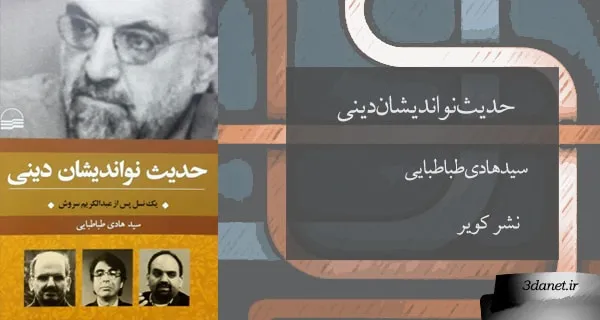
Hamid Zarei: The discussion of religious intellectualism seemingly never subsides in our country. At one time this school of thought was at its peak and the works of its thinkers received much attention. At another time, it faced many criticisms and attacks. But at no time has attention to this thought been overlooked. Kavir Publications has released a book, this time speaking of a generation after Abdolkarim Soroush. If the criticisms of the religious intellectual movement were directed at Soroush's intellectual project, this book now demonstrates a step further and places other individuals within the school of religious intellectualism. The book "The Discourse of Religious Reformists" with the subtitle "A Generation After Abdolkarim Soroush" undertakes the discussion of three intellectuals who are active in the arena of Iranian thought today. This book has been authored by Seyed Hadi Tabatabaei. The first chapter of this book is dedicated to the views of Abolghasem Fanaei. Fanaei's most important idea is the primacy of ethics over religion. To present this idea, the author has attempted to first demonstrate the necessity of this discussion from Fanaei's perspective. To enter into this issue, he first shows the problems that result from the "primacy of religion over ethics." In the author's words: "There have been no shortage of injustices and inhumanities that have befallen humanity bearing the stamp of religiosity on their forehead. From the time when the horseshoes of the Yazidis trampled the body of the third Shiite Imam while expecting to seek nearness to God; to today when they sever the head of a Syrian child and shout cries of 'Allahu Akbar,' religion and religiosity have been among the accused in these violences. The black garb and disheveled locks of the Daeshis were painful because they bore the label of religion on their brow. Perhaps the religious texts also had the capacity for some to raise the banner of 'La ilaha illa Allah' and commit savagery, nurturing the dream of forming the Islamic State of Iraq and Syria. To take brutality to its extreme and name themselves Muslims, earning the disgrace of humanity." (p. 28)
After these interpretations, the author states that: "Pass over the naked crimes of these inhumane people; look at the jurisprudential opinions of some jurists, how they turn a blind eye to ethics in order to, in their own view, implement the ruling of religion." He then demonstrates some jurisprudential opinions that are contrary to ethics and, in today's world, those rulings can be considered unethical. By mentioning these cases, he lays the groundwork to address Fanaei's main discussion. By proposing the issue of the primacy of ethics over religion, Fanaei has tried to prevent these unethical rulings from entering religious understanding. He first demonstrates the inefficiencies of the theory of the primacy of religion over ethics and enumerates its disadvantages; then he presents his main idea, which is the primacy of ethics over religion.
In presenting the discussions quoted from Fanaei, the author has tried to also show the fruits of these discussions in today's society. In one place, he states it this way: "Removing ethics from the backing of jurisprudential attitudes has the capability to bring about unfortunate results. It scatters Iraqi children from pillar to post; kidnaps young Nigerian girls under the pretext of Quranic instruction and commits cruelty against them; violates Yazidi women; stifles 'a word of truth before an unjust ruler' in its infancy; disrupts academic gatherings under the pretext of promoting religious thought. It is from here that Fanaei, in a key phrase, states that: Enjoining what is religiously good through unethical means is, in truth, itself considered one of the ethical evils." (p. 41)
One of the key discussions that Fanaei has proposed is the discussion of "God as the Ideal Observer." In this scheme, it is said that God is the exemplar and primary source of all ethical judgments. If a person's conception of God is that of a despotic and autocratic God, their worship and servitude will yield nothing but immorality. Fanaei emphasizes this important point that mere worship and servitude to God is not sufficient for a person to become ethical and remain ethical. Rather, one must see which God and which deity a person worships.
In a key phrase, Fanaei states that one’s relationship with God, and one’s closeness to or distance from Him, is a personal and private matter and cannot be the source of special social rights or discrimination in social rights. The author highlights this statement by Fanaei, depicts its fruits in today’s society, and goes on to say: “This is also a blight in religious societies. In some of these societies, even when selecting individuals for administrative posts and governmental positions, their relationship with God is brought into the equation. People are asked to what extent they participate in religious ceremonies. How much do they devote themselves to the transmitted supplications? They are asked about the supererogatory acts following prayer. They ask about attendance at religious congregations. More astonishing than these is that when choosing a national official, their relationship with God is brought up. Some individuals in religious societies, in order to attract the devout to themselves, put forward their personal relationship with God. One says, ‘I made a pact with my God and accepted the responsibility’; another states that ‘it was God’s will that I ascend to the seat of presidency.’ But, a thousand times but, religious purity is no criterion for superiority in attaining leadership in worldly and social affairs. It is a naive notion that because someone performs constant prayer and is perpetually fasting, they can and should sit upon the seat of leadership. The criterion and standard for undertaking worldly affairs is scientific, ethical, and specialized competence and merit, and nothing else.” (p. 50)
In this book, other important topics raised by Fanaei are also discussed. The encounter with jurisprudence, apostasy, a reflection on canonical times, sacred spirituality, the conflict between rationality and spirituality, are among the other topics addressed in the first chapter of the book. The second chapter consists of a discussion of Arash Naraghi. Naraghi’s main project is a system he has named “critical traditionalism.” Based on this project, Naraghi has tried to both pay attention to the achievements of the new world and not turn his back on the teachings of tradition. It is based on this very system that he has proposed and advanced his discussions. For example, when he speaks of bodily resurrection, he introduces an idea that is both consistent with new human achievements and takes into account the teachings transmitted in religious texts. Naraghi’s encounter with the category of revelation is also not devoid of this same approach. The author has shown in this book that with the precise conception of revelation that Naraghi presents, he has also leveled criticisms at unrefined understandings of revelation. In this regard, Naraghi has criticized the views of Abdolkarim Soroush, Mohammad Mojtahed Shabestari, and Akbar Ganji, and does not consider them certainly useful for a correct understanding of revelation. Ethical reflections, the ethics of human rights, the ethics of violence, the ethics of torture, religiosity and civility, the right to be wrong, tolerance, a reflection on the taboo of homosexuality, mystical matters, the age of divine hiddenness, the experience of boredom in the present age, and other topics that Naraghi has spoken about are also considered and discussed in this book. The intellectual system of Soroush Dabbagh constitutes the third chapter of this book. At the beginning of each chapter, the author has tried to depict a brief account of the lives of these thinkers. In this chapter, regarding Dabbagh’s circumstances, it is stated that: “... Dabbagh, along with his father, attended circles where poetry, science, and literature were the abundant and common fare. He went twice with his father to visit Ayatollah Khomeini in Jamaran. He would visit Ayatollah Montazeri in Qom. When the father took up the pen and cast his views into the sunlight, oppositions also reared their heads. His child witnessed the repeated attacks of a group that raided the father’s gatherings and disrupted his circles. He witnessed how threatening letters disturbed the family’s peace... All this terror and intimidation, however, was entirely dispelled by the murmur of the father’s Masnavi recitations. On Friday mornings, when the father melodiously recited the poems of Rumi, Saadi, and Hafez, it was enough to make sorrow leave the house.” (p. 282)
Among those from whom Soroush Dabbagh has drawn influence and whose presence he has also brought into the constellation of religious intellectualism are Sohrab Sepehri and Ludwig Wittgenstein. These two have both left intellectual marks on Dabbagh, and Dabbagh has endeavored to highlight their role in his own ideas. Dabbagh has put forward designs in defense of the title of religious intellectualism. He has also highlighted the strengths of this school of thought and shown its distinction from other intellectual rivals. His ideas concerning modern mysticism, the issue of hijab, apostasy, common-law marriage, Quranic exegesis, types of faith, and reflections on film and the novel are among the other topics addressed in this chapter. The author has tried, at the end of each chapter, to show how the views of each of these thinkers are of use to us today. In this chapter as well, in a section titled "How Are Dabbagh's Views of Use to Us?", it is stated that: "One can walk in step with Dabbagh and give a religious hue to this-worldly life. With Dabbagh, one can join hands with Sohrab Sepehri and not fear death. One can take life in this very abode seriously and refrain from dwelling on the unattainable and unnecessary affairs of the other world....He directs fundamental attention to this-worldly life. He emphasizes that one must find a way of salvation from within the very adversities of life, from this worldly mace and iron, and make religion a means for peace and tranquility in this very world." (pp. 410-411)
The author has confined himself to these three thinkers. It seems that other individuals could also have been discussed in this book. Furthermore, some of the ideas of these intellectuals have not been presented. For example, Arash Naraghi's ideas concerning the problem of evil could also have been discussed, but this discussion is not mentioned in the book. The author has attempted to offer some criticisms of the views of these three thinkers as well. However, it appears that this book has adopted a sympathetic reading in delineating their perspectives. On the whole, this book, which is written in a readable and fluent style, should be read. Even if we do not agree with the reading of religious reformists, we can still pay attention to this book, which also addresses some of the predicaments of our society today.
.
.
Book Title: The Discourse of Religious Reformists
Book Author: Seyyed Hadi Tabatabai
Book Introducer: Hamid Zarei
.
.

Discussion3 comments
لطفا کلمه (میدوانند) به (میتوانند) تغییر و در مطلبم اصلاح گردد.
به نظر من این نوع مطالب برای عامه مردمی ارائه میشود که لازم است تفکرشان دستکاری شود . و نه برای کسانی که زوایای اصلی دین و ارتباط آنرا با بشر مورد تجزیه و تحلیل قرار میدهند. به گونه ای این نوع ارائه برای انحراف افکار عمومی برای نفوذ نئولیبرالیسم ( اباحه گری جدید) است. افرادی هستند که میتوانند ارتباط سیستمی بین دنیای مجازی را با دنیای مادی و اثر بخشی آنها بر هم را اثبات کنند ، فقط آنها میتوانند به تمامی سؤالات بشر در خصوص دین پاسخ دهند.آنها میدوانند حوزه اخلاق را با حقیقت ادیان پیوند دهند.
عالی