Religion
The Narrative of Religious New Thinkers
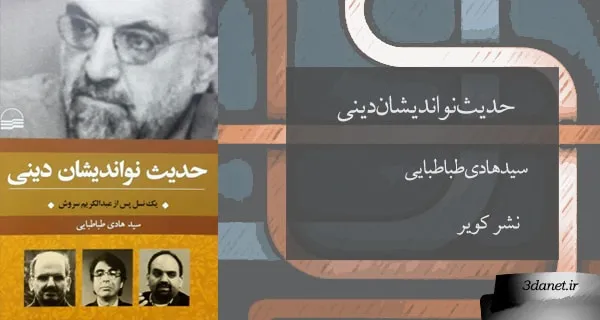
In his book Hadith-e Nowandishan-e Dini (The Discourse of New Religious Thinkers), Seyyed Hadi Tabatabai examines the ideas of Fanai, Naraghi, and Dabbagh. He explains that the title was chosen to avoid the negative connotations of 'religious intellectualism.' These thinkers belong to a generation after Soroush, though they are not necessarily his students.
The Qalam Yaran Journal: Seyed Hadi Tabatabai is the author of the book "The Narrative of Religious New Thinkers; One Generation After Abdolkarim Soroush". In this book, Tabatabai addresses some of the views of three religious intellectuals, namely Abolghasem Fanaei, Arash Naraghi, and Soroush Dabbagh. He believes that each of these intellectuals has introduced numerous ideas and each has kept the furnace of thought in the realm of religion warm. Therefore, given that he has familiarized himself with and examined the views of these three religious intellectuals, we have conducted an interview with him on this subject so that the accuracy and soundness of the arguments in this field may be revealed to the experts.
First, we would like you to provide some explanation regarding the title of the book; you have chosen the title "The Narrative of Religious New Thinkers," was there a specific reason for this choice? This question arises because in the text of the book you also speak of religious intellectualism; is there a substantive difference between these two terms?
As you are aware, the term "religious intellectualism" has for some time been subject to misinterpretations and, at times, injustices. Some define it in a framework as if the thinkers who fall under this term are pursuing a political project; or that all these individuals share one belief and lead and guide a single project to, for instance, attack jurisprudence and jurists and disparage the clergy. This, however, is an unjust understanding of the term religious intellectualism. It is as if this term has lost its scholarly weight and its non-epistemic dimensions have increased. The majority of critiques leveled against this intellectual current in recent years have targeted non-epistemic aspects, and precise scholarly disputation can rarely be found among them. The situation has reached a point where confronting this intellectual current has turned into a conflict. It is based on this manner of treatment that even some thinkers whose intellectual structure can be defined under the concept of religious intellectualism step back and refrain from getting involved in these conflicts and being defined under the title of religious intellectualism. Those who are concerned with research and scholarly matters, if confronted with the label of religious intellectualism, quickly shrug it off and do not tolerate any connection or relation to this intellectual current. The encounter with this term, like many other matters, has taken on prominent non-scholarly aspects and has driven intellectual rivals to declare a negative and rejective stance. Choosing the title "Religious New Thinkers" might somewhat reduce the negative burden of this conflict. It may also be more acceptable to some professors who advance their intellectual system in line with the confrontation between religion and the modern world and have a purely scholarly and research-oriented approach. In this book, I have sought to present the discourse of three thinkers in this field based solely on its epistemic aspects and to refrain from falling into non-scholarly conflicts. I do not favor conflicts that sometimes suffice with accusations and labeling, and I desire that the discourses be heard, brought to the arena of judgment, and their soundness and unsoundness be determined based on a scholarly disputation. For this reason, I have also stated in the book that this work is merely a narrative of thoughts that can be heard and whose wares can be assessed. The choice of the title "The Narrative of Religious New Thinkers" was for this reason.
Why have you examined only three of the intellectuals; does this mean that you do not consider Mostafa Malekian, Mojtahed Shabestari, etc., as falling under religious intellectualism?
The number of these thinkers could be extended even further, and one could also discuss the intellectual systems of certain other intellectuals. For instance, one could have spoken of seminary new thinkers in this book as well. I imagine that figures such as Messrs. Davoud Feirahi, Soroush Mahallati, Mohaghegh Damad, and others could also be addressed under the rubric of seminary new thinkers. This work, however, did not have the scope for that, and the views of these gentlemen could be addressed in an independent work. The aim of this book has been to show that there are thinkers present in our here and now whose words can be effective in achieving a better understanding of religion; but the veil of contemporaneity has fallen over their thought, and they are not given due attention. As you are aware, it is an unacceptable custom of our society that we do not much appreciate our thinkers while they are alive and engaged in reflection. But as soon as they turn their faces to the dust and are beyond our reach, tributes, eulogies, panegyrics, and sometimes the dissection of their views and opinions emerge and receive greater attention. This is not a reasonable or acceptable custom. We must appreciate our thinkers while they are present, by subjecting them and their views to repeated scholarly scrutiny. The lineage of religious new thinking (religious intellectualism) is traced back to Ali Shariati, Mehdi Bazargan, Mojtahed Shabestari, and Abdolkarim Soroush. The premise of this book has been to show that after these four prominent thinkers, other individuals have also entered the field of inquiry and are striving to construct a system that speaks of the connection and relationship of religion in the new world and offers a more acceptable understanding of it. It neither rejects the contemporary world outright nor shows unkindness to the components of religiosity. It seems that Messrs. Fanaei, Naraghi, and Dabbagh have designed and presented a coherent system in this regard. I must also mention that the subtitle of the book is "A Generation After Abdolkarim Soroush"; but this does not mean that the individuals whose views are examined were necessarily students or like-minded thinkers of Dr. Soroush. As you witness in the book, some explicit criticisms of Dr. Soroush's views have also been expressed by these thinkers. Secondly, although Messrs. Naraghi and Dabbagh have attended Dr. Soroush's lectures, Dr. Abolghasem Fanaei essentially never attended Dr. Soroush's classes and cannot be called a student of Soroush. Moreover, Dr. Fanaei also has criticisms of Soroush's intellectual system, and from this perspective too, he cannot be considered affiliated with Dr. Soroush. The application of the title "A Generation After Abdolkarim Soroush" is because these individuals have entered the field after Dr. Soroush and have designed and articulated their own intellectual system. Just as, for example, if one were to discuss the views of Mojtahed Shabestari or Abdolkarim Soroush, it could be called "A Generation After Ali Shariati." But as you are aware, both Soroush and Shabestari have criticisms of Shariati's views and perhaps define their intellectual project entirely independently of Shariati. At the same time, one must not overlook the important point that predecessors introduced ideas that have, willy-nilly, left their effects on the views of later thinkers.
It is for this reason that further discussion of Mojtahed Shabestari's intellectual system in this book was not appropriate. For he can be considered a contemporary of Soroush, and he himself belongs to a generation prior to these later thinkers. It seems that Mostafa Malekian, in the multiple phases of his thinking, has now moved beyond religious intellectualism and speaks of a spirituality independent of religions, and he increasingly incorporates fewer religious concerns into his views. Therefore, his intellectual system falls outside the scope of religious new thinking. Compare this very matter and Mr. Malekian's idea of rationality and spirituality with the idea of sacred spirituality proposed by Dr. Fanaei, and note how prominent the religious dimensions of this mode of spirituality are.
Is it possible for you to explain at length how jurisprudence remains the obese science of the Islamic world? And do you even still consider such a thing to be "existent"?
As you are aware, the science of jurisprudence (fiqh) has been the principal discipline in our seminaries. Essentially, the measure and standard of our scholars was gauged by their jurisprudential knowledge. Among the general public as well, acting upon jurisprudential rulings was considered the foundation and essence of religiosity. It is fasting, prayer, pilgrimage, and alms that, in the belief of the general faithful, have been regarded as the criterion and standard of religious practice. Beyond this, even our jurists have played a prominent role in the history of political and social developments. Roy Mottahedeh—the contemporary Orientalist and Iranologist—has said that the history of Iran is the history of the jurists of Iran. It is as if, in every historical event, the role of the jurists has been so prominent that without considering their opinions, views, and activities, writing the history of Iran was not possible.
The obesity of and attention to jurisprudence has been such that it has constricted the space for other areas of religion. Consider the encounters that have taken place with the exegesis of the Quran. When Ayatollah Khoei began interpreting the Quran in the seminary of Najaf, he faced opposition and abandoned writing the exegesis Al-Bayan. Ayatollah Khoei even said, in describing Allameh Tabatabai, who was engaged in Quranic exegesis in Qom, that Mr. Tabatabai had "sacrificed" himself. That is, by interpreting the Quran, he sacrificed himself and fell from social standing. This was the seminaries' encounter with the discipline of exegesis as one of the branches of religious sciences. Look at the encounter with philosophy in the seminaries and the extent to which it was opposed until recently. In the memoirs of some clerics, we witness how much opposition there was to the discipline of philosophy, and any seminarian who pursued its study was subjected to taunts and rejection. These kinds of treatments of sciences other than jurisprudence have, of course, somewhat subsided, and other dimensions of religion have also received attention; yet other disciplines have still not been able to find a status equal alongside jurisprudence. The main criterion and standard in the seminary vocation and religious knowledge is still the science of jurisprudence. These kinds of attitudes naturally leave their effects on society as well. Among the general faithful, a religious person is referred to as someone who acts upon jurisprudential commands, performs prayer and fasting to the utmost, and does not step outside the circle of Sharia. This matter is, of course, acceptable, and jurisprudence defines the circle of religiosity, but it should not prevent attention to other aspects of religion. As religious intellectuals have repeatedly emphasized, the matter of religion is beyond jurisprudential affairs. Consider that famous division by Dr. Soroush, who divided religiosity into livelihood-minded, knowledge-minded, and expediency-minded. The entryway into the arena of religiosity can be the very practice of jurisprudential matters, which shapes livelihood-minded or expediency-minded religiosity. But there are also other degrees of religiosity that must not be neglected. Livelihood-minded religiosity should not, of course, create the impression that this mode of religiosity is reprehensible. No, this is not the case. Blessed is the one who enters this fold of religiosity. But one must consider this important point: there are other realms of religiosity that rest upon the shoulders of livelihood-minded religiosity and reveal a loftier horizon.
One must not do an injustice to the knowledge of jurisprudence either. Just as it is unacceptable to ignore the mystical, philosophical, historical, and other dimensions of religiosity, it is also impermissible to ignore religious jurisprudence. Religious new thinkers are, of course, well aware of this important point. As an example, observe that when Dr. Fanai speaks of the primacy of ethics-centeredness over religiosity, his entire concern is that the opinion of the jurists not fall outside the framework of ethics. In this sense, his scholarly endeavor is directed toward reflecting on the philosophy of jurisprudence so that, ultimately, a refined opinion may be issued by the juristic community. He has repeatedly stated that he engages in his reflections within the framework of the philosophy of jurisprudence and has no intention whatsoever of entering the domain of the jurists' activity. It might be interesting to mention that, while writing the book, in one of the sections where Dr. Fanai had brought up the encounter with jurisprudence, I had chosen the title
Dr. Naraghi has also introduced certain concepts into the intellectual framework of religious new thinking. The “critical traditionalism” he has proposed provides believers with a suitable framework within which to safeguard their reasonable convictions. Or when he speaks of the age of the hiddenness of God, it seems that many of today’s questions that challenge believers can find reasonable answers under its rubric. Although the concept of the age of the hiddenness of God has a Western genealogy, Dr. Naraghi has redefined and developed it within the framework of Islamic-religious thought. Dr. Dabbagh, too, has introduced a concept such as “varieties of faith.” It seems that this concept greatly assists believers in their faith in the modern world. The epistemic, passionate, tranquil, and wishful faith that Dr. Dabbagh has outlined can assist many believers so that they do not consider themselves outside the circle of faith. It is through this very concept that one can understand to what extent the faith spoken of by our predecessors is operational in today’s world, and whether, if we do not attain that mode of faith, we should withdraw from the circle of believers or not. This idea and conceptualization is worthy of much attention and consideration. The concept of “modern mysticism” that he has proposed is another one of the constructs and conceptualizations of religious intellectuals. It seems that the later generation of religious new thinkers has striven greatly in constructing such concepts and has also achieved successes.
Does saying that Ahmad Kasravi considered pure religion the cure for the ailment, cast religious beliefs out of the realm of religion with the cudgel of doubt, and harbored pure delusion, mean that no pure religion exists? Of course, we must consider that this issue and its explanation must be elucidated within a system of concepts.
One can imagine that a pure religion also exists and is inscribed in the Preserved Tablet, but one cannot ignore the fact that access to this pure religion is something difficult to attain and perhaps impossible. When the divine matter is presented to people, it inevitably dons earthly garb and diminishes in its purity. Although attaining pure religion is an aspiration and the faithful strive to reach it, achieving it seems impossible. Secondly, attaining this religious purity is even less achievable by what Ahmad Kasravi advocated. He believed that the minutiae of religious matters must be judged by the standard of tangible human reason. While this may resolve certain issues, it cannot unveil all dimensions of religion. As Dr. Fanaei has also pointed out, the sources of knowledge are not confined solely to external and sensory experiences. Human beings draw upon four principal sources in acquiring knowledge, which are: 1- Inner experience 2- External or sensory experience 3- Intuition 4- Transmission or the testimony of others. Whenever rationality is discussed, these four sources must be considered, rather than confining it to one mode of sensory experience. This is the very flawed understanding that Fanaei refers to as rationalism or scientism. And it is in response to such approaches that Dr. Naraghi argues that the faithful must remain committed to a minimal rationality. By this, he means demonstrating that the rival arguments in criticizing the religious beliefs of the faithful are sterile. By adhering to minimal rationality, the faithful have fulfilled their rational duty. For instance, Mirza Fathali Akhundzadeh was among those who sought to test all religious beliefs against the criterion of this very tangible reason. He said: "Absolutely no benefit accrues from the rights of God, only harm... For example, five times of prayer each day and night keep you from your work and trade, fasting harms your body, the Hajj leads to your peril, and so on." It seems that this mode of encountering religion and religious beliefs cannot be of much use. In the paradigm of religious thought, firstly, one must not rely solely on this tangible experience and perception, because reason has various dimensions. Secondly, stepping into the realm of religion has its own requirements. For example, certain sacred matters cannot be ignored in the religious sphere. Sacred time and space are among the things that exist in religions and cannot be approached with this external reason alone. Mircea Eliade has written a book and spoken well of sacred matters among the faithful. Thirdly, in the realm of religion, one must always keep a point in mind, which is what Hafez referred to as "devotion." "Show devotion so that you may attain felicity." When you enter the realm of religion, you must also show your devotion. Some matters do not fit within the framework of tangible reason, and you must attain them through your devotion. It is not right for a person to sacrifice possessions to obtain anything, yet expect to acquire spirituality without making any effort or expending anything of their own. To acquire spirituality, we must show our devotion. Some of these matters and the attainment of spirituality pass only through paths known to those who have traversed this path themselves and then assist others. On this path, shedding tears, rising at dawn, prostration, prayer, and fasting are of use and increase spirituality. These matters, of course, do not fit within the tangible reason of human beings and are inevitably rejected by it. But one must understand that the domain of religiosity is not confined to the understanding and perception of this external reason alone.
What Kasravi advocated, accepting everything only by the test of tangible reason, may be useful up to a point. However, acquiring spirituality and stepping into the higher levels of religiosity requires other keys. I think the idea of the types of faith proposed by Dr. Dabbagh can also be helpful in this regard. What Kasravi says can be useful to some extent in knowledge-oriented faith, but there are other types of faith for which one cannot hope for a result using Kasravi's measure and criterion.
In the introduction to the book, you spoke of the title Contraction and Expansion in Religion; if the issue is the contraction and expansion of religion, how can it be reconciled with the transformation and evolution of religious knowledge? And does transformation occur in something eternal?
I too have meant transformation in religious knowledge and have not proposed a transformation in religion itself. The phrase referred to in the introduction is this:
Mr. Naraghi and Mr. Dabbagh have also indicated components based on which religion in the new world can be made more comprehensible and acceptable. The primary mission of religious new thinkers is to engage with religion. In the book *The Narrative of Religious New Thinkers*, an effort has also been made to discuss concepts that pertain to religious topics or have an influence on them. For instance, if we wish to demonstrate political or economic inquiries among religious new thinkers, we have shown discussions where religious understanding aids economic theories; or where religious understanding resolves a social dilemma. As an example, Dr. Fanaei has brought up the discussion of bank interest and has shown that the usury spoken of in religious texts has no connection or relation whatsoever to the bank interest utilized in the new world. Or when Dr. Dabbagh proposes the discussion of common-law marriage, he is addressing a social dilemma that a correct religious understanding can untangle many knots of. Dr. Naraghi has presented the discussion of religiosity and civility along the same lines. According to the belief of some religious people, modern civility cannot be in agreement with a religious creed. Dr. Naraghi, however, has shown what components exist in religion that compel us toward a commitment to civility. Or his discussion regarding the ethics of torture; he points to aspects that can resolve some legal and social dilemmas. It seems that each of the ideas of these later new thinkers can also pertain to social, economic, political, cultural, etc., discussions. But these individuals have tried to enter these discussions from the standpoint of religious interpretations. They have tried to show the entanglements that religious understandings have in these matters and to discuss the relationship between religion and the new world. In this book, at the end of each chapter, it has also been shown how the views of each of these thinkers can solve certain dilemmas and be of use to us today.
.
.
The Narrative of Religious New Thinkers
Author: Seyed Hadi Tabatabaei
Source: Qalam Yaran Monthly - July 2018 – Issue 11 – Second Year
.
.
Related Content:
Introduction to the book *The Narrative of Religious New Thinkers* by Hamid Zarei
.
.
Discussion2 comments
جناب طباطبایی ابتدا باید دین را تعریف کنند بعد راجع به اینکه ایا دین میتواند با عقلانیت جدید هماهنگ شود بحث نمایند البته تلاشهای روشنفکران دینی قابل اعتنا واحترام است ولی انچه حدو حدود دین را مشخص میکند نظر مراجع وفقهاست همانطور که اقای طباطبایی هم از قول دکتر فنایی ودکتر دباغ عنوان کردند که انها قصد ورود به فقه را ندارند وفقط راجع به فلسفه فقه صحبت میکنند واین یعنی انها هم معتقدند فقه همچنان حوزه ی اختصاصی فقهاست اینکه دکتر فنایی ودکتر طباطبایی و... دین را ابتدا در ذهن خود بپرورانند وماورایی مفروض بگیرند وبعد احکام دینی را با ان دین ماورایی خود محک بزنند حتما راه عملیاتی دینداری نیست وهرگز مورد قبول فقها نمیباشد مطرح کردن یکی دونفر از فقها تحت تاثیر شرایط ویزه از احکام فقهی عدول کردند نمیتواند بمعنای تاثیر پذیری وموفقیت افرادی باشد که دین و عقل را ودین دموکراسی را باهم میخواهند داشته باشند اجماع فقها واکثریت مطلق فقها تعیین کننده تکلیف احکام فقهی است
به نظر میرسد که دو خطا در این مصاحبه رخ داده است: ۱. گفته شده که: به نظر می رسد که مصطفی ملکیان نیز در دوران چندگانه ی اندیشه ورزیِ خود، اینک از روشنفکری دینی گذر کرده و از معنویتی مستقل از ادیان سخن به میان می آورد و کمتر دغدغه های دینی را در آراء خود لحاظ می کند. تا جایی که من خبر دارم، مراد مصطفی ملکیان از معنویت، از ابتدای طرح بحث عقلانیت و معنویت تا کنون، "ما به الاشتراک ادیان" بوده است. واضح مینماید که اگر مراد او از معنویت، این باشد، چنین معنویتی مستقل از ادیان نیست؛ بلکه وابسته به دین خاصی نیست. ۲. گفته شده که: در ثانی، آقایان نراقی و دباغ، اگرچه محضر دکتر سروش را درک کرده اند، اما دکتر ابوالقاسم فنایی اساساً هیچگاه پایِ درسِ دکتر سروش حاضر نبوده و نمی توان ایشان را شاگرد سروش نامید. علاوه بر این دکتر فنایی انتقاداتی نیز به منظومه ی فکری سروش دارد و نمی توان از این حیث نیز ایشان را منتسب به دکتر سروش دانست. هرچند در عالم اندیشه، شاگردی شخصی خاص یا انتساب به او، در ارزیابی حقانیت یا بطلان مدعیات وی، اهمیت ندارد، و نیز نگارنده ی کامنت، از اینکه دکتر فنایی حضورا شاگرد دکتر سروش بوده یا نه، بی خبر است، اما مطالعه ی کتاب "اخلاق دین شناسی"، به وضوح، اثرپذیری دکتر فنایی را از مباحث دکتر سروش نشان میدهد. فصول "قبض و بسط تئوریک فقه"، بسط تجربه ی فقهی نبوی"، و "ترجمه ی فرهنگی متون دینی"، آشکارا متاثر از آراء دکتر سروش است. چنانکه خود نویسنده هم به این اثرپذیری اشاره دارد (ص۲۸۷).