Psychology
The Nine Personality Types of Human Beings, Dr. Abdolkarim Soroush
There are nine core personality types in the world, which are not necessarily fixed and can undergo ascent or descent; from the strict and compassionate perfectionist to the boss and the peacemaker, the characteristics of each are briefly introduced.
There are nine main personality types found in the world. These nine types, which also have sub-varieties, can undergo both disintegration and decline, as well as ascent and evolution. That is, no personality type necessarily remains fixed throughout one's entire life; it can move toward dissolution and descent, and it can move toward ascent and evolution. The paths of ascent and evolution and the paths of descent and dissolution have been more or less identified, and by following the lines and trajectories provided by this school, one can understand how individuals transition from one state to another. I will introduce these here in a very concise manner.
.
The first type they posit is a type they have named the "Perfectionist, Strict" type.
It is very difficult for us to provide a precise Persian equivalent for these. Moreover, the very people who coined these titles and labels did not themselves tread the path of precision, because trying to encompass all dimensions of a personality with a single word is, in fairness, a difficult and impossible task. Therefore, do not pay too much attention to the word and the titles themselves, and focus on the explanations surrounding them. This perfectionist, strict type is a type with specific characteristics. It has healthy, average, and sick varieties. Each of these types is found in its perfected state, in its normal and average state, and in its pathological state. This type represents a person who is calculating, orderly, disciplined, and precise; they are strict, adhere to moral constraints, and in action and dealing with others, they are stern and are called principled. They are a person who controls their emotions, is dogmatic, and is not flexible. And of course, if they incline toward illness, hypocrisy and dissimulation appear in them, and they see themselves as superior to and separate from others, forming an almost closed existence, a closed and besieged fortress, which exhibits strict and calculating behaviors outwardly, while inwardly being hard on themselves and bound by moral and legal constraints.
.
The second type is the helper and giver type. The word helper means compassionate, meaning generous.
That is, a person who is willing to sacrifice themselves for others. Other characteristics include being service-oriented, without expectations, kind, altruistic, and benevolent. In the pathological states of this type, they are, of course, also resentful of others, wondering, for example, why others do not appreciate them. But what is predominant in this type (that is, the compassionate type) is that they are willing to sacrifice and devote themselves to others, and without bribe, wage, or expectation of reward and recompense, they approach others with kindness and generosity, and like rain, they shower upon everyone without expectation.
.
The third type, which is called the performer type, is a self-infatuated type
They are a person who seeks prestige and employs whatever serves this pursuit of prestige fearlessly and without delay. Characteristics of this type include being competitive, exhibitionistic, and opportunistic, and of course, in its pathological state, they are also crushing to others. They think of moving forward, advancing, and promoting themselves above all else, and in a sense, they are ambitious. Individually, they take very good care of themselves, and collectively, they attend to others only to the extent that it also serves their own interests.
. The fourth type is the artist type.
In this type, the person is romantic, melancholic, and depressed, yet at the same time inventive. They are introverted, constantly living within themselves and conversing with others inside their own mind. They have a world of their own making, and their achievements are very dear to them, but they are relatively incapable of forming relationships with others and cannot easily connect with people. They are a very sensory and intuitive person, meaning they better understand things that are directly and immediately placed within them, and they lack the patience for taking long, roundabout paths, lining up chains of reasoning, or engaging with deep or complex thoughts. They are a very emotional person, not much given to action, more inclined to the cultivation of taste, and they are an aesthete. In its very pathological states, it can even progress to the brink of suicide because the person sees themselves as alienated from others. They are relatively incapable of connecting with the world outside themselves. They do not know their place in this world and find themselves a stranger in this universe. They have questions and problems for which they believe others have no answers. They live a life filled with sorrow and grief.
. The fifth type is the thoughtful type.
People who are thoughtful, and their characteristics are clear. They are analytical, unconventional, and contrary to habit; they are not like everyone else and differ from others. They are insightful, somewhat impartial, and inclined toward research. In a pathological state, they are detached from reality and become absorbed in their own thoughts. There is generally a kind of insecurity, paranoia, and anxiety within them. In pathological states, they can be very prone to obsessive thoughts, cut off from the community and reality, and their most important defense mechanism is withdrawing from others and becoming accustomed to solitude.
. The sixth type is the disciple-like type.
These people have a personality dependent on others and must be absorbed in someone. Many of them are dutiful but self-punishing; they are people who suffer themselves so that others may be comfortable. They are very concerned with appearing good in the eyes of others, lest they act in a way that others see them badly. They concede very easily (in their own case, of course), but if they hear any criticism or complaint from others, they immediately scramble to satisfy the other party, even if they themselves become dissatisfied. They are a passive-aggressive type, meaning they are not very decisive, yet sometimes they suddenly attack. Their defining traits are loyalty, and of course, dependence on others, indecisiveness, excessive caution, always considering themselves guilty, and believing the right belongs to others.
. The seventh type is the generalist type.
The characteristics of this type are being frenzied (agitated, distraught, and lover-like) and at the same time very disheartened, though of course hardworking, pleasure-seeking, high-spirited, multi-talented, without usual constraints, and a dilettante (one who dabbles in everything, gets a taste of everything, and enjoys every pleasure). They are life-oriented and ambitious, and of course, in a pathological state, they are avaricious, melancholic, and somewhat mad.
.
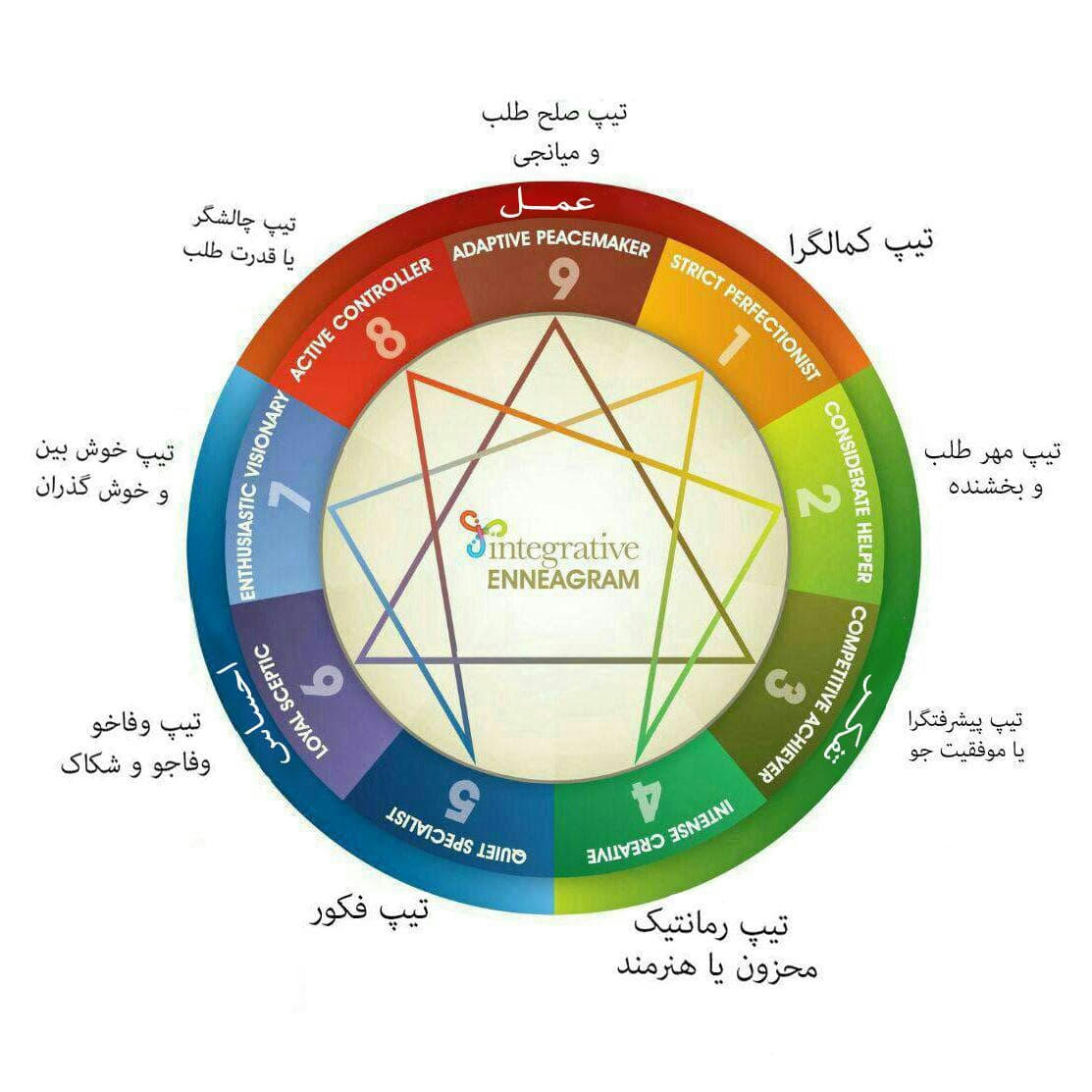
The eighth type is the boss type.
People who have a boss-like quality. They are domineering, believing that others must be under their command. In very strong forms, they are powerful, aggressive, destructive, courageous, and dominant individuals. They are sometimes ruthless and tyrannical. They are effective and good at planning. At times, they even destroy others and violate the rights of others.
. The ninth and final type is the peacemaker type.
That is, a person who is carefree, calm, easygoing, patient, lazy, optimistic, and at the same time humble, unpretentious, ordinary, and conventional. They have no ambition and not many expectations. They are also fatalistic. I have presented these types in brief. This typology contains much material, and individuals can easily study themselves and, with these descriptions we have provided, see which one they ultimately fall into. But a point more important than this typology is that each of these types has a path of ascent and a path of descent. The art of its descent is that it approaches the artist personality, and here its personality completely breaks down, but conversely, if it ascends and evolves, type 1 reaches type 7. Likewise, type five (the thinker), if it ascends, moves toward type eight (the boss). But type eight, if it wishes to ascend, will move toward type two, which is the compassionate and loving type. These ascents and descents exist for all of these types.
.
Download audio of Human Personality | Watch on YouTube Human Personality
.





Discussion0 comments
No comments yet; let yours be the first voice.