Political Science
“The Rule of Which Law?” by Shahram Etefagh
The meaning of 'law' has not been uniform in recent rule-of-law sessions; Shahram Etefagh argues that 'national interest' cannot serve as the foundation of law due to its indeterminacy, and examines the tension between individual rights and the collective good.
The Rule of Which Law?
Shahram Etefagh – 24 December 2022 – PDF file of this article
Article link at Fardaye Eghtesad
Introduction:
The esteemed media outlet “Fardaye Eghtesad” has recently organized several sessions on the subject of “law and the rule of law,” which should be taken as a good omen, and the wisdom in choosing this topic should be praised.[1]
At first glance, the guests at these sessions all emphasize the dignity of “law and the rule of law” and consider the ordering of Iranian society’s affairs to be contingent upon its establishment. In reality, however, the meaning of “law” for the distinguished speakers at those sessions does not rest upon a single concept, and each of them intends the word “law” with a different understanding. Despite what Rumi describes: “Though in writing, lion and milk appear the same.”
Therefore, it can be claimed that one of the precious achievements of these sessions has been to highlight these very fundamental differences, and it seems that an inquiry into a few of them may pave the way for us in uncovering these foundational distinctions:
A) “Law” and “National Interests”:
In the first session, one of the guests, explaining the nature of law, says: “I return again to the importance of national interests, which is a foundation for defining law, and law in the precise sense of the word.”[2]
The concept inferred from the words of that esteemed scholar is that “national interests” are a foundation for defining “law,” or in other words, “law” is a structure whose pillars are (or should be) built upon the foundation of “national interests.”
Whereas the aforementioned conception of the relationship between “law” and “national interests” means giving precedence to the status and rank of an indeterminate concept called “national interests” over “individual rights,” and is, of course, an unwarranted claim.
In fact, concepts such as national rights or national interests are manifestations of a “collective matter” and are considered functions of time and place and indeterminate; consequently, they can always be subject to change or various, and sometimes completely contradictory, interpretations. For example, in a liberal democratic country, all parties respect the laws, while simultaneously contending over what is called “national interests,” and upon coming to power, they adopt completely contradictory approaches in the realms of foreign and domestic policy.
In Iranian society as well, the dispute over the nationalization of oil is a clear and historical example of the indeterminacy of “national interests.” Just as some believe that the nationalization of the oil industry led to the restitution of the Iranian nation’s rights, in clear opposition to this claim, others hold the view that the event of so-called oil nationalization resulted in nothing but loss for the Iranian nation, and that oil was not nationalized, but rather governmentalized.[3]
Similarly, the controversy over Britain’s exit from the European Union, or Brexit[4], is considered a contemporary example of the lack of consensus on national interest among the people of England.[5]
Simply put, examples of this kind show that phrases like “national interests” do not denote a single meaning.
However, the “natural rights”[6] of each individual, including “the right to life, the right to property, and the right to liberty,” are trans-spatial and trans-temporal rights, and as “independently rational propositions”[7], they are not a function of the rights or interests of this or that nation, or this or that time period.[8]
Of course, it is clear that “natural law” is a product of the evolution of thought in Europe and is considered an imported concept for Iranian society; therefore, the establishment of such a law will only be meaningful when the host society is receptive to the modern concepts of the new era and provides the necessary groundwork for creating a kind of harmony and compatibility.
Unlike natural law, there are other kinds of law in which the “host society” has the right to intervene and make alterations in parts of it. Here we are dealing with a combination of customary law[9] and positive law[10].
Customary law is discovered and then articulated from the ongoing traditions and spontaneous orders of that very society, while positive law arises from the exigencies of the new era and will necessarily bring about transformations in ancient social traditions. For example, if we are intent on codifying “water rights and law” in a country, on the one hand, we are compelled to direct our attention to all the traditional procedures and rules concerning the ownership, consumption, or distribution of water in that society,[11] and on the other hand, international law[12] and the law of the sea[13] have added new concepts regarding shared water resources and seas to “water rights and law” and have obliged countries to adhere to new limitations and regulations.
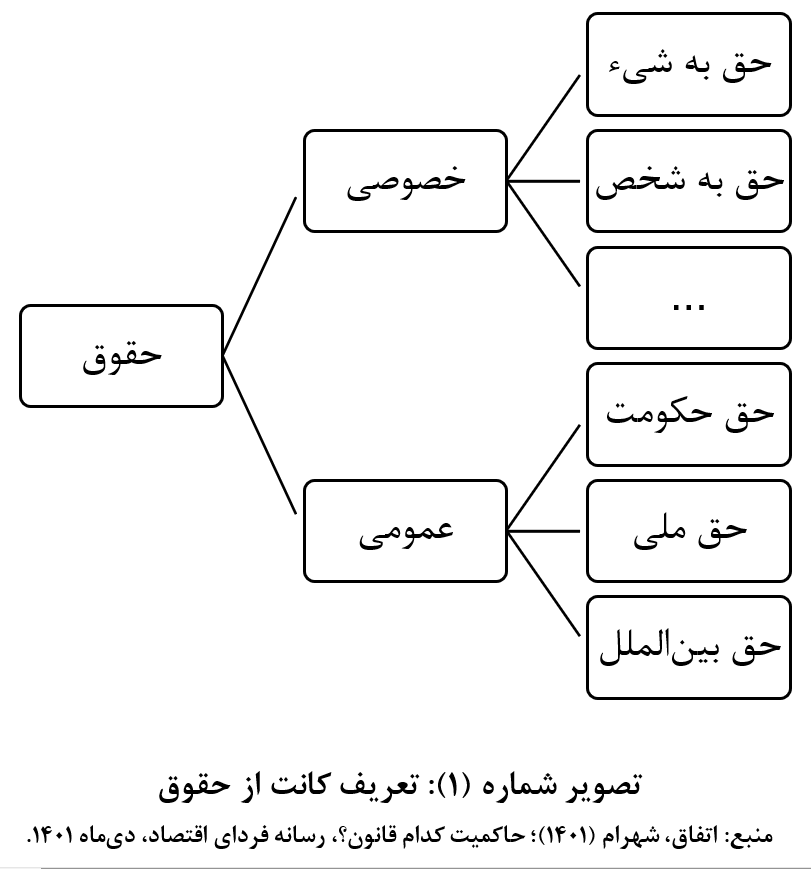
It seems that paying attention to Kant’s classification of “rights” is very beneficial and enlightening. Socially speaking, Kant speaks of two types of rights, which include private right and public right. However, in terms of their origin, he divides rights into natural right, positive right, and so on.[14] (Figure 1)
In this regard, “national interests” cannot be the substructure and foundation of “law.” “Law” is a more long-term, deep-rooted, and ancient concept, and in contrast, the substance of “national interests” changes over shorter time spans. This is because the collective interest of the inhabitants of a political unit called a nation is constantly changing in accordance with the course of rapid global developments. Moreover, “law” enjoys greater consensus within a society, whereas “national interests” are always a subject of dispute. Simply put, “national interests” are far more superstructural than “law.”
B) “Natural Law” and the “Common Good”:
In the third session, the subject of “natural law” and its relationship with the “common good” is raised, and one of the guests at that meeting, in order to shed light on the relations between these concepts, says: “Sometimes, in order to achieve a common good, you may trample upon an individual right.”[15]
Then, in opposition to this claim, some of the other attendees at the session insist on the unconditional priority of individual rights.
Here we are faced with two approaches:
(i) An approach that intends to trample upon “individual rights” in order to achieve a “common good,” and what usually happens in practice is that a specific group imposes its political will on society in the name of the “Ummah,” the “working class,” the “nation,” “economic development,” and the “common good.”
(ii) The second approach is a reciprocal one that believes it can establish an ideal social structure in which individual rights are never violated under any circumstances.
Here, I will try to introduce a third approach, distinct from the two previous ones, which was overlooked in that session and not mentioned, and an exploration of which seems beneficial.
(iii) The third approach holds that sometimes, safeguarding one part of natural rights requires encroaching upon another part of individual rights. For instance, circumstances arise where preserving the right to life depends on violating the right to liberty.
As an example, certain sub-branches of the Taoist religious tradition[16] in India opposed injecting their children with the polio vaccine, considering it a result of the dominance of “false thought.” The outcome of these beliefs was children who were paralyzed for their entire lives. In such circumstances, when the authority over children’s affairs rests with the parents, compulsory vaccination of children is considered synonymous with the “deprivation of liberty” of the family by an “external authority.”
Recent reactions to the mandatory “Covid-19” vaccination issue can also be examined within this framework. On the one hand, measures such as the mandatory injection of a vaccine or mandatory quarantine can be considered a violation of the “freedom” of individuals in a society, and on the other hand, an individual carrying the coronavirus can endanger the “lives” of other citizens.
Hayek is well aware of this complexity and paradox, and for this reason, he adequately describes both sides of the issue. On the one hand, in his critique of the concept of the “common good,” he writes: “The social goal, or common purpose, for which society is organized is usually vaguely described as the common good, the general welfare, or the public interest. It does not need much reflection to see that these terms do not possess a sufficiently definite meaning to determine a particular course of action. The welfare of a people, like the happiness of a person, depends on a great many things that can be provided in an infinite variety of combinations, and it cannot be adequately expressed as a single end.”[17]
But on the other hand, he rises to critique the misunderstanding of individualism, emphasizing that: “According to this common misunderstanding, individualism, instead of starting from men whose whole nature and character are determined by their existence in society, takes the existence of isolated and self-sufficient individuals for granted, or bases its arguments on the assumption of the existence of such individuals. If this were so, it would indeed contribute nothing to our understanding of society.”[18]
In the third approach, we are not faced with a collectivist conception under the title of the “common good,” and what is at the center of attention is establishing a balance between individual rights and creating a kind of compatibility among these rights in a diverse and pluralistic society.
c) “Law” and “Neoliberalism”:
In that same third session, the guest defending the “common good” says: “Neoliberalism, with this very principle of Hayek and with this very right to property, has expanded inequality ... What do the neoliberals say? They say that if you distribute money in society, people will not work ... On the other hand, opponents [of neoliberalism] say that if a flood comes and destroys an old man’s house, why shouldn’t we help this individual?”[19]
Then that esteemed speaker, referring to historical experiences in Asia, considers the growth and development of some countries, such as South Korea, to be the product of applying methods based on the “common good” and defends it.
It is important to pay attention to the fact that narratives of the “common good” often begin with the tragic story of harmed individuals in society, gradually extend to the subject of free education and healthcare, and ultimately end up with state ownership and enterprise management in the economy.
Whereas Hayek writes about individuals who have faced social harms: “In a free society we can provide, outside the market, insurance for all against common hazards and thereby set a minimum which nobody need fall below.”[20] Furthermore, Hayek also endorses the payment of educational expenses by the government[21] and considers the state’s role in solving environmental problems permissible and recommends it.[22]
Hence, contrary to what is commonly propagated against Hayek, his primary concern is not the elimination of social services, the lack of financial support for free education, or disregard for the environment; what lies at the heart of his focus is the defense of a “market-based economy.”
Hayek and all proponents of a “market-based economy” believe that the “market,” more than any other institution, is capable of securing the “common good,” and for this reason, they insist that the rule of law cannot have a more solid foundation than individual rights (life, property, and liberty).
.
.
[1] Refer to the sessions (1) The Rule of Law; From Misconceptions to a Correct Definition, (2) The Relationship Between Economics and the Rule of Law, (3) The Rule of Law or Rule by Law? on the Fardaye Eghtesad media platform.
[2] First session (1401 [2022]); The Rule of Law; From Misconceptions to a Correct Definition, Fardaye Eghtesad media platform, around 01:19:30 of the video file, here
[3] For further reading, refer to the following four documents:
- Katouzian, Homayoun (1387 [2008]); We Should Have Accepted the Proposal at That Time, Iranian Diplomacy media platform, News Code 2144, at the address:
http://irdiplomacy.ir/
- Ghaninejad, Mousa (1387 [2008]); We Nationalized Oil and We Are Proud of It, Iranian Diplomacy media platform, News Code 2179, at the address:
http://irdiplomacy.ir/
- Kazemi, Morteza (1400 [2021] a); Why Was Oil National Even Before Mosaddegh? And Why Did Iran's Oil Industry Become State-Owned After 29 Esfand 1329 [March 20, 1951]? – A Conversation with Shahram Etefagh, here
- Kazemi, Morteza (1400 [2021] b); “Why Is It Claimed That From 29 Esfand 1329 [March 20, 1951] Onwards, the Oil Industry in Iran Became State-Owned?” – A Conversation with Ebrahim Sahafi, here
[4] Brexit
[5] The Crescent Petroleum Contract in contemporary Iran is another example of a lack of agreement on the national interest. For further reading, refer to: Crescent (1400 [2021]); The 20-Year Crescent Controversy, Etemad Newspaper, Issue 5383.
[6] natural rights
[7] Derived from reasonable reason
[8] Locke, John (1397 [2018]); Two Treatises of Government, translated by Hamid Azdanlou, Ney Publishing, pp. 94, 123, 140, and 141.
[9] Customary law
[10] Positive law
[11] For instance, an approach called “Haqqabeh” (water rights) was among the traditional rules for consuming a shared water resource in Iranian society. The shared resource could be spring water, river water, qanat water, groundwater, or well water, and the consumers could be gardens, farms, houses, or villages. In Iranian society, the “Haqqabeh” model determined the legitimate amount or share of each consumer within a specific framework.
[12] International law
[13] Law of the sea
[14] Kant, Immanuel (2001); Philosophy of Law, translated by Manouchehr Sanei Darehbidi, Naqsh o Negar Publications.
[15] Third Session (2022); The Rule of Law or Rule by Law?, Fardaye Eghtesad Media, around 00:46:10 of the video file, here
[16]Taoism
[17] Hayek, Friedrich von (2011); The Road to Serfdom, translated by Fereydoun Tafazzoli and Hamid Padash, Negah-e Moaser Publishing, p. 106.
[18] Hayek, Friedrich von (2015); Individualism and Economic Order, translated by Mohsen Ranjbar, Markaz Publishing, p. 8.
[19] Third Session, around 00:43:10 of the video file.
[20] Hayek, Friedrich von (2021); In the Trenches of Freedom, translated by Ezzatollah Fooladvand, Mahi Publishing, p. 186.
[21] Hayek, Friedrich von (2014); Law, Legislation and Liberty, Volume 3, translated by Mahshid Moayeri and Mousa Ghaninejad, Donya-ye Eghtesad Publications, p. 71.
[22] Etefagh, Shahram (2022); Hayek and the Environment, Qalamyaran Magazine, Fifth Year, Spring, No. 32, p. 26.
.
.




Discussion0 comments
No comments yet; let yours be the first voice.