Philosophy
The Worship of Beauty in Manichaeism and the Mysticism of Beauty by Henry Corbin
Contrary to the common perception of asceticism and austerity, Manichaeism regarded beauty as a manifestation of light and an instrument of salvation. Henry Corbin elucidates the link between the mysticism of beauty and the theory of theophany in the mirror, connecting the Manichaean religion of beauty with Persian amorous Sufism.
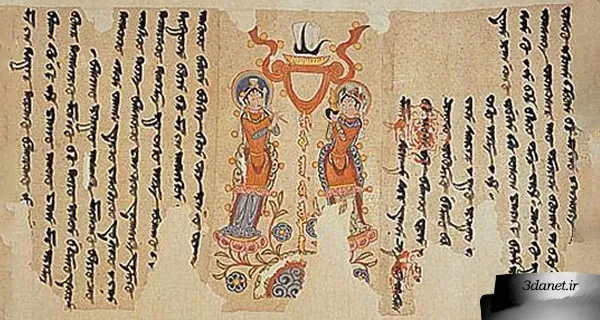
Manichaeism is the religion of Mani, the Iranian prophet. This faith emerged in Mesopotamia in the third century CE. Beauty and the theories pertaining to it in this religion manifested in various forms such as painting, calligraphy, music, bookmaking, poetry, and hymns. Aesthetics in Manichaean art is a means for the salvation of the soul and attaining the Paradise of Light. This text is a translation and abridgment of Henry Corbin's article entitled "Manichaeism and the Religion of Beauty," which was first published in the book Herne, a special issue on Henry Corbin, and later reprinted in the book "The Hidden Imam" through the efforts of Christian Jambet and with an introduction by him.
How can one reconcile and bring together amorous ecstasies, mystical intoxications, and the worship of human beauty with seclusion, renunciation of the world, and the harsh, grueling disciplines of the mystical path? For example, the majority of people equate Manichaeism with renouncing the world and enduring harsh and exhausting practices. The general public can never believe that reality is entirely at odds with their beliefs and conceptions. Moreover, these erroneous and superficial beliefs and conceptions reveal the level of their information and knowledge, showing us to what degree they have fallen into banality, been distorted, and strayed from the truth. This is while we possess Arabic and Persian texts from the early Islamic centuries. These texts clearly show that during this period, Manichaeism was still alive in Central Asia, and how the "religion of beauty" was propagated by Mani's followers. The same superficial and ineffectual objections were raised against these texts as well. In response to these objections, one can and must invoke the answers and arguments found in the mysticism of beauty and amorous Sufism, or the justifications of the Sufis of the school of Ruzbihan Shirazi (twelfth century).
Abd al-Qahir al-Baghdadi mentions the existence of a school called "al-Hulmāniyya"1. The name of this school is derived from its founder, Abu Hulmān, who was an Iranian (Shiite) from the Fārs region (d. 340/951). The "Hulmāniyya" school propagated the belief that God dwells in beautiful beings. It is said that when the followers of this school reached a state of passion and ecstasy, they would bow in reverence before every beautiful human face.
We also have Abu Shākir al-Salīmī, who lived in the fifth century AH (eleventh century CE). Abu Shākir al-Salīmī mentions the Manichaeans of China, who resided in the region of Khotan2 and Tibet. According to al-Salīmī, whatever appeared beautiful to the eyes of the people of these regions was worshipped by them; such as light, flowing waters, trees, and animals. The Manichaeans of these regions held the view that in every beautiful being, the Lord of Light has taken up abode. Abu Shākir even uses a term specific to Sufism and writes that "God exists in every 'witness' (shāhid) or wayfarer on the path of Truth."
Abu Shākir al-Salīmī points to the relationship between the Manichaeans of the China region and the "Hulmāniyya" school, reinforcing the theory that Shiites also played a role and were influential in the formation of the religion of beauty.
Here, one must mention the theologian and religious scholar Imam Muhammad al-Ghazali, who attributes these same beliefs to the Turks of the Far East. In fact, we know that the "Uyghur" Turks had adopted Manichaeism, and the "Uyghur" state, which unfortunately was short-lived, was the only state that allowed the Manichaeans freedom to propagate their beliefs and did not persecute or harass them, and this was a great honor for that state. Al-Ghazali continues that the Manichaeans, who lack a sharīʿa (in the sense that exists in Islam), worshipped a single God, and this single God was the most beautiful of beings; for this reason, they would bow in reverence before any being possessing exceptional and extraordinary beauty and declare that this (beautiful being) is our God.
In fact, the above argument does not entirely rule out the possibility of a simultaneous perception of the sensory world and the suprasensory world. Such a perception, although incompatible with the rational cognition of the modern era, is the indispensable condition for penetrating the phenomenon of beauty in the sense we have mentioned. This argument implicitly assumes the theory of incarnation in Manichaeism to be one and identical with the theory of incarnation and the doctrine of indwelling in (early) Christianity.
In fact, Manichaean Christology differs from the Christology of the official Church. Manichaean Christology is consonant and harmonious with its anthropology. Manichaean anthropological theory is founded upon the three-dimensional structure of the human being, which is body, soul, and spirit.
The relationship between the "Luminous–Heavenly Christ" and the "Suffering Christ" who is bound on earth is not of the composite kind that occurs between material bodies, but is rather of an admixture type, because the luminous substance of the Heavenly Christ cannot assume a material form. Wherever there was brightness, sparks of light, pleasing colors, the sweet scent of perfume, or the delightful song of birds, even in plants and especially in flowers and fruits, the Manichaeans found Christ (this imprisoned heart of light) there.
Here we see a remarkable consensus between Manichaean beliefs and the observations recorded by Muslim writers; in Islamic mystical literature, various examples are given to define "epiphany" (mazhariyyat). For instance, we can admire the red substances used in a red object, because this object and its constituent materials are of the same kind.
However, when we praise an image in a mirror, our admiration and praise for that image have nothing to do with the materials that constitute the mirror, and it is only this face visible in the mirror that compels us to admiration and praise. Authorities on mysticism and Sufi literature have long used the example of the mirror to explain the phenomenon of theophany (tajalli). The phenomenon of theophany and epiphany stands in contrast to the theory of incarnation (hulul) (as expressed by the Church regarding Jesus Christ). The theories of incarnation and theophany (epiphany) are two different doctrines concerning the manifestation of the Absolute in the material world. The religion of beauty, or the mysticism of beauty (irfan-e jamali), takes the theory of theophany and epiphany as its foundation and basis.
Beauty is a light that transfigures beings and things without entering into their bodies or incarnating within them. Beauty in beings and things is like the image in a mirror. The mirror is the locus of the appearance and theophany of the image, without the two sharing a common substance. In principle, the worship of beauty is the worship of a light that appears from behind the veil of the mortal body, without ever being an essential attribute of matter or a quality held in common with it.
Beauty possesses a spiritual and celestial substance.
Beauty announces the manifestation of the supersensible realm.
It is noteworthy that among the Sufis of Iran, the one who perhaps represents the religion of beauty and the mysticism of beauty more than anyone else is Rūzbihān Baqlī Shīrāzī (6th century AH / 12th century CE). Rūzbihān refers to the people of Central Asia, some of whom were renowned for their striking and superhuman beauty. His important book, entitled Mūnis al-ʿUshshāq (The Companion of Lovers), which is a kind of autobiography in the form of a dialogue, expresses what he has termed the prophetic meaning of beauty. In a sense, the Sufi is the prophet of absolute beauty. It is with this understanding that we can grasp why and how not only is human love not opposed to or set against divine love, but it is a necessary rung on the ladder and a condition for attaining divine love. Thus, in the perspective of Rūzbihān Shīrāzī, and in the mysticism of beauty in general, divine love and human love are not opposed to one another and do not negate each other; and, as is customary in Christian monasteries and circles, we are not forced to choose one and negate the other. More importantly, here we are not faced with two different loves, each having a different beloved. For fundamentally, the Divinity (the primordial origin) never becomes an object (objet), that is, it can never be reduced to an object (a thing, a person, or a love). Here we are dealing with two forms or two degrees of a single love. The transition from one to the other does not mean a transition from one beloved (a human) to another beloved (God). Rather, this transition signifies a transformation that takes place within the mystic and Sufi (Sujet). For this reason, Rūzbihān draws a clear distinction and a precise line of demarcation between the Sufis whom he calls "the devout legalists" (mutasharriʿīn ʿābid) and the wayfarers of love and ecstatic passion (mūnis al-ʿushshāq). Thus, in the mysticism of beauty, the conversion and change lies in the level of perception, the mode of interpretation, and our relationship to the beloved, and not in the beloved itself. And in this way, they acquire the possibility of perceiving and communing with the substance of light (beauty), which has taken up its abode everywhere. Consequently, we understand well that in the mysticism of beauty and in Sufi love, light and beauty are trans-sensible and transcendent categories. Such a spirituality certainly draws a bold boundary with the rules and principles of modern Enlightenment. In this short piece, we have endeavored, very concisely, to recall the spiritual roots of the phenomenon of beauty with a passing glance at Manichaeism, and particularly the theory of the "religion of beauty" among them. In our view, the Manichaean interpretation of light not only does not contradict earthly beauties, but is its presupposition and inevitable condition. Recalling and re-reading these matters is also a call for a broader rethinking around these issues. This rethinking must be undertaken by those who do not accept pre-determined, fashionable solutions. For the urgency and necessity of our time, for spiritual human beings, is the same as it ever was. These urgencies have neither become obsolete nor have they yet found a fitting and worthy response..
.
.
Endnotes:
1. In al-Baghdādī's al-Farq bayn al-Firaq, it is written that the Ḥulmāniyya are among the Ḥulūliyya and are attributed to a person named Abū Ḥulmān al-Dimashqī, whose origin was from Fārs and whose upbringing was in Aleppo, and he revealed his heresy in Damascus. He was both among the antinomians (Ibāḥiyya) and a believer in the incarnation of God in beautiful persons, prostrating himself before them. Al-Baghdādī himself debated with one of them, which is recorded in brief in his book. Massignon considers Abū Ḥulmān to be among the Sufis and a disciple of Salīm al-Baṣrī. Al-Kalābādhī, in his al-Taʿarruf, also counted him among the Sufis. Some heresiographers have not mentioned the Ḥulmāniyya. Abū Naṣr al-Sarrāj, in al-Lumaʿ fī al-Taṣawwuf, also called him Abū Ḥulmān al-Ṣūfī.
.
.
The Worship of Beauty in Manichaeism and the Mysticism of Beauty by Henry Corbin
Source: Ettela'at-e Hekmat va Ma'refat, Year 5, No. 1
Translated and summarized by Masoud Jalali Farahani
.
.








Discussion0 comments
No comments yet; let yours be the first voice.