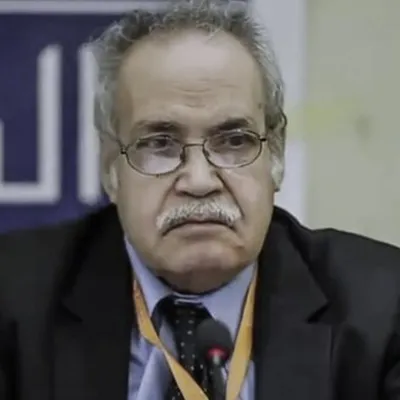
Foreign thinker
Hassan Hanafi
Hassan HanafiIslamic Philosophy, Religious Intellectualism, and the Science of OccidentalismEgyptian1935–2021
"The task of Heritage and Renewal is liberation from domination in all its forms; the domination of the past and the domination of heritage; so there is no domination except that of reason and the necessity of the reality in which we live."

Life and Thought
Hassan Hanafi was an Egyptian philosopher, thinker, and professor of philosophy at Cairo University, regarded as one of the influential figures of contemporary Arab thought and a theorist of the "Islamic Left." His intellectual project, titled "al-Turāth wa-l-Tajdīd" (Heritage and Renewal), focused on re-reading the Islamic heritage from the perspective of contemporary issues, critiquing Western intellectual hegemony, and establishing the "Science of Occidentalism" (ʿIlm al-Istighrāb).
Hassan Hanafi was born on February 23, 1935, in Cairo. He studied philosophy at Cairo University, graduating in 1956. That same year, he traveled to France to continue his studies, and after about a decade of study and research at the Sorbonne, he received his doctorate in philosophy in 1966. He began teaching at Cairo University in 1967 and later served as chair of its philosophy department. He also taught and conducted research at universities in the United States, Europe, the Arab world, and Japan.
The central focus of Hanafi's intellectual activity was the vast project "al-Turāth wa-l-Tajdīd" or "Heritage and Renewal." He sought to re-read the theological, philosophical, and jurisprudential heritage of Islam not merely as a collection belonging to the past, but as material for responding to the problems of contemporary society. In this project, methods drawn from hermeneutics and phenomenology are employed alongside traditional Islamic knowledge, with the goal of shifting the center of gravity of thought from preserving and commenting on heritage to reconstructing it based on the issues of the time.
Hanafi was also one of the most important theorists of the "Islamic Left." By this term, he meant an effort to extract the justice-seeking, freedom-seeking, and emancipatory potentials from the Islamic tradition and to link religion with contemporary social and political issues. The multi-volume work "Min al-ʿAqīda ilā al-Thawra" (From Doctrine to Revolution) is one of the most significant examples of this approach; a work in which he attempts to transform theological concepts from abstract forms into concepts related to humanity, society, and historical change.
Another famous concept in Hanafi's project is "ʿIlm al-Istighrāb" or the "Science of Occidentalism," which he proposed in opposition to the long-standing tradition of Orientalism. In his view, just as the West has made "the East" an object of study for centuries, non-Western societies must also make the West an object of historical and critical knowledge. His aim was not simply to invert Orientalism, but to reduce the epistemic centrality of the West and create a more balanced relationship between intellectual traditions.
Among his other important works are "al-Dīn wa-l-Thawra fī Miṣr" (Religion and Revolution in Egypt), "Qaḍāyā Muʿāṣira" (Contemporary Issues), "Dirāsāt Islāmiyya" (Islamic Studies), "al-Turāth wa-l-Tajdīd" (Heritage and Renewal), and "Muqaddima fī ʿIlm al-Istighrāb" (Introduction to the Science of Occidentalism). His writings span a range from philosophy and theology to politics, religious studies, and cultural criticism. He also translated a number of works of Western philosophy into Arabic and played a role in introducing phenomenology and certain currents of modern European philosophy to the Arab intellectual sphere.
Hassan Hanafi passed away on October 21, 2021, at the age of 86. His importance in contemporary Arab thought stems above all from his systematic effort to establish a critical dialogue between the Islamic heritage, modern Western philosophy, and the political and social problems of the Arab world. His project, whether in the form of "Heritage and Renewal," the "Islamic Left," or the "Science of Occidentalism," has been among the most controversial attempts to reconstruct Islamic thought in the contemporary Arab world.