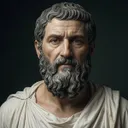
Foreign thinker
Iris Murdoch
Iris MurdochPhilosophy and LiteratureIrish-British1919–1999
Love is difficult; love means realising that something other than oneself is real.
In their times
Open in the Timeline of Thought


Life and Thought
Iris Murdoch (1919–1999) was a British-Irish novelist and philosopher known for exploring ethical themes and the complexity of the human mind in her works. She won the Booker Prize for her novel The Sea, the Sea.
Iris Murdoch, born 15 July 1919 and died 8 February 1999, was a British-Irish novelist and philosopher. She is considered one of the most important English-language writers of the twentieth century, and her works are known for their engagement with ethics, good and evil, love, freedom, individual responsibility, and the complexity of the human mind.
Murdoch was born in Dublin and moved to London with her family as a child. She studied Classics, Ancient History, and Philosophy at Somerville College, Oxford, and later taught at Oxford herself. Her familiarity with continental philosophy, particularly the thought of Sartre, as well as her interest in Plato and moral philosophy, played a significant role in shaping her intellectual and literary world.
Her first published work was an analytical book on Jean-Paul Sartre, and her first novel, Under the Net, was published in 1954. Murdoch wrote more than twenty novels over the course of her life, and alongside her fiction, she also left behind important philosophical essays and works. In her novels, she examines human relationships, moral struggles, and the power of imagination and the unconscious with a precise and psychological gaze.
Iris Murdoch won the Booker Prize in 1978 for her novel The Sea, the Sea. Her standing in contemporary culture, both as a creative novelist and as a moral philosopher, is a distinguished one; a writer who brought literature and philosophy together in a vivid and thought-provoking way.
Bibliography
Writings and transcribed lectures26 titles
Under the Net
The Flight of Happiness
Sandcastle
Bell
The Severed Head
The Unofficial Rose
The Unicorn
The Italian Girl
Red and Green
The Age of Angels
Beautiful and Good
Bruno's Dream
Honorable Defeat
The Accidental Man
The Black Prince
The Machine of Sacred and Profane Love
Child-Word
Henry and Cato
The Sea, the Sea
Nuns and Soldiers
The Philosopher's Apprentice
A Good Student
The Book and Brotherhood
A Message from Earth
The Green Knight
Jackson's Dilemma



.webp)