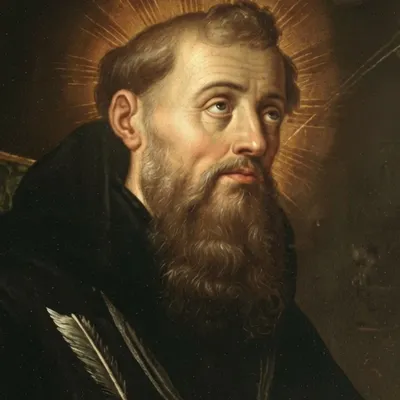
Foreign thinker
Saint Augustine
Saint AugustinePhilosophy and TheologyRoman-Berber354–430
Our hearts are restless until they rest in You.


Life and Thought
Augustine was a Christian philosopher and theologian of late antiquity and the early Middle Ages. By linking the Greek philosophical tradition with Christian theology, he left a profound impact on European culture and philosophy.
Augustine, known as Saint Augustine, is one of the most prominent Christian philosophers and theologians of late antiquity and the early Middle Ages. He was born in 354 CE in Thagaste, in North Africa within the territory of the Roman Empire, and later became one of the most important figures in the intellectual tradition of Western Christianity.
In his youth, Augustine developed an interest in literature, rhetoric, and philosophy, and spent time studying and teaching in Carthage, Rome, and Milan. His encounter with the works of Cicero, Neoplatonic thought, and subsequently Christian teachings transformed his intellectual path. After a period of intellectual and spiritual searching, he converted to Christianity and later became the bishop of the city of Hippo in North Africa.
Augustine's significance in the history of culture and philosophy lies in his effort to link the Greek philosophical tradition, particularly Platonism, with Christian theology. He thought and wrote about subjects such as truth, the soul, time, creation, good and evil, will, faith, sin, salvation, and the relationship between humanity and God. His works have had a profound impact not only on Christian theology but also on moral philosophy, philosophy of history, political philosophy, and the tradition of autobiographical writing.
Augustine died in 430 CE in Hippo, but his ideas remained influential for centuries in shaping European culture and philosophy and are still considered among the most important sources for studying the history of religious and philosophical thought.
Bibliography
Writings and transcribed lectures7 titles
Confessions
The City of God
On the Trinity
On the Literal Meaning of the Book of Genesis
On the Principles of Christian Doctrine
On Eighty-Three Different Questions
Anti-Manichaean Writings