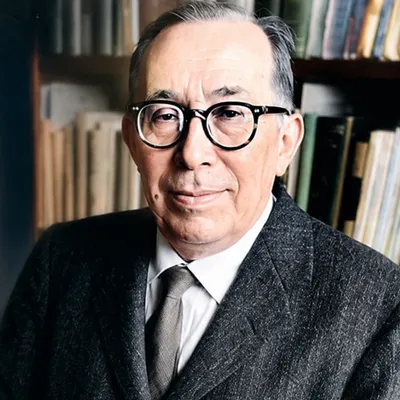
Foreign thinker
Leo Strauss
Leo StraussPolitical Philosophy and Classical PhilosophyGerman-American1899–1973
"Political philosophy is that branch of philosophy which is closest to political life, to non-philosophic life, to human life."
In their times
Open in the Timeline of Thought


Life and Thought
Leo Strauss was a German-American political philosopher and historian of philosophy, and one of the most important interpreters of classical and modern political philosophy in the twentieth century. Through his defense of natural right, critique of relativism and historicism, and emphasis on the theological-political problem and the method of reading classical texts, he had a broad influence on political philosophy research.
Leo Strauss was born on September 20, 1899, in the town of Kirchhain in Hesse, Germany. He studied philosophy at the University of Hamburg and received his doctorate in 1921 with a dissertation on the problem of knowledge in the philosophy of Friedrich Heinrich Jacobi, under the supervision of Ernst Cassirer. He subsequently attended the classes of Edmund Husserl and Martin Heidegger in Freiburg and, in the following years, maintained intellectual connections with a number of prominent German and European thinkers.
In his early years of research, Strauss initially focused on the philosophy of religion and Jewish philosophy. His book *Spinoza’s Critique of Religion* was the result of his studies on Spinoza and the problem of the critique of religion. He then turned to the study of political philosophy and wrote works on Hobbes, Plato, Machiavelli, Maimonides, Farabi, and other classical and modern thinkers.
Among Strauss's most important works are *The Political Philosophy of Hobbes*, *On Tyranny*, *Natural Right and History*, and *Thoughts on Machiavelli*. The book *Natural Right and History* is one of his major works defending the problem of natural right against relativism and historicism. Within this framework, Strauss advocated a critical return to classical political philosophy and the question of the "good" in individual and political life.
One of the central themes of Strauss's thought is the critique of historicism and relativism. He believed that reducing values and political questions to specific historical conditions could undermine the possibility of rational judgment about the good, justice, and the best form of political life. For this reason, the rereading of the classical political philosophy tradition and the problem of natural right became central to his intellectual project.
Strauss also proposed a famous theory regarding the manner of writing philosophical texts under conditions of political pressure and censorship, which relates to the distinction between exoteric and esoteric teachings, or an "exoteric" and "esoteric" reading of texts. He believed that some past philosophers may have used specific writing techniques to express their controversial views.
He joined the University of Chicago in 1949, where he became one of the central figures in political philosophy studies. In the final years of his life, he also worked at St. John's College in Annapolis and died on October 18, 1973, in Annapolis, Maryland. His legacy in the studies of political philosophy, classical philosophy, American political thought, and Jewish and Islamic studies continues to be discussed and researched.