Iranian thinker
Mehdi Bazargan
Mehdi BazarganPolitical ThoughtIranian1907–1995
We were called to freedom, independence, and a republic, not to hand over the authority and destiny of the country to a single person.


Life and Thought
Mehdi Bazargan (1907–1995) was an Iranian engineer, politician, and Quran scholar, and the first prime minister of the interim government after the 1979 Revolution. He was one of the founders of the Freedom Movement of Iran and a leading figure in the religious intellectual movement in contemporary Iran.
Mehdi Bazargan, born on 31 August 1907 in Tehran and died on 20 January 1995, was an engineer, university professor, politician, Quran scholar, and one of the most important figures of religious intellectualism in Iran. He was among the first Iranian students sent to France, where he studied thermodynamics and engineering. After returning to Iran, he taught at the University of Tehran and later became the dean of its Faculty of Engineering.
Bazargan also played a crucial role in Iranian politics: he cooperated with the Mosaddegh government during the nationalization of the oil industry, was active in the National Resistance Movement after the 1953 coup, was a co-founder of the Freedom Movement of Iran, and became the prime minister of the interim government after the 1979 Revolution. However, his intellectual standing is not merely political; he is one of the central figures of the religious intellectual movement, religious rationalism, and the scientific-social interpretation of religion in contemporary Iran.
Bazargan's intellectual project can be summarized in several key themes: the relationship between science and religion, a return to the Quran, social ethics, the critique of despotism, responsible religiosity, and the relationship of faith with freedom and progress. As an engineer and technical professor, he was familiar with the language of science and empirical order and sought to connect religion with rationality, nature, evolution, society, and modern life.
In his religious works, the Quran holds a central place. He aimed to extract the Quran from a purely ritualistic framework and present it as a source for moral education, social reform, and civic responsibility. In his social and political works, his main concerns were despotism, backwardness, the weakness of collective cooperation, and the lack of public ethics in Iran.
After Bazargan's death, the Mehdi Bazargan Cultural Foundation took charge of collecting and publishing his works. On the foundation's website, his collected works have been published in multiple volumes, covering topics such as fundamental discussions, the Prophetic mission, daily notes, social and technical articles, defenses, scientific-Islamic discussions, the evolution of the Quran, industrial and scientific works, a return to the Quran, and doctrinal and social issues.
Some bibliographic sources have noted that Bazargan's collected works are compiled in 35 volumes, pointing out that many of his writings were originally lectures, articles, or small pamphlets that were later edited and published.
Bibliography
Writings and transcribed lectures24 titles
The Path Traveled
The Infinite Particle
Love and Worship
Purifiers in Islam
Work in Islam
Thermodynamics in Life
Wind and Rain in the Quran
The Biʿtha and Ideology
The Bi'tha and Evolution
Monotheism, Nature, Evolution
The Evolution of the Quran
Return to the Quran
Religion and Civilization
The Worship of God and Modern Thought
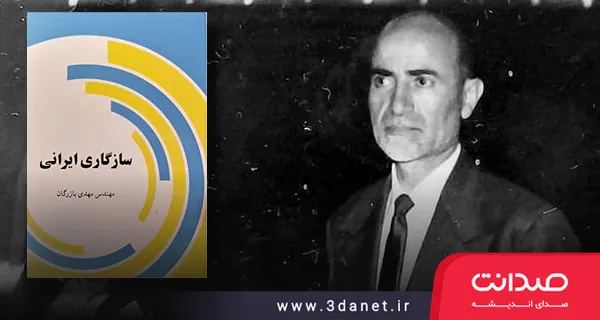
Iranian Compatibility
The Secret of the Backwardness of Muslim Nations
Islam: A Combative and Generative School of Thought
The Boundary Between Religion and Politics
Why We Oppose Despotism
Defenses in the Military Court of First Instance
The Iranian Revolution in Two Movements
Prison Memoirs
Memories of the Hajj Pilgrimage
The Scientific Nature of Marxism