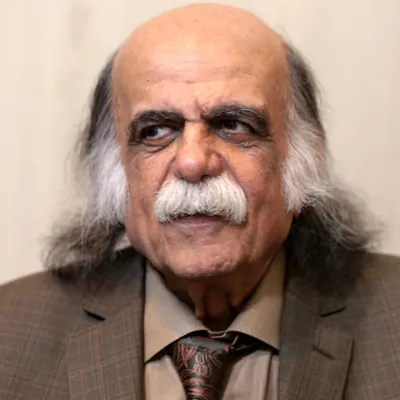
Iranian thinker
Mir Jalaleddin Kazzazi
Mir Jalaleddin KazzaziPersian Literature, Shahnameh Studies, and Iranian StudiesIranianb. 1949
Life and Thought
Mir Jalaleddin Kazzazi, born in Kermanshah in 1949, is a professor of Persian literature, writer, translator, poet, and a prominent scholar of the Shahnameh and Iranian culture. He is particularly known for his extensive research on Ferdowsi and the Shahnameh, mythology, the aesthetics of Persian literature, and his deliberate use of Persian vocabulary in speech and writing.
Mir Jalaleddin Kazzazi was born in Kermanshah in 1949. He became acquainted with French in childhood and, after completing high school, entered the University of Tehran to study Persian language and literature. He continued his studies to the doctoral level in the same field and wrote his dissertation on the characteristics of the heroes of the Shahnameh, a study later published as Dream, Epic, Myth.
Kazzazi taught Persian language and literature for many years and was a faculty member at Allameh Tabataba’i University. He also taught Iranian studies and Persian literature in Spain for a time. His scholarly activity encompasses Shahnameh studies, mythology, stylistics, the aesthetics of Persian literary expression, Hafez studies, Khāqāni studies, and literary translation.
A substantial part of Kazzazi’s work is devoted to Ferdowsi and the Shahnameh. Nameh-ye Bastan, his multivolume commentary on the Shahnameh, is among his most important works in this field. Dream, Epic, Myth, Of Another Kind, The Pearl of the Persian Sea, and A Whirlwind from a Corner are also among his writings on the Shahnameh. He has written works on other figures in Persian literature as well, including The Wine-Drinker’s Temple and Counsel and Connection on Hafez, and The Face of Dawn and Jesus’s Needle on Khāqāni.
Kazzazi has also been active in literary translation and has rendered works of classical Western literature, including Virgil’s Aeneid, into Persian. Another well-known feature of his work is his effort to make extensive use of Persian vocabulary and reduce the use of foreign words in speech and writing. This feature, together with his research on language, myth, and epic, is linked to his Iranianist outlook and his particular attention to Iran’s cultural and literary heritage.