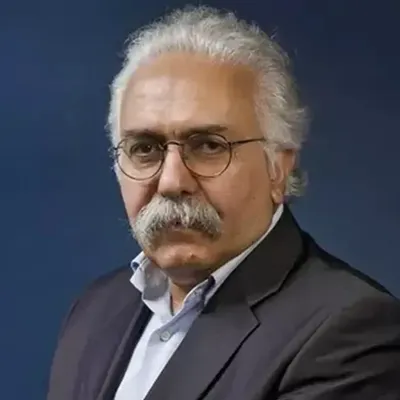
Iranian thinker
Mohammad Ali Amir-Moezzi
Mohammad Ali Amir-MoezziIslamic Studies, Shi'a Studies, and Qur’anic StudiesIranianb. 1956
"History is not only not a threat to faith, but can even strengthen it."

Life and Thought
Mohammad Ali Amir-Moezzi is an Iranian scholar of Islam, Shi'ism, and the Qur’an based in France, and a Director of Studies at the École Pratique des Hautes Études in Paris. His research focuses on early Shi'ism, the place of the Imam in Shi'a theology, Islamic esotericism, and the history of the formation and interpretation of the Qur’an.
Mohammad Ali Amir-Moezzi was born in Tehran on 26 January 1956. He grew up in a cultured family with religious interests and completed his secondary education at the French-language Razi School. In his final years of secondary school, he met Henry Corbin, an encounter that played an important role in directing him toward Islamic studies and, in particular, the study of Shi'ism. After receiving his diploma in 1974, he moved to France and continued his studies at the École Pratique des Hautes Études in Paris.
Alongside Islamic studies, Amir-Moezzi acquired specialist knowledge of Arabic and became familiar with languages including Middle Persian, Greek, and Latin. He received his doctorate in 1991 for research on the exegesis and theology of Shi'a Islam. His academic career continued within the same scholarly tradition, and he eventually assumed the chair of Exegesis and Theology of Shi'a Islam at the École Pratique des Hautes Études.
The core of Amir-Moezzi’s scholarship is the historical and critical study of early Shi'ism, especially its first three centuries. In analysing early Shi'a texts, he emphasises the central place of the Imam and shows that, in many of these texts, the Imam is not merely the leader of the community but also the bearer of esoteric knowledge and the true interpreter of revelation. From this perspective, Imam-centredness is one of the essential features of early forms of Shi'ism.
Another important part of Amir-Moezzi’s work concerns the history of the Qur’an and the formation of the Qur’anic text. He stresses the need to use early Shi'a sources alongside Sunni sources, arguing that excluding them produces an incomplete historical picture of early Islam and Qur’anic history. His research addresses the political and religious conflicts of the first Islamic centuries, the transmission and codification of the text, and the place of the Qur’an in the historical memory of Muslims.
His major works include The Divine Guide in Early Shi’ism, La religion discrète, Le Coran silencieux et le Coran parlant, and the co-authored Qu’est-ce que le shî’isme? He has also contributed to the editing and direction of works such as Dictionnaire du Coran and the multi-volume Le Coran des historiens, which examines the Qur’an through a historical-critical approach involving a group of scholars.
Amir-Moezzi distinguishes between historical and changing beliefs on the one hand, and faith as an inner experience on the other. He maintains that critical historical inquiry can purify faith of certain non-essential elements. His work lies at the intersection of the history of religions, Shi'a studies, Qur’anic studies, and the study of Islamic esoteric traditions.