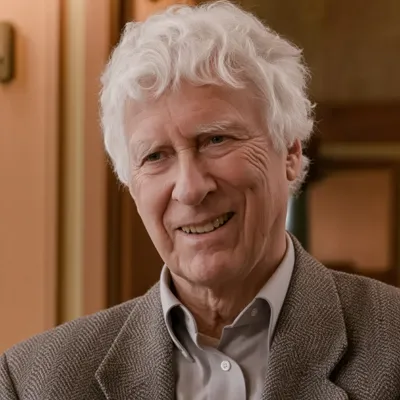
Foreign thinker
Nicholas Wolterstorff
Nicholas WolterstorffPhilosophy of Religion, Epistemology, Political Philosophy, and AestheticsAmericanb. 1932

Life and Thought
Nicholas Wolterstorff is an American philosopher and Professor Emeritus of Philosophical Theology at Yale University whose influential writings span philosophy of religion, epistemology, political philosophy, aesthetics, and philosophy of education. Alongside Alvin Plantinga, he is a leading figure in Reformed epistemology, while his later work focuses particularly on justice, rights, religion in public life, and the relationship between faith and rationality.
Nicholas Paul Wolterstorff was born on 21 January 1932 in Bigelow, Minnesota, into a family of Dutch descent. He studied philosophy at Calvin College and received his bachelor’s degree in 1953. He then continued his education at Harvard University, earning a PhD in philosophy in 1956. After a brief period at the University of Cambridge and teaching at Yale University, he returned to Calvin College in 1959 and taught philosophy there for nearly three decades. In 1989, he joined Yale University, where he held the Noah Porter Professorship of Philosophical Theology until his retirement in 2002.
Wolterstorff’s work ranges from metaphysics and aesthetics to epistemology, philosophy of religion, political philosophy, and philosophy of education. He began his philosophical career with research in metaphysics, and On Universals was among his early works in this area. He later turned to philosophy of art and aesthetics, discussing the nature of artworks, the functions of art, and its place in human life in books such as Works and Worlds of Art and Art in Action.
Wolterstorff is a leading figure in Reformed epistemology, a movement also associated with Alvin Plantinga and William Alston. This approach rejects the assumption that religious belief is rational or justified only when it rests on independent arguments or evidence conforming to classical evidentialist standards. In Reason within the Bounds of Religion and subsequently in the volume Faith and Rationality, Wolterstorff criticized certain foundations of modern epistemology and explored the relationship among faith, fundamental commitments, and rationality. His later studies of John Locke and Thomas Reid form part of his broader inquiry into the history and ethics of belief.
Philosophy of religion constitutes another major part of Wolterstorff’s work. In Divine Discourse, he asks what it means for God to speak and how the possibility of divine address and discourse with human beings can be defended philosophically. Unlike approaches that regard religion primarily as a set of theoretical propositions, he also attends to religious practices, revelation, worship, and the lived experience of believers.
From the middle decades of Wolterstorff’s career onward, justice and political philosophy acquired increasing prominence in his work. Until Justice and Peace Embrace, Justice: Rights and Wrongs, and Justice in Love are among his most important contributions to this field. He defends a rights-based theory of justice and argues that human beings possess rights by virtue of their inherent worth and dignity. On this account, justice is not limited to distributing goods or applying rules; it requires respecting what is due to each person as a bearer of rights.
Wolterstorff has also examined the relationship between religion and liberal democracy and the place of religious convictions in public life. Religion in the Public Square, co-authored with Robert Audi, is an important example of this concern. In later works, including Understanding Liberal Democracy and The Mighty and the Almighty, he discusses the limits of state authority, citizens’ rights, religious freedom, and the possibility of believers’ participation in democratic politics.
One of his most personal and best-known works is Lament for a Son, written after his son Eric died in a mountaineering accident in 1983. The book consists of brief reflections on grief, love, suffering, and Christian faith, illustrating how Wolterstorff’s philosophical and theological questions are connected to his lived experience. A distinctive feature of his intellectual project is its effort to connect rigorous philosophical analysis with the realities of religious and social life, from knowledge and art to grief, worship, justice, and human rights.