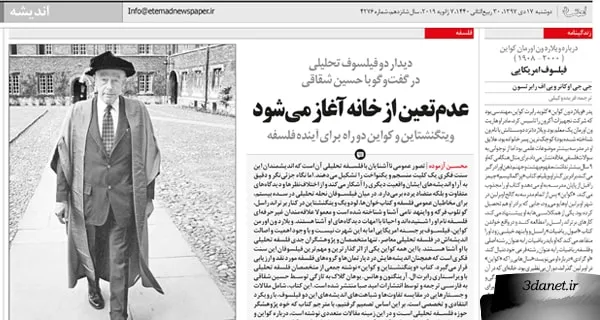
Foreign thinker
Willard Van Orman Quine
Willard Van Orman QuineAnalytic Philosophy, Logic, and Philosophy of LanguageAmerican
To be is to be the value of a variable.
Life and Thought
Willard Van Orman Quine was an American philosopher and logician and one of the major figures of twentieth-century analytic philosophy. By criticizing the analytic/synthetic distinction, defending confirmational holism, naturalized epistemology, and the theory of ontological commitment, he had a profound influence on the philosophy of language, logic, metaphysics, and the philosophy of science.
Willard Van Orman Quine was born in 1908 in Akron, Ohio, and died in 2000. He studied mathematics at Oberlin College and then earned his PhD in philosophy at Harvard University under Alfred North Whitehead. Quine spent most of his academic career at Harvard and became one of the most important American philosophers of the twentieth century.
Quine's early work was in formal logic and set theory, but his philosophical fame was shaped primarily by seminal papers such as "On What There Is" and "Two Dogmas of Empiricism." In "On What There Is," he put forward his famous formulation of ontological commitment, writing that to accept the existence of something, that thing must be the value of a variable in our theoretical framework. This idea played a significant role in linking logic, language, and metaphysics.
In the paper "Two Dogmas of Empiricism," Quine attacked two important pillars of logical empiricism: the distinction between analytic and synthetic statements, and the notion that every meaningful statement can be individually reduced to experience. Against this view, he defended a kind of holism according to which scientific statements confront experience not one by one, but as part of a total web of beliefs.
Quine is also known for the idea of "naturalized epistemology." He believed that philosophy should not sit in a position outside of science and justify its foundations from without, but should be a continuous part of science, especially psychology and the empirical sciences. In the philosophy of language, his theories of the "indeterminacy of translation" and the "inscrutability of reference" showed that meaning and reference cannot always be determined in a unique and definitive way.
Among his major works are "From a Logical Point of View," "Word and Object," "Ontological Relativity and Other Essays," and "Philosophy of Logic." Quine's thought transformed many debates in analytic philosophy after him and continues to have a decisive presence in discussions concerning meaning, existence, science, and logic.
Sedanet articles about Willard Van Orman Quine