Philosophy
A Meeting of Two Analytic Philosophers: A Conversation with Hossein Shaghaghi
Hossein Shaghaghi discusses the fundamental differences between Wittgenstein and Quine and the rifts within the analytic philosophy tradition. From Quine's perspective, philosophy is an activity continuous with science, and the mental entities of classical empiricists are replaced by linguistic ones.
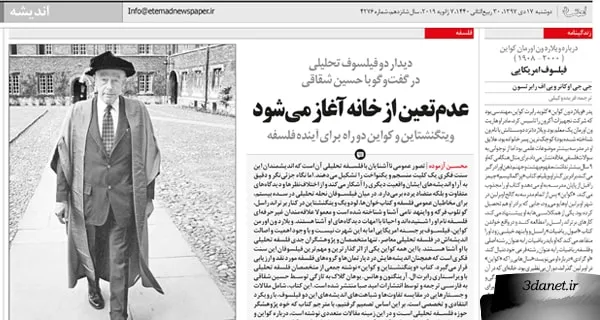
Mohsen Azmoudeh: The general impression among those unfamiliar with analytic philosophy is that the thinkers of this intellectual tradition form a coherent and uniform whole. But a detailed and precise look at their opinions and thoughts reveals a different reality and uncovers disagreements and differing, even contradictory, viewpoints. Among the philosophers of the analytic school in the twentieth century, for the general audience of philosophy and book readers, Ludwig Wittgenstein, alongside Bertrand Russell, Gottlob Frege, and Whitehead, is a familiar and recognized name, and usually non-professional enthusiasts of philosophy have heard his name and are perhaps acquainted with the main outlines of his views. Willard Van Orman Quine, the prominent American philosopher, however, does not enjoy this fame, and despite the importance and originality of his thought in contemporary analytic philosophy, only specialists and serious researchers of analytic philosophy are familiar with him. Nevertheless, Quine is one of the most influential and important philosophers of this intellectual tradition, whose ideas are still being critiqued and evaluated in philosophy departments and groups. The book “Wittgenstein and Quine,” written by a group of specialists in analytic philosophy and edited by Robert L. Arrington and Hans-Johann Glock, has recently been translated into Persian by Hossein Shaghaghi and published by Omid-e Saba Publications. This book contains articles and essays comparing the differences and similarities of the thoughts of these two philosophers, with a critical and specialized approach. On this basis, we decided to have a conversation with the translator of the book, who is himself a researcher in the field of analytic philosophy and has written numerous articles on this subject, about Quine and his relation to Wittgenstein, which follows.
It is often said that analytic philosophy, in terms of content, is more entangled in logical, analytical, and abstract linguistic discussions and deals less with concrete issues such as society, politics, art, etc.; of course, regarding Wittgenstein, many have made effective comparisons between him and continental thinkers such as Marx, Heidegger, Foucault, etc., and have extended his views to the aforementioned domains. Can the same be done in the case of Quine?
Yes, this common perception about the difference between analytic and continental philosophy exists. But it should be noted that in some of the areas you mentioned, for example in aesthetics, important discussions are raised in analytic philosophy. However, specifically regarding Quine, among the most concrete topics he focuses on are science and language. Science is a concrete activity, and Quine actually tries to transform philosophy, in this respect, into a concrete activity and, so to speak, to bring the philosopher back from an ivory tower to a conventional and natural position. He rejects first philosophy and considers philosophy an activity continuous with science. Fundamentally, one of the dimensions of Quine's naturalism is precisely this, that is, the commitment to the philosopher and philosophy occupying a natural position and status. As a consequence of such an attitude, many philosophical problems that can be considered among the most important abstract discussions in the history of philosophy are ruled out in Quine's philosophy, such as the problem of Cartesian doubt, because from Quine's perspective, answering such a problem requires assuming an unnatural and non-concrete position for the philosopher; an assumption that conflicts with the most accepted knowledge and sciences of our time. Another concrete dimension of Quine's thought is his view on the nature of the language of science and its relation to everyday language. He sees the language of science as a continuation of everyday language. Quine's so-called genetic project considers the process of language learning from the earliest stages of a child's entry into the realm of language up to the learning of the language of science, and presents the philosophical implications of this process as answers to important philosophical problems such as meaning, reference, truth, etc.
Quine is usually categorized within the tradition of analytic philosophy, under the names of the founders of this philosophical school—namely Frege, Russell, Whitehead, Moore, and Wittgenstein—and in the continuation of the path they opened. However, in the book you have translated, it seems that Quine's fundamental disagreements and differences with one of the most famous of these pioneers, namely Wittgenstein, are discussed. This approach calls into question the common perception among the uninitiated that considers the tradition of analytic philosophy a coherent whole, and particularly reveals a rift between the enthusiasts of this tradition in Britain and America. Please explain this rift and the differences between these two bases of Anglo-American philosophy (as many know it).
If we want to look at this trajectory more fundamentally, we see these names in the continuation of the philosophy of classical empiricism. The story is that at a certain point in the history of empiricism, linguistic entities, for some reasons, became a philosophical problem for empiricist epistemologists. Quine himself has stated this in simple language in the essay "Five Milestones of Empiricism." With careful reflection on this essay, as well as the essay "Two Dogmas of Empiricism" and other works by Quine, we conclude that the central problem of analytic philosophers is the same central problem of classical empiricists, namely finding an empirical way to answer the epistemological dilemmas resulting from Cartesian skepticism. In classical empiricism, in explaining knowledge, a relationship is assumed; a relationship between experience and what is formed in the "mind," so one end of this relationship is mental entities. But these mental entities themselves, and fundamentally an entity like the "mind," are an obscure problem for an empiricist philosopher, because Hume shows us that we have no reason to assume and accept the existence of something called mind or mental substance. Analytic philosophers, instead of these mental entities, focus on linguistic entities, and here the aforementioned relationship transforms into the relationship between experience on the one hand, and meaning, proposition, meaningfulness, reference, truth, etc., on the other. In this respect, the names you mentioned all fall within this framework and in a single philosophical current. But within this current itself, different categorizations and stances emerge, one of the most important of which is the distinction and rift that exists between Quine and Wittgenstein.
I understand your point to be that in analytic philosophy, linguistic entities assume the same role that mental entities held in classical empiricism. Is that correct?
Yes, according to Quine's account of the history of empiricist and analytic philosophy, that is the case.
Is Quine's emphasis on various situations of language use—for example, radical translation—related to this very subject?
Exactly. The situation of radical translation is highly worthy of reflection. Let me give an introduction about its importance. What do you think is the strangest and most complex phenomenon in human history? If you ask different people this question, they will mostly point to examples of technology, advances in the natural sciences, sending spacecraft into space, etc., and consider that the strangest and most complex phenomenon. But Richards (the English literary critic) in the mid-twentieth century says that probably the most complex phenomenon in history is "translation." But why? We can get the answer to this question from Quine. When you carefully consider the thought experiment of radical translation, you will confirm that translation is truly a strange phenomenon. Because this experiment leads to the conclusion that translation (and fundamentally meaning) is indeterminate.
We have often heard the term indeterminacy of translation, which is one of Quine's famous theses. Can you briefly and in simple language say what the claim of this thesis is?
The indeterminacy of translation thesis states that empirical evidence—which, from an empiricist perspective, is the only evidence available to us in understanding another and in translation—no matter how abundant, cannot determine meaning; in other words, based on identical evidence, one can offer multiple translations of an utterance that, while conflicting with one another, are all compatible with the available evidence; to put it another way, if five English-speaking linguists independently set out to compile a dictionary between English and the language of a completely alien tribe, and their empirical and field evidence were identical, they would end up with five divergent and incompatible dictionaries, all of which are consistent with the empirical and field evidence.
That is a grand claim; regardless of the method of argumentation for reaching it, doesn't the claim itself lead to the impossibility of understanding another and of translation?
No. Quine is not a radical skeptic. His claim is that understanding another is fundamentally like this. Understanding exists, communication and relations between humans exist, but they are always in an indeterminate condition.
Surely by the indeterminacy of communication he means the communication and relations that take place between two speakers of two different languages, correct?
No, it is not just that; every kind of understanding and communication is like this; as Quine puts it, "indeterminacy begins at home," and by home here he means the mother tongue. Quine's argument known as the child language learning argument is presented with this very motivation. Behind every communication lies a hidden misunderstanding. The possibility of alternative understandings always exists. Empirical evidence, no matter how abundant, cannot determine one specific understanding, one specific translation of a speaker's utterance.
In the book's introduction, you considered the thought experiment of radical translation and the child language learning argument among the similarities between Quine and Wittgenstein. Does Wittgenstein also attend to translation and child language learning with these same considerations?
I think in light of these considerations we can regard both of them as philosophers of dialogue. Dialogue and communication with the other is an important issue for both of them. The positions they adopt based on their reflections on translation and language learning are, in some respects, very similar; one of the authors of the articles in this book has also noted that in some Western academic circles, Wittgenstein and Quine are considered two sides of the same coin. But the points of divergence are also serious, to the extent that some authors consider their similarities to be merely superficial.
What are the most important similarities?
In my view, one of the most important similarities is the adoption of a behaviorist or quasi-behaviorist stance on the problem of meaning. Both of them oppose subjectivist conceptions as well as quasi-Platonic conceptions of the problem of meaning. If meaning is anything, we must seek it in the realm of collective behavior; in a sense, meaning is "use." Both of them emphasize that the meaning of a word or phrase is the use it has for speakers in different contexts and situations. This very similarity entails other aspects, such as the acceptance of the idea of language-games. Quine explicitly accepted Wittgenstein's idea of language-games, while acknowledging that he himself focuses more on the language-game of science. But we must be careful that these similarities do not lead us to a hasty conclusion. One of the strengths of the book Wittgenstein and Quine is that some of its articles are written with a highly divergent view on the relationship between Wittgenstein and Quine, and this very stance further highlights the subtle yet important differences between the thoughts of these two. For example, one of the authors of these articles implicitly accuses Quine of misunderstanding Wittgenstein's idea of language-games, because the requirements of accepting Wittgenstein's idea of language-games are absent in Quine's thought. Perhaps the most important issue here is the focus on the problem of knowledge. The epistemic aspect of language is very important for Quine, and in a way, the central function of language is its epistemic and descriptive function, whereas for Wittgenstein, language has multiple functions, and the epistemic and descriptive function of language has no priority over other functions. In this respect, Quine is still close to the logical positivists, while Wittgenstein distances himself from them ever more.
Does the difference between Wittgenstein's and Quine's views on philosophy also stem from this?
Precisely. The main issue here is the place and importance of science, or the epistemic function of language. Both of them are philosophers of language and, in the sense I mentioned, philosophers of dialogue. Therefore, the nature and essence of philosophy is also determined in light of their view on the nature and essence of language. The primary function of language from Quine's perspective is to provide knowledge, and thus, despite Quine's endorsement of the idea of language-games, he himself admits that the language-game of science is central for him, and philosophy is continuous with science and, using the scientific and empirical method, reflects on scientific and epistemic achievements and claims. But for Wittgenstein, meaning and language themselves, and not merely the language of science, are central to philosophy. For Quine, science and its method, which is the empirical method, are central, and therefore the method of philosophy is also empirical. Non-empirical philosophical propositions and statements have no place for him. This is, in a way, a critique of the empirical philosophies before him, because many empiricists had accepted the division of propositions into "a posteriori" and "a priori," but Quine considers this division a breach of the tenets of empiricism. For Wittgenstein, we are faced with the problem of the grammar of language and grammatical propositions as a central issue. He, like Quine, is a critic of the philosophies before him, but he does this in a different way, namely by focusing on the problem of language and the grammar of language. Philosophy must put an end to conceptual confusions and errors by clarifying the grammar of language. Here, the paths of Quine and Wittgenstein diverge, and an important rift is created between these two thoughts. According to the editors of the book Wittgenstein and Quine, namely Arrington and Glock, this rift charts a decisive course for the future of philosophy, because for future philosophizing, there is no choice but to accept one of these two conceptions of philosophy.
In a brief explanation, you have pointed to similarities between the thought of Quine and Wittgenstein, and you have enumerated things such as their stances in criticizing positivism, support for holism, adopting positions close to behaviorists, the use of thought experiments like child language learning, etc. Explain their relationship with logical positivism. Why, as you have written, have some read these two figures as representatives of a single thought expressed in different languages?
One of the most important similarities is that both of them are at odds with the logical positivists. I should note here that when Wittgenstein is discussed in the book Wittgenstein and Quine, the reference is primarily to the later period of Wittgenstein's thought. We know that the logical positivists were greatly influenced by the early Wittgenstein. It is well known that the members of the Vienna Circle (the logical positivists) discussed Wittgenstein's Tractatus Logico-Philosophicus line by line in their meetings, but the later Wittgenstein moves beyond this thinking. Also, note that the peak of the logical positivism movement is realized in Carnap, and Carnap is a highly influential teacher for Quine, and most of Quine's innovative views are a stance against his teacher's positions. Therefore, there are impasses in positivist thought that Wittgenstein expresses in his critique of his own views in the Tractatus, and Quine points them out in his critique of his teacher's views. Both Wittgenstein and Quine oppose the atomistic, reductionist, and foundationalist attitudes of the logical positivists. Wittgenstein shows that the positivist picture of language is incompatible with what is actually realized as language, and Quine shows that the positivist picture suffers from internal contradictions and that its goal and purpose are incompatible with its foundations.
.
.
Download pdf file - Etemad Newspaper
.
.
A Meeting of Two Analytic Philosophers: A Conversation with Hossein Shaghaghi
Indeterminacy Begins at Home
Wittgenstein and Quine: Two Paths for the Future of Philosophy
Published in: Page 15, Andisheh, Etemad Newspaper, dated Monday, January 7, 2019
.
.




Discussion7 comments
در جهان فلسفه امروزی خارج از غرب که در آن مغز وجود دارد بقیه در فرگشت به سطح هوشمندی انسان اوبرمانش غرب نرسیده اند برخی غرب زده اند شاپور اعتماد. برخی عقل زده اند سروش. بعضی به دانشگاه خارجی تکیه دارند و حرف خود را در همان چارچب جبری غرب می زنند وحید (که مورد احترام است). اندکی قائل به اندیشه اند اما باز بجز غرب مرجعی نیافته اند زیبا کلام. برخی حرف های متفاوت و عاقلانه فلسفی می زنند ملکیان. برخی خیلی با هوشند و فقط حرف دقیق به روز می زنند ... . اندکی هم به کرسی تدریس خود در فرنگ می نازند ... . عده ای هم هر چه مد روز بود تکرار می کنند. بقیه هم که بیسوادن فرانسه نمی دانند جلال، یال ادبیات خوانده اند شریعتی. یا سنت گرا و در اشتباهند اقبال. پرفشنالیسم گسترده است و برخی هم که تلاش فکری می کنند از جبر فلسفه غرب رها نشده اند.حال که فلسفه غیر غربی ناتوان و فلسفه غربی شکست خورده است ادعا ی فلسفه نکنیم و به عقلانیت ساده پر اشکال اما نتیجه اندیشه رو بیاوریم.
و در نهایت: خیر. کواین یک شکاک حداکثری نیست. ادعای او این است که اساسا فهمِ دیگری، چنین چیزی است. فهم وجود دارد، مفاهمه و ارتباطات بین انسانها وجود دارد، ولی همواره در شرایطی نامتعین است. --- هر کس با فلسفه تحلیلی آشنا باشد میداند که کواین دقیقا به شکاک حداکثری متهم شد (درباره معنا و ترجمه) و هیچگاه درسدد رفع این اتهتم برنیامد. نه در این رابطه نه در رابطه با رویکردش به گژارههای تحلیلی. حتی وقتی مقاله خودش دو دگما in retrospect را نوشت، ۲۵ سال پس از دو دگمای معروف. رویکرد گلوک به ویتگنشتاین غیراستاندارد است و مورد توافق تحلیلیها نیست. اگر کسی میخواهد با ویتگنشتاین تخصصی آشنا شود و از این توریستبازیها در امان باشد آثار اگزجتیکال پیتر هکر را بخوند. خیلی دقیق و مو به مو همه چیو مستند تحلیل و بررسی کرده. فلسفه هم در ایران شهرنویی شده متاسفانه.
گزاره و جمله فلسفی غیرتجربی نزد او هیچ جایگاهی ندارد. این هم عبارت غلط دیگری از آقای فیلسوف است. چه کسی مجبورتان کررده بیایید متخصص چیزی بشوید که نمیدانید؟ اگر اینطور بود چرا کواین هر دو مکتب فلسفه تحلیلی آن زمان در آکسفورد و کمبریج را تایید میکرد؟ دوم اینکه کواین در هستهی فلسفهاش برای گزارههای ریاضی و منطق جا گذاشته بود، درسته که باور داشت اینها هم در اصل میتوانند revise بشوند ولی هیچگاه دلیلی ارائه نکرد چرا. و اگر نقد ویلیامسون یا بوغوسیان به کواین را بخوانید (درباره گژارههای تحلیلی) متوجه میشوید که تعصب بیجایی داشته.
به نظر می رسد خود کواین را نخوانده اید و از نوشته های ناقدان چیزهایی آشفته برداشت کردید گزاره غیرتجربی نزد اوجایگاهی ندارد، این متن خود او است نه تفسیر. برای اطلاع احتمالا متن خود کواین برایتان سنگین باشد ولی می توانید به صفحات هفتاد و چهار تا هشتاد شرح Hylton بر کواین مراجعه کنید توضیح مفصل و استدلال کواین را گفته با ارجاع به آثار او.
در ضمن برای مسئولین سایت و بقیه مراجعین بیاطلاع از فلسفهی سایت صدانت، عرض کنم کواین در پنل فوگلین (در یوتیوب میتوانید ببینیدشان) کتاب تراکتاتوس را کتاب آشفته و ضعیفی برمیشمرد و پرینکیپیای راسل و وایتهد را ایدهآل فلسفه تحلیلی میدانست و الگوی خود.
ویتگنشتاین نگفت معنا همان کاربرد است گفت در اکثر مواقع معنی را کاربرد تعیین میکند. و این خوانش کلیشهای از ویتگنشتاین که رفتارگرا نامیده میشود (در حوزه معنا) را زیر سوال میبرد. بقیه موارد هم یک فهم عرفی و غیرتخصصی لز ویتگنشتاین بود بخصوص مقایسه بیربط زبانآموزی نزد ویتگنشتاین و کواین. در ضمن تا به حال ژورنالیست به این پررویی ندیده بودم، نباید افاضه کند باید سوال بپرسد. نظرات را بدون سانسور منتشر کنید.
«در اکثر مواقع معنی را کاربرد تعیین میکند»؟!! تعیین می کند؟ اساسا بحث بر سر نامتعین بودن معنا است. معنا چیزی نیست که بخواهد متعین شود. از متن ویتگنشتاین: the mistake is to say there is anything that meaning something consist in Zettel در پژوهش ها هم می گوید در اکثر موارد معنا همان کاربرد است، نه این که کاربرد معنا را «تعیین» کند! رجوع کنید به بند چهل و سه پژوهش ها (اگر کسی با توجه، و نه غفلت، از تعیین معنا در ویتگنشتاین دوم سخن بگه، بعیده فهم درستی از او داشته باشه) یکی بودن معنا و کاربرد تعبیر دیگری است از عدمی بودن معنا، چرا که اساسا خود کاربرد یک عبارت نامتعین است. یکی بودن معنا و کاربرد نزد ویتگنشتاین یک سخن پیش پاافتاده در باب اندیشه او است، و از اطلاعات دایرت المعارفی در باب اندیشه متاخر او محسوب می شود. نگاه کنید به: https://en.wikipedia.org/wiki/Philosophical_Investigations#Meaning_is_use