Political Science
War and Democracy: How War Helped Create Democracy and Democracy Restrained War
The history of the modern state shows that war and democracy are bound together in both directions: war's need for taxes and soldiers strengthened the bargaining power of citizens and representative institutions, while democracy, through electoral accountability and public oversight, limited the freedom of rulers to begin and continue wars. Drawing on Charles Tilly, Kant and democratic peace theory, this piece revisits one of the great paradoxes in the history of the modern state.
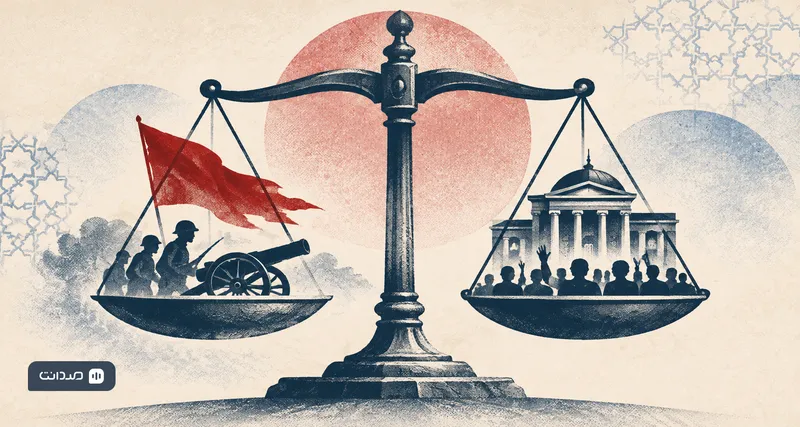
The history of the modern state shows that war and democracy have had a deep, two-way relationship. War, particularly with the growth of large armies and the increasing need of states for financial resources and manpower, was among the important factors behind the formation of the centralized state, representative institutions and the expansion of political participation. Conversely, democracy, by transferring part of decision-making power to citizens and creating mechanisms of accountability, limited the freedom of rulers to begin and continue wars. This relationship does not mean that every war creates democracy, nor that every democratic state is peace-loving. The more precise claim is that under certain historical conditions war helped expand democracy, and that democracy, once established, became one of the most important mechanisms for restraining war.
War and the Making of the Modern State
In past centuries, when a war began, rulers needed resources beyond the royal treasury to meet military costs. Supplying an army, buying equipment, building fortifications and conducting long wars required taxes, credit, manpower and an extensive administrative apparatus. In this sense war was not merely a military event; it was a force that transformed the financial and administrative structure of government.
This is where the well-known theory of Charles Tilly on the formation of the modern state becomes important. In Coercion, Capital, and European States, Tilly shows that successive wars pushed European rulers to expand their capacities for extracting resources, organizing armies and concentrating the instruments of coercion. The compressed form of his argument is expressed in the famous phrase "war made the state, and the state made war." States needed taxes, loans, soldiers and executive mechanisms for war, and these needs led to the expansion of bureaucracy, the tax system and central power. Even so, Tilly does not trace a single, inevitable path of state-building: the mix of capital and coercion, and the weight of cities, landowners and commercial networks, differed across regions of Europe. [1]
Two consequences of this transformation must be distinguished from each other. The first was the concentration of power and the growth of state capacity; the second was the formation of institutions able to limit the ruler's power. The two were not necessarily simultaneous or aligned. A state might acquire a stronger army and tax apparatus without its citizens enjoying greater political rights. But whenever the financing of war came to depend on the cooperation and credit of groups outside the court, rulers had to bargain with cities, merchants, landowners or representative assemblies. Negotiation over taxes could widen into a demand for oversight of how they were spent, a right of protest, and then a share in political decision-making. In his discussion of "states and citizens," Tilly shows that the expansion of direct rule, the growth of public obligations and the mobilization of resources created new relations between state and society, relations that in some contexts opened room for rights, bargaining and collective action. [2]
This process should not be read as a liberating and automatic story of war. In his article "War Making and State Making as Organized Crime," Tilly also stresses the coercive and extractive side of state-building: rulers did not gather resources merely to provide public services; they also expanded their power through threat, coercion and the monopoly of violence. War could therefore both strengthen the state and expose society to greater taxation and coercion. What made possible the passage from concentrated power to limited power was not war alone; it was social resistance, the organization of groups, and the conversion of one-off concessions into durable rules and institutions. [3]
Here another distinction matters: the modern state and the democratic state are not the same. The administrative, financial and military capacity of a state may grow, but democratization requires that more citizens enjoy equal rights, that consultation and accountability toward them be binding, and that independent centers of power, especially those with the means of coercion, come under the oversight of public politics. In his book Democracy, Tilly sees democratization as the product of the interaction of three processes: the integration of networks of social trust into public politics, the decline of the effect of categorical inequalities on political rights, and the curbing of autonomous power centers beyond public oversight. This framework explains why the expansion of the state can lay the ground for democracy but is not sufficient on its own to bring it about. [4]
Mass Armies and the Expansion of Suffrage
With the growth of mass armies and compulsory conscription, the relationship between war and political participation took on new dimensions. Once states needed to mobilize large numbers of ordinary men for war, they could no longer regard soldiering merely as a professional service or a privilege confined to a particular group. Citizens who had to risk their lives on the battlefield could pose this question: if defending the country is our duty and the cost of war falls on our shoulders, why should we have no share in determining its political fate? This demand can be seen as the political form of a kind of exchange: participation in defense and the bearing of risk in return for the recognition of citizenship rights.
An important empirical study that has examined this relationship on a wide scale is "The Martial Origins of Democracy," which Tony Ingesson, Mårten Lindberg, Johannes Lindvall and Jan Teorell published in 2018 in the journal Democratization. Using comparable historical data on conscription and changes in suffrage across countries, the authors test two explanations: first, the "exchange" hypothesis, which stresses the demand for the vote by those called to military service; second, the "mobilization" hypothesis, which expects conscripted armies to impose broader democratic reforms after a war by threatening revolt. Their main result supports the first hypothesis: conscription raises the likelihood of an extension of men's suffrage, but the relationship becomes visible when the country is at war and the conscripted army is actually mobilized. The study finds no general relationship between conscription and the transition to democracy or a reduced likelihood of coups. [5]
The case of Germany in 1871 clarifies this distinction. After the Franco-Prussian War and the founding of the German Empire, universal male suffrage was established for men over 25, but women remained excluded from the vote until 1918. The expansion of political participation in this case was therefore real, but it was neither universal nor equal. Nor does this research show that war by itself creates democracy; rather, it shows that when the danger and sacrifice of conscripts become tangible, states may extend men's suffrage in order to preserve the legitimacy of military mobilization. [6]
War should therefore be seen as one of the forces contributing to the expansion of political participation, not its sole cause. Labor movements, revolutions, the spread of education, economic change, women's struggles and anticolonial movements also played a part in the development of political rights. Moreover, in some countries war led to the strengthening of authoritarianism, the repression of opponents and the militarization of politics. The historical significance of war lies in the fact that the state's need to mobilize society could increase the bargaining power of groups previously excluded from political participation; but whether this bargaining power turned into democracy depended on the balance of social forces and on political institutions.
From Kant's Republicanism to Democratic Peace Theory
The relationship between war and democracy is not limited to the historical origins of political participation. Once formed, democracy changed the relations of power between rulers and citizens and exposed military decisions to oversight and accountability. The philosophical root of one of the most important formulations of this idea can be found in Immanuel Kant's essay Perpetual Peace (1795). In the first definitive article of perpetual peace, Kant requires that the constitution of every state be republican, and argues that in such a system the consent of citizens is necessary for deciding on war. Citizens, unlike a sovereign who largely imposes the costs of war on others, must fight, pay for it, repair its devastation and bear the burden of public debt; they will therefore be more cautious about beginning a war. [7]
Even so, one must distinguish between Kant's argument and the empirical theory of democratic peace in contemporary political science. Kant offered a philosophical and normative argument about a legitimate constitution and the possibility of peace; he did not formulate a statistical hypothesis about the behavior of states. Nor should his concept of republicanism be directly equated with today's liberal democracy and universal suffrage. Kant's importance in this debate lies in the principle that a decision for war, if its costs are to fall on citizens, must not arise from the unaccountable will of a ruler.
In two well-known articles, "Kant, Liberal Legacies, and Foreign Affairs" (1983), Michael W. Doyle linked this insight to the study of international relations. His argument was that liberal states create a kind of "separate peace" in their mutual relations, but that this peace does not extend to all of their foreign relations. Liberal states can have relatively peaceful relations with one another while turning to war, intervention or imperialist policies against illiberal states. In a later article, "Liberalism and World Politics" (1986), Doyle makes this duality clearer: the liberal legacy in foreign policy contains both restraint and self-limitation and the potential for aggression and imperialism. [8] [9]
In Grasping the Democratic Peace, Bruce Russett systematically examined the historical and statistical evidence for this phenomenon. The central question was why democratic states rarely go to war with one another. Russett and his colleagues highlighted two sets of mechanisms: political norms of compromise and peaceful settlement of disputes, and institutional constraints that make leaders' decision-making slower and costlier. In a system in which leaders face parliament, rival parties, public opinion and elections, mobilizing resources for war and justifying it to citizens is harder. [10]
The joint study by Zeev Maoz and Bruce Russett, "Normative and Structural Causes of Democratic Peace, 1946–1986," demonstrated this distinction with greater statistical precision. Their important finding is that democratic states overall are not necessarily less involved in conflict and war than nondemocratic states, but that the likelihood of violent conflict between two democratic states is significantly low. In other words, the strongest empirical formulation of the theory is "peace among democracies," not "the general peaceableness of democracies." This distinction prevents us from concluding, from the reduced likelihood of war between democratic states, that democratic states never fight other countries or that their foreign policy is always peaceful. [11]
Elections, Accountability and the Limits on the Decision for War
At the domestic level, elections are among the most important ways of returning the political cost of war to leaders. Casualties, tax pressure, inflation, economic disruption and the prolongation of conflict can reduce public support for the government. Parliament and opposition parties can also question the aims of the war, the military budget and its consequences. Even so, public opinion does not respond merely to the number of casualties. Research by Christopher Gelpi, Peter Feaver and Jason Reifler on American wars shows that citizens' assessment of a mission's likelihood of success and its justifiability, alongside the human cost, matters for the continuation of support for war: if people believe in success, they may bear heavy costs; but if they see the prospect of success as weak, even fewer casualties can erode support. Matthew Baum has also shown that public scrutiny and sensitivity can tie the president's hands in the use of military force, especially in conflicts with limited strategic interests. [12]
Here the concept of "audience costs" becomes important, a concept that should not be confused with the direct cost of casualties or discontent with war. James Fearon shows that when a leader makes a public threat in an international crisis, a later retreat may carry political and reputational costs at home. This mechanism can make a democratic state's threat more credible to a rival, but at the same time it may make retreat and compromise difficult and raise the risk of escalation. Public accountability therefore does not always mean greater caution at every moment; sometimes the same public pressure pushes a leader toward costly obstinacy. [13]
By contrast, party competition can also help reduce the risk of war. Kenneth Schultz shows that the presence of an independent opposition, and its ability to publicly voice opposition to or support for the use of force, gives the other side more information about the government's true resolve and can reduce the likelihood of war arising from misperception. The importance of this mechanism is that political opposition is not merely an obstacle to the government; sometimes it contributes to the transparency and credibility of diplomatic messages. [14]
The approach of an election also changes leaders' calculations, though not always in one direction. If voters punish the government for casualties, economic cost or military defeat, the leader has an incentive to avoid entering a costly war or to find a way to end it. At the same time, if retreat is interpreted as failure or incapacity, the same leader may continue the war or take a harder line to protect electoral credibility. In a theoretical model, Alastair Smith shows that when voters' assessments of foreign policy affect the chances of reelection, governments may tend toward more adventurous and violent foreign policy; institutional constraints can reduce this bias. The important point is that in his model the effect of the electoral cycle relates to the whole political term and is not necessarily confined to the days near an election. [15]
Research on leader survival and the electoral consequences of war also shows that defeat, heavy costs and the leader's responsibility for starting a war can threaten his political position; but the extent of this threat depends on the type of political system, the possibility of removing the leader, and the stance of opposition parties. Examining states' participation in international wars from 1816 to 1975, Bruce Bueno de Mesquita and Randolph Siverson showed that war, and especially defeat and its high costs, creates political risk for leaders' survival. Philip Arena also showed that the electoral consequence of a war's outcome depends on whether opposition parties supported the government during the war; independent opposition can increase voters' ability to hold the government accountable. Elections thus neither guarantee a quick end to war nor necessarily drive its escalation; elections are the arena in which costs return to politicians, and the outcome depends on how responsibility is distributed, on the public's assessment of success, and on the strength of oversight institutions. [16]
The Historical Paradox of War and Democracy
The historical relationship between war and democracy reveals an important paradox. For centuries war was among the main instruments for concentrating power, expanding the administrative apparatus and consolidating states. Yet this same need for taxes, manpower and social cooperation, in some circumstances, increased the bargaining power of groups outside the court and opened the way for representative institutions and the extension of suffrage. This transition was neither automatic nor identical in every country; even so, mass wars were one of the important historical forces that made the state more dependent on society.
After the spread of democratic institutions, the direction of the relationship changed. Elections, parliament, party competition, the media and public opinion took the decision for war out of the personal and unaccountable discretion of the ruler and exposed it to public evaluation. These mechanisms did not eliminate war, and can sometimes even lead to the escalation of a crisis or the prolongation of a conflict; but they raised the political cost of military decisions and sharply reduced the likelihood of war between democratic states.
War helped expand democracy, and democracy led to the restraint of war. This statement is neither a celebration of war nor a claim of the absolute pacifism of democracies; it is a summary of a historical and institutional relationship: a need that once fueled the concentration of power in rulers' hands, under certain conditions led to the expansion of political participation; and the institutions that emerged from that participation later limited that same power in decisions about war.
Sources
Arena, Philip. “Success Breeds Success? War Outcomes, Domestic Opposition, and Elections.” Conflict Management and Peace Science 25, no. 2 (2008): 136–151. https://doi.org/10.1080/07388940802007249.
Baum, Matthew A. “How Public Opinion Constrains the Use of Force: The Case of Operation Restore Hope.” Presidential Studies Quarterly 34, no. 2 (2004): 187–226. https://doi.org/10.1111/j.1541-0072.2007.00236.x-i1.
Bueno de Mesquita, Bruce, and Randolph M. Siverson. “War and the Survival of Political Leaders: A Comparative Study of Regime Types and Political Accountability.” American Political Science Review 89, no. 4 (1995): 841–855. https://doi.org/10.2307/2082512.
Doyle, Michael W. “Kant, Liberal Legacies, and Foreign Affairs.” Philosophy & Public Affairs 12, no. 3 (1983): 205–235. https://www.jstor.org/stable/2265298.
Doyle, Michael W. “Kant, Liberal Legacies, and Foreign Affairs, Part 2.” Philosophy & Public Affairs 12, no. 4 (1983): 323–353. https://www.jstor.org/stable/2265377.
Doyle, Michael W. “Liberalism and World Politics.” American Political Science Review 80, no. 4 (1986): 1151–1169. https://doi.org/10.2307/1960861.
Fearon, James D. “Domestic Political Audiences and the Escalation of International Disputes.” American Political Science Review 88, no. 3 (1994): 577–592. https://doi.org/10.2307/2944796.
Gelpi, Christopher, Peter D. Feaver, and Jason Reifler. Paying the Human Costs of War: American Public Opinion and Casualties in Military Conflicts. Princeton, NJ: Princeton University Press, 2009.
Ingesson, Tony, Mårten Lindberg, Johannes Lindvall, and Jan Teorell. “The Martial Origins of Democracy: A Global Study of Military Conscription and Suffrage Extensions since the Napoleonic Wars.” Democratization 25, no. 4 (2018): 633–651. https://doi.org/10.1080/13510347.2017.1405935.
Kant, Immanuel. “Perpetual Peace: A Philosophical Sketch” (1795). In Kant: Political Writings, edited by H. S. Reiss, translated by H. B. Nisbet, 2nd ed., 93–130. Cambridge: Cambridge University Press, 1991. https://doi.org/10.1017/CBO9780511809620.
Maoz, Zeev, and Bruce Russett. “Normative and Structural Causes of Democratic Peace, 1946–1986.” American Political Science Review 87, no. 3 (1993): 624–638. https://doi.org/10.2307/2938740.
Russett, Bruce. Grasping the Democratic Peace: Principles for a Post-Cold War World. Princeton, NJ: Princeton University Press, 1993.
Schultz, Kenneth A. “Domestic Opposition and Signaling in International Crises.” American Political Science Review 92, no. 4 (1998): 829–844. https://doi.org/10.2307/2586306.
Smith, Alastair. “Diversionary Foreign Policy in Democratic Systems.” International Studies Quarterly 40, no. 1 (1996): 133–153. https://doi.org/10.2307/2600934.
Tilly, Charles. Coercion, Capital, and European States, AD 990–1992. Rev. ed. Oxford: Blackwell, 1992.
Tilly, Charles. Democracy. Cambridge: Cambridge University Press, 2007. https://doi.org/10.1017/CBO9780511804922.
You are a literary translator for «صدانت» (Sedanet), a Persian-language website about philosophy, religious intellectualism and the humanities. Translate the Persian source below into English. The source is one article of the site, titled «جنگ و دموکراسی؛ چگونه جنگ به پیدایش دموکراسی کمک کرد و دموکراسی جنگ را مهار کرد؟».Rules: - Translate meaning, not words. The result must read as if written by a native editor of a serious ideas magazine in the target language. - Keep the register of the original: a title stays a title, an SEO description stays one plain sentence of description. - Translate the source in full. Never summarise, expand, merge or drop anything. - Do not explain or editorialise. No translator's notes, no "[Translated]".English rules: - Names of people, books, journals and institutions: use the established English form when one exists (مصطفی ملکیان → Mostafa Malekian, عبدالکریم سروش → Abdolkarim Soroush, نیچه → Nietzsche). Otherwise transliterate; never leave Persian script in the output. - Persian technical vocabulary keeps its scholarly English equivalent (روشنفکری دینی → religious intellectualism, حکمت متعالیه → Transcendent Theosophy, اجتهاد → ijtihad).The field to translate is «متن» (body). - The article body, given as raw HTML. - Reproduce every HTML tag, attribute and entity EXACTLY as given, in the same order and nesting. Copy `style`, `class`, `href`, `id` and `src` values character for character. Never add, drop, merge, split or reorder tags. - Translate ONLY human-readable text between tags, plus the `alt` and `title` attributes. - Never translate or rewrite URLs, file names, slugs or e-mail addresses. - This field is part 2 of 2 of one long text. Translate ONLY this part; the other parts are handled separately, so do not summarise them or refer to them. - The part may begin or end mid-sentence, or open a tag it does not close. That is expected: keep it exactly that way — do not close a dangling tag and do not finish a dangling sentence.==== PERSIAN SOURCE — PART 2 OF 2 ====
Tilly, Charles. “War Making and State Making as Organized Crime.” In Bringing the State Back In, edited by Peter B. Evans, Dietrich Rueschemeyer, and Theda Skocpol, 169–191. Cambridge: Cambridge University Press, 1985. https://doi.org/10.1017/CBO9780511628283.008.
[1]Charles Tilly, Coercion, Capital, and European States, AD 990–1992, rev. ed. (Oxford: Blackwell, 1992), ch. 3, pp. 67–91. فهرست فصلها و صفحات در نسخه ناشر، فصل «How War Made States, and Vice Versa» را در صفحات ۶۷ تا ۹۱ ثبت میکند.
[2]Tilly, Coercion, Capital, and European States, pp. 99–124، بهویژه بخش «Bargaining, Rights, and Collective Action» (صص. ۹۹–۱۰۳) و بحث گسترش حکومت مستقیم و پیامدهای آن برای شهروندان.
[3]Charles Tilly, “War Making and State Making as Organized Crime,” in Bringing the State Back In, ed. Peter B. Evans, Dietrich Rueschemeyer, and Theda Skocpol (Cambridge: Cambridge University Press, 1985), pp. 169–191, https://doi.org/10.1017/CBO9780511628283.008.
[4]Charles Tilly, Democracy (Cambridge: Cambridge University Press, 2007),
بهویژه فصلهای ۳ و ۶، بهترتیب درباره دموکراتیزاسیون و دموکراتیکزدایی (صص. ۵۱–۷۹) و قدرت و سیاست عمومی (صص. ۱۳۳–۱۶۰)، https://doi.org/10.1017/CBO9780511804922.
[5]Tony Ingesson, Mårten Lindberg, Johannes Lindvall, and Jan Teorell, “The Martial Origins of Democracy: A Global Study of Military Conscription and Suffrage Extensions since the Napoleonic Wars,” Democratization 25, no. 4 (2018): 633–651, https://doi.org/10.1080/13510347.2017.1405935.
مقاله دادههای تاریخیِ تطبیقی درباره سربازگیری و دموکراسی را به کار میگیرد و فرضیه مبادله حق رأی در برابر خدمت نظامی را از فرضیه بسیج و تهدید شورش تفکیک میکند.
[6]Ingesson et al., “The Martial Origins of Democracy,” pp. 633–651.
نویسندگان نمونه آلمان را بررسی میکنند: حق رأی مردان بالای ۲۵ سال در امپراتوری آلمان در ۱۸۷۱ گسترش یافت، درحالیکه زنان تا ۱۹۱۸ از حق رأی برخوردار نشدند.
[7]Immanuel Kant, “Perpetual Peace: A Philosophical Sketch” (1795), in Kant: Political Writings, ed. H. S. Reiss, trans. H. B. Nisbet, 2nd ed. (Cambridge: Cambridge University Press, 1991), pp. 93–130
بهویژه ماده قطعی نخست و بحث رضایت شهروندان درباره جنگ، ص. ۱۰۰. اطلاعات نسخه و ترجمه: https://doi.org/10.1017/CBO9780511809620.
[8]Michael W. Doyle, “Kant, Liberal Legacies, and Foreign Affairs,” Philosophy & Public Affairs 12, no. 3 (1983): 205–235؛ و “Kant, Liberal Legacies, and Foreign Affairs, Part 2,” Philosophy & Public Affairs 12, no. 4 (1983): 323–353.
[9]Michael W. Doyle, “Liberalism and World Politics,” American Political Science Review 80, no. 4 (1986): 1151–1169, https://doi.org/10.2307/1960861.
[10]Bruce Russett, Grasping the Democratic Peace: Principles for a Post-Cold War World (Princeton, NJ: Princeton University Press, 1993).
در تدوین کتاب، ویلیام آنتولیس، زئیف ماعوز، کارول امبر و ملوین امبر نیز همکاری داشتهاند.
[11]Zeev Maoz and Bruce Russett, “Normative and Structural Causes of Democratic Peace, 1946–1986,” American Political Science Review 87, no. 3 (1993): 624–638, https://doi.org/10.2307/2938740.
چکیده مقاله تصریح میکند که دموکراسیها در مجموع تقریباً به اندازه غیردموکراسیها مستعد منازعهاند، اما بهندرت با یکدیگر درگیر منازعه خشونتآمیز میشوند.
[12]Matthew A. Baum, “How Public Opinion Constrains the Use of Force: The Case of Operation Restore Hope,” Presidential Studies Quarterly 34, no. 2 (2004): 187–226, https://doi.org/10.1111/j.1541-0072.2007.00236.x-i1؛ Christopher Gelpi, Peter D. Feaver, and Jason Reifler, Paying the Human Costs of War: American Public Opinion and Casualties in Military Conflicts (Princeton, NJ: Princeton University Press, 2009).
[13]James D. Fearon, “Domestic Political Audiences and the Escalation of International Disputes,” American Political Science Review 88, no. 3 (1994): 577–592, https://doi.org/10.2307/2944796.
در این مقاله، «هزینه مخاطب» به هزینه سیاسیِ عقبنشینی پس از موضعگیری علنی اشاره دارد، نه صرفاً نارضایتی عمومی از تلفات جنگ.
[14]Kenneth A. Schultz, “Domestic Opposition and Signaling in International Crises,” American Political Science Review 92, no. 4 (1998): 829–844, https://doi.org/10.2307/2586306.
[15]Alastair Smith, “Diversionary Foreign Policy in Democratic Systems,” International Studies Quarterly 40, no. 1 (1996): 133–153, https://doi.org/10.2307/2600934.
مقاله یک مدل نظری از اثر چشمانداز انتخاب مجدد بر سیاست خارجی ارائه میکند و نشان میدهد که انگیزه انتخاباتی میتواند، در غیاب محدودیتهای نهادی کافی، به سیاست ماجراجویانهتر بینجامد.
[16]Bruce Bueno de Mesquita and Randolph M. Siverson, “War and the Survival of Political Leaders: A Comparative Study of Regime Types and Political Accountability,” American Political Science Review 89, no. 4 (1995): 841–855, https://doi.org/10.2307/2082512؛ Philip Arena, “Success Breeds Success? War Outcomes, Domestic Opposition, and Elections,” Conflict Management and Peace Science 25, no. 2 (2008): 136–151, https://doi.org/10.1080/07388940802007249.
==== END OF SOURCE ====Return only «متن» in English, with nothing before or after it — no preamble, no explanation, no code fences.


Discussion0 comments
No comments yet; let yours be the first voice.