Philosophy
We Are Nothing, We Are a Fable
MacIntyre sees humans as storytelling animals embedded in traditions—traditions that suffer from epistemological crises and a rift between appearance and reality. Overcoming such a crisis requires a new narrative that explains the failures while remaining coherent with the tradition.
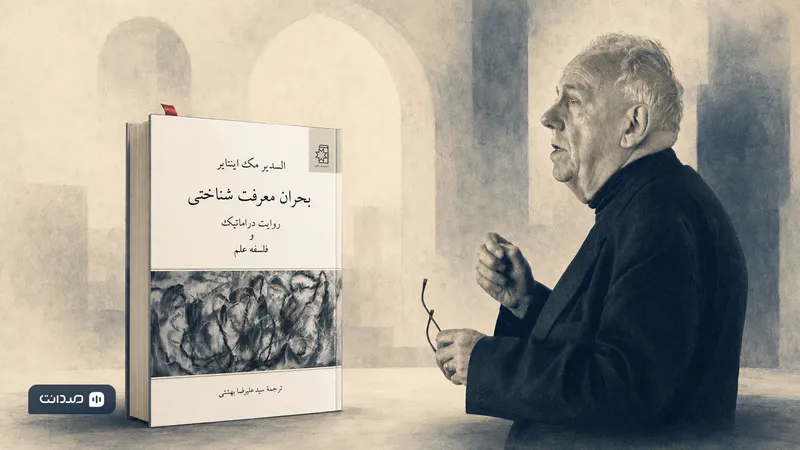
It has not been long since the publication of the book The Epistemological Crisis, Dramatic Narrative, and the Philosophy of Science by the renowned contemporary Scottish philosopher Alasdair MacIntyre, translated by Seyed Alireza Beheshti.[1] The book is in fact a translation of one of MacIntyre's essays of the same name. The present writing will be a review of the views set forth in this essay, and then some points will be raised concerning the translation of this work.
MacIntyre is a philosopher of tradition. A philosopher who, according to some of his commentators, even considers rationality—which for philosophers mostly has a universal and tradition-untainted status—to be something confined within the bounds of tradition. In this respect, the lineage of his thought reaches back to the eighteenth-century Irish philosopher Edmund Burke, the godfather of modern conservatism, although MacIntyre himself, especially in this very essay under discussion, rightly points out the differences between his view and Burke's. Burke, who had emigrated to England in his youth and had become a prominent literary figure there, writing on sublimity and beauty,[2] also had a hand in politics and entered the English Parliament. He was fundamentally opposed to the French Revolution (and, of course, to any other revolution except the English Revolution of 1688, whose aim was to depose King James II).[3] Burke considered the autonomous and tradition-defying thought of the philosophes of the Enlightenment era to be abstract and ineffective, a view whose like can be found in abundance in MacIntyre's anti-Enlightenment stances. In Burke's view, the virtue of tradition lies in its bringing stability. Altering traditions, however "charming a hat," is "not worth the loss of a head." MacIntyre believes that "man is a story-telling animal." The life of each of us humans has its own plot. But the story of each person's life is defined within the larger story of the tradition or traditions within which they live and which they carry. Every tradition is the product of the conflict of interpretations that have been given of that tradition. Reasoning is nothing but the methods that these very stories provide. It is these very stories, these dramatic narratives, that define the meaning and values of human life. MacIntyre laments that in our time, narrative (or story) has been reduced to a merely aesthetic matter, whereas it is story that shapes our minds from the very beginning of childhood and determines our way of seeing. "It is from fairy tales that the child learns how to understand social reality." He does not believe in the British-positivist separation of facts from values (oughts from is's) and considers the fact "like the wig and the telescope, a seventeenth-century invention." To escape Nietzschean immorality and the slayers of reason, he dreams of a return to a form of Aristotelian-Thomistic virtue ethics in our time. Liberalism, capitalism, moral relativism (under the more technical title of "emotivism" in meta-ethics) are, in MacIntyre's view, among the signs of the emergence of crisis in the body of the modern age, and among his preoccupations is addressing crisis within traditions.
The essay in question speaks of the emergence of just such epistemological crises within traditions. In this work, MacIntyre defines crisis as the gap between being and seeming—the gap between “what appears to exist and what really exists.” We can clarify the matter with an example. Consider an ugly man who does not think of himself as such, and who, as it happens, considers himself one of the beauties of the age. In confronting the “reality principle” (as Freud put it), this man may gradually come to his senses and, like Socrates, understand the truth: that while he may enjoy certain blessings of the age—wisdom, for instance—he has been denied the gift of beauty. But if he refuses to accept the truth and does not align his beliefs with reality, he will gradually fall into an epistemological crisis. For example, a beautiful woman, or even one not so beautiful, who has captured his heart, will not show him any favor. Nor will anyone praise him for his captivating countenance, and so on. In short, it is as if what really is differs from what appears to his mind as much as heaven from earth, and this is what crisis means in the sphere of that individual’s knowledge. To overcome the crisis, this person must produce a new interpretation of reality and construct a new story—a new story that both shows where the previous story went wrong and brings him a new way of understanding himself and the world around him. In the same sense, traditions may also grapple with crisis and, to escape it, require new interpretations and a reformulation of themselves. Of course, this new formulation must, in addition to demonstrating the reasons for the failures of the previous tradition’s narratives, show that the new narrative is consistent with the core themes of that tradition; if it is not, a rupture has arrived and the sun is setting on the tradition in question. Traditions that pass through crisis will become stronger, like an athlete who emerges victorious from a difficult contest. Appropriating one of Nietzsche’s aphorisms (the antagonism of MacIntyre’s work), one could say that in MacIntyre’s eyes, what does not kill a tradition makes it stronger. Granted, traditions do not always survive crises unscathed. Crisis is the destiny of traditions. However stout and robust a tradition may be, a day will eventually come when that tradition, by the standards and criteria nurtured within itself, will no longer be able to answer the questions with which it is grappling. Crisis is the day when “the methods of inquiry nurtured within a tradition, which had until then been reliable and authoritative, lose their reliability and authority.”[4]
MacIntyre says that the play Hamlet is a representation of this very epistemological crisis. “Hamlet’s problem arises from the fact that his narrative (or interpretation) of the state of the kingdom of Denmark no longer works. He must construct a new story for understanding himself and his relationship with those around him. He must produce a new formulation of the truth. This view is, in one respect, a Kantian one. We never have access to the thing-in-itself (read: noumenon) and only ever reach the best story (or possible explanation, read: phenomenon).[5] He also holds a Hegelian view and considers thought to possess a historical character. In MacIntyre’s view, we are never in a position to suppose that the truth is in our grasp; rather, older and less workable stories are always giving way to newer and more workable ones. He says this is why the play Hamlet lends itself to various interpretations. MacIntyre compares this with Jane Austen’s novel Emma. It is as if Emma in that novel had arrived at the truth itself, not at a newer and more serviceable interpretation or narrative. Having been trained in the contemporary Anglo-Saxon philosophical tradition and understanding well the dogmatisms of analytic right-wingers, he says, “Philosophers have traditionally been Emmas, not Hamlets.”
Hamletian Doubt versus Cartesian Doubt
The emergence of skeptical figures signals the existence of an epistemological crisis within a tradition. It is as if the interpretive models or stories that had been effective until now have lost their efficacy and collapsed. MacIntyre names two skeptical figures in the modern age: the first is René Descartes, the father of modern skepticism, who sought, through universal doubt (doubt in all his knowledge) and with the aid of the firm and systematic model of mathematics, to rebuild the edifice of knowledge upon a new foundation (namely, the self-evidence of the thinking subject). Cartesian "methodical doubt" (or, as Descartes's Persian translators put it, "prescriptive doubt") is doubt in all the presuppositions and first principles with which a person begins to think. Descartes's famous motto was that "one must doubt everything" (de omnibus dubitandum est). A phrase that later became the motto of Hans Lassen Martensen, Søren Kierkegaard's rival at the University of Copenhagen. Martensen believed Cartesian skepticism to be the model of modern philosophical thought. He saw the perfect mirror of this skepticism in Goethe's Faust, which was the symbol of modern secular knowledge and the embodiment of the desire to deviate from divine laws.[6] MacIntyre, however, while considering Cartesian skepticism an influential description of the epistemological crisis of his time, is also a stringent critic of it and believes that Descartes's description of this crisis is fundamentally incorrect and provides a flawed and simplistic model for doubting. In his view, Descartes does not understand that the very language with which he speaks, thinks, and doubts (in Descartes's case, French and Latin) is a tradition that shapes his thought, and Descartes's epistemological ideals are derived from these very traditions. He says that even the foundation or basis that Descartes finds for his epistemological system (that is, the famous phrase "I think, therefore I am") can be found before him in Saint Augustine.[7] MacIntyre instead speaks in advocacy of Hamletian skepticism. If Cartesian doubt lacks any kind of context (is contextless), Hamletian doubt occurs within a context of firm beliefs, and unlike Cartesian doubt, which has an ahistorical character and seems to be posed out of nowhere, Hamlet's doubt takes shape within a tradition of which the human self is a product.
MacIntyre's critique of Descartes is precisely the same critique he levels at the renowned philosopher of science, Thomas Kuhn. He believes that Kuhn's view of the "epistemological crisis in the empirical sciences is fundamentally similar to Descartes's view of the epistemological crisis in philosophy." Kuhn likened the transition from one scientific paradigm to another to a "conversion experience." He describes this transition not as a step-by-step passage but as a kind of "gestalt switch." In Kuhn's view, in a scientific revolution, everything is called into question all at once. For both Descartes and Kuhn, there is no rational continuity between the situation that exists before the crisis and the situation that follows it. Since MacIntyre believes that calling everything into question all at once is an impossible feat, he also critiques Kuhn's view of scientific revolution.
Hume's Paranoia and Kafka's Theory of Knowledge
Another skeptical figure of the modern world is David Hume, the Scottish Enlightenment philosopher, whose radical skepticism intertwined with his empiricism is, in MacIntyre's view, also a defective form of skepticism that leaves no means for making sense of oneself and others, and
5- The equivalent "farāyand" for the word progress (p. 25) is not a suitable equivalent, and it is better to choose the equivalent "pīshraft" for this word, so that we may keep "farāyand" for process. It is obvious that processes can be progressive or regressive.
6- The equivalent "setāreh-shenāsī" for the word astrology is not a suitable equivalent, and it is better to use the equivalent "tāle‘-bīnī," leaving "setāreh-shenāsī" or "nojoom" for astronomy. In fact, MacIntyre speaks of the "decay of modern astrology"; otherwise, modern astronomy is a living and flourishing science.
7- The equivalent "manteq-e rasmī" for formal logic (p. 42) is undoubtedly an incorrect equivalent, and the established and correct equivalent "manteq-e soorī" (form/content) should be used.
8- The translated text reads: "... if Kuhn's [or Kioon's] position[10] is understood in light of assuming something like Polanyi's position, all of Kuhn's early formulations of his own positions will be excessively unintelligible..." (p. 50)
Considering that in the preceding lines MacIntyre had spoken of Thomas Kuhn being influenced by Michael Polanyi, this sentence seemed somewhat strange. And by referring to the original text, one can understand that at least an inadvertent error has occurred, which the editor perhaps did not notice due to the "turmoil and disorder of our life and times." The correct translation should be: "... if understood in light of assuming something like Polanyi's position, all of Kuhn's early formulations of his own positions will be very intelligible..."
9- The translated text reads: "There is no rational continuity between the situation that immediately follows the crisis and the situations after it." (p. 50)
Again, as is evident, the translation is incorrect, because there is no difference between the situation that "follows the crisis" and the "situations after it." By referring to the original text, we will find that the correct translation is as follows:
"There is no rational continuity between the situation at the time immediately before the occurrence of the crisis and the situations after it."
10- "The experience it seems to describe belongs to a person who has been wholly educated under a tradition defined and shaped by a paradigm and must now be transferred to a scientific tradition established by a completely different paradigm." (pp. 50 and 51)
In addition to the ambiguity of the translation and the not very eloquent use of the word "by," contrary to editorial tradition, the translator has conflated the word practice with tradition. Given that practice and tradition are two separate concepts (and, of course, in MacIntyre's view, practices are nurtured by traditions), this unwarranted substitution does not seem correct, and the following translation is probably more accurate:
"The experience he describes seems to be that of someone who has been wholly educated into practices defined and shaped by one paradigm and must now transition to a form of scientific practice defined and shaped by an entirely different paradigm."
11- "He accuses Lakatos of substituting 'examples with philosophical context' for history." (p. 57)
"Examples with philosophical context" is an incorrect translation of the phrase philosophy fabricating examples, the correct rendering of which is "examples fabricated (or contrived) by philosophy," which carries a negative connotation and alerts us to the accusation Kuhn levels against Lakatos.
Although the above cases merely show some of the errors that have crept into the translation of the book in question, they will not diminish the value of the translator's work and the effort put into rendering the book. It is hoped that the shortcomings of this book will be remedied in subsequent editions. In the opinion of the writer of these lines, a proper and suitable editing could make the work more polished and refined for future editions.
.
.
[1] The details of the original text and the book in question are as follows:
EPISTEMOLOGICAL CRISES, DRAMATIC NARRATIVE AND THE PHILOSOPHY OF SCIENCE, Alasdair MacIntyre, The Monist,Vol. 60, No. 4, Historicism and Epistemology (OCTOBER, 1977), pp. 453-472
Epistemological Crises, Dramatic Narrative and the Philosophy of Science, translated by Seyed Alireza Beheshti, Nahid Publications, Spring 2016, subsequent references in this text are to this book.
[2] A Philosophical Enquiry into the Origin of Our Ideas of the Sublime and Beautiful, Edmund Burke, 1757.
[3] A serious difference between MacIntyre and Burke lies precisely here: for MacIntyre, traditions that suffer from incoherence and rifts sometimes require revolution and reconstruction for their continuity.
[4] For a more detailed introduction to Alasdair MacIntyre, see: The Philosophy of MacIntyre, Jack Russell Weinstein, translated by Kaveh Behbahani, Ney Publishing, 2011.
[5] Of course, MacIntyre's view differs fundamentally from Kant's and the Enlightenment thinkers' view of rationality, and MacIntyre is in fact a critic of the Enlightenment project. Perhaps the crisis that Emma Bovary undergoes in Flaubert's masterpiece, Madame Bovary (which ends in Emma's suicide), can be seen as a mirror of the crisis of the Enlightenment era.
[6] Of course, Martensen did not go to Goethe's original play Faust. Rather, he examined a version of Faust retold by the 19th-century Hungarian-Austrian poet named Niembsch von Strehlenau, known as Nikolaus Lenau. The title of Martensen's article was "Observations on the Idea of Faust with Reference to Lenau's Faust." Kierkegaard, who himself was enamored with the play Faust and had offered a new interpretation of Faust in his journal BB, considered it his misfortune that Martensen had written about Faust. If we recall Kierkegaard's infatuation with Socrates, this view of his in Journal AA, where he considered Faust similar to Socrates, becomes meaningful. See:
The Cultural Crisis of the Danish Golden Age: Heiberg, Martensen and Kierkegaard, Jon Stewart, Museum Tusculanum Press, Copenhagen, 2015, P. 105.
.
.
[7] MacIntyre's remark refers to Saint Augustine's famous phrase in The City of God: "If I am mistaken, I am."
[8] It seems that, with reference to MacIntyre's view, one can find a fitting justification for the work of an editor. The editor, as philosophers say, trusts tradition "at first glance" (prima facie). That is, they do not rescind what has come from the linguistic tradition unless they have a compelling reason to do so. Likewise, the issues raised in the translation of this work share this MacIntyrean presupposition: a tradition of finding equivalents that works and is not facing a crisis should not be discarded without reason.
[9] For example, see:
Lying and Deception: Theory and Practice, Thomas L. Carson, Oxford University Press, 2010
[10] The italics are mine.
.
.
We Are Nothing, We Are a Fable
A Note on the Occasion of Translating a Work by Alasdair MacIntyre
Kaveh Behbahani
.
.
Lying and Deception: Theory and Practice, Thomas L. Carson, Oxford University Press, 2010
[10] The brackets are mine.
.
.
We Are Nothing, We Are a Fable
A Note on the Occasion of Translating a Work by Alasdair MacIntyre
Kaveh Behbahani
.
.



Discussion2 comments
از تلاش خوب شما براي معرفي كتاب فوق، تشكر مي كنم. معرفي مفيد و جذابي بود. سپاس
جناب آقای بهبهانی گرامی، از معرفی این بحث و این کتاب مهم فلسفی از شما تشکر می کنم. اگر ممکن باشد خوشحال می شوم ای میل تان را در کامنت گاه سایت عدم خشونت دریافت کنم: ghkeshani دات کام