Psychology
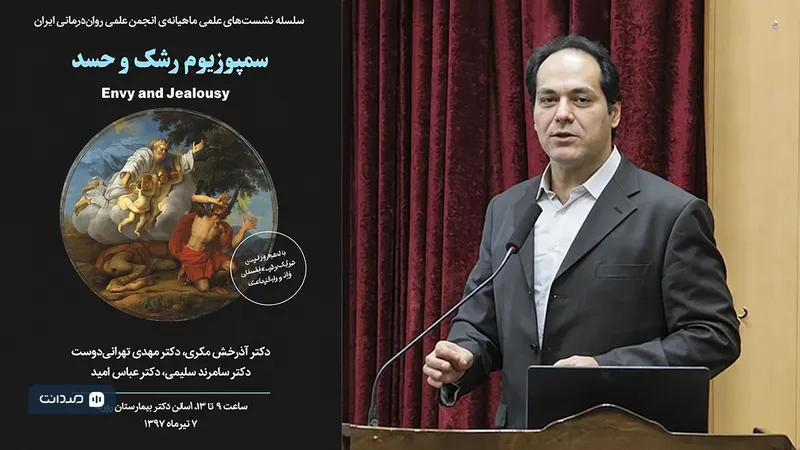
Why Does Other People's Success Threaten Us? A Lecture by Azarakhsh Mokri
Why does the success and progress of others sometimes arouse a sense of threat and discontent in us instead of making us glad? In his lecture "When Another Profits," Azarakhsh Mokri examines the zero-sum mindset, egalitarianism and hypotheses from evolutionary psychology to trace the possible roots of rivalry, backbiting and resistance to other people's advancement.


Azarakhsh Mokri
نویسندهWhy Does Other People's Success Threaten Us?
A Report on Dr. Azarakhsh Mokri's Lecture "When Another Profits" at TELSI SCIENCE TALK 21
Opening the Discussion: Why Does Another's Gain Make Us Feel Bad?
Dr. Azarakhsh Mokri opens his lecture "When Another Profits" by doubting a simple picture of evolution: the idea that better genes produce superior traits; superior traits lead to greater survival and adaptation; and as a result, the bearers of those traits have more children and multiply their genes. In his view, the story of evolution is not so simple. Sometimes a trait that should, at first glance, lead to an individual's success exposes him to the reaction of others; as though getting ahead, rather than being merely an advantage, also carries a social danger.[1]
He says that if he had chosen the title of the lecture himself, he might have chosen "The Psychology of Backbiting": why can people sometimes not tolerate another's growth, why do they form coalitions to stop him, and where does this behavior come from? The official title, "When Another Profits," approaches the same question: why does seeing another's gain and progress, in some cases, instead of being neutral or pleasant, create an unpleasant feeling in us?
Mokri develops this problem in connection with three concepts: egalitarianism, the zero-sum mindset, and the anti-profit mindset. The zero-sum mindset means understanding one person's gain as though a share has been taken from someone else; the anti-profit mindset refers to a tendency to treat the mere fact of an individual or firm making a profit as a negative sign. The speaker's question is not whether inequality is always good or bad, but where our reaction to another's gain comes from and how far it has evolutionary roots.
For Mokri, this question also arises from professional experience. He has repeatedly been invited to workplaces and educational settings to speak about resilience, but in conversations with people he has found that burnout and disillusionment do not always stem from anxiety, depression or traumatic experiences. Sometimes the dynamics of the environment, especially the feeling that others do not want the person to advance or cannot bear his success, reduce his capacity to endure. In in-depth interviews with students, colleagues and physicians, complaints of this kind are heard: "He doesn't work as much as I do, but he earns far more," or "He doesn't deserve to profit this much." Comparisons like these can create serious tension in relationships.
To clarify the problem, Mokri gives a simple example: two people each have one coin; then a situation arises in which one ends up with fifteen coins and the other with a hundred. Is the first person better off or worse off? The answer depends on the relationship between the two, the degree of competition, job position and other factors; but the speaker deliberately sets these details aside in order to pose a more general question. He warns that we should not generalize our own experience and reaction to everyone. One person may be very happy about an increase in his income, while another, even after his living conditions have improved, keeps thinking about why someone else has gained more.
According to Mokri, objection to another's larger share does not necessarily disappear with poverty or deprivation. Even in a society that has become more industrialized and prosperous, some people may remain dissatisfied, not because they have gained nothing, but because another has gained more than they have. From here the main question takes shape: is such a reaction part of the "hardware" of our minds, or does it arise in the course of social and cultural learning?
Coalitionary Leveling: Pulling Back the One Who Has Pulled Ahead
To explain the possible evolutionary roots of this behavior, Mokri invokes a concept he calls "coalitionary leveling": when someone pulls ahead of others, the others unite to pull him back. In the speaker's account, this idea stands in tension with the familiar image of the alpha male in some evolutionary-psychological explanations. In that image, an individual with traits such as greater physical strength or attractiveness may have an advantage in mating and reproduction. But Mokri asks why we should assume the other members of the group remain passive and allow one person, unrivaled, to cement his superiority. Perhaps they form a coalition and threaten his position.
He links this possibility to workplaces as well. We usually assume that a person who becomes the victim of mistreatment by colleagues is weak, unskilled or passive; but Mokri says not all victims are like this. Some of those who come under pressure are very intelligent, work faster and have outstanding ability. It is precisely this lead that may make others feel that their share or standing is in danger.
The speaker then puts forward a hypothesis whose uncertainty he himself stresses. Christopher Boehm and Richard Wrangham, in discussions of human evolution, have raised the possibility that members of early human groups resorted to coordinated coalitions to restrain bullying or excessively dominant individuals. Mokri describes this mechanism with the English term targeted conspiratorial killing; that is, the deliberate, conspiratorial killing of an individual by a group of his fellows. In his account, if an individual became too power-hungry, the others could gather when he was alone and eliminate him. This hypothesis is also linked to the concept of human "self-domestication": by restraining the dominant individual, the group limits dominating behavior.[2]
Mokri does not present this account as established fact; on the contrary, he says several times that it is unclear how far the hypothesis is correct and whether it can be considered part of humanity's evolutionary heritage. Even so, if such a mechanism played a role in the past, it might explain why, in human groups, individual success sometimes meets with suspicion and resistance from others. In a hunting band, someone who returns each time with more game may, instead of simply being admired, be seen as a threatening figure. By restraining him, the group may pay a material cost but reduce the danger of one person becoming too powerful.
From this standpoint, Mokri suggests that the phenomenon known in some contemporary accounts as "elite-killing" is not necessarily the exclusive feature of one society or one country. He mentions the book "The Sociology of Elite-Killing," but states plainly that he has not read it and does not intend to critique it; his point is that the tendency to pull down the person who is ahead may be more universal than the political conditions of any one society. If so, what we experience in the workplace or university as sabotage, slander or obstruction may be a more modern form of an old struggle over power and superiority.
This hypothesis also complicates the meaning of egalitarianism. Did early groups maintain equality because their members, out of altruism, wanted to lift up the left-behind, or because they feared that one individual would become too powerful and harm the others? Mokri provisionally takes the second possibility more seriously: perhaps some apparently egalitarian behaviors originated not in benevolence but in fear of the consequences of one person pulling ahead. For him this conclusion is still a hypothesis, not a final verdict.
What Do Children Tell Us About Equality?
To examine how innate the reaction to inequality is, Mokri points to research on children. The general logic of these studies is that if the reactions of young children can be compared across different cultures and societies, it may be possible to separate signs of early tendencies from the effects of teaching and social norms. The speaker himself, however, reminds us that this is difficult: from their earliest years children are exposed to family, culture and living environment, and no experiment simply shows a "clean mind" separate from experience.
In one experimental design, a child is shown that he and a peer receive different shares. Two cases are distinguished: disadvantageous inequality, when the other gets more than the child; and advantageous inequality, when the child's share is larger than the other's. For example, one is given four units and the other one. In some versions of the experiment, the child can accept or reject the unequal division; if he rejects it, both shares vanish. Protest against inequality therefore carries a cost: to prevent the other's greater gain, the child gives up part of his own benefit as well.
Mokri says the finding that stands out in these studies is the difference in reaction to the two kinds of inequality. When children receive the smaller share, they become more likely with age to reject the unequal distribution; but when the larger share falls to them, in most cases they do not protest to the same degree. In other words, protest against disadvantageous inequality is clearer than protest against advantageous inequality. In Mokri's view, this difference raises a serious challenge to a naive interpretation of egalitarianism: if the primary motive were impartial justice, why is a child less willing to give up a benefit when he gains more?
He compares this result with the well-known example of macaque monkeys, who in some experiments show protest at receiving unequal rewards. But as he stresses, protest at a smaller share is not the same as protest at inequality in both directions. If a child is dissatisfied only when he himself receives less, this reaction cannot immediately be called altruism or a desire for justice. Mokri considers it possible that part of the sensitivity to "eating alone" takes shape with age and through learning, rather than being fully built into the mind from the start.
In another part of the discussion, he describes an experiment in which children use magnetic fishing rods to gather cubes, which are later to be turned into chocolates. The subtle point of the experiment is that one child's rod is unknowingly stronger, making it easier for him to collect cubes; but the child is unaware of this difference and may suppose the haul is the product of his own skill and effort. The researchers can then observe how the children divide the final product. This situation bears on a larger debate about merit and opportunity: if one person has gained more, has he really worked harder, or did he have better circumstances?
Mokri places this question within a familiar dispute in public life. One view holds that wealth is the product of an individual's effort and merit; the other emphasizes opportunities, family resources and circumstances that made success more likely for some. The experiment, at least in his account, is a way of seeing how children decide on division in situations where shares arise from apparent effort.
In another example, children are asked to divide the product of two people's work: one has gathered nine units and the other three; there are twelve units in all. An equal division means each gets six; a division by achievement means the person who gathered nine gets nine and the other three. If physical strength or force determines the outcome, the stronger person's share will be larger. Mokri says the comparison he raises covers children from hunter-gatherer societies, from pastoral and early farming societies, and from modern Germany. The German children leaned more toward dividing according to how much each had gathered; the children of hunter-gatherer societies were close to equal division; and in the pastoral and farming groups equal division was seen less often.
In the speaker's view, these results do not yield a simple picture of early humans. Equal division in a hunter-gatherer group may be a sign of egalitarianism, but by itself it does not make clear whether the motive is empathy and altruism or fear of the group's reaction against someone who takes too large a share. He stresses that one should not romanticize the data and conclude from them that early humans were inherently more benevolent.
Mokri points to other research, including the work of Joseph Henrich and his colleagues, which used the dictator game and the ultimatum game in various societies to study behavior around division. In the dictator game, a person can freely give part of his money to another; in the ultimatum game, the recipient can reject an unequal offer, in which case neither receives anything. The speaker says that in comparing societies, the size of the society, the influence of cultural and religious institutions, and the degree of integration into markets and exchange were associated with fairer behavior. In this account, larger societies and those more engaged in market exchange sometimes show greater readiness to punish unfair division or to observe fair rules.[3][4]
He also points to studies of the Hadza, one of the hunter-gatherer societies. In the example Mokri describes, a person can forgo part of his larger share to compensate for another's smaller share, or, in the other's absence, take from his share. The results, according to the speaker, are not uniform: some individuals give up part of their share, but some also take from the absent person's share. He mentions this heterogeneity to show that averages and collective patterns matter, but that no society can be described by a single moral trait.
The provisional summary of this section is as follows: protest against inequality and fair division are not necessarily a single ability, and neither can easily be reduced to genes or to culture. In many situations children react more to inequality that works against them; at the same time, some modern societies show more egalitarian behavior, or more punishment of inequality, in certain situations. For Mokri these findings are enough to cast doubt on the romantic account of the "altruistic early human," but not enough to close the case on the origin of altruism.
From Egalitarianism to the Anti-Profit Mindset
After the discussion of egalitarianism, Mokri turns to another tendency, which he calls the "anti-profit mindset": the notion that if an individual or company makes a great deal of profit, it is probably harmful to society. He describes an experiment in which a group of American participants were asked to guess the revenue of a number of large companies and then to judge how useful or harmful those companies were to society. As Mokri tells it, the higher a company's revenue was imagined to be, the more negative the assessment of its social benefit. Even a company like Pfizer, which makes pharmaceutical products, did not necessarily earn a positive standing in this measure because of its high revenue.
So that the result would not merely reflect the notoriety of particular brands, the researchers in other samples used types of economic activity instead of real company names, including oil, pharmaceuticals, fast food, books and newspapers. In Mokri's description, activities with higher revenue and profit were at times judged less useful, while activities such as book and newspaper publishing, despite lower profit, seemed more useful. Also, when people were told that a company's goal was to make a profit, their evaluation changed; that is, the company's declared motive, independent of the description of its work and product, played an important role in moral judgment.
Here Mokri asks: why have profit-seeking and being bad become so closely tied in our minds? Why does hearing that an organization is "nonprofit" create a more positive feeling in advance, while an announced profit motive can provoke suspicion? He links this reaction to coalitionary leveling: if someone makes a great deal of profit and gains greater power by it, perhaps the group automatically sees him as dangerous and wants to stop his growth.
In this section the speaker does not claim that every profit is beneficial or that every criticism of profit-driven firms is baseless. His concern is the automatic reaction to "making a profit," a reaction that sometimes forms before examination of the product, the quality of the service, the social effects or the terms of the transaction. In his words, even when a company's activity can be beneficial to others, its profit-seeking intent may push our assessment toward the negative.
Next, Mokri refers to a sentence he attributes to Charles Schultze: that harnessing the selfish motive of profit-seeking to increase the public good has been one of humanity's most important social inventions. His point is that people may act for personal gain, yet the interweaving of these interests may produce goods, services and opportunities that benefit others as well. Accepting this possibility is hard because we usually equate a person's intention with the consequence of his action: if someone works for money, we may assume his work is necessarily to our detriment.
Here Mokri approaches one of the central questions of the lecture: can we distinguish between a selfish motive and a beneficial outcome? A person may start a company in order to earn income, yet offer a product or service that is valuable to others as well. His motive is not necessarily altruistic; even so, this does not in itself prove that the result of his activity is harmful to others. In the speaker's view, the anti-profit mindset prevents us from separating these two levels.
The Mental Bottleneck: Another's Gain Is Not Necessarily My Loss
Mokri then moves the problem from the evaluation of companies to our mental capacity to understand the interests of others. He asks why, when we learn that someone has profited, we automatically assume that he has harmed us or will threaten us in the future. This is the link that joins the zero-sum mindset and the anti-profit mindset: another's gain is interpreted not as an independent event but as a sign of our own possible loss.
To clarify this difficulty, Mokri points to the concept of "differentiation of self" in Murray Bowen's theory. In the speaker's use of the concept, differentiation refers to the ability to keep personal judgment and decision separate from the emotional pressure of relationships. A person with this ability can cooperate with someone he does not like or whose intentions he dislikes, without taking the cooperation as a sign of moral or intellectual kinship. He can say: this person is pursuing his own benefit, and I too do not necessarily regard him as an altruist; but his activity may, in certain circumstances, turn out to my advantage.[5]
Mokri describes several obstacles that make it hard to get past this point. One is "fusion": the notion that if I cooperate with a person, then I am of his kind, or our values and identity are the same. Another obstacle is "cutoff": the tendency to say that if I dislike someone, I must cut off every kind of contact and cooperation with him. Emotion and cognition may also merge: because I loathe someone, I assume his actions must be wrong; or conversely, because I like someone, I evaluate his conduct positively.
Against these reactions, Mokri invokes a stance he calls the I-position in the lecture; a stance in which a person can recognize his feelings but does not leave his decision to them alone. In such a situation, cooperating with another does not mean endorsing him. Two people can share an interest in one matter without resembling each other or agreeing on everything. An alliance can be strategic and temporary, and can end when circumstances change.
In Mokri's view, this ability matters for individual life and also for organizational, educational and social relations. In close relationships, if one of the two feels that the other is constantly profiting while he alone pays the cost, the relationship becomes a real problem that must be talked through. But the speaker asks whether this same reaction can be carried over unchanged into larger arenas. In an environment of hundreds or thousands of people, an individual may be pursuing only his own benefit, yet his activity may at the same time create opportunity or gain for others. Seeing this possibility requires us to separate intention, consequence and our own interests.
To explain why this separation matters, Mokri points to research on economic exchange. In the examples he describes, participants judge situations: one person buys a T-shirt, another buys chocolate, someone pays for a massage or spends money on fixing a pipe; in other examples, people exchange goods with one another. Participants are asked who profited in each transaction. In Mokri's account, people notice the money the seller has received more than the value the buyer has obtained. Money in the seller's hand is taken as a sign of profit, while the good or service the buyer received is less often seen as his benefit.
According to the speaker, this reaction reflects a kind of mercantilist mindset: as though the money left in one person's hands at the end of a transaction were the main measure of winning. But if the buyer voluntarily gave his money in exchange for a good he wanted, both sides may have profited from the deal. The seller receives money; the buyer receives something of value to him. Mokri says that in these studies, merely reminding people that individuals may want different things increased the sense of a win-win. When a participant, instead of evaluating the transaction only from his own standpoint, also thought about the other party's preference, he could more readily see that both had gotten what they wanted.
Changing the price in the experimental examples did not, by itself, alter this impression much; the main issue was not whether the good was cheap or expensive, but whether a person can step outside his own mind and see the value of the transaction from the other party's perspective as well. From here Mokri reaches a limited but important conclusion: understanding win-win depends in part on the ability to see people's different preferences. If I prefer money and the other prefers the good or service, his receiving the money does not necessarily mean I have lost.
This idea forms the final link of the lecture. Coalitionary leveling, the egalitarianism that springs from concern about the power of the individual who pulls ahead, the anti-profit mindset, and the difficulty of grasping a win-win exchange all meet at one point: we may interpret another's gain as a threat to ourselves rather than weighing it by its actual consequences. In some situations this reaction can be a justified warning; but if it operates automatically and across the board, it hides from view the possibility of cooperation and mutual benefit.
A Cautious Conclusion: From Automatic Opposition to the Possibility of Win-Win
In closing, Mokri ties together the three threads of the lecture: egalitarianism, the zero-sum mindset and the anti-profit mindset. He reminds us that in environments where resources are limited and individual power can become a threat to others, one person's pulling ahead may truly have been dangerous. In such conditions, a group might form a coalition to restrain the dominant individual. But in modern societies, despite institutions and rules that can protect individuals against arbitrary power, that same old reaction may remain active and treat every profit as a sign of threat.[6]
In Mokri's view, one of the important changes in the modern world is the possibility of grasping the "non-zero-sum": a situation in which one person's gain is not necessarily paid out of another's pocket and conditions can be created in which more than one party benefits. He raises this idea in connection with the expansion of exchange and the modern economy, but his emphasis is not that all market transactions are fair or that every profit-driven activity leads to the public good. His point is that another's merely making a profit is not sufficient reason to oppose him; one must ask how this profit was created, what consequences it has, and whether it can be aligned with one's own benefit.
On the ultimate origin of altruism, the speaker continues to exercise caution. He considers it possible that some aspects of benevolent behavior, rather than being a direct product of genes, took shape in connection with learning, culture, the experience of complex interactions and an understanding of non-zero-sum relations. Nevertheless, he says explicitly that his mind is not closed, and that future research may yet reveal other roots of altruism. What he finds dangerous is betting on the notion that human beings are inherently and automatically altruistic, and that a more humane society can be built on that assumption alone.
The path Mokri proposes at the end is neither to deny human selfishness nor to condemn everyone who profits. He stresses the need to reduce the anti-profit mindset: as soon as we see that someone has gained a benefit, we should not immediately conclude that we must oppose him because he has surely diminished our share. Perhaps a mechanism can be found by which his gain becomes our gain too. In that case, cooperation does not necessarily require moral or intellectual likeness, and shared benefit can take shape even among people who dislike one another or have different motives.
This is the very question the lecture pursued from the beginning: when another profits, has something necessarily been taken from us? Mokri's answer is not that we should welcome others' success in every case; rather, he invites us, before opposing, to distance ourselves from the automatic reaction and to weigh another possibility as well: that another's gain may be part of a win-win game.
References
Wrangham, Richard W. “Targeted conspiratorial killing, human self-domestication and the evolution of groupishness.” Evolutionary Human Sciences 3 (2021):
e26. https://doi.org/10.1017/ehs.2021.20
https://doi.org/10.1017/ehs.2021.20
Henrich, Joseph, et al. “Economic man” in cross-cultural perspective: Behavioral experiments in 15 small-scale societies. Behavioral and Brain Sciences 28, no. 6 (2005): 795–815. https://doi.org/10.1017/S0140525X05000142
https://doi.org/10.1017/S0140525X05000142
Bowen Center for the Study of the Family. “Differentiation of Self.” https://www.thebowencenter.org/differentiation-of-self
https://www.thebowencenter.org/differentiation-of-self
Mokri, Azarakhsh. "When Another Profits." Lecture at TELSI SCIENCE TALK 21, on the theme "The Selfish Gene, the Self-Sacrificing Human."
[1]This report is based on the lecture "When Another Profits" by Dr. Azarakhsh Mokri at the event "TELSI SCIENCE TALK 21," on the theme "The Selfish Gene, the Self-Sacrificing Human." Video:
youtube.com/watch?v=Q6uLSG8lFio
[2]Richard W. Wrangham, “Targeted conspiratorial killing, human self-domestication and the evolution of groupishness,” Evolutionary Human Sciences, 3 (2021), e26. DOI: 10.1017/ehs.2021.20.
This article examines the hypothesis of targeted coalitionary killing and its relation to human self-domestication; in the report, this hypothesis is presented as a view under discussion and not as established fact.
[3]The dictator game and the ultimatum game are common experimental methods for studying the division of resources. In the dictator game, the decision-maker can give part of the resources to another; in the ultimatum game, the recipient can reject the offer, and rejection usually results in both sides losing their shares.
[4]For the research background of this discussion, see:
Joseph Henrich et al., “Economic man” in cross-cultural perspective: Behavioral experiments in 15 small-scale societies, Behavioral and Brain Sciences 28, no. 6 (2005): 795–815. DOI: 10.1017/S0140525X05000142.
The lecture refers to cross-cultural research on markets, fairness and punishment; the details of the results are given in the report cautiously, following the speaker's account.
[5]In Bowen family systems theory, "differentiation of self" refers to the ability to maintain one's own intellectual and emotional position in close relationships and under emotional pressure. Source introducing the concept:
Bowen Center for the Study of the Family, “Differentiation of Self,” https://www.thebowencenter.org/differentiation-of-self
[6]"Zero-sum mindset" refers to a situational understanding in which one party's gain is assumed to equal the other party's loss; by contrast, the non-zero-sum leaves open the possibility of mutual gain in an interaction. In this report, these terms are used in the same sense in which the speaker uses them to explain his examples.









Discussion0 comments
No comments yet; let yours be the first voice.