Philosophy
How Meritocracy Reinforces Inequality: Michael Sandel
In this article, Michael Sandel challenges the belief that meritocracy is necessarily the enemy of inequality. He shows how meritocratic systems can justify economic and social inequalities and deepen social divides by creating a sense of entitlement among winners and contempt toward losers. In response to this view, Sandel emphasizes the importance of the dignity of work and “participatory justice”—a society that does not measure the worth of individuals solely by income and competitive success.
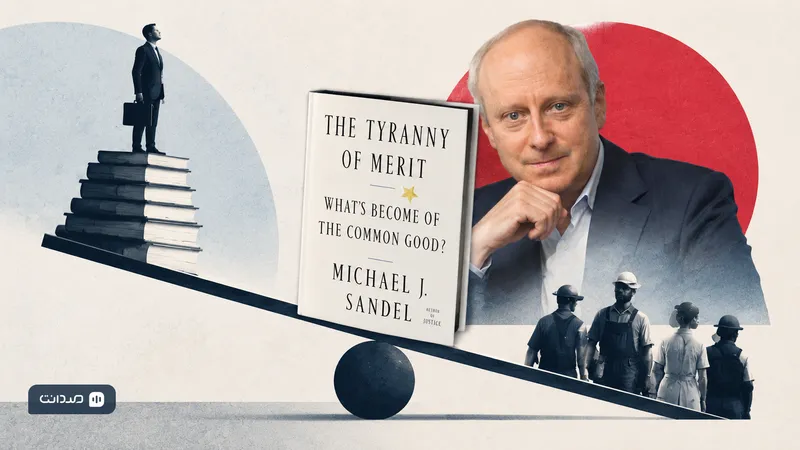

Michael Sandel
نویسنده
Manouchehr Zaker
ترجمه و توضیحHow Meritocracy Reinforces Inequality
Michael Sandel[1]
(Professor of Political Philosophy at Harvard University)
Translation and Notes: Manouchehr Zaker
Translator’s Note:
In recent years, economic and social inequalities in societies have been the subject of growing academic research, especially in Western countries. This issue is also of particular historical, social, and economic importance for Iranian society, though unfortunately it has received very limited attention in academic research. In addition to the economic structures that produce inequality in society, the beliefs that lead to the acceptance of inequality among the general public and intellectual elites are also important subjects of study. In Iran, these beliefs have roots in ancient ideas and traditions such as cosmic order, divine justice, innate worthiness of individuals, luck, fate, and sin. The creation of passivity among the public and resistance to fundamental reforms in society are among the consequences of these deeply rooted beliefs. Common research shows that in contemporary Western societies, meritocracy, as an economic-social structure, has intensified inequality and, as a belief system, has contributed to the acceptance of inequality among the public and elites. In Iran as well, there is a common belief that a person who acquires wealth is clever and deserving, while someone who does not is lazy and incapable. In the following article, political philosopher Michael Sandel examines aspects of meritocracy. Although part of the article concerns economic and academic institutions in American society, Sandel’s proposals are strongly applicable to any country, including Iran. Sandel’s critique leads to an analysis of the concepts of the common good and the dignity and worth of work. By definition, the common good refers to that which all or most members of a particular society share and from which they benefit. The common good also refers to what emerges from citizenship, collective action, and active participation in the realm of politics and public services. Referring to the prevailing inequalities in the social and economic recognition of different forms of work, Sandel finds the answer in Contributive Justice. In Sandel’s view, every profession that contributes to the common good should receive social respect and recognition. On this basis, he criticizes the view that ties the value of work to the economic benefit or financial capital generated by it. Honoring the realm of work helps reduce the divide produced by capital-driven meritocracy. It should be noted that the term social (or class) mobility used in this article refers to the possibility of moving from lower economic classes or disadvantaged social groups to higher classes or groups for individuals, families, and other social categories. The possibility and degree of social mobility in a society are measured through certain established criteria. Explanations within the text marked with M are from the translator.
End of translator’s note
It is tempting to think of meritocracy as a friend of equality. In hereditary aristocracies and caste societies (M: a type of highly hierarchical society, the most prominent example of which is found in India), people’s destinies are determined by their birth. By contrast, in meritocratic systems, people can rise; they can compete for desirable jobs and social roles based on their merits. Meritocratic selection appears egalitarian when compared with familiar alternatives such as bribery, favoritism, prejudice, and discrimination. Hiring people based on their talents rather than their connections seems like a fairer way of treating them. Of course, identifying talent is not always easy, especially when some people have greater opportunities to cultivate and demonstrate their abilities. But this does not mean meritocracy conflicts with equality. It only means that a genuine meritocracy requires truly equal opportunities for everyone to develop their talents.
In my book The Tyranny of Merit: What’s Become of the Common Good? [2], I argue that meritocracy is not the friend of equality that it appears to be. On the contrary, today meritocracy functions less as an alternative to inequality and more as its primary justification.
1 Winners and Losers
My reasons for opposing meritocracy are partly philosophical and partly political. The philosophical argument focuses on merit as a principle of moral desert: if everyone begins with equal chances, those who succeed deserve the rewards their talents bring them. This principle, although it may seem reasonable, faces three objections. First, having talents that give me an advantage is not something I choose; it is my good fortune. If everyone began a race from the same starting line and had equal access to good coaches, training facilities, running shoes, healthy diets, and so on, the most talented runners would most likely win. But being talented is a matter of luck. Therefore, it is difficult to see how winners can claim that they are morally deserving of the rewards society grants them.
Second, the fact that the society in which I live values the talents I possess is also a matter of luck. LeBron James is a great basketball player and receives enormous rewards for leading his teams to the NBA Finals. But these rewards reflect the fact that he lives in a society and a time when basketball is highly popular. If LeBron had lived during the Renaissance, his income and fame would probably have been much lower. People at that time were not as interested in basketball; they cared more about mural painters. Billionaire investor Warren Buffett has made a similar observation about the luck and chance that made his wealth possible. [3]
These two points—about the accidental nature of talent and the morally arbitrary nature of market demand for one talent or another—led thinkers with very different ideologies, such as Friedrich von Hayek and John Rawls, to reject meritocracy. Both rejected the idea that market rewards accurately reflect people’s merit or desert.[4]
To these two objections, I add a third, concerning the character and dispositions that meritocratic societies encourage in pursuit of success. Those who reach the top come to believe that their success is the result of their own actions—that is, their merit—and those who fail deserve their fate. This way of thinking reveals the darker side of meritocracy. It leads to what I call “meritocratic hubris”: the tendency of successful individuals to deeply absorb their success and look down on those who have achieved less. Such arrogance is not only morally unpleasant; it also deepens the divide between winners and losers, which is corrosive and destructive of the common good.
One way to address this divide is to try to level the playing field so that everyone has a genuinely equal chance of winning. But this cannot heal the inequalities of respect and self-worth that meritocracies produce. Even if everyone had equal chances of success, the divide between winners and losers would remain. The real problem lies in the image of social life as a competitive contest—a contest in which successful people believe, and have reason to believe, that they have earned their success and its benefits through their own efforts. Paradoxically, the closer we get to achieving genuine equality of opportunity, the stronger the belief becomes among both the successful and the unsuccessful that winners achieved success through their own effort and deserve its rewards.
This argument against meritocracy was first developed by British sociologist Michael Young, who introduced the term in his 1958 book The Rise of the Meritocracy. Although we now often regard meritocracy as an ideal concept, Young viewed it as a dystopia; he warned that this system would produce self-congratulation among the successful and discouragement among those who failed.[5]
Young’s argument against meritocracy concerned the moral psychology of “earning through effort” and “deserving” as well as the moral foundations of social respect. This argument was not directly about injustice. But if he was right, the attitudes that meritocracy creates in pursuit of success make it harder to correct inequalities of income and wealth through redistribution. The more we believe that market outcomes reflect people’s “moral desert,” the stronger the assumption becomes that income and wealth, wherever they are low, should remain that way.
In recent decades, the meritocratic way of thinking about success has become more prominent in public discourse, even as neoliberal globalization increased inequalities. In The Tyranny of Merit, I show that these two trends are connected. It is as though the winners of globalization want more than simply winning; they want to believe that they deserve a disproportionately large share of the income and wealth brought to them by four decades of deregulation, financialization, and neoliberal economic policies.
Max Weber (M: German sociologist, 1864–1920) observed:
A fortunate person is rarely satisfied with being fortunate. He needs to know that he has the right to enjoy his good fortune. He wants to be convinced that he “deserves” it, and above all, compared with others, that he is more deserving. He wants to be allowed to believe that those who are less fortunate experience only what they deserve. [6]
Weber was referring in his reflections to a religious belief that regards success as a sign of God’s favor and suffering as punishment for sin. A century later, advocates of neoliberal globalization treated market success as confirmation of merit. Lawrence Summers, economic adviser to Barack Obama, expressed this view openly: “One of the challenges of our society is that truth is inherently inequality-producing. One reason inequality has probably increased in our society is that people are increasingly treated in ways they expect to be treated.”[7]
2 The Sermon of Upward Mobility
Meritocracy as a political project was expressed through a familiar slogan: that everyone should be able to rise “as far as their effort and talent take them.” In recent years, politicians from both major American parties repeatedly invoked this phrase as a kind of magical slogan. Republicans, including Ronald Reagan, George W. Bush, and Marco Rubio, and Democrats, including Bill Clinton, Barack Obama, and Hillary Clinton, all appealed to this idea.[8]
This sermon of advancement has an egalitarian appeal because it emphasizes removing barriers to success: regardless of family background, class, race, religion, ethnicity, gender, or sexual orientation, you too should be able to advance as far as your talents allow. Few would disagree with this statement.
Yet despite its egalitarian appearance, this discourse of advancement reinforced rather than weakened inequalities of income and wealth. It did not reconsider the economic policies that created those inequalities. Instead, it offered an easy solution: individual upward mobility through higher education. To workers frustrated by stagnant wages and the relocation of jobs to low-wage countries, elites in the 1990s and 2000s offered an encouraging message: if you want to compete and win in the global economy, go to college. “What you earn depends on what you learn.” “If you work hard, you can win.”[9]
The elites who conveyed this message failed to see the implicit insult within it: if you did not go to college and are not thriving in the new economy, your failure is simply your own fault.
No wonder many workers turned against meritocratic elites. Those who spend their days among degree holders easily forget a simple fact: most people do not have a four-year college degree. Nearly two-thirds of Americans do not have such a degree [10]. Therefore, building an economy in which a college diploma becomes a requirement for dignified work and a respectable life is foolish.
Elites have so elevated the university—both as a path to advancement and as the foundation of social respect—that they struggle to understand the resentment produced by meritocracy and its harsh judgment of those who did not attend college. Such attitudes fueled resentment toward elites that Donald Trump, the current president of the United States, was able to exploit.[11]
When Joe Biden won the Democratic nomination in 2020, he was the first Democratic presidential nominee in 36 years without an Ivy League degree (M: a group of eight prestigious private American universities, mostly located in the northeastern United States). This may have helped him connect with blue-collar workers whom his party had struggled to attract in recent years. But the fact that a Democratic presidential nominee from a state university was such a new phenomenon reveals the influence of credentialism. By 2016, when Hillary Clinton lost to Trump, the Democratic Party had become closer to the interests and perspectives of the professional educated class than to the blue-collar voters who had once formed its base. This may help explain why mainstream Democrats during the Clinton–Obama era did little to reverse growing inequality.
White working-class voters who supported Trump are not the only ones overlooked by a meritocratic focus on higher education as the solution to their problems. Workers of color were also neglected by a political project that offered little support and social respect to those seeking occupations that did not require college degrees. James Clyburn, a representative from South Carolina and the most senior African American member of Congress, offered a devastating critique of his party’s meritocratic turn. Clyburn, whose endorsement of Biden in the South Carolina primary rescued Biden’s struggling campaign and propelled him toward the nomination, saw Biden as an alternative to the relentless credentialism that had driven workers away from the Democratic Party.
Clyburn said: “Our problem is that candidates spend too much time trying to show people how smart they are, instead of connecting with people.” [12] He believed Democrats had placed too much emphasis on university education. “When a candidate says, you ought to be able to send your kids to college, what does that mean? How many times have you heard that? I hate hearing it... I don’t need to hear it. Because we have people who want to be electricians, plumbers, barbers.” [13] Although he did not say it exactly this way, Clyburn was resisting a meritocratic political project that had unintentionally demeaned working-class voters and opened the way for Trump.
If meritocratic attitudes toward success have deepened the divide between winners and losers; if upward mobility through higher education is a weak response to inequalities of income and wealth; if the discourse of advancement has become, for many, no longer a promise but a taunt, what is the alternative?
We must begin by acknowledging that upward mobility cannot compensate for inequality. Any serious response to the divide between the wealthy and everyone else must directly confront inequalities of power and wealth, rather than settling for a project that helps people climb a ladder whose rungs are moving farther and farther away. This requires changing the concepts and terms of public discourse. In general, we should focus less on equipping people to compete in meritocratic contests and more on affirming the dignity and worth of work. We should ask what policies ensure that Americans who are not part of the privileged professional classes can find work that allows them to support their families, participate in their communities, and gain respect and social recognition for doing so.[14]
3 The Credential Divide
Part of the solution requires rethinking the role of higher education. Selective colleges and universities now act as judges of opportunity, granting credentials that market-driven meritocracy rewards. But turning universities into sorting machines reinforces and consolidates inequality. Wealthy parents have learned how to pass on their advantages to their children—not by leaving them vast estates, but by equipping them to compete in the meritocratic tournament and gain admission to elite universities. SAT scores (M: one of the two main standardized exams for university admission in the United States) are strongly correlated with family income. Access to internships, music lessons, training in sports such as squash, rowing, fencing, golf, and water polo also follows the same pattern; as do trips to distant places for volunteer work and other activities that make college applications stand out.[15]
At Ivy League universities and other elite institutions, the number of students from families in the top one percent of income exceeds the total number of students from all families in the bottom half of the income distribution. Only three percent of students on elite campuses come from low-income families (the bottom quarter). Most young people from the lower half of the income distribution either attend two-year colleges or do not attend college at all.[16]
Moreover, higher education is not the engine of upward economic mobility that we often imagine. Economist Raj Chetty and his colleagues calculated rates of economic mobility at around 1,800 American colleges and universities, both public and private, selective and non-selective. They examined how many students from these institutions moved from poverty (families in the bottom fifth) to the highest level of living in adulthood (the top fifth). The answer: about two percent. [17] The main reason is that very few students from low-income families enter four-year colleges. Higher education is like an elevator in a building where most people enter from the upper floors.
Although expanding access to elite universities is important, we also need to reduce the impact of the intense competition for admission. We should invest far more than we currently do in forms of learning that most people rely on to prepare themselves for the world of work, including state colleges, two-year colleges, and technical and vocational education. According to economist Isabel Sawhill of the Brookings Institution, we spend $162 billion annually to help people attend college, but only about $1.1 billion on occupational and technical education.[18]
This striking inequality not only limits economic opportunities for those who cannot or do not want to obtain four-year degrees, but also reveals the meritocratic priorities of those in power. Although around two-thirds of Americans do not have bachelor’s degrees, very few of them serve in the U.S. Congress. Ninety-five percent of members of the House of Representatives and all senators have four-year degrees. More than half of senators and more than one-third of House members are lawyers, and many others hold advanced degrees. [19] It has not always been this way. Educated people have always been disproportionately represented in Congress, but until the mid-1980s, fifteen percent of House members and twelve percent of senators did not have college degrees.[20]
One consequence of the credentialist wave is that the working class is now effectively absent from government representation. In the United States, around half of the workforce is employed in working-class occupations, defined as manual labor, service jobs, and clerical work. Yet fewer than two percent of members of Congress worked in such occupations before being elected. In state legislatures, only three percent of individuals have a working-class background.[21]
This brings us back to the failure of mainstream parties and politicians to address the uncontrolled inequality of recent decades. The era of globalization brought enormous rewards to those with prestigious credentials, but did little for most workers. From 1979 to 2016, the number of manufacturing jobs in the United States declined from 19.5 million to 12 million. Productivity increased, but workers received a smaller share of what they produced; executives and shareholders received a larger share. In the late 1970s, CEOs of major American companies earned 30 times the income of the average worker; by 2014, they earned 300 times as much.[22]
Economic hardship and the income gap were not the only sources of workers’ dissatisfaction. These injuries were intensified by a deeper, less visible wound: the destruction of the dignity and worth of work. By glorifying the “brains” required to achieve high scores on college entrance exams, the sorting machine humiliates those who lack meritocratic credentials. It tells them that their work—which the market values less than the work of highly paid professionals—contributes less to the common good and therefore deserves less respect and social recognition. This system legitimizes lavish market rewards for the winners and meager wages for workers without college degrees.[23]
The financialization of the economy has reinforced this discouraging message. As economic activity shifted from producing goods to managing money, and as society granted disproportionate rewards to hedge fund managers and Wall Street bankers, respected employment became more fragile and uncertain. At a time when finance has captured a larger share of corporate profits, many of those who produce useful goods and services in the real economy have faced not only stagnant wages and insecure job prospects, but also the feeling that society respects working-class labor less than other forms of work.[24]
This way of thinking about who deserves what is morally indefensible. Yet in recent decades, the idea that the money a person earns is a measure of their contribution to the common good has become deeply rooted.
Meritocratic sorting helped reinforce this idea. So did the market-friendly version of globalization embraced by center-right and center-left parties since the 1980s. Even as globalization created enormous inequality, meritocratic and neoliberal assumptions narrowed the space for resistance to inequality. They also weakened the dignity and status of work, fueled resentment toward elites, and provoked political backlash.[25]
4 Contributive Justice
To address inequality, we must reconsider meritocratic standards of success and neoliberal conceptions of the common good. The coronavirus pandemic offers a useful starting point. Those of us fortunate enough to work from home during the pandemic came to recognize our deep dependence on workers we often overlook—delivery and distribution workers, warehouse employees, supermarket cashiers and grocery store workers, public service workers, nurses, childcare providers, and home care workers. These are not the highest-paid or most socially honored workers in our society. Yet we now call them “essential workers.” This could be a moment for public debate about how to rebuild the economy so that their wages and social valuation correspond with the importance of their work.[26]
Such a reconstruction goes beyond familiar debates about the generosity or strictness of the welfare state. It requires democratic deliberation among citizens about what constitutes a contribution to the common good and how such contributions should be rewarded—without assuming that markets can answer these questions for us.
Such a debate moves us from disputes about distributive justice (how income, opportunities, and the goods of life are distributed) to disputes about contributive justice (how to create conditions in which everyone can contribute to the common good and receive pride and recognition for doing so).
A political program centered on the dignity of work must address contributive justice as well as distributive justice. Policy proposals to increase the purchasing power of working- and middle-class families or strengthen the safety net, though important, cannot by themselves resolve the deep anger and resentment that now exist. This is because the injury that most provokes workers’ complaints concerns their status as producers. Only a political program that recognizes this injury can effectively address the discontent that has disrupted our politics. For it is our role as producers, not merely as consumers, that determines what counts as a contribution to the common good and earns respect and social recognition. [27]
Half a century ago, Robert F. Kennedy expressed this well: “Fellowship, community, a shared patriotism—these essential values... are not gained simply through the purchase and consumption of goods.” Rather, they arise from “decent work at a fair wage,” the kind of work that allows us to say: “I helped build this country. I am a participant in its great public enterprises.”[28]
This idea—that citizens’ work brings them together in a framework of mutual contribution and recognition—was expressed in Martin Luther King Jr.’s memorable speech to striking sanitation workers in Memphis, Tennessee, shortly before his assassination: “Our society must one day come to respect the sanitation worker, because in the final analysis the person who collects our garbage is as important as the physician. If he does not do his job, diseases will spread. All labor has dignity.”[29]
What would it mean to place contributive justice and the dignity of work at the center of political debate? A few examples are illuminating: we could reconsider tax policies so that income from labor is not taxed more heavily than dividends and investment gains; adopt federal wage subsidies to ensure that low-wage workers earn enough income to support their families, neighborhoods, and thriving communities; prohibit publicly traded companies from buying back shares to raise stock prices and inflate CEO compensation; classify gig workers (M: independent, temporary, freelance, contract, telephone-based, or platform-based workers and others) as employees rather than independent contractors; expand economic bargaining power so, for example, fast-food workers can negotiate wages and working conditions across the entire industry rather than company by company; encourage domestic production of certain goods (such as surgical masks, medical equipment, and medicines) instead of outsourcing them to low-wage countries; and shift part of the tax burden from payroll taxes to taxes on financial transactions.
Such measures would reduce inequality to some extent. But my aim is not to offer a set of policy prescriptions; rather, it is to suggest ways of stimulating public debate about what constitutes a valuable contribution to the common good. Consider a tax on financial transactions. Even the most enthusiastic defenders of markets would find it difficult to claim that the social contribution of a high-frequency trader (M: a trader whose number of financial transactions is extremely large) is hundreds of times more valuable than that of a nurse, as their incomes suggest.
To know whether care workers are underpaid and high-frequency traders are overpaid, we must ask and debate the value of their contributions. The growth of finance in recent decades would not have been a problem if it had led to a corresponding growth of new businesses, factories, roads, airports, schools, hospitals, and homes. But as finance has exploded as a share of the American economy, very little of it has gone toward the real economy. Instead, more and more has been devoted to complex financial engineering that generates enormous profits for its practitioners but does not make the economy more productive. According to one estimate, only fifteen percent of financial flows now go toward new productive enterprises, while a larger share is devoted to speculation on existing assets or elaborate financial instruments.[30]
A tax on financial transactions and a reduction in payroll taxes would not only make the tax system more progressive; it would also reflect society’s judgment that work is more valuable than gambling-like forms of buying and selling. By discouraging extractive methods of earning income and instead honoring productive labor, this approach would reconfigure an economy of dignity and respect. These proposals are illustrative. My broader argument is that restoring the dignity and worth of work requires confronting the moral questions underlying our economic arrangements—questions that have been obscured by the technocratic politics of recent decades.[31]
One of these questions is what kind of work deserves recognition and respect. Another is what obligations we, as citizens, owe one another. These questions are connected because we cannot understand what forms of contribution deserve affirmation without discussing the goals and purposes of the shared life in which we participate. And we cannot debate common purposes if we lack a sense of belonging—if we do not see ourselves as members of a community to which we owe something.
Over the past four decades, market-driven globalization and the meritocratic conception of success have worked together to weaken these moral bonds. Global supply chains, flows of capital, and the cosmopolitan identities they fostered have made us less dependent on our fellow citizens, reduced our appreciation for their labor, and made us less attentive to demands for social solidarity. Meritocratic selection taught us that success is the result of our own efforts and thereby diminished our sense of indebtedness to society. We now find ourselves at the center of a storm of anger created by this rupture and lack of commitment. To renew civic life, we must repair the social bonds that the age of merit has broken.
[1] The article by Michael Sandel was published in the following journal:
American Journal of Law and Equality (2021) 1: 4-14
[2] Michael J. Sandel, The Tyranny of Merit: What’s Become of the Common Good? (2020).
[30] See Sandel, supra note 1, at 216–18. On the role of finance, see Rana Foroohar, Makers and Takers: The Rise of Finance and the Fall of American Business (2016); Adair Turner, Economics After the Crisis: Objectives and Means 35–55 (2012); J. Bradford Delong, Starving the Squid, Project Syndicate (June 28, 2013), https://project-syndicate.org/commentary/time-to-bypass-modern-finance-by-j--bradford-delong. The fifteen percent estimate is by Adair Turner, Foroohar, supra note 30, at 7.
[31] In this and the following two paragraphs, I draw upon Sandel, supra note 1, at 221–22.






Discussion0 comments
No comments yet; let yours be the first voice.