Religion
A Conversation with Karl Popper, an Agnostic Philosopher
Karl Popper spoke little about religion and God during his academic life. His conversation with Edward Zerin is one of the few sources for his views on religion—an interview conducted and published on the condition that it be released only after the philosopher's death.
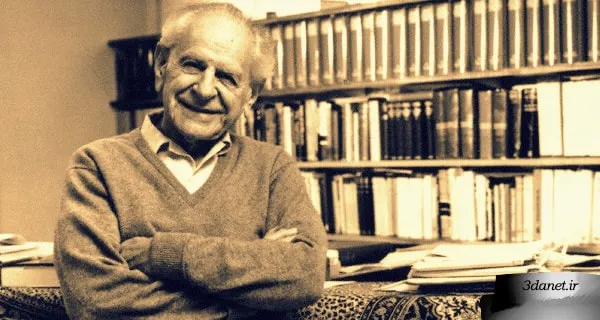
The interview you see in this text is the result of a conversation between Edward Zerin, a Jewish historian, and Karl Popper, the eminent contemporary philosopher. Throughout his academic life, Popper never spoke about religion or God, and this interview is among the few sources from which one can learn about his views on the matter. Popper had also set one important condition for conducting this interview: that it must not be published during his lifetime, but only after his death.
.
.
Popper as an Agnostic Philosopher
A Conversation with Karl Popper on Religion and God – Part One
Translation and Introduction:Yaser Mirdamadi
Translator's Introduction: What you will read after this section, in the second part of this article, is the Persian translation of a conversation that Rabbi Edward Zerin (Edwaed Zerin), a researcher of Jewish history and the philosophy of science, conducted with Karl Popper (Karl Popper), the eminent British-Austrian philosopher (1902–1994) (1). Throughout his prolific philosophical life, Popper almost never spoke about God and religion. Precisely for this reason, this short conversation, which took place in 1969, is one of the few sources that provides the reader with scant information about Popper's theological views. In this conversation, he explains why he chose to remain silent about God during his lifetime, and for this reason, he only agreed to speak on the matter on the condition that the conversation be published after his death. This conversation was first published in 1998.
The diligent Persian-speaking reader had, of course, read a few words from Popper about his view on religion and God before the English-speaking reader did. Dr. Hossein Kamali, who is now a professor of Islamic Studies and Middle Eastern History at Columbia University, asked Popper about God and religion in a short conversation at his home in suburban London in the solar year 71 (2). At the very beginning, Popper says, "I can be counted among the skeptical philosophers regarding the existence of God" (3) and then briefly attempts to reduce religion to ethics.
In the following, you will read the introduction by Edward Zerin, the interviewer, and as I mentioned, you can read the conversation itself in the second part of this article.
Interviewer's Introduction (Edward Zerin):
Karl Raimund Popper was one of the most prolific philosophers of the twentieth century. He left behind an original and bold intellectual legacy concerning the so-called “problem of demarcation” between science and pseudoscience in general, and the distinction between science and metaphysics in particular. He showed that the dividing line between science and pseudoscience, contrary to the claims of the logical positivists, is neither so precise nor so impermeable. The logical positivists held that through empirical verifiability one could distinguish meaningful from meaningless discourse. Popper, however, argued in favor of falsifiability, rather than verifiability, as the proper criterion demonstrating a theory’s empirical and scientific character. Popper’s hypothetico-deductive method presented the world with a new formulation of scientific activity; in Popper’s words, “Science is not a system of certain, or well-established, statements. Science is not epistēmē (knowledge)... Science can never claim to attain truth, or even a substitute for it. We do not know: we can only guess.” (The Logic of Scientific Discovery)
Popper’s legacy, though challenged, remains brilliant. In his lifetime, he was described thus: “No modern philosopher has deployed a more comprehensive critique of the quest for certainty than Popper’s.” (Quinton, Encyclopedia of Philosophy, Vol. 6)
Karl Popper was born in 1902 in Vienna, Austria, a city and country rife with anti-Semitic sentiment. His parents, both of Jewish descent, had decided to be baptized in a Lutheran church before starting a family. Years later, Popper wrote, “After much thought, my father decided that living in an overwhelmingly Christian society obliged one to give as little offense as possible—he assimilated into it because it served his work.” (The Open Society, Vol. 1)
Karl Popper was not, in the formal sense of the word, a religious person. He had no connection to the Jewish world of his ancestors, nor was he a devout Lutheran. Yet, it was Popper who granted me a deeper understanding of Judaism and opened the doors to a rich spirituality for me, a Jew.
In 1968, having received a Hillel Foundation fellowship to continue teaching Jewish clergy (rabbis), I was invited to Boston University as a researcher in the philosophy of science. There I gained access to classes at Harvard and Brandeis Universities. The philosophy department, chaired by Dr. Marx Wartofsky, welcomed me warmly, and Dr. Joseph Agassi and Dr. Robert Cohen guided me toward new intellectual adventures. Almost every day I knelt before great professors in pursuit of knowledge, and despite the rabbinical curriculum being a busy one, I took lesson after lesson from those professors. That is how I met Karl Popper. He was then a visiting professor at Brandeis University.
In November 1969, I conducted two private interviews with Karl Popper. He stipulated that these conversations not be published before his death. He died in 1994. What follows are excerpts from those conversations. This interview is being published for the first time.
Karl Popper opened a new world of thought to me. Nurtured on positivism, I had spent many of the early years of my scholarly career seeking truth through empirical activity. But my research soon showed that empiricism is not as objective as it claims to be. On the contrary, empiricism too is theory-laden and not free of theory, and is often a reflection of the sociology or culture of the scientific community as well as a reflection of theoretical assumptions. To me, Popper's conjecture was more convincing, which held that scientific paradigms are often cloaked in what he "called 'proof bluster'" or [value assumptions that are perhaps] "hasty and untimely expectations … or prejudices that are taken to be sincere and definitive". (Conjectures and Refutations)
Furthermore, I realized that behind the logic of rationality and intuitive claims lie proof bluster or unproven assumptions. Gradually, I adopted for myself a dual intellectual frame of reference, based on the idea that I cannot know anything with certainty and that my share of knowledge is only conjecture, "to err, to err, and to err / but less, less, and less". Over time, just as verisimilitude, and not truth, became my intellectual frame of reference, I also realized that before I could passionately admit God into my life, I no longer needed to prove God's existence. This idea became the religious/spiritual proof bluster in my new thinking.
In 1973, I shared my new outlook with Karl Popper. The reply he sent from England was: "The poem you shared with me -a poem, or perhaps a religious hymn?- was very beautiful."
Dedicated to Sir Karl Popper
It is not that we bow our heads to this belief
That there is no god for this world
Nor that He, in the pavilion of the Unseen
.Has become hidden
We hold that there is a god in our midst
Yet we can never know Him.
Yes, not so.
A kind of faithfulness brought
Upon this predicament
Us
Neither manifest blasphemy
Among the perished, talk of the Divine Essence
Was nothing but the speech of a confessor
Who has acknowledged the Truth as Truth
I had no news of the existence of Truth
I had no trace of His command
Our share from all this debate and lament
Is a mere supposition
Confirmed by a sign
We do not know if the world
Has bound itself to a purpose
Or if it is all chance
The direction of our being
Is beauty and goodness
The provision of our belief is this much, that it is.
The essence of this belief and this ember
Requires much pondering
Perhaps it is existence
Indeed, yes, we are
Who give it meaning
We give it shape
.Or we give it form
It is our intention, mind, and tongue
And our bodies
That give shape and form,
Yes, to the world
To the Living God, behold, it bore witness
This existence of ours.
It was itself a witness
This persistence of ours
To the transformation within our world.
That the cosmos
Has existence or becoming
It was not ours to decree and determine it
To live in contradiction is
Our state and condition, for in this world
The fact of the matter,
Which does not come-
Lo, ever into
-the grasp of our understanding
Arises, tests
Our woven fabrics
Of truth
Now, thirty years after I first became acquainted with Popper and his epistemology, I am more than ever an inquirer who thinks, rather than a thinker who inquires. Before I met Popper, I was a thinker addicted to the truth of my own hypotheses, someone who tried to influence others by imposing my own arbitrary authority. Now, however, I wish to be an inquirer who lives with a broader conception of autonomy and has a broader conception of his responsibility toward the autonomy of others. As an inquirer, I am more inclined to take intellectual risks. So, “let us err, err, and err / but less, less, and less.”
-----------------------------------------------
Translator’s Introduction Endnotes:
1- The details of this interview are as follows:
Zerin, Edward. “Karl Popper on God: The Lost Interview.” Skeptic 6, no. 2 (1998): 46–49.
2- “Kiyan’s Conversation with Karl Popper”, Interviewer: Hossein Kamali, Kiyan Monthly, 1371, No. 10, pp. 4-7. Link to Interview
3- Ibid, p. 6.
.
.
Popper as an Agnostic Philosopher
Popper as an Agnostic Philosopher: A Conversation with Karl Popper on Religion and God — Part Two (Final)
Translation: Yaser Mirdamadi
Note: In the first part of this article, a brief introduction to Karl Popper and his silence on religion and God was mentioned, followed by a translation of the interviewer Edward Zerin's introduction to this conversation. Now, the conversation itself is presented for your consideration.
Zerin: Does God have a place in your thinking?
Popper: Although I am not a Jew, I have come to the conclusion that there is profound wisdom in the Jewish commandment that says: "Thou shalt not take the name of the Lord thy God in vain." [The third commandment of the Ten Commandments: Exodus 20:7 and also Deuteronomy 5:11] My criticism of institutionalized religions is that they are intent on taking the name of the Lord in vain.
I do not know whether God exists or not. We may know how little we know, but this not-knowing should not be turned into a positive knowledge about a deep mystery. There are many things in the world that have the nature of a deep mystery, but I do not think it is permissible to construct a theology out of our lack of knowledge, nor do I think it is permissible to turn our ignorance into a positive knowledge. Some forms of atheism are arrogant and ignorant and should be rejected, but agnosticism—acknowledging that we do not know and therefore engaging in inquiry—is acceptable.
I would be happy if God existed, because I would be able to focus my sense of gratitude on a personage to whom one is grateful. Despite the mess that bad philosophers and theologians have made, the world is a wonderful place. These people must be blamed for many wars and cruelties.
Although monotheism is philosophically and emotionally superior to polytheism, much can be said in favor of polytheism. The structure of polytheism is such that the likelihood of recognizing other religions is greater, and the likelihood of extremism is not high. In monotheism, it is much more difficult to make room for the truth of other religions.
The whole issue goes back to myths which, although they may have some truth at their very foundation, are false. So why should the Jewish myth be true and the Indian and Egyptian myths not be true?
Zerin: You said that you respect religions for two reasons: first, that you know nothing about God, and second, that perhaps some people need religion, and consequently, religion might be beneficial for them.
Popper: I do not think that all individuals, myself included, are religious people. We all believe in something that is more important and higher than ourselves—finding the right word to describe it is, of course, difficult. I do not want to create a new religion, but that higher thing we believe in is something I have named "World 3." Something that is beyond us and with which we interact (interaction in the literal sense of the word) and through which we can transcend ourselves. This is a mode of exchange—not an exchange on an animal level, of course—that is the result of creative works. Art is an example of this. Music is the art that has the most meaning for me. I can surrender myself to music, which for me is an objective experience, and thereby improve my state and mood.
Zerin: We are not isolated individuals. If our existence depends on social groups, how can we make creative use of your epistemology?
Popper: Do you remember that phrase:
The path to wisdom, which is indeed
Clear and simple
Behold, this is it, indeed
We err, we err, and err
But less, less and less
I do not possess the mania for doing great things to the extent that those who fulfill social needs do.
Zerin: Perhaps you remember the Hasid story I wrote in one of my articles: "I want to know who I am and who 'You' are—and 'You' here means God—before I continue my prayer." Life can end before the Hasid knows the answers to his questions: "What should I do? How can I transform from a thinking individual into a searching individual? What assumptions should I, at least temporarily, put to the test?"
Popper: Yes, you must take action.
برای عمل کردن باید به پارهای امور باور داشته باشید، حتی اگر این باورها گاهی صادق نباشد. برای عمل کردن، شما باید چیزهایی را بپذیرید. پس از آن، شاید شما بتوانید باورهای خود را مورد بازنگری قرار دهید، گرچه شاید واقعاً هیچگاه وقت کافی برای این کار نداشته باشید. زِرین: آنطور که من دریافتم، جایگزینِ استبداد، نه بیعملی است و نه مرجعیت خودسرانه، بلکه خودآیینیِ مسؤولانه است -مسؤولیت، یعنی مشارکت و خطر کردنِ حسابشده.
پوپر: خطا کنیم، خطا کنیم و خطا / کمتر اما، کمتر و کمتر.
زِرین: بله، امید آن است که خطا کمتر شود.
پوپر: اما ما نمیدانیم که خطا کمتر میشود یا نه. خطر کردنِ حسابشده، خطری است که در آن ما تنها محدودیتهای خطر کردن را میدانیم.
اگر صدقْ معیاری میداشت، ما کمابیش عالم مطلق میبودیم. وقتی میخواهیم واقعیاتی را کشف کنیم، باید دوباره و دوباره بکوشیم خطا کنیم. با این حال، حتی با وجود دانشِ ناکافی، باید موضعمان را برگزینیم.
زِرین: چرا نمیتوانید مشابه همین موضع را نسبت به موضوع خدا بگیرید؟
پوپر: موضعِ بهترین دین نیز در باب خدا چنان مبهم است -و به درستی اینگونه است- که به سختی میتوان گفت چیز ملموسی برای آزمودن در این میان وجود دارد. در باب دین، تنها چیزی که به احساسات ما خوش میآید، وجود دارد. دین تا جایی که آزمونپذیر است، به نظر کاذب میآید. این حکم تهمتی نسبت به دین نیست، زیرا دین، علم نیست. بلکه این حکم تهمتی است علیه الاهیدانانی که با دین چنان برخورد میکنند که انگاری دین، علم است.
من معیار ابطالپذیری را پیشنهاد کردم تا علم را از آنچه علم نیست، جدا سازم. اما، چیزی که علم نیست، به این معنا نیست که بیمعنا است.
هرگونه سخن گفتن از خدا، به نحوی و به یک معنا، ناخوشآیند است. وقتی به چیزی مینگرم که آنرا هدیۀ حیات مینامم، احساس شکرگزاری میکنم و این احساسی است که با برخی تصورات دینی در باب خدا سازگار است. اما، همان لحظه که حتی از چنین امری سخن میگویم، آشفته میشوم که چه بسا با سخن گفتن از خدا، به خدا جفا کرده باشم.
زِرین: ممکن است سؤالی مربوط به زندگی شخصیتان بپرسم؟ آیا شما تشکیل خانواده دادهاید؟
پوپر: ما بچه نداریم. من و همسرم در بدترین دورهی هیتلری ازدواج کردیم. همسرم نیز مثل من یهودی نیست، و ما تصمیم گرفتیم بچه نیاوریم. به نظرم این احتمالاً کاری از سرِ ترس بود اما به گونهای تصمیم درستی بود. بچه نیاوردن هم یکی از آن چیزهایی است که کاری علیه خدا از کار درمیآید. اگر کسی در بدترین وضعیت توانست شجاعت خود را حفظ کند، این خود دلیلی به سود خدا است. من فکر نمیکنم که هیچ انسانی بتواند در مقابل شکنجهها در اردوگاههای کار اجباری -شکنجههایی که روح آدمی را درهممیشکند- مقاومت کند. برخی البته مقاومت کردند، اما همه به یک اندازه شکنجه نشده بودند.
زِرین: شما در دوران جنگ در اروپا نبودید؟
پوپر: وقتی اردوگاههای کار اجباری آغاز شد، من در اروپا بودم، و دریافتم که چه چیزی دارد اتفاق میافتد. برخی از بهترین دوستانم در این اردوگاهها بودند. تقریبا هفده نفر از بستگانام -عموها، عمهها و دیگر بستگانام- در اردوگاههای کار اجباری کشته شدند. زِرین: به خاطر اینکه یهودی بودند کشته شدند؟ یا به خاطر اینکه آزادیخواه بودند؟ پوپر: چون یهودی بودند. من سه نفر از آنان را از این اردوگاهها در آوردم.
زِرین: اگر درست به خاطر بیاورم، شما در بخش مهمی از جنگ در نیوزلند بودید، هنگامی که «جامعۀ باز» را نوشتید.
پوپر: بله.
زِرین: با مسألهی شرّ در جهان چگونه سر میکنید؟
پوپر: این یکی از همان مسائل است ...
زِرین: خب، این مسأله را چگونه میبینید؟
پوپر: نه تنها احتمال شرّ وجود دارد بلکه همچنین احتمال شرّ بنیادی (رادیکال) وجود دارد، این اصطلاحی است که کانت پیش نهاد. شر بنیادی با بشر کاری میکند که حتی شجاعترین و بهترین انسانها نمیتوانند -بی آنکه روحشان درهمشکسته شود- در مقابل آن مقاومت کنند. من فکر نمیکنم کانت میدانست دارد از چه سخن میگوید. پیش از هیتلر من نیز نمیدانستم شرّ بنیادی یعنی چه.
زِرین: وجود شرّ را چگونه توضیح میدهید؟
پوپر: من نمیتوانم وجود شرّ را توضیح دهم. It is evil that has turned me against God and made me doubt whether God, or any being like it, exists or not, and has made me more certain that one should not speak of God.
Zerin: In your view, how can one overcome “radical evil”?
Popper: Overcome? That is a bold word. I do not know. All we can do is try as hard as we can to make people aware, through rational means (and also through not entirely rational means, such as a subtle appeal to their emotions), that violence and brutality must, at any cost, be set aside.


Discussion6 comments
همه چیز را همهگان دانند و همهگان هنوز ز مادر نزائیده اند! علت اینکه کارل پوپر در طول عمر پر بار خود به خدا و دین نپرداخته است، این سهل انگاری و اشتباه کلیه اندیشمندان ماقبل او و خود او می باشد که نتوانسته اند مفهوم خدا را از اسارت دین و مذهب نجات دهند و دین را فقط یک زاویه ساده کودکانه به خداوند بدانند و و ادعای وارث بودن دین به شناخت حکمت الاهی را باطل کنند و حکمت الاهی را از دیدگاه علم بررسی کنند.
چرا اسارت ؟ دین همیشه مؤید مشاهده ، عقل، و علم بوده لااقل در نگاه شیعه شما اگر شیعه هستید. این موضع سکولاریسم است که علم را مغایر با دین می داند و دین را در مسیحیت کاتولیک خلاصه می کند که اشتباهی مشخص و واضح است. یادتان نرود که دانشگاه هی اروپا از حوزه های علمیه seminary های کلیسا در آمد. مسیر غرب در انکار مسیحیت تعصب ضد کاتولیک بود و غلو در سیاهی قرون وسطی با بیرون آمدن دانشگاه وروشنگری از دل این برچسب قرون وسطا ناسازگار است. کتب زیادی در این ابطه وجود دارد اما در هیاهوی سکولار ها و تسلط ناحق آن ها بر دانشگاه و ساینس سکو.لار و فالسفه مد روز شنیده نمی شود و در کشور شما مورد سانسور شهرت طلبان عاشق توجه و جایگاه است.
از کجا معلوم که این مصاحبه انجام گرفته واقعا؟!الان من اگه یک مصاحبه اختصاصی از نیچه که فقط با من انجام داده و گفته سال 2018 منتشر کن، منتشر کنم شما چرا باید باورتون بشه؟ کاملا معلومه این فرد یهودی بیشتر در پی منافع یهودیت و جعل تاریخ بوده، همون چیزی که اونها ید طوڸایی در این کار دارن
با سلام و تشکر کنجکاوی در خصوص پاسخ به پرسش های بنیادین توسط کسانی که پایه گذاران علوم بشری هستند بسیار فرح بخش است .
با سلام ممنون از مدیران و مسئولان سایت. در صورت امکان فایل کامل قرائت نبوی از جهان استاد محمد مجتهد شبستری رو در سایت قرار دهید. با تشکر
بسیار ممنون از سایت خوبتان و نیز از مترجم محترم.