Religion
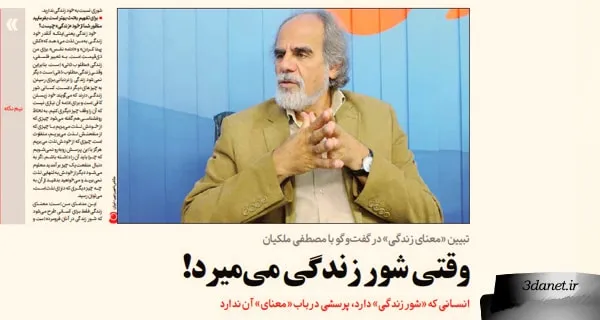
A Conversation with Mostafa Malekian: Hope and Hopefulness from the Perspectives of Islam and Buddhism
Hope finds meaning only in the realm of the non-rational; comparing Islam and Buddhism with a secular worldview, Mostafa Malekian analyzes the difference between traditional and modern humanity in their ways of encountering the outer and inner worlds, and examines the concept of progress.
It is evident that the discussion of "what human beings are permitted to hope for" is among the most fundamental issues related to hopefulness. This conversation, while examining the propositions to which we are permitted to pin our hopes, compares the concept of hope in two worldviews, religious and non-religious. Subsequently, the perspectives of Islam and Buddhism on hopefulness and the objects of hope will be reviewed, and finally, the crucial question of "what hope can one have for human beings?" will be discussed.
To begin with, as an introduction, would you please explain to what kind of propositions it is, in principle, permissible to attach hope?
We can divide matters into three categories: reason-affirming, reason-opposing, and reason-evading. Reason-affirming matters are those that reason fully accepts; reason-opposing matters are those that reason fully rejects; and reason-evading matters are those that reason neither accepts nor rejects—as if they hold an equal status before reason. In fact, hope only finds meaning in the realm of reason-evading matters. In many cases, our hope is attached to a change in one of the natural and existential laws governing the universe and humanity, which is an irrational hope—psychologists call this type of hope wishful thinking. For example, one cannot say, "I hope water boils at one hundred degrees Celsius," because this is actually a reason-affirming matter and therefore cannot be an object of hope. Or, for instance, you cannot say, "I hope to find a five-sided square" or "I hope to find someone older than their father," because all these cases are reason-opposing matters.
Of course, we must not forget that reason-evading matters themselves can be divided into three categories. The first category is preponderant reason-evading matters, which are annexed to reason-affirming matters, because reason is neither able to confirm nor reject them, but the evidence brought in favor of their truth outweighs the evidence for their falsehood. The second category is outweighed reason-evading matters, which, conversely, are annexed to reason-opposing matters. And finally, the third group consists of reason-evading matters that are neither preponderant nor outweighed, and it is this last category of reason-evading matters that accommodates hope. Therefore, this classification will reduce many of the things we call hope; but it is not the case that the number of our hopes drops to zero with this classification; that is, we still have many reason-evading matters to which we can attach hope.
Hope, in the words of philosophers, especially phenomenologist philosophers, possesses intentionality, and in this respect, hope can be likened to love, which is always directed toward an entity: "I cannot say there is love in my heart and not know toward whom the love in my heart is directed." "You cannot say, 'I am hopeful, but I do not know what I am hopeful for.' Therefore, we must see what we have pinned our hopes on."
In general, how is hope defined in the religious worldview?
In order for hope in the religious worldview to be well understood, it is necessary to identify its counterpart in the non-religious worldview, so that through the contrast between hope and its counterpart in the non-religious worldview, we can better grasp what hope is like. Today, one of the very common concepts and findings, understood and accepted by humanity, is the concept of progress, and the general belief is that humanity is progressing day by day. It can be said that this is one of the settled intuitions and ideas in the minds and consciences of people today, but it is interesting to know that this idea is very recent and has a history of less than 250 years. Until 250 years ago, no one in history had maintained that humanity is progressing.
The idea of progress emerged in Europe from the late eighteenth century onward. The emergence of this idea depends on three factors. These three factors worked together, and humanity gradually came to believe in this idea. In my opinion, none of these three factors is a logical consequence of the idea of progress, but psychologically they prepared human beings to receive and accept this idea. I will briefly offer an introduction, so that after this introduction all three factors will reveal themselves. All human beings, through the collective experience they have had throughout history, have arrived at this point: when things are not in accordance with our wishes, two things can be done: one is to make things conform to our wishes, and the other is to make our wishes conform to things. In either case, I have eliminated this incompatibility between my inner world and the outer world, except that one time I eliminated it by making the outer world conform to my inner world, and another time by making the inner world conform to the outer world, and both actions are possible. Of course, discussions concerning duty and obligation are not at issue now. These two things can be done; you can make things conform to your wishes, and you can adapt your wishes to things.
Imam Ali ibn Abi Talib (AS), in describing one of his religious brothers, said: Lā yashtahī mā lā yajid, he did not desire what he did not find. What does this mean? This is the second way. In the ancient world, this issue had not been raised, but humanity's general inclination was more toward making one's inner self conform to the outer world. This inclination was fully present in the traditional world. From the time humanity began to consciously change this inclination and alter the outer world to make it conform to its inner world, we step into the era of modernity. In my view, the distinguishing difference between traditional man and modern man lies precisely in this. Traditional man is traditional to the extent that he wants to transform his inner self. According to this conception, the definition of traditional man is a person who makes his wishes conform to things, and modern man is a person who makes things conform to his wishes. When humanity, by virtue of this very mode of conception, sought to transform the outer world, it also took note of a second point, namely that among the various branches of the sciences and knowledge, only one branch possesses the power to change the outer world. If we confine the totality of human sciences and knowledge to four categories—empirical sciences and knowledge, historical knowledge, rational and philosophical knowledge, and intuitive sciences and knowledge—it appears that only the empirical sciences and knowledge can transform the outer world. In the second step, modern man turned to the empirical sciences, encompassing both the natural empirical sciences, such as physics, chemistry, and biology, and the human empirical sciences, such as psychology, sociology, and economics. As it happened, when this turn toward the empirical sciences took place, these sciences also answered this call, and humanity saw that it had acquired a staggering power to change the world. According to some thinkers, such as Fourastié, humanity gradually became dizzy, as it were, realizing that we can change the world so much, and until now neither we nor our forefathers and ancestors had been changing the world—how much power exists in empirical matters! When these empirical sciences grew and fulfilled humanity's expectations, they did not disappoint the hope that humanity had placed in them.
With the growth of the empirical sciences, technology also grew, and gradually, psychologically speaking, humanity became predisposed to think that we are progressing in every respect. Yet what was actually observed was the growth of the empirical sciences and the technology derived from them. Now, in what respects did this progress occur? One could say progress emerged in six respects, which I will describe in the form of a pyramid. At the base of this pyramid or cone were those who believed that humanity has progressed only in the area of the empirical sciences. A smaller number held that humanity has not only progressed in the empirical sciences but has also continually advanced in technology. Those fewer still in number said that the progress of empirical science and the progress of technology have also brought about progress in human welfare. That is, we have also advanced in terms of biological needs, such as sleep, rest, food, clothing, shelter, recreation, and so on. A fourth group, again smaller in number, believed that humanity has also continually progressed in terms of social ideals. Social ideals refer to justice, freedom, order, security, and social welfare. A fifth group posited yet another kind of progress, saying that humanity has been progressing in terms of moral ideals as well; today there is more honesty than before. There is also a sixth view that goes even further and says: humanity is also progressing in terms of its own psychological and perceptual faculties, and human beings are becoming more rational day by day.
In this pyramid, where the number of adherents decreases as we move from the base toward the apex, what reason did the proponents of progress have for these views? There was no logical justification. Two factors caused this thought: one was the growth of the empirical sciences, and the other was the growth of technology. If, epistemologically, you believe that the sole path to discovering the truths of the real world is the use of the methods of the empirical sciences, then it is said that you have adopted scientism; you are a science-worshipper, afflicted with scientism. Suppose I own a four-story house, and because I am completely young and vigorous, I move about freely on all four floors of the building. Then suppose I gradually grow old, or for some other reason, I can no longer climb the stairs; naturally, my house becomes a single-story one. I have lost the ability to access, handle, and move about on the other three floors. It is even possible that I live on this ground floor for so long that I gradually forget my house ever had a second, third, and fourth floor. It might even go further than that, and I might say my house was always a single story.
Now let us return to scientism. Scientism was an epistemological view, whether right or wrong. When humanity came to believe in scientism—that is, came to hold that the sole path to discovering the truths of the universe is the method and methodology of the empirical sciences, and said that truths not discoverable by this method are also not discoverable by any other method—it would say those truths exist but are undiscoverable; it did not say no other truth exists, it said they exist but we have no way to discover them. This was an epistemological claim. Gradually, psychologically, humanity came to regard what it considered an undiscoverable reality as also unreal. This scientism led to an ontological tendency that the universe is confined to nature. This epistemological scientism resulted in ontological materialism. When humanity lost belief in a supernatural realm, even if undisclosed, it gradually came to hold that whatever is undisclosed is nonexistent. That is, it transformed its epistemological subject into an ontological subject, and then sought everything it desired within this very natural world. This scientism caused humanity’s attention to be confined to the natural world and to search for manifestations of progress within the natural world. Gradually, this idea of progress, due to the three factors of empirical sciences, technology, and scientism, became established, and we became psychologically predisposed to accept it.
But this idea was a newly emergent phenomenon. For example, at the dawn of Iran's Constitutional Revolution, the constitutionalist intellectuals who were familiar with Europe and Western thought observed the Westerners' belief in progress. This was so strange and peculiar to Iranian intellectuals—how could one possibly believe in progress?! First of all, they had no word for it in Persian, and for this reason, in Iranian newspapers from 90 years ago, since in European languages they say "progrès" for progress, they used that very word; so-and-so believes in "progrès," such-and-such a thinker believes in "progrès." This idea was that novel. Of course, this point has many proponents and opponents. Some in the West disagree with what I am saying, though some agree as well. Critics of the idea of progress are abundant. On the other hand, many thinkers defend this idea, if we are to examine it fairly. Therefore, the idea that humanity is necessarily progressing lacks validity. The second point is that there is also a value concept within progress. Even if it is proven that the empirical sciences are constantly growing, can this growth of the empirical sciences truly be interpreted as progress or not? Is the growth of the empirical sciences truly a desirable thing or not? That, too, in my opinion, is debatable. In the non-religious worldview of modern man, the idea of progress is thoroughly established.
Now, what do religions say? It seems that in religions, the idea of progress does not exist, and in its place, the idea of hope exists. Religions replaced progress with something else called hope; they said you are not progressing. It is not the case that every father is more backward than his son, and every son more backward than his grandson, and every grandson more backward than his great-grandson; such a thing does not exist at all. Rather, for every individual human being, there is something called hope. Hope is very different from progress. There are at least three major differences between progress and hope. Firstly, progress is a claim about the past, present, and future of humanity that has actuality, but it is not necessary for hope to be attached to realized matters. I may hope for something, and it may be realized. I may also pin my hopes on something, and it may not be realized. In hope, a kind of desirability is the focus, not a kind of actuality, whereas in progress, a kind of actuality is the subject of the claim. Secondly, progress is a social idea. When we say today's society is more advanced than the society of a hundred years ago, we do not mean that every human being in this society is more advanced than every human being in the society of a hundred years ago. Progress is a judgment about society, not about each and every individual member of the community, but hope is an individual matter.
The next point is that hope leads to action, but the idea of progress does not necessarily call for action. Why? Because the idea of progress says this law governs existence; whether you are lazy or not, this law holds sway. If you are aboard a ship, its movement and stillness have nothing to do with you, the ship's passengers. But if, instead of being aboard a ship, I am myself swimming in the sea, what I approach and what I distance myself from depends on my own activity. The idea of progress says a ship called progress has set sail and there is a general forward-moving trend; therefore, it issues no call to action whatsoever. But hope cannot fail to have some effect in the realm of action. Hope is, in fact, an individual matter, although it does not guarantee fulfillment. There is always a kind of uncertainty, suspicion, and doubt in hope, and this very uncertainty helps create motivation. Religions subscribe to this hope.
One who subscribes to hope has at least two major presuppositions. Their first presupposition must be that the laws governing the universe are not limited to the known laws. If you consider the laws governing the universe to be limited to the known laws, then hope no longer exists. Hope is always a kind of transcending of what humanity has so far scientifically attained. There is room for hope only if we believe that the laws at work in the universe are broader than the set of laws that science has encompassed to date. Otherwise, there is no room for hope. The second presupposition that exists in the idea of hope is that the human being believes a kind of awareness flows and courses through the world, if I do not say it governs the world.
What does Islam identify as the object of hope; and how does it evaluate hope and terms close to it?
In Islam, hope—but hope in God—is emphasized; we must place our hope only in God and must sever hope from all else. That is why we find in the supplications: “Ilahi hab li kamal inqita‘i ilayk; O God, detach my heart from everything and join it to Thyself.” In the Qur’an and our Islamic traditions, rajā’ has always been regarded as desirable and commendable, though its object is understood to be God—“Let none of you hope for anything but his Lord”; this is usually translated into Persian as omid (hope). On the other hand, there are instances in the Qur’an and traditions that are condemned, and that is umniyya: “Those are their amānī.” How does umniyya differ from rajā’? Suppose its Persian translation is wishful thinking. Umnīya means wishful thinking, but the Persian translation does not settle the matter. How does hope differ from wishful thinking? While hope is highly commendable and good, umniyya is, on the other hand, very repugnant. We also have a third subject that is neither commendable nor repugnant, though some of its branches are good and some of its branches are bad, and that is amal. Amal has not been deemed repugnant in religion in general, but ṭūl al-amal, or prolonged desire, has been deemed repugnant.
The Qur’an, in response to the Jews who said we will not enter Hell, and if we do, we will enter it for only a short time, says: “Those are their amānī”—this is umniyya. Well, if I, as a Muslim, come to believe that I will be encompassed by divine pardon, by divine forgiveness, should I regard this as belonging to the category of divine mercy, or wishful thinking, or ṭūl al-amal? As far as I know, in all cultures there are a number of phenomena that are on the same horizon as hope, with closely related sources and closely related outcomes.
In the Islamic world, I have not seen any precise work done on this subject. Only a well-known German Islamicist named Rosenthal, who is originally Russian, has written a book in English entitled Sweeter than Hope. In that book he has tried to elucidate the concept of hope and these several adjacent concepts in Islamic culture, including the Qur’an, traditions, and Arabic literature, both poetry and prose. He has written this book superbly, yet I still feel that it is not exactly clear where the boundaries between them are distinguished. I mentioned these things because the phenomenon of the advent of the savior can also be viewed from several dimensions. One dimension of looking at the phenomenon of the advent of the savior, saviorism, and, in the Shi‘i expression, Mahdism, is to regard it as belonging to the category of hope. So this can also be considered one of the instances of hope, and it seems that the concept of hope has a necessity, or at least a great benefit, for the very issue of belief in a savior.
Given that you have mentioned in your previous remarks that a small number of thinkers, such as the Buddha, regarded hope not as a virtue but as a vice, would you please explain the details of such views?
In many ethical systems, hope is considered a virtue. The Buddha was the only founder of a religion and creed who considered hope a vice. The Buddha believed: hope is no virtue in a human being; rather, hopelessness is the virtue. Hope is a vice; hope is one of the feelings and emotions that does not contribute to our well-being but exists within us, like malice and hatred, which exist within us and are part of our emotional and affective sphere but do not help our lives. He, however, has a specific meaning of hope in mind and believes that hope in three things must be severed. When I say that we must sever hope, I mean hope in three things to which our hopes are attached and which destroy the well-being of our lives.
The first is severing hope in supernatural forces. That is, hope in forces that are beyond the laws that govern existence—meaning, for instance, that you hope these forces will stretch out their hand and suspend the laws governing existence in your favor.
Hope in supernatural forces is harmful to us; when you have a problem in a ministry, on the first day you go they tell you that you must complete fourteen tasks, unless you can see the minister himself, in which case seeing him eliminates the need to go through these fourteen stages—that is, the minister can reach out his hand and provide you with a shortcut that bypasses all fourteen stages. Many times we think that there are laws governing existence that have fourteen stages we must go through, unless a god, a spiritual master, or a prophet reaches out and cancels these laws. I call this belief in the supernatural intervention of supernatural forces. Of course, I am not making an ontological argument, and I do not want to say that supernatural forces do not exist. The point is that if supernatural forces do not exist, then good for us and good riddance to them, and if they do exist, they do not intervene in the laws governing existence for the benefit of any particular person; this was a point that Buddha first pointed out. Buddha said that supernatural forces do not intervene in natural affairs, so cut off your hope in supernatural forces that would make supernatural interventions in natural affairs. This teaching of Buddha received less attention in Eastern religions, but in Western religions—that is, the religions we call Abrahamic, and which are sometimes called Mosaic religions, namely Islam, Christianity, and Judaism—it was not heeded at all. In this respect, in these religions there is prayer for personal purposes, which implies that as if, besides natural channels, there are also supernatural channels that make supernatural interventions in natural affairs.
The first time Buddha's message entered the Christian world was through Simone Weil, the philosopher, mystic, political and social activist, and philosophical theologian of the early twentieth century. She strove greatly in this direction to inject Buddha's message into theological culture. In her famous book Gravity and Grace, Simone Weil expresses this discussion and says: Throughout history, human beings have been divided into two groups, and we also suppose that we must go either this way or the other, but Buddha wanted to say that there is a third way. In Christian theology, too, we must instill this way. The two ways people took were these: people believed either that God exists and if we ask and supplicate Him, He will intervene in our lives for our benefit, or that there is no God in the world at all. Thus, they either believed in an interventionist God or believed in "philosophical materialism." Therefore, they say that if someone prays in a state of dire distress and it is not answered, it turns out that God did not exist, because if God existed, He would have answered the prayer. That is, He would have intervened for their benefit and entered the course of history, since He Himself has said, "He answers the distressed one when he calls upon Him and removes the evil." That is, you reach a state of dire distress and ask God for something. God has stipulated that you must reach a state of dire distress, in which case He hears your words, perceives your need, and removes the evil from you—that is, He wards off evil from you. Because in our minds it is such that if someone prays in a state of dire distress and their prayer is not answered, they themselves or others say it turns out there is no God. Simone Weil said: I believe there is a third way in the world. God exists but does not intervene for anyone's benefit; therefore, our matter is not confined to either being a materialist who says there is no God at all, or saying that God exists and intervenes in our lives. God exists, but in no one's life does He make any intervention for anyone's benefit or harm. Why?
Simone Weil said that the world is a world of necessity. God created the world based on the principle of necessity, and the principle of necessity means the principle of inviolable causal laws. Causal laws are not confined to the laws of physics, chemistry, and biology; the laws of psychology, sociology, education, politics, economics, and so on also govern existence. By laws, I do not mean only empirical natural laws, that is, the exact sciences like physics, chemistry, and biology. Therefore, by laws, I do not mean the laws governing inanimate nature. Yet, at the same time, psychological laws and spiritual laws are also laws, and a law imposes a necessity upon existence in which even God does not intervene. This is the requirement of existence. God can choose not to create oxygen, and can choose not to create hydrogen, but cannot create oxygen and also create hydrogen without the two having a chemical affinity for each other, because if you created oxygen, oxygen has its own properties. If you created hydrogen, hydrogen also has its own properties. If you created oxygen and hydrogen, the two have a chemical affinity for each other. God can choose not to create oxygen, and can also choose not to create gold, but if He created oxygen and gold, He cannot say, 'I created you, but have a chemical affinity for each other.' Oxygen and gold do not have a chemical affinity for each other. Oxygen does not combine with gold; this is necessity. God could have not created the beings He created. He could create beings He did not create, but He cannot create beings and then make exceptions to the necessities arising from their existence. You are gold, and you are oxygen. You have no chemical affinity for each other, but I desire that you develop a chemical affinity. It is impossible. Gold says, in the language of its state, 'O God, if You wish to annihilate me, do so.' Oxygen also says, in the language of its state, 'O God, if You wish to annihilate me, do so, but if You do not wish to annihilate either of us, we have no chemical affinity.' Go up, go down, it is what it is. Because necessity rules, and it is from here that Simone Weil said: We make a mistake when we say the laws governing things; they are the laws to which things are subject. What does 'laws governing things' mean? It is as if God could create oxygen and also create gold, and then say, instead of having no chemical affinity, have a chemical affinity, and impose another law upon them.
Therefore, God does not impose a law upon anything. Laws are what beings are subject to, not what governs beings, and this is called the world of necessity. Therefore, God exists. It is not that we must either say God does not exist, or that God exists and intervenes. God exists and does not intervene for or against anyone. The world is a world of natural laws; by natural laws, I mean ontological laws. By natural laws, I do not mean physics, chemistry, and biology. Ontological laws govern the universe. Therefore, abandon your hope. Can you imagine a human being more desperate than one in a torture chamber 350 meters underground, whose voice does not carry beyond the wall, who is alone in this dungeon with a set of torture instruments and a ruthless torturer devoid of humanity? With all his being, he begs existence that the torturer not crush his foot, not brand his eyes, not press the iron to his body. But he does it. So, who said that if you reach desperation, that pain and suffering will be removed? Can you give an example of desperation greater than this, where a person loses all hope? He no longer has hope in himself, nor in his faction, nor in his relatives, nor in his friends, nor in his students, nor in his disciples, nor in anyone. He no longer has hope in his money, that you might say, 'I will transfer money to this torturer's account'; he has lost hope in his wealth, his power, his status and position, his social standing, his fame, and his popularity. It is just him, a torturer, and a set of torture instruments, the mere sight of which causes a thousand terrors. Yet, despite all this, why is it that even when these people, with all their being, seek salvation only from the universe, still no one comes to their aid, they are tortured, crushed, and destroyed?
So, having no hope does not necessarily mean believing that supernatural beings do not exist; rather, it means we must abandon hope that attaching our hearts to these supernatural beings for supernatural intervention in the course of affairs makes our lives bad and does not make them better day by day.
The second severance of hope is the severance of hope from the future. Hope is always directed toward the future, and this hoping for the future means losing the present. For it is not certain that I will be alive in the next second. Whatever hope you pin on something happening in the future, or on doing something in the future, or on circumstances becoming a certain way in the future—whatever you say of this kind is directed toward the future and causes us to lose our present. There is a poem attributed to Imam Ali (AS): That which has passed, has passed, and as for what is to come, where is it? What guarantee is there that it will arrive? Have you been given a safe-conduct that the future will surely come? Rise, and awaken this opportunity that lies asleep between two non-existences, and make use of this opportunity. Every moment is an opportunity lying dormant between two infinite non-existences. We must awaken it and make the utmost use of it.
Hope, insofar as it is directed toward the future, hangs upon an illusion, the illusion that a safe-conduct has been brought for us, assuring that I will be alive in 20 or 30 years. Therefore, hope for the future and hope for what will occur in the future must be severed.
And the third severance of hope is the severance of hope from all the human beings who appear to you to be in a position to help you. Suppose: I want to buy a house; out of the 100 million I must pay, I have 20 million. I say to myself, I have a brother, I also have a close friend, there is also a bank that gives good loans, and my neighbor has also said he will help me buy the house. Then the neighbor goes back on his word. My friend is also upset with me. The bank also suspends its loan facilities until further notice: "Your restlessness comes from seeking your own repose; become a restless seeker, so that repose may come to you" is an instance of this. Is it because you have thought that everything remains with the same stability and rules according to the stability you imagined? Whereas we do not know that we dwell in a world of restlessness. I now see certain people in a position to help me and think that since they are now in a position to help me, they will remain in a position to help me.
From this perspective, religions draw our attention to not attaching our hearts to fathers, mothers, children, and so on, because the world is a world of restlessness and instability; everything undergoes evolution, transformation, and change, and because you have been a seeker of stability in a restless world, you become restless. I have said many times that this is a piece of wisdom in mysticism, especially in the mysticism of Rumi: as long as you are a seeker of stability in a restless world, you are restless. If you want to find stability, you must become a seeker of restlessness. Taking things seriously means becoming a seeker of stability in unstable affairs. When you become a seeker of stability in unstable affairs, you become a seeker of the stabilization of restless affairs, and you yourself become restless. Epictetus, the Stoic philosopher, was a slave. The Stoics have two first-rate philosophers: one is Marcus Aurelius, who was a Roman emperor, and the other is Epictetus, who was a slave. Epictetus's master twisted his hand. He said, 'Master, do not twist it; it will break.' He twisted it again. He said, 'Master, the rule is that a hand that is twisted will break.' He twisted it again, and Epictetus's hand broke. He said, 'Master, did I not say it would break?' Socrates said you must face existence with rascality. Rascality means that although affairs do not claim stability, they do claim stability and say, 'I will stand firm to the death.' Some students tell their teachers, 'Your eternal friend, your eternal student.' But a human being undergoes evolution, and their feelings, emotions, and excitements change, their beliefs change. If a friend is your eternal friend, then that is the desired outcome. And if they cease to be your eternal friend, we have not encountered an unexpected matter that would shock us. Being shocked is because we wonder why an affair that was stable for us became restless, or why an affair that was supposed to remain in one manner and mode transformed into another manner and mode. Hope in the third sense, which, according to the Buddha's recommendation, must be severed, is hope in those who are in a position to help you: your friend, your student, your colleague, or your lover. Because affairs do not remain in their own state, any friend may turn into an enemy, and of course, any enemy may also turn into a friend. But if we tell ourselves that the world is a transforming affair, we have prepared ourselves for a transforming world and we ourselves find stability; but when we want to make the restless world stable, we ourselves become restless.
Given this human condition, where a large fraction of people follow their feelings, emotions, and passions, do you think one can hope for the improvement of the human situation toward rationalism? And aside from rationalism, do you see anything else in human beings in which one can place hope?
Many imagine that because the power of reason is ineffective in people, and people only follow their feelings, emotions, and passions, then reasoning is ineffective in reforming society. Lectures, dialogues, roundtables, and debates seemingly have no effect on changing the state of society, because they think people take positions only with their feelings, emotions, and passions. But I place hope in an anthropological reality, namely the power of reason in reform. This anthropological reality has not been proven in psychology; and if it had been proven, hope would have become "rational acceptance," which would fall outside the circle of hope. Therefore, I hope that the power of reason will prove effective in people and that they can accept an opinion free from their feelings, emotions, and passions. This too is hope, in the sense that it is still beyond reason, and psychology has not yet been able to prove that people necessarily change their opinion under the influence of the other party's power of reasoning and adopt a new opinion, or at least abandon their old reasoning. This has not been proven, but I hope for it. The reason is that there are a series of cases where I see that these effects have occurred.
Another thing is my hope that human beings are fundamentally benevolent. I have pinned my hope on this belief; although this is Jean-Jacques Rousseau's theory, this theory has never been proven in philosophy, nor has it been proven in psychology, because if it had been refuted as well, it would have become contrary to reason. But I still hope for the benevolence that lies in the depths of human existence, and therefore I hope that wounds which touch the last fibers of the human soul will change them, alter the course of their lives, and draw them toward rectitude. These are the hopes I have. That is, hope in human benevolence, which is truly a hope. Hope in the power of the reasoning force to change people's opinions, this too is a hope. These are not incompatible with rationality and remain for us. Yet many of the actions and reactions we exhibit in society seem to lack this feeling and hope. If we had this feeling and hope, our actions and reactions would not be as they are. I believe that most people, even those who intend social reform, seem to consider some degree of resort to violence and some degree of resort to deceit necessary, whereas if we had the hopes I speak of, we would not feel the slightest need for deceit, nor would we feel any need for violence.
.
.
References
In preparing the above conversation, material has been drawn from Lectures on Applied Ethics, the interview Disenchantment in the Theory of Rationality and Spirituality, Nasim-e Bidari No. 38-39, the lecture The Idea of Progress versus Religious Hope, March 2005, and Lectures on Moral Psychology.
.
.
Hope and Hopefulness from the Perspectives of Islam and Buddhism
A Conversation with Mostafa Malekian
Ettela'at-e Hekmat va Ma'refat Magazine - Year 11, Issue 130 - February 2017
.
.

Discussion3 comments
نظر شما استاد گرامی پیرامون امید بسیار جالب بود به امید آگاه شدن بیشر ما انسانها برای کم شدن از درد و رنجمان فقط نگفتید آن غلام با چگونه ترفندی با اربابش حرف میزد که دستش را نشکند
سلام دوست گرامی آذردخت جان.با درود به کسانی که این مطالب را در اختیار قرار میدهند.به قول مولوی تمام علم ها در سرشت آدمی موجود است و آدم نیاز به تذکر دارد که آقای ملکیان بسیار ارزشمند هستند.ساده بگم جواب شما این است : دستش میشکند باید کرنش هم بکند..چنین است رسم سرای سپنچ.با تشکر
سلام بزرگوارا بنظر می رسد باید نوع بینش به هستی عوض شود. باید دندانِ واژه ها را مسواک زد و دهانِ فهم و اداراک را از نو شست. وقغ ما از وجود (اَستی - اَستَن) فرهنگزاد بوده است و لذا یکی فرهنگِ دیگر، نو بیار ای اصلِ دانایی! تجربه درد است. خاطره درد است. حال (ارتباط مستقیم با پدیدار) درد نیست. به همین مقدار بسنده می کند این بنده.🙏🏻⚘