Religion
A Meeting and Conversation with Rasul Jafarian at Ayandeh Bookshop
At Ayandeh Bookshop, Jafarian disapproved of the Bagh-e Ketab project, arguing that information must be converted into other formats because, within two generations, no trace of the book will remain. He also spoke about his specialised library of Islamic and Iranian history and its digitisation.
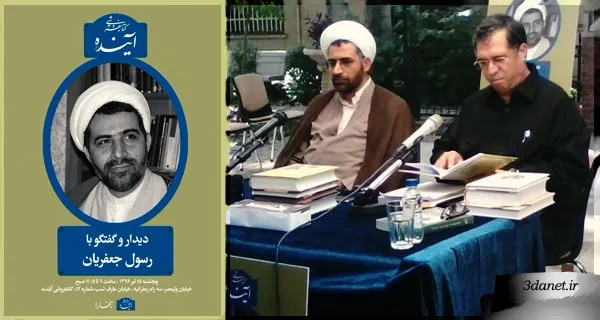
According to the reporter for Farhangi Event, the ninety-fourth session of the Thursday Morning Meetings at Ayandeh Bookshop, in collaboration with Bukhara Magazine, was dedicated to a meeting and conversation with Rasul Jafarian.
Rasul Jafarian is a professor in the History Department of the Faculty of Literature at the University of Tehran and heads the Specialized Library of the History of Islam and Iran (a unique library on the subjects of Iran and Islam), which he founded in 1995. His fields of study and numerous books range from the history of Shi'ism to Hajj travelogues, particularly covering the Safavid period. Before heading the library, Jafarian was in charge of the Library, Museum, and Document Center of the Islamic Consultative Assembly, a period of management that is renowned among both the elite and the public.
I am not happy about the establishment of the Book Garden
In this meeting, Jafarian referred to the year 1989 and his first acquaintance with computers, stating: From 1989, when we first became familiar with computers, the Noor Research Center (active in providing religious and literary information in a modern digital style) was established in Qom, and from 1991, Bihar al-Anwar was published as its first output on old diskettes.
Expressing that he was not happy about the establishment and operation of the Book Garden, he continued: I have been saying this for years and am ridiculed each time, that bringing people back to books is not the right thing to do, and we must change our methods anyway. Although I am not a specialist in this field, I think someone should work on this issue.
Jafarian said: Currently, we see that 80 percent of my students use digital books or sources other than books for their work; therefore, we must think about converting the information in books into other forms, because in two more generations, whether we want it or not, no trace of the book will remain.
The Specialized Library of Iran and Islam with 191,000 volumes
Regarding the Specialized Library of Iran and Islam, which operates in three languages—Persian, Latin, and Arabic—Jafarian stated: This library began its work with about 400 volumes and now, after 22 years, with 191,000 volumes solely in the fields of history and geography, it continues to operate and, in terms of funding over these years, has been under the supervision of Ayatollah Sistani.
According to him, currently six specialized libraries, including those for jurisprudence and law, Quranic sciences, philosophy, ethics and mysticism, hadith sciences, and others, are active in Qom and meet a significant portion of the needs of doctoral students.
This professor in the History Department of the Faculty of Literature at the University of Tehran also gave news about the establishment of several specialized libraries during his time at the Islamic Consultative Assembly, stating: For example, for the specialized library on women's affairs in the parliament, we bought 20,000 volumes from just one person. I do not know now whether the specialized libraries of the parliament are still operating or not.
Stating that, following the importance of specializing libraries, we are now thinking about specializing digital libraries, he said: The services in Qom for digital works are not comparable to the activities in Tehran in this regard, because, for example, the parliament library has been dormant for about six months and does not have much performance, although there are also inactive centers in Qom, but this city is youth-oriented and usually entrusts tasks to individuals with more creativity.
A decline or growth in digital book sales?
Mahmoud Amouzegar, head of the Publishers and Booksellers Union in Tehran, was present at the event. He stated: The gap in the professional field is having information about the state of the world. For example, even in America, with its specific liberal logic in economics, according to 2011 statistics, the number of digital and paper books will reach parity in 2016, meaning digital books are growing.
He continued: In fact, according to various statistics, for instance from UNESCO, institutions that look at it from an economic perspective show that sales of digital books are declining and paper books are growing. So the world is changing, and people are changing too.
In response to this, Jafarian considered changes to be sometimes gradual and accompanied by long pauses, and stated: One should not pay too much attention to such statistics, because in our country we see that paper books sell even while their digital versions are available to everyone.
Stating that the accumulation of information builds the mind and that the transfer of concepts is important in this regard, Jafarian remarked: All your statistics may contradict the discussion of the growth of digital resources and information and the decline in referring to books, but whether you like it or not, this change exists and is felt.
He stated: I have no opposition to paper books. Even at the university, in addition to providing digital versions, we also print a number of paper books (for example, 50 copies). But in my opinion, if the money for the Book Garden had been spent on digitizing books, then everyone could easily access all books and resources.
From the excessive conservatism of publishers to resolving a concern that leads to progress
Later in the meeting, Amouzegar introduced himself as one of the customers of the Noor Research Center in Qom and said: I think we are still grappling with understanding the issue of intellectual property rights for ordinary books and we have the issue of illegal printing of books. Therefore, conservatism is high among publishers because they consider the virtual space to be far more chaotic than the usual physical space. In fact, when publishers see the controllable physical space in this way, they no longer make an effort for the virtual space.
According to him, resolving this concern will lead to a leap and progress in this field.
Referring to the programs of his library in Qom, Rasul Jafarian stated: We prefer that applicants do not come to the library, and we scan whatever they want within a day and send it to them via various tools like email. We also plan to have a group of young job seekers type up all the legible manuscripts and well-printed books up to the year 1350 (1971).
He continued: Our students spend 70 percent of their time finding information, but if the required articles were always accessible, they would have more time to address more important tasks.
Tofiq Rafiq as a valuable work in the field of politics from the Safavid era
The professor of the history department at the Faculty of Literature, University of Tehran explained about the publication of parts of individuals' memoirs: Perhaps the Noor Center has put up more than 100 of my works. In fact, my collection of articles is in the hands of the Noor Center, and people can download it after paying a fee.
He stated that the cost of downloading and receiving the collection of articles goes to the center, and he does not receive any amount for this.
Jafarian also, in the continuation of his talk, explained a little about Morakhkh Publications (for printing books of 10 copies and above, and frequently, which has so far had between 10 and 20 books and does not charge a fee for printing books and articles) and introduced his recent work, “Tawfiq Rafiq” as a valuable work in the field of politics from the Safavid period.
He stated: Unfortunately, our communication system with foreign countries is limited, and at present we are using new channels more to acquire books; the advent of digital files has somewhat reduced the problems.
We are still unaware of the process of knowledge production
In this meeting and conversation, Jafarian answered the questions of the participating students and researchers of Iranian and Islamic history.
In response to a question from one of those present about his activity in various fields, Jafarian stated: For the diversity of my mind, I had to work in different fields. We still do not know the process of knowledge production, and it is not clear to us; as a result, sometimes Sharif University in the computer science department, or sometimes Amirkabir University in the laboratory sector, and so on, advance the country. In fact, this issue shows our weakness.
He also, in response to another question, remarked: Apart from the Quran and Mafatih al-Jinan, I do not even have one other book at home, and I do my work on my computer; this is while up until 50 years ago, manuscripts could even be found in some homes, but not anymore.
Jafarian said: I defend the book in terms of focusing the mind, but in general, it is a matter of the mind and how concepts should be transmitted.
.
.
Audio of the Meeting and Conversation with Rasul Jafarian
.
.
This program was organized by Bukhara Magazine and Ayandeh Bookshop.
6 July 2017 - Ayandeh Bookshop
.
.

Discussion0 comments
No comments yet; let yours be the first voice.