Religion
“A Night with Rumi’s Thought”: A Session with Mostafa Malekian and Seyyed Amir Akrami
At the 'Night of Rumi's Thoughts' gathering, Mostafa Malekian posed five questions to elucidate Rumi's conception of God. In his view, God is the spirit of the tree of existence, and the world is a part of His essence, not a separate entity.
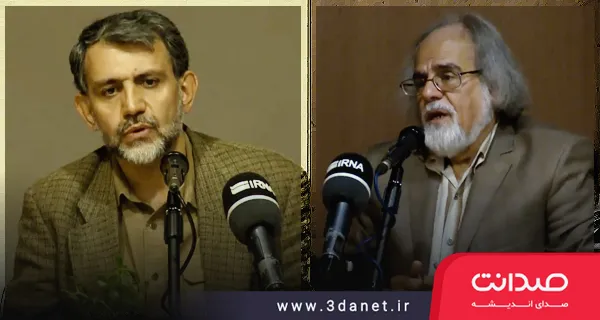
Mostafa Malekian
Speaker
Seyed Amir Akrami
SpeakerBukhara Magazine, in collaboration with the Soroush-e Mowlana Institute and the National Library of Iran, held “A Night with Rumi’s Thought” on Sunday, November 10, 2019. At this event, Mostafa Malekian spoke on “The Place of the Universe and God from Rumi’s Perspective,” and Seyyed Amir Akrami spoke on “Unbelief and Faith from Rumi’s Viewpoint.”
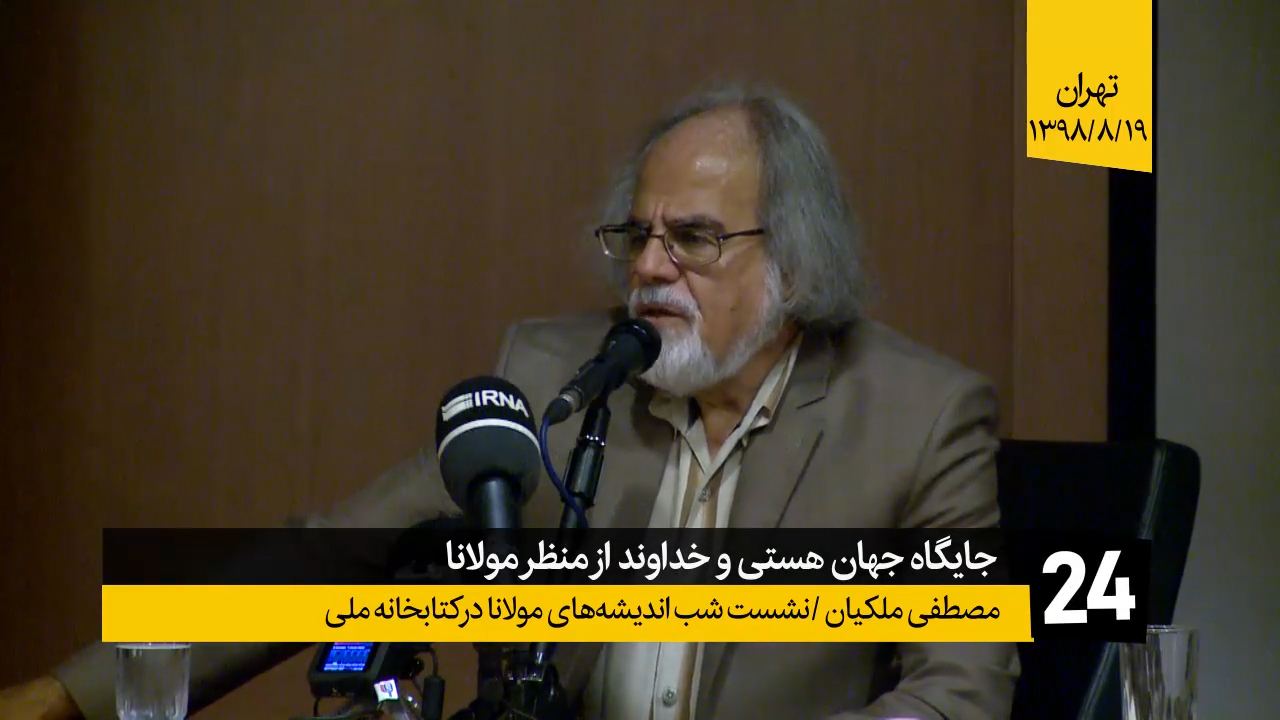
Mostafa Malekian’s lecture at A Night with Rumi’s Thought, titled “The Place of the Universe and God from Rumi’s Perspective”
Malekian began his remarks by saying: My talk today concerns what image and conception of God Rumi held. Throughout human history, although the majority of human beings have believed in God, there has never been a single conception of God. Humans have held various conceptions of God and directed their faith toward that image.
He continued: In classifying the different conceptions of God, we must ask five main questions for a person who believes in God to answer. The first question is whether there is an aspect of God’s being that is non-spatial and non-temporal. We know that if something is bound by time and space, it undergoes change; otherwise, it will possess absolute constancy. This question concerns God’s eternity. The second question is whether there is an aspect or aspects of God’s being by which God is spatial and temporal and consequently undergoes change? Such that at least from that realm and aspect, He changes?
The contemporary philosopher continued: The third question is whether God is aware of His own existence? The fourth question is whether God has awareness of other than Himself? Does He have knowledge of everything that is not God and is other than Him? This is not a far-fetched question. For example, Aristotle, the greatest philosopher of the Western tradition, said that God has no awareness of other than Himself. The fifth question is whether the entire universe is apart from God or not? Is the entire universe a part of God, with God encompassing it within Himself? In other words, is there nothing in the universe that God’s existence does not encompass? Meaning God created and sustains them, but they are not God and are distant from Him?
Malekian continued: In answering these questions, we can give various answers. Based on these questions and depending on our answers, we will have 32 conceptions of God. Of these 32 conceptions, 3 are not reasonable. So, throughout history, based on these questions, there have been 29 conceptions of God.
He then asked which of these 29 conceptions Rumi’s acceptance and understanding of God could be, and said: The general body of the faithful throughout the history of religions have held relatively superficial and imitative understandings of God, which have had two characteristics. First, they believed that there are things in the world which, despite existing, God is not in them, and God, separate from them, is one of the entities of the universe. In other words, if a census of the entities of existence were taken, there are n entities in the universe, and with the addition of God, their total would be n+1. The second characteristic of this image was that God has human attributes. Such as anger, pleasure, command, wrath, compassion, defending some and attacking others, bearing grudges. Of course, they immediately add that these attributes in God do not have their human corruptions. In this sense, God is a “great human being,” but purified and refined.
Malekian added: The conception that Rumi had of God was not like this. In answer to the first question, he says yes, and in answer to the second question, Rumi’s answer is no. That is, he says no change occurs in God. Rumi’s answer to the third and fourth questions is also affirmative. But in answer to the fifth question, Rumi says that we are all contained within God, and God is not an additional entity over and above the realm of existence. That is, if we count the entities of the universe and their sum is x, counting God does not make it x+1, and the number will remain x.
To further illustrate Rumi’s image of God, Malekian employed the analogy of a tree, saying: Imagine a tree with two characteristics. This tree receives nothing from the outside, such as light or soil. Therefore, it does not increase. The second assumption is that if anything is separated from this tree—such as blossoms, leaves, or branches—it is immediately reabsorbed through the tree’s roots and does not spread outward. Thus, the tree does not decrease either. This tree differs from ordinary trees in two ways: it neither increases nor decreases.
Malekian continued: Rumi believes the entire universe is like such a tree. Nothing is added to it because there is no outside from which existence could receive anything. Nothing is subtracted from it either, because nothing leaps out of or leaves this universe. In likening the universe to this tree, the body of the tree is this very natural world. Therefore, to find God, one must turn to the natural world. Inanimate objects and plants in the past, present, and future, and everything that exists in this world even if we do not know it, are the buds of this tree. They are the blossoms, flowers, and branches of this tree. Each of these, including us, is a part of the tree’s components.
The author of Longing and Abandonment said: If we want to point to the tree, following the direction of the pointing finger inevitably leads to one of the tree’s parts, not the tree itself. No one can say, “I want the tree itself.” The tree is nothing other than these parts. By the same token, God cannot be shown except in this very world, except in you and me and inanimate objects and plants. It is wrong to say, “Set aside human beings and show us God.” God cannot be shown anywhere else.
Malekian added: This tree has various manifestations. At one time it manifests in a rabbit, at another in a human being, and at another in the sea. So do not say, “Set aside these manifestations.” If we set them aside, God does not exist. The manifestations cannot be set aside. In this sense, Rumi considers God to be of the nature of non-existence. This non-existence does not mean non-being. God here is like the totality of the tree: although it exists, it appears not to, and it cannot be shown apart from its parts. We, too, although we do not exist, appear to exist.
Malekian added: According to common understanding, besides our body, we also have a soul that is not visible in our body. God is, in reality, the soul of this tree of existence. We see the soul of this tree when this soul departs and the body becomes lifeless and dry. God is the life of this tree, and we are the physical manifestations of this tree. Life is not visible, but when it departs, we see that the tree is nothing but dry wood. Just as it is with the death of a human being. God is the life of the natural world, and all creatures are physical manifestations that depend on Him. For this reason, no one can seek God outside of you and me. In Rumi’s view, these physical manifestations are visible and we can see them, but the spiritual essence is not visible. The God who is not Himself physical is not bound by time and space.
With the perspective born of this view, Rumi resolves the problems of predestination and free will, faith and unbelief, and egotism and the negation of egotism.
The author of Destiny and Prudence added: If an individual, like a leaf, were to separate from this tree, it would no longer be a leaf. If a fruit separates, it is no longer a fruit. A leaf is the leaf of the tree, and a fruit is the fruit of the tree. If the tree does not exist, these have no meaning. We humans, even if we want to separate from the tree of God, cannot. If we will to separate, in Rumi’s view, a withering befalls us. What Rumi wants from us is that, as parts of this tree, we know that everything we have comes from this tree: intelligence, memory, power, independence, reasoning, health, and physical strength and beauty. The day we say that all these belong to the tree whose name is God, in Rumi’s view, that is the beginning of our growth.
Malekian continued by rejecting the idea that anyone could attribute these endowments to themselves, saying: If someone claims this, let them increase these attributes if they are truthful. If you credit your intelligence, memory, management ability, and eloquence to yourself, then double or triple them. Why have you settled for this amount? If you are truthful, prevent yourself from yellowing and falling like the leaves of this tree. This is the same as what Rumi expresses: “In summer, the season says, O nations, / See yourselves as I pass by.” The spirit of this tree, that is, God, is what determines these things. Rumi calls it meaning and states that all arts, powers, and endowments depend on it.
Pointing to the educational effect of such a view, Malekian noted: If the parts of the tree acknowledge that everything they have comes from the tree, no conflict arises among them. In this context, Rumi sometimes considers us a part, and sometimes a manifestation and appearance of that universal meaning of existence. The appearance of something that in itself has no appearance. God is an existent that seems nonexistent, and we are nonexistents that seem existent.
In the final part of his speech, Malekian said: One educational point in Rumi’s words is that even if we do not accept God or are ambiguous about Him, that is, even if we do not know whether God is personal or not, anthropomorphic or not, whether Darwin’s theory of creation is correct or not, we at least know that we did not bring our intelligence and abilities into existence ourselves, nor did we give them to ourselves. Because if we had given them to ourselves, we would have given more. It is more accurate to say that these were given to us. With this acknowledgment, egotism and arrogance disappear. Even if we are positivists, physicalists, agnostics, or naturalists.
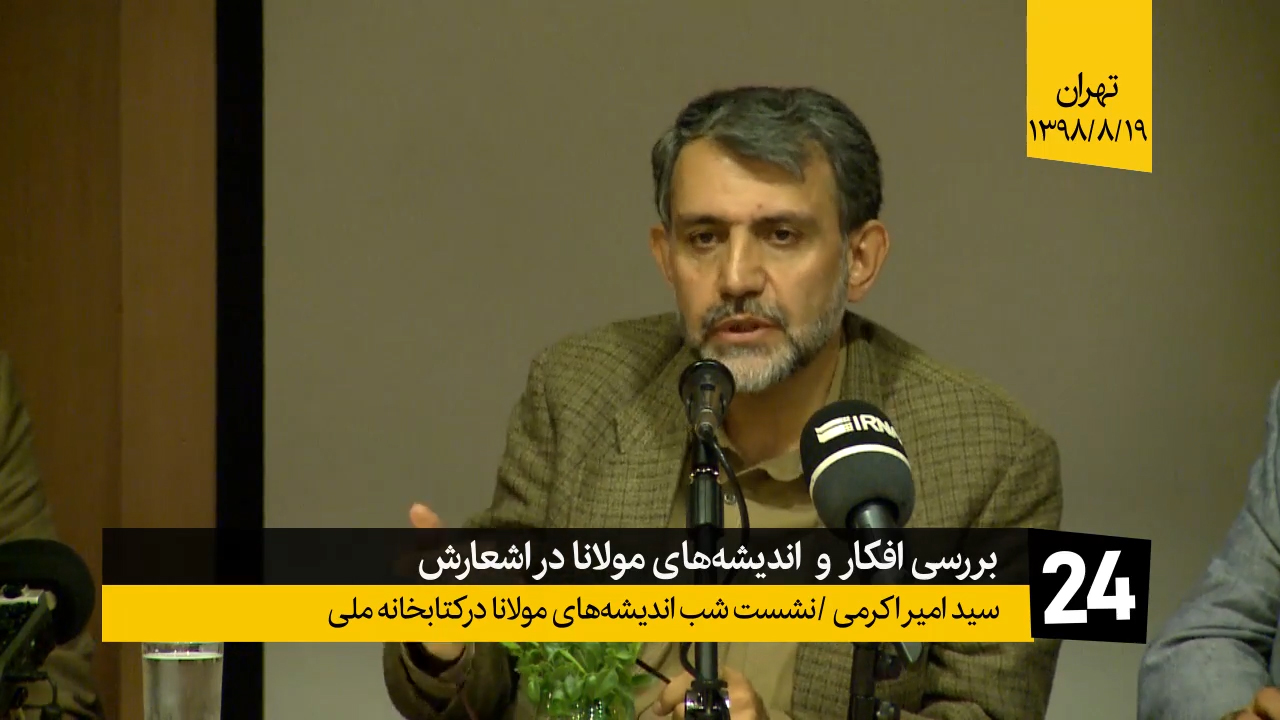
Lecture by Seyyed Amir Akrami on the Night of Rumi's Thoughts, titled “Disbelief and Faith from Rumi's Perspective”
At the beginning of his speech, Amir Akrami noted that faith and disbelief have been among the most important theological topics in all religions, saying: The question has always been, what does faith mean? What is the essence of religions based on? Does faith admit of degrees or not? From the very beginning, especially among Christian theologians, the definition of faith has been a subject of discussion.
He continued by noting that Rumi, in addressing faith, did not engage with such questions, saying: The first point is that, for Rumi, faith is etymologically and semantically related to security and safety. This is a very important point: unlike the theologians of many religions, who linked the discussion of faith to heartfelt and cognitive affirmation and bodily action, Rumi relates faith above all to the security of the person themselves and the security they create for those around them. The result of this faith is that the person becomes secure from error and mistake. Others are also safe from their error. Rumi alludes to a similar point in the story of Moses and the Shepherd. There, Rumi says, “You are security, and a world is secure from you.”
Expressing the second point regarding faith in Rumi’s thought, Akrami said: For Rumi, faith is the source of many virtues, including patience—a rare and valuable virtue. Also, among the properties and effects of faith is that the believer becomes sweet, while the disbeliever, in contrast, is sullen and bitter. “Believers are a mine of honey, like bees; / Disbelievers themselves are a mine of poison, like a snake.”
The faculty member of the Institute for Humanities and Cultural Studies stated that faith is transformative, saying: Faith is such that others, upon observing it in the believer, are filled with envy. Rumi says, “The believer is one who, in the ebb and flow, / The disbeliever envies their faith.” Moreover, bad moral traits are not only the result of disbelief but, in Rumi’s view, are disbelief itself. That is, the disbeliever is one who possesses those moral evils, such as greed, suspicion, anger, and so on.
Raising the question of where God should be sought, Akrami said: In light of Rumi's thoughts, it must be said that the believer's heart is a vessel whose content is God. God, in the words of Rumi and the narrations, is contained within the believer's heart. "In earth and sky and the Throne too, / I do not fit, know this for certain, O dear one, / Yet in the believer's heart I fit, O wonder! / If you seek Me, search in those hearts."
Continuing, while discussing miracles in Rumi's thought, he said: From Rumi's perspective, miracles do not bring faith to anyone. If there were prophets who had miracles, faith has nothing to do with their miracles; if someone came to believe in a prophet, it was from observing a kinship and closeness of states. "Miracles do not cause faith, / The scent of kinship attracts qualities. / Miracles are for vanquishing the enemy, / The scent of kinship is for winning hearts."
In this earthly world, we constantly feel ourselves bound hand and foot by time and space. In a wearisome repetition and imprisoned in a world. Religions and mysticism each offer us a prescription for escaping this narrow world of matter. From Rumi's perspective, faith takes us out of this prison of day and night. "Reason says the six directions are limits, and there is no way out; / Love says there is a way, and I have gone it many times." Rumi also raises this point in the story of Zayd ibn Harithah in the Masnavi, where the Prophet (PBUH) asks him about his state in the morning.
Akrami continued: In Rumi's thought, we encounter imitative and investigative faith, the faith of the common, the elect, and the elect of the elect, or outward and inward faith. We can also speak of faith of the Sharia, the Path, and the Truth. Faith based on a chain of imitative premises, if one stops there, yields little benefit for the person. After these premises comes the turn of the Path, and then the Truth. In his soliloquy, Rumi offers a definition of faith here. "I did not become a believer by testimony—that witness is the soul; / I became a believer at that moment when I became an unbeliever to myself." He says that when we become an unbeliever to our lower self, we attain our human self. And here, to attain this, we are in need of faith.
Akrami added: In Rumi's allusions, there are three couplets that are key to the meaning of faith. In these verses, he uses the analogy of the husk, the flesh, and the kernel, which implies the same faith of the Sharia, the Path, and the Truth. Elsewhere, he uses the expression imitative and investigative, and believes that in investigative faith, we can be safe from the anxieties of doubt.
This Rumi scholar continued: Another key couplet for understanding faith in Rumi's thought is the verse that says, "As long as caprice is fresh, faith is not fresh, / For this caprice is nothing but the lock on that gate." When the wayfarer abandons caprice, they turn toward the Beloved. This is the beginning of attaining the faith of Truth. The next stage is reaching the faith of Truth and investigation, where the wayfarer stands before the Beloved and union occurs. Here, unbelief and faith lose their meaning, and we dwell in a station beyond them. Like one who has reached the Kaaba itself. As he says, "Lovers have God as their religion and creed," or "Since you came into my embrace, unbelief and faith have become my servants; / O seeing you is my religion, and your face is my faith."
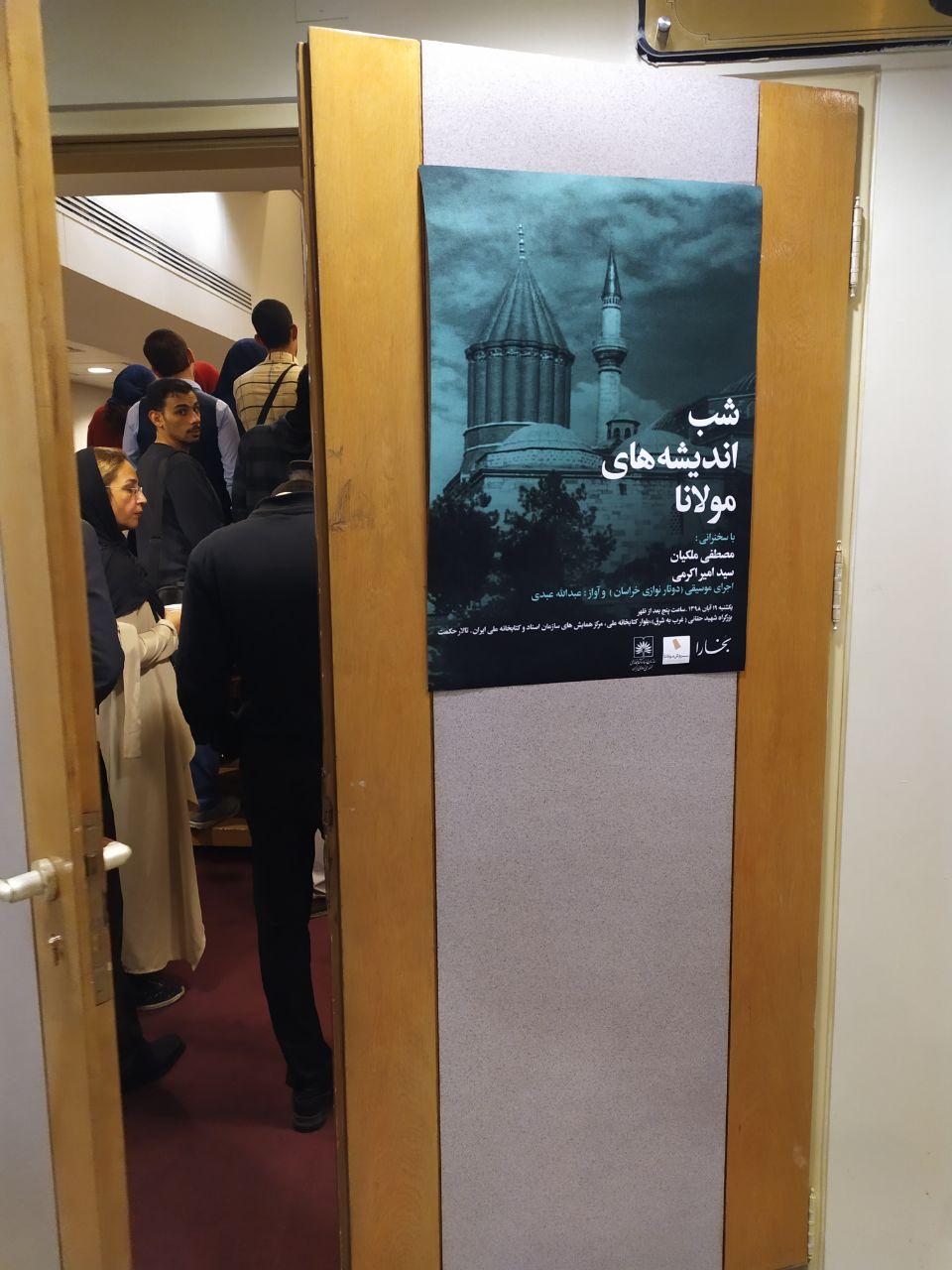
The session "A Night with Rumi's Thought" organized by Bukhara Magazine in collaboration with the Soroush-e Mowlana Institute and the National Library of Iran, with the presence of Mostafa Malekian and Seyyed Amir Akrami
.
Lecture by Mostafa Malekian titled "The Place of the Universe and God from Rumi's Perspective"
Audio file - Watch on Aparat - Watch on YouTube - View on IRNA
.
Lecture by Seyyed Amir Akrami titled "Unbelief and Faith from Rumi's Perspective"
Audio File - Watch on Aparat - Watch on YouTube - View on IRNA
.



Discussion0 comments
No comments yet; let yours be the first voice.