Religion
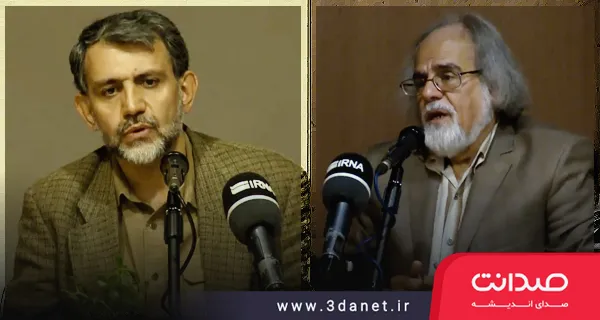
Lectures by Mostafa Malekian and Seyyed Amir Akrami at the Symposium “Rumi and Mystical Migration”
At the symposium 'Rumi and Mystical Migration', Mostafa Malekian described Rumi's migration not as a physical journey, but as a vertical ascent from false selves to the true self—a journey that begins by moving from self-worship to truth-worship and from idolatry to God-worship.
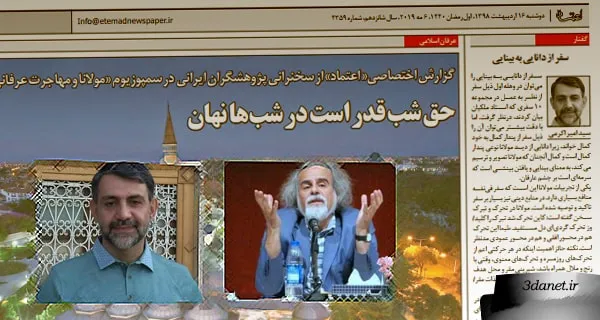
The Night of Power is hidden among the nights
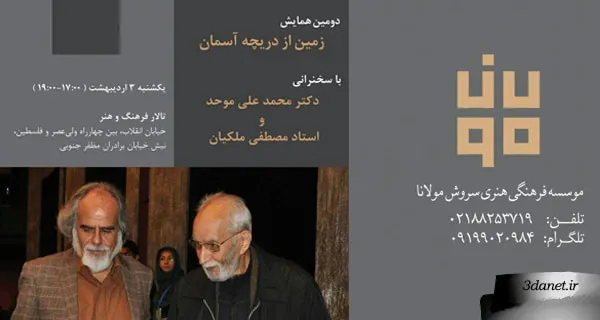
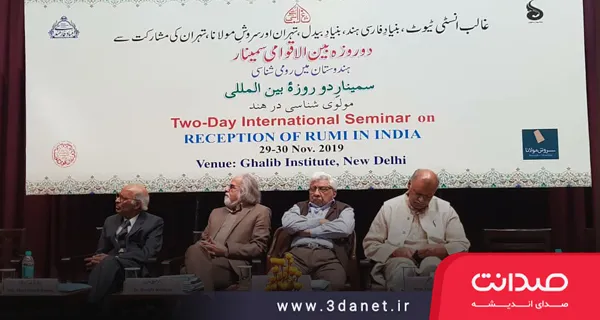
Mohsen Azmoudeh | Today, the concept of migration is primarily considered in its material and physical sense, meaning the individual or collective relocation of beings from one place to another with various motives and goals, and overall, for the betterment of conditions. Jalal al-Din Mohammad (604-672 AH) was also born in Balkh, but migrated from his birthplace with his family in early childhood. He traveled to Baghdad and Mecca, then to Sham, and finally made his way to Konya, where he remained until the end of his life. For Rumi, however, the concept of migration transcended this physical meaning. Like most mystics, he considered migration in its mystical sense, as spiritual wayfaring and conduct, and consequently, as Mostafa Malekian says, on a vertical axis. The theme of the fifth International Rumi Symposium in Konya was also “Rumi and Mystical Migration,” held on May 3rd and 4th at Selçuk University in Konya. A number of scholars and researchers from Iran, Turkey, Afghanistan, the Republic of Azerbaijan, Northern Cyprus, Bangladesh, and Bosnia and Herzegovina attended this gathering. The Soroush Mowlana Institute from Iran played a role in organizing this symposium, and among the Iranian scholars, Mostafa Malekian and Seyyed Amir Akrami delivered lectures at the event. The following page presents Etemad’s exclusive report on the lectures of these two researchers.
***
Mostafa Malekian
Migration, in its most general and precise definition, means traveling from one place to another to reach a better state. Migration in this sense can be divided into two main types: 1. Horizontal journeys or forward journeys; 2. Vertical journeys or upward journeys. In forward migrations, we pass from one land to another that is on the same level of existence and realm of being, in order to find a better situation in the second land, but whether we succeed in this goal or not, the level of these two lands—the one left behind and the one we go to—is the same. But spiritual migration is an upward journey. Perhaps, and very likely, when the Holy Quran says: “Ihdina al-sirat al-mustaqim” (Holy Quran, Surah Al-Fatiha, verse 6), meaning “Guide us to the straight path,” “mustaqim” is derived from the root “qiyam” and means upward movement; therefore, one meaning of this verse is: Guide us to the upward path, not merely the path to the right.
Migration for Rumi
From this perspective, since spiritual migrations, as we find in Rumi’s language, are upward, they should be interpreted as flight or ascension (miraj), both of which are expressions Rumi used: The soul flings its wings toward the heights / The body has struck its claws into the earth. Here, flight is used as a metaphor for the upward journey. Or the term “miraj,” which is frequently used in Rumi’s writings and works: If you are not in the ranks of those who ascend / Your non-existence will draw you up like Buraq. That is, one must stand in the ranks of those who travel upward. Therefore, Rumi’s migration was of the second type, that is, upward.
Of course, Rumi also experienced the first type of migration and had a long horizontal migration from Balkh to Konya. But at the same time, this migration was not very important to him. The migration that made Rumi someone whose spiritual state and condition we envy was from low to high. This immense and, at the same time, very arduous and difficult migration is the migration from the land of false “selves” to the land of the true “self.” Rumi holds this belief and himself undertook this journey, that we have carved out many false selves for ourselves and usually dwell in our false selves. We sometimes identify ourselves with our body, mind, ego, nation, wealth, power, fame, the respect of others, popularity, reputation, etc. If we feel a sense of unity with any of these things, in Rumi’s view, we have felt unity with something that is not, in reality, our self. From his perspective, none of the forms we imagine for ourselves is our real self.
Our true self is something without form and possesses no form. If I feel a sense of unity with any of these formed things, I have lost myself, or to put it more precisely, I have not attained or found myself. Rumi's primary journey is a journey from these false selves to a true self that is formless and, according to the mystics, is the same as meaning and spirit, and in religious terms, "al-ma'na huwa Allah," meaning the meaning is God. The spirit is God. In the words of Meister Eckhart, the Christian mystic, there is something within every human being that is neither created nor creatable, and that thing is the spirit. The journey from the mind, body, ego, nationality, wealth, fame, power, respect, reputation, popularity, and everything else that has a determinate form and separates a person from other human beings, is a journey from the self or false selves to the true self. This, in my opinion, is the greatest migration.
Ten Preliminary Journeys
This migration requires ten smaller journeys:
1- The journey from self-centeredness to God-centeredness or truth-centeredness: That is, the journey from what I like to what the truth requires, not what my liking requires. Truth-centeredness means paying attention to what I find to be in accordance with reality, not what is pleasing to my own self. We interpret this as the journey from egotism to righteousness, or the journey from self-being to truth-being. In this journey, I sacrifice all my egoistic interests, feelings, and emotions for the reality of the universe, and wherever these desires conflict and coincide with the reality of the universe, I sacrifice these realities for the sake of those truths. Therefore, I prioritize following the truth over following my own desires.
2- The journey from idolatry to God-worship: In Rumi's view, anything that substitutes for God is an idol, and since I must only worship God, I cannot worship anything other than God. The requirement of breaking away from this idolatry in this journey is that nothing be taken as equal to God, and this means that even God's religion is other than God, and one should not worship God's religion either; rather, one must worship God Himself. The belief in the existence of God is not God. God's religion is also not God. That which is God must be worshipped. Therefore, one of the greatest instances of passing from idolatry to God-worship is the passage from religion-worship to God-worship; in other words, anything that substitutes for God is an idol, whether that thing be a nation, a religion or creed, a faith or rite, a doctrine, a cause, an ism, an ideology, etc. If all these become the object of my heart's devotion and worship, then my beloved is no longer God.
3- The journey from attachment to love: While Rumi warns us against attachment to beings, he simultaneously invites us to be wholly in love. This means it is clear that attachment is one end of the spectrum, and at the extreme opposite end lies love. How is it that we are warned against attachment but invited to love? Because it is very important that we know the difference between attachment and love. In attachment, I want you for myself, but in love, I want myself for you. In fact, the boundary between attachment and love is whether my centrality still remains or not. Wherever my centrality remains, I am attached to beings, and those beings to which I am attached are meant to become my tools, to be in my service, and to fulfill my desires. But where true love exists, I myself am the servant, I place myself in the service of my beloved, and I consider myself the servant of my beloved.
4- The journey from imitation to investigation: or, in the language of today’s existentialist philosophers, the migration from a borrowed life to an authentic life, or the passage from living derivatively to living authentically. Instead of the terms “derivative” and “authentic” living, Rumi uses the expressions “imitative” living and “investigative” living. Today, some psychologists, especially existential psychologists, interpret this as the passage from heteronomy to autonomy; meaning that I must live according to my own understanding and discernment, not according to what has been handed down to me, or what my ancestors have said, or what my tradition dictates, or what public opinion and the spirit of the age demand of me. That is, the passage from suggestibility and susceptibility to indoctrination to what I find within myself. It means placing my own scales within myself and seeing what my reason and moral conscience dictate in terms of behavior, speech, deeds, stance, and way of life, not what others expect of me in terms of a way of life, speech, deeds, and stance. This journey from imitation to investigation is strongly emphasized by Rumi, and perhaps in the works of our mystics we find no one who stresses it as emphatically as Rumi and Shams Tabrizi.
5- The journey from narrow-mindedness to open-heartedness or ocean-heartedness: That is, not to suppose that the world is merely what is seen from my window and my aperture. Meaning, not to suppose that the world is necessarily nothing other than what I have found. In Rumi’s very fine expression, truth is the Night of Qadr. Why has the Night of Qadr been concealed, and why has it not been determined exactly which night it is? So that on every night we might hope to find the Night of Qadr, and peer into every night, and probe every night, and not despair completely of any night. Rumi said that truth, too, is the Night of Qadr, and one should not despair of any human being. He said: “Truth is the Night of Qadr, hidden among nights / So that the soul may test every night.” Rumi said that the minds and souls of others are Nights of Qadr in which truth is concealed. We must peer into all of them and not turn away completely from any of them. He says: “So do not say, ‘All these are on the path of falsehood’ / The false ones, for the scent of truth, are snares for the heart // So do not say, ‘All is illusion and error’ / There is no illusion in the world without a truth.” He considers it possible that everyone knows something and has discovered a truth. He considers no one the complete embodiment of truth and no one the complete embodiment of falsehood. All human beings are a mixture of truth and falsehood, and there is no one who is absolute truth and no one who is absolute falsehood. Therefore, through this journey, I search and explore in all human beings, and I do not wish for a truth to be hidden somewhere and be lost to me; and because I become like this, I distance myself from fanaticism, dogmatism, rigidity, wishful thinking, superstition, intolerance, and prejudice, whether positive or negative, for whichever I turn toward, the likelihood of missing one of the truths becomes stronger in me.
6- The journey from unbridledness to self-restraint: That is, if the circle of my capabilities, meaning the circle of what I have the power to do, is of a certain size, then the circle of my permissions, meaning the circle of things I permit myself to do, must be much smaller than the first circle. Those who lack self-restraint and personal discipline permit themselves to do anything they have the power to do. Those who possess self-restraint have a circle of permissions that is very narrow and small compared to their circle of capabilities. The more I narrow and constrict the circle of my permissions, in other words, the fewer of the things I have the power to do I actually do, the less unbridledness and licentiousness there is in me, and the reins and control of the self come into my own hands. This characteristic and trait is called self-restraint. The ascetic discipline that mystics like Rumi and Shams spoke of was this, not the severe physical austerities prescribed by some Sufis and certain mystical schools.
7- The journey from theorizing to practicing: that is, journeying from merely speaking about existence and reflecting upon existence, to taking action. In the words of our other poet, Sa‘di, two hundred sayings are not worth half a deed. Rumi considers any theorizing that does not lead to action and does not affect me in practice to be an instance of useless knowledge, indeed an instance of harmful knowledge, and he disregards it; in other words, any question that, before it arises in my mind, makes no practical difference to my life compared to after it arises, any question whose being unanswered or being answered makes no difference in my practical life, and any question where its answer being A or being B makes no difference—if a question has these characteristics, one should not pursue it. A person should pursue solving problems and answering questions that are such that a person’s life is practically different before they arise in the mind compared to after they arise, or a person’s practical life changes before finding the answer to this question compared to after finding the answer, or a person’s practical life changes when its answer is A compared to when its answer is B. That is, when I pursue these questions, their answer is of benefit to me. But any theorizing that is otherwise is, in Rumi’s expression, futile. He says: They say that in Saqsin, a man had two bows / Of those two, one was lost, what loss is that to us? In Rumi’s view, most of the questions we raise fall into this category. One can see that Rumi paid serious attention to the wisdom of “What is that to me?” and in the face of any theoretical issue, he would say, if it relates to me and has an effect on me in practice, I engage with it; otherwise, no.
8- Turning away from the part and turning toward the whole: In today’s language, if we turn our need toward any part of the parts of the world, we have erred, and we must turn our need only toward the whole of existence. If a single leaf on a tree wishes to remain healthy, it cannot ask anything of the other leaves, it cannot entreat the blossoms and buds. It must ask something of the tree. The health of the leaf lies in the health of the whole tree, and for its health, the leaf must cling to the whole tree. Every particle that relies on a particle of the particles of the universe, less than the whole, is like a leaf that, for its own health, presents its need to another leaf and does not notice that the health of all buds, flowers, blossoms, and fruits depends on the health of the whole. Therefore, the eighth journey means turning one’s back on presenting one’s need to creatures and the feeling that others can do something for me, and instead seeking all healing from the whole of existence, whether we call this whole of existence God, or the Soul of the World, or the Spirit
9- The journey from negative feelings and emotions to positive feelings and emotions: This kind of perspective gradually detaches us from every kind of negative feeling and emotion and steers us toward positive feelings and emotions. In Rumi’s conception of positive feelings and emotions, no more than six are given special attention. In Rumi’s view, these six positive feelings and emotions—namely trust (tawakkul), submission (taslīm), gratitude (shukr), contentment (riḍā), joy (shādī), and serenity (ārāmish)—are the mother of all positive feelings and emotions. When he said: I was weeping, I became laughter; I was dead, I became alive, this life is the emotional and affective life that Rumi found, in contrast to our life, which is constantly subject to anger, malice, hatred, and so on.
10- The journey from the illusion of perfection to perfection: Rumi says: There is no worse malady in your soul, O coquettish one / Than the conceit of perfection. We are all subject to the conceit of perfection, subject to the notion that we are perfect and have no need of perfection. Rumi would say that as long as we are subject to the conceit of perfection, we are deprived of perfection itself. I find the possibility, or at least the probability, of attaining perfection only when I abandon the conceit of perfection. Of course, the perfection Rumi speaks of is the perfection attainable by a human being, not absolute perfection. That is, the perfection that is within human capacity, not the absolute perfection that is within the capacity of no human being, insofar as they are human.
The Journey from Knowledge to Insight
Seyyed Amir Akrami
The journey from knowledge to insight can, in the first instance, be considered under the journey from theory to practice within the set of 10 journeys that Professor Malekian expounded. But upon closer examination, it can be called a subset of the journey from the conceit of perfection to perfection itself, because knowledge, from Rumi’s perspective, is a kind of conceit of perfection, and perfection, as Rumi depicts and delineates it, means insight and finding the vision that is a collyrium upon the eye of the mystics.
One of Rumi’s experiences is that travel in itself has many benefits. In religious sources, too, travel is greatly emphasized and recommended. Rumi has spoken of movement and blessing: For this movement became the key to blessing / And from movement, O heart, you derive benefit. Naturally, this movement is considered both on the horizontal and the vertical axis. The important point is that in any movement, whether everyday movements or spiritual movements, when it is accompanied by hardship and weariness, the sweetness of the destination and the goal will be greater: For the sweetness and pleasures of the abode / Are in proportion to the hardship of the journey.
The title “The Journey from Knowledge to Vision” is taken from a ghazal by Rumi in the Divan-e Shams, where he says: The passion for that beloved drew me out / From knowledge and recitation, until I became so frenzied and passionate // I took hold of the prayer mat and the seat of learning with utmost effort / I wore the garment of asceticism to increase good deeds // Love entered the mosque and said, O master guide / Tear apart the bonds of existence, why are you bound to a prayer rug? // Before the blow of my sword, do not let your heart tremble, submit your neck / If you wish to journey from knowledge to vision.
But what is this knowledge and what are its harms that Rumi emphasizes the necessity of moving beyond it, and what is that vision and what does it mean? For Rumi, this knowledge is like certain spiritual pleasures that have apparently been given to him, and some he has attained through ascetic practice and effort. He believes that the knowledge a person learns in the presence of a master, which is acquired and earned, entails harms, and he compares it with the spiritual insights he has gained as a result of his own spiritual experience.
For us, this acquired knowledge is the result of all our years of effort, but in Rumi’s experience, these sciences are nothing but a bouquet of flowers. Whereas many of us humans have been seeking to acquire this knowledge since childhood. In Rumi’s words: The meticulous crafts of the science of geometry / Or astronomy, and the science of medicine and philosophy // Which are connected only with this world / Have no path to the seventh heaven // All this knowledge is the building of the stable / Which was the pillar for the ox and camel // The science of the path of Truth and the science of its stages / The possessor of the heart knows that with his heart.
Rumi believes that these sciences not only have not solved our problem and made us light of burden, but like a load, they weigh heavily on our hands and feet: The sciences of the people of the body are their burdens / The sciences of the people of the heart are their bearers // If knowledge strikes the body, it becomes a burden / If knowledge strikes the heart, it becomes a help / God said, “He carries their burdens” / Knowledge that is not from Him is a burden. The reason worldly knowledge is blameworthy in Rumi’s view is that it is borrowed, acquired from outside, and does not well up from within: Knowledge that is not from Him, without intermediary / Does not last, like the dye of a hairdresser.
But another important harm of acquired knowledge is that it is about other things and not about the human self: He knows a hundred thousand excellences from the sciences / Yet that wrongdoer does not know his own soul // He knows the property of every substance / But in describing his own essence, he is like a donkey // You know the price of every commodity, what it is / Not knowing your own price is foolishness. In this verse, Rumi criticizes the scholars of acquired knowledge, from theologians and jurists and others. Another harm of acquired knowledge in Rumi’s view is pride, an example of which in the Masnavi is the story of
the grammarian.
Rumi says: You have seen the back of the world, behold the face of the world / Turn your back on yourself so that the world may show its face // O moon beneath the cloud, alas you have not seen yourself / How long will you run like a shadow in pursuit of these others? (Divan-e Shams). Vision is seeing the back of the world, which means seeing the human self. Existential transformation or purifying oneself is the condition for attaining vision: Whoever weaned himself from caprice / Made his eye acquainted with the secret. Caprice is not merely our unbridled instincts, but even this very eye and ear of ours: Close the ear of the head to jest and lies / So you may behold the city of the soul with splendor. Therefore, the way to reach insight is to polish the inner self, through which deeper insight and the possibility of seeing the back of the world are obtained. Another requirement for attaining insight is humility, modesty, and the negation of pride and arrogance: Strip yourself bare of excellence and excess / So that mercy may descend upon you every moment // Cleverness is the opposite of brokenness and need / Abandon cleverness and make do with foolishness // Seek in supplication and in the annihilation of yourself / For from thinking, only partial forms come forth. One of these necessities and necessary conditions for reaching vision from knowledge is that one finds oneself in a strait in this world. Someone who feels at ease feels no need to journey.
One goes on a journey because one feels discomfort and weariness in one's own home; therefore, the condition for a spiritual journey is also hardship and constraint, and this is the role that, from Rumi's perspective, love plays—that is, the role of love provides for our journey from knowledge to vision: Loving is making that window / By which the breast is illumined by the beloved's beauty // So always gaze upon the beloved's face / This is in your hands, listen, O son // Make a way into your own inner selves / Remove the perception of other thoughts.
.
.
Audio file of lecturer Mostafa Malekian (Lecture title: "Rumi's Spiritual Migrations")
Audio file of lecturer Seyyed Amir Akrami (Lecture title: "The Journey from Knowledge to Vision")
PDF file of the Etemad newspaper report
.
.
Symposium “Rumi and Mystical Migration”
Lectures by Mostafa Malekian and Seyyed Amir Akrami at Selçuk University
Text source: Page 15 of the Thought section of Etemad newspaper | 6 Ordibehesht 1398
Courtesy of Soroush-e Molana
.
.

Discussion0 comments
No comments yet; let yours be the first voice.