Philosophy
A Note “Beyond History” by Majid Ahsan
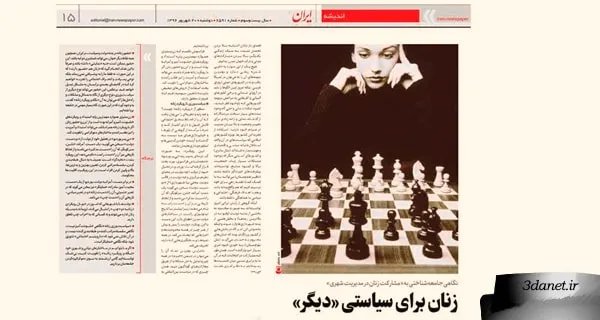
The history of thought has often depicted women as deficient and subordinate; yet thinkers within the Islamic tradition have, ahead of their time, regarded women as conscious beings worthy of the highest standing. An examination of two past thinkers' views on women.

The dragon, the demon of the desert and dry land, has imprisoned the rain; thus the dragon-slaying gods set the rain free.*
A glance at history reveals that from Greece to the modern era, from East to West, from Christian theology to Islamic theology, from the jurist to the philosopher, from Kant to Haji Sabzevari, from the man on the street to the specialist, from the devout to the irreligious, from pre-Islamic Arabia to other nations, and even from within women’s own society, one can find traces of statements, analyses, and metaphors in which an instrumental and secondary view of women is pronounced. In such a view, the role of woman is reduced to that of a deficient, deceitful being who corrupts morality and virtue, and at best is considered a devoted wife, daughter, or mother whose status is defined in relation to the primary sex, i.e., man. In this way, philosophy and woman have been regarded as contradictory matters, and wisdom and intellect as masculine affairs to whose realm women have no access. Perhaps such a view persists in some minds even today. The history of Iran also bears witness to such a perspective, and as Baraheni puts it in his book Masculine History, it has always been the case that man, masculine adventures, masculine force and oppressions, masculine justice and affections, masculine goodness and evil, masculine loves and vilenesses have shaped its process; a history in which the superior power, i.e., man, has alienated and absorbed the other sex, i.e., woman, within himself and concealed her within the horizon of his own being.
For several days now, the disparaging remarks of Mulla Hadi Sabzevari concerning women have been circulating again in various channels, appended to a statement by Sadr al-Muta'allihin Shirazi, provoking minds to criticism and tongues to regret; as if Sabzevari and Islamic philosophy were the sole champions of this arena and the legacy of Islamic philosophy consisted of nothing else. Yet within this very tradition, one can find thinkers who did not remain confined within the prison of their own time, did not go along with the dominant current of history, and thought differently; thinkers who, transcending all ages, observed women who, with their innate talent and lofty resolve, have refuted false conceptions; they defended woman, like man, as a conscious, wise, and free being worthy of the highest station.
Setting aside the thought and practice of the general populace, the crucial question is whether the disparaging view of thinkers toward women was a reflection of the culture of their time in their expression, or a requirement of the foundations of their thought? Whatever the answer to this question may be, it is certain that one must not approach past thinkers with the lens of the present time and the scale of contemporary validations, praising or blaming them based on current conditions. The realm of thought requires the absence of prejudice and entails an effort to understand the claim that has been articulated. What thinkers have expressed on this matter, with all the differences in their foundations and explanations, can be stated in two general approaches:
1) According to the first approach, the different natures of women and men in their physical structure lead to differences in the perceptual, emotional, and behavioral structures of the two sexes. In the view of those who have defended this approach, the body is a fundamental matter that completely separates the paths of man and woman, thereby determining different perceptual and emotional structures for them. It is as if men are from Mars and women are from Venus, each belonging to two different planets that revolve in their own orbits and have no path to one another. Nevertheless, from the perspective of such thinkers, since masculine existence is nobler than feminine existence, discrimination between man and woman is permissible. One might well say that the acknowledgment of women's society's unfitness to choose its own path in life and the emphasis on the necessity of their destiny being determined by men, as put forward in the statements of Aristotle and Kant, is the result of such a view. A perspective that has also manifested itself in many social laws in various countries, including post-Constitutional Iran.
2) In the second approach, acknowledging the aforementioned differences has not led thinkers to emphasize patriarchy or affirm male superiority. In such a view, gender, like color, race, or social class, is not a meaningful difference that would warrant legal discrimination between two human beings, one female and the other male. Just as it is possible and necessary to provide a just opportunity for the cultivation of individuals’ identity and character regardless of color and race, so too must we regard the status of women and men as human beings irrespective of gender, and by offering them equal opportunities, witness a tremendous transformation in various human spheres. Accordingly, woman is regarded as a self-conscious being and not merely an instrument in the service of men; many of the incapacities attributed to her stem not from feminine nature but, in the words of Ibn Rushd, are the product of upbringing and a male-centered social fabric. Such a perspective, in past centuries, has been able to glimpse the radiance of woman’s existence from behind the veil of history; and in the contemporary era, it has been objectified through women’s scholarship and their emergent self-consciousness in vast domains of human activity; so much so that today we observe many women in the guise of philosophers, thinkers, saints, poets, and politicians, without considering their gender an obstacle to the realization of their standing.
Research and fairness are the primary conditions for rereading the history of thought regarding the question of woman and any other issue. The intellectual tradition in the Islamic world, like the intellectual tradition of the West, has had representatives of both aforementioned approaches; a rereading of the positions of Muslim thinkers shows that, in contrast to the negative view of figures like Haji Sabzevari, there have also been other, progressive views that have stood above history and defended the human status of woman. Although the contemporary self-consciousness of the female subject, which emerges in her critical reflections on the negative statements of predecessors, has diminished the need for such documentation. Nevertheless, such thought-provoking views cannot be ignored, and their documentation has been quoted verbatim in the Andisheh dar Aknun channel.
* From the myths of ancient Iran
Beyond History
Author: Majid Ahsan
.
.
Ibn Rushd: (Quoted from Andisheh dar Aknun channel)
و بصورة مشابهة، طالما أن بعض النساء ینشأن و هن علی جانب کبیر من الفطنة و العقل، فإنه من غیر المحال أن نجد بینهن حکیمات و حاکمات و ما شابه ذلک، و إن کان هناک من یعتقد أن هذا النوع من النساء نادر الحصول، لا سیما و أن بعض الشرایع ترفض أن تقرّ للنساء بالإمامة، أی الامامة العظمی، بینما نجد شرایع أخری علی خلاف ذالک، ما دام وجود مثل هولاء النسوة بینهم أمراً لیس بالمحال
و فی مدننا القائمة، فإن قابلیة النساء لیست واضحة لأن النساء غالباما یوخذن للإنجاب، و لهذا فإنهن یوضعن فی خدمة أزواجهن، و ما علیهن الا الإنجاب و الرضاعة و العنایة بالولد. و إن کان هذا الامر یعطل افعالهن الاخری. و الذی یبدو للعیان أن نساء مدننا لا یصلحن لفضیلة غیر هذه، و هن بذلک یشبهن النباتات. و کونهن عالة علی الرحال فی هذه المدن جعلها فقیرة
And similarly, since there have always been some women who grow up possessing a great share of intelligence and reason, it is not impossible to find among women philosophers, rulers, and the like, although there are those who believe that this type of woman is rare and scarce. Especially since some religious laws refuse to acknowledge the imamate of women—that is, political leadership (the supreme imamate)—while other religious laws can be found that, contrary to the first group, rule in favor of the permissibility of women’s political leadership, since they do not deem the existence of such women impossible.
In our present cities, the capabilities of women have not been revealed because women are mostly employed for childbearing; for this reason, they are always in the service of their husbands and have no duty other than childbearing, breastfeeding, and attending to children, and this work prevents them from other activities! And it is quite evident that the women of our cities and societies are not qualified for any virtue other than this! And in this respect, they resemble plants! This eating of their husbands' bread and living at their expense in our societies has made them poor and weak.
?Talkhīṣ al-Siyāsa, pp. 125-126
? To examine the view that Ibn Rushd criticizes, refer to the statements of Shahrazūrī in Rasāʾil al-Shajara al-Ilāhīya, p. 493.
.
.
Al-Jāḥiẓ: (Quoted from The Thought in the Now Channel)
We do not say, nor does anyone endowed with reason say, that women are above men or below them by one or two degrees or more. But we have seen people who disparage them most severely, despise them most contemptuously, and deprive them of most of their rights. And it is out of impotence that a man cannot fulfill the rights of fathers and paternal uncles without denying the rights of mothers and maternal uncles. For this reason, we have mentioned a summary of the good qualities of women. And were it not that some people boast of toughness, strength of vigor, and turning the soul away from the love of women—to the point that they make a man's intense love for his female slave, his wife, and his child a sign of weakness and a form of feebleness—we would not have taken the trouble to set down much of what we have stipulated in this book.
And neither we nor anyone who partakes of rationality utters the statement as to whether women are superior to men or men are, in some way, superior to them. But there are people who, contrary to the rational, belittle the status of women, despise them, oppress them in their rights, and, out of impotence and incapacity, think that observing the rights of fathers and the paternal family depends on ignoring the rights of mothers and the maternal family. What compelled us to undertake explaining this in this book and to point out some of the beauties of woman's existence is that these people, far from rationality, take pride in quarrelsomeness, lack of affection, and lording it over women, and they interpret men's love for women—whether wife, daughter, etc.—as weakness and abjectness (in today's language, being pussy-whipped).
?Rasāʾil Kalāmīya, pp. 97-100
.
.
Al-Fārābī: (Quoted from The Thought in the Now Channel)
As for the human being, it is not so. Rather, these two faculties are distinct in two persons, and each of them has organs specific to it: these are the organs known for them, while the rest of the organs are common to both. Likewise, they share in all the faculties of the soul except these two. As for the organs they share, they are warmer in the male, and those whose function is movement and causing movement are stronger in movement and causing movement in the male. As for the psychic accidents, those that incline toward strength, such as anger and harshness, are weaker in the female and stronger in the male. And those accidents that incline toward weakness, such as compassion and mercy, are stronger in the female. However, it is not impossible that among human males there are some whose accidents resemble those found in females, and among females there are some whose accidents resemble those found in males. It is by these that females and males differ in the human being. As for the sensitive faculty, the imaginative faculty, and the rational faculty, they do not differ.
The male and female reproductive faculties in humans—unlike in many plants and some animals—are distinct and not combined in a single individual. Each woman and man possesses their own specific reproductive organs, and apart from this exceptional case, there is no difference between them in other organs and psychic faculties. There is no difference between woman and man in sensation, imagination, and rationality, although men are stronger in the shared bodily organs, particularly the motor organs. Likewise, women, unlike men, are weaker in spiritual characteristics related to power, such as anger and violence, just as men are stronger in matters like kindness and compassion, which are not so. Thus, men are physically stronger and harder of heart, while women are physically weaker and more tender of heart. Of course, these differences pertain to the prevailing current in the existence of women and men, and it is possible for a man or woman, contrary to the prevailing current, to possess characteristics of the opposite sex. Nevertheless, this general current is also a matter of accidents, and woman and man, apart from the difference in their specific sexual apparatus, have no essential difference, and their sensory, imaginative, and rational faculties are identical.
?The Opinions of the People of the Virtuous City, p. 87
.
.
Ibn Sina (Quoted from the Andisheh Aknun Channel)
And masculinity and femininity only affect the state of the instruments by which reproduction occurs, and reproduction is inevitably an accidental matter after life and after life has become diversified into a specific, concretely realized thing. Thus, these two and their like are among the states that adhere after the species has become a species... So, whatever affections and concomitants are of this description, let it be known that they are not among the differentiae of the genera.
Masculinity and femininity are accidental matters and merely characteristics pertaining to the reproductive organs, which occur to the human being after the principle of life and the concrete realization of the human species, and are not among the essential characteristics of the human being (genus and differentia = species) so as to cause an essential difference between man and woman.
?The Metaphysics of the Healing, p. 224; see also: Fakhr al-Din al-Razi, Al-Mabahith al-Mashriqiyya, vol. 1, p. 70; Fakhr al-Din al-Razi's Commentary on al-Isharat, p. 91; Bahmanyar, Al-Tahsil, pp. 509 and 510
.
.
Modarres's Speech in the Second Assembly on the Issue of Women's Suffrage (Quoted from Rasul Jafarian's Channel)
When, during the second term of the National Consultative Assembly, Mohammad Taqi Vakil al-Ro'aya, the representative from Hamadan, raised the issue of women's suffrage, the late Seyyed Hassan Modarres opposed it. Modarres's words, following Vakil al-Ro'aya, in the session of the eighth of Sha'ban 1329 AH (Second Term, Session 280) were as follows:
«The proof is that today, however much we reflect, we see that God has not placed in them the capability to be worthy of the right to vote. The weak-minded men and weak-minded women, they are of that category whose intellects lack the capacity. And apart from this, in truth, women in our Islamic religion are under guardianship, 'Men are the protectors and maintainers of women'; they are under the guardianship of men, and our official religion is Islam. They are under guardianship. They shall never have the right to vote. Others must protect the rights of women, as God also states in the Quran that they are under guardianship and shall have no right to vote, neither religiously nor secularly. This was a matter that, in brief, the electoral law of the National Consultative Assembly, approved on the 14th of Jumada al-Thani 1324 AH, post-Constitutional Revolution*
.
.
(Quoted from the Andisheh Aknun Channel):
Article Three: The persons who are entirely {in general} deprived of voting are as detailed below: Firstly, the class of women Secondly, persons outside of maturity and those who require a legal guardian. Thirdly, foreign subjects... Article Five: The persons who are deprived of voting: 1- The class of women 2- Foreign subjects 3- Land and naval military personnel who are on active service 4- A bankrupt by negligence... *Reza Baraheni, Masculine History, p. 129
.
.




Discussion3 comments
سلام لطفا تو یکی از پیام رسانای داخلی کانال بزنید. گپ و بله و ایتا کیفیتشون خوبه واقعا خیلی خوب میشه
دوستان گرداننده سایت صدانت ممنون میشم اگه توجه کنید
دو تا یادداشت از زنها در رابطه با زنها بذارید من تا حالا ندیدم مطلبی از زن فیلسوف خارجی هم بذارید این همه هست