Philosophy
A Note by Masoud Pourfard: “No Dialogue Took Place”
On the occasion of the Soroush–Malekian debate, Masoud Pourfard examines the genealogy of Western intellectualism from the French Revolution to the critique of power structures and the difficulty of applying it to Iran. The differing stances of European and Anglo-Saxon intellectuals toward power are also explored.
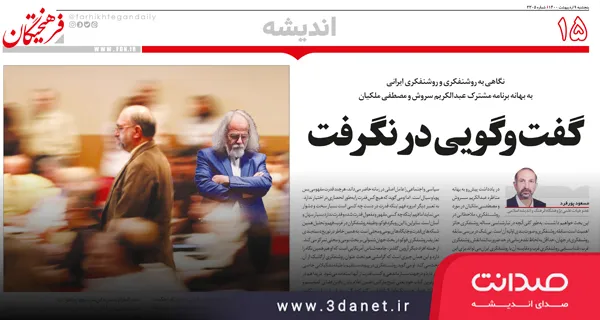
A Look at Intellectualism and Iranian Intellectualism
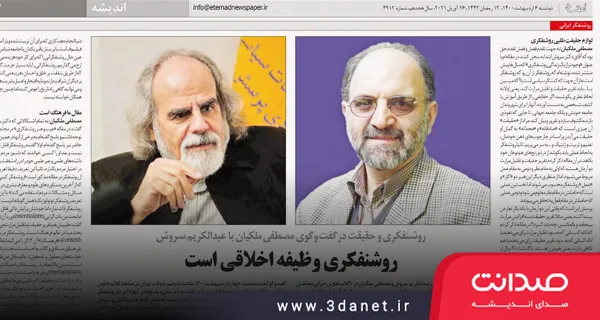
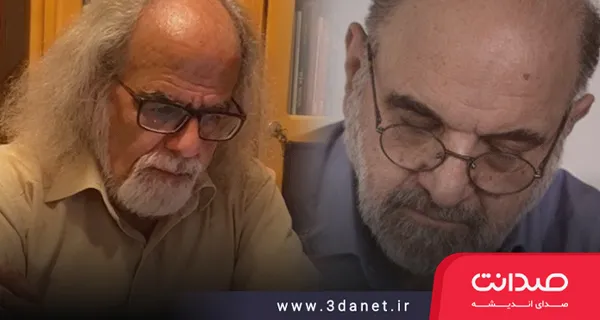
On the Occasion of the Joint Program of Abdolkarim Soroush and Mostafa Malekian
No Dialogue Took Place
Masoud Pourfard
Masoud Pourfard, faculty member of the Institute for Culture and Islamic Thought: In the present note, on the occasion of the debate between Abdolkarim Soroush and Mostafa Malekian[1] on intellectualism, we will offer some observations on this discussion. Generally speaking, what is important in the genealogy of the problem of intellectualism is the history of intellectualism and its initial formulation. Undoubtedly, in examining the history of intellectualism in the world, at least in terms of temporal priority and as a necessity, the role of Western intellectualism, identifying Western intellectualism, and comparing it with Iranian intellectualism can be very key for this discussion and debate. After raising this issue, I will then express my expectations of Professor Malekian's discussion in the debate with Dr. Soroush.
Regarding intellectualism in the West, I must briefly say that considering the developments of the French Revolution from the eighteenth century to the twentieth century and its subsequent consequences, one must admit that the center of the intellectual current in the West was in this land, and most countries were influenced by the intellectual project in France. Various examples and comparisons in the eighteenth century that indicate France's role in the subject of intellectualism can be observed in three countries: France, England, and Germany. England was involved in colonial issues and the expansion of its sphere of influence, and the consequences of this approach led to capitalism based on free trade. Germany, since it had not yet achieved political unity, had an intellectual situation that was the result of some scattered and incoherent philosophical reflections. In fact, Germany was immersed in the atmosphere of idealist philosophy, while intellectualism in France was very active and influential due to social upheavals. So, this key factor of the intellectualism debate in France is what determines the origin of its growth. The reason for its influence was that France, firstly, had reached a degree of cohesion in the social sphere and also enjoyed a relative consensus in the field of intellectualism. This itself strengthened the foundations of intellectualism in that land. The worst atmosphere of intellectual conflicts, instead of causing the decline and decay of France's political and social foundations, led to the strengthening of mechanisms and the dynamism of ideas. This social approach of French intellectuals, in a process, took on an anti-bourgeois character, and leftist interests grew among French intellectualism, a tendency that, it must be said, arose from the emergence of the Industrial Revolution in France, which began later compared to England. Of course, the beginning of the Industrial Revolution in France dates to after 1830.
It is from these times that the socialist movement takes shape in the form of an intellectual current. In short, it can be said that amidst these developments, classical intellectuals such as Voltaire, Montesquieu, and Rousseau emerge, leading to the socialism of the 19th century and figures like Saint-Simon and Proudhon. After that comes the turn of pragmatist intellectuals who operate within the framework of democratic government and through parties.
After the Second World War until the 1960s, Sartre gained extraordinary importance, and for more than two decades, namely the 1950s and 1960s, he cast a shadow over all intellectual currents, such that Sartre's presence and his existentialism prevented the emergence of other thoughts. Then, after two decades, the intellectual scene was prepared for the structuralists. The structuralists criticized modernity's excessive emphasis on the subject or the thinking self. Overall, the thought of this school, instead of emphasizing the mind, mainly paid attention to the system of signs and analyzed social and individual phenomena within the framework of linguistic structures. It was for this reason that they made the death of the subject their fundamental slogan. But the situation did not remain this way, and structuralism was also criticized by thinkers such as Foucault, Derrida, and others. Post-structuralists, instead of falling into binary oppositions, paid attention to the signifying element, meaning that the importance and dynamism of language can be sought in the instability of meanings. In their view, it is power that takes hold of language and uses it to expand itself and knowledge. In truth, the intellectual, within the network of language, power, and knowledge, is both the agent and the subject and instrument of power.
It seems that the intellectual project in the West, having traversed this trajectory, has undergone its evolutionary process based on societal needs, intellectual developments, and within a scientific process, and it possesses specific capabilities and capacities. However, generalizing this process to a different geography, particularly one like Iran, is truly difficult and challenging.
Broadly speaking, the two major Western intellectual traditions—namely, the Anglo-American intellectuals and the European intellectuals—adopted two well-known modes of action regarding social and political structures.
We are pointing this out here so that, in the discussion of the debate between Professor Malekian and Mr. Soroush, you understand what discourses take place in the West. Is it merely cultural, economic, or political? This examination helps us become familiar with the topics these two thinkers have raised.
The two major Western intellectual traditions, namely the Anglo-American intellectuals and the European intellectuals, have adopted two well-known modes of action concerning cultural, social, and political structures. Anglo-American intellectuals served power and played the role of advisors and agents of power, such as Fukuyama and Huntington, while European intellectuals predominantly assumed a critical role toward cultural, social, and political structures, among whom Sartre, Habermas, and Foucault can be named.
Regarding the narrative of intellectuals and social, political, and cultural structures, one of the most famous structuralists is Althusser, who sought to rethink the fundamental concepts of this school of thought.
In his 1970 essay "Ideology and Ideological State Apparatuses"—that is, nine years before the Iranian Revolution—he claimed that all individuals who consider themselves intellectuals are, in a way, already part of the apparatus of ideological structures. In other words, ideology, while destroying existing relations and conditions of production, also offers a kind of arrangement through which people can connect. Ideology contributes to the consolidation of human subjectivity; it praises those who agree with it and condemns those who distance themselves from it, and it bestows identity upon people. Althusser wants to make the point that you and I are each among these subjects and are subject to the interpellation of ideologies. Here, from Althusser's perspective, the role of intellectuals as subjects who are effective in the perpetuation and stabilization of the ideological apparatus is undeniable. On the other hand, Foucault, in the post-structuralist tradition, considers political and social structures to be the main factor in the present era, although power is a highly dynamic and fluid concept. But he says that no one holds power exclusively. In other words, today, understanding who holds power seems very hard and difficult, but understanding who is subjugated and acted upon by power and is powerless is very easy and simple. Therefore, with this Foucauldian approach, the task of intellectuals in the West is to understand and analyze these very networks of power and local, indigenous sites. For this reason, in the distribution of the categorization of definitions of the intellectual, Foucault, in the discussion of universalism, focuses on the local and indigenous discussion.
Among other figures is Alvin Gouldner, an American sociologist, who holds the same view, and this is the very thing that Gramsci also discusses under the title of the organic intellectual. He says that the intellectual is directly linked to a specific organizational class and is used for organizing and gaining power. Derrida, too, in his most important book, Specters of Marx, while declaring the end of the communist space and the emergence of a new technological space, states that following Sartre, Russell, and Camus is over, and the hegemony that the intellectual possessed has ended in light of this new space. In general, the emergence and dissemination of new information and communications have placed new responsibilities before intellectuals, and they must therefore seek to critique the despotisms of hegemonic powers and act as the eyes and tongue of the deprived classes.
So, if we look here in terms of examining the history of the intellectual in the West, we see that it is not merely a cultural discussion, and the critique of power and the despotisms of power becomes manifest here.
In any case, it is obvious that neither in America nor in Europe does the intellectual have a cohesive and distinct figure. That is, he should no longer be regarded as a mythical figure like Sartre, Albert Camus, Raymond Aron, Russell, and the like, but rather as an entity whose professional aspect has come to dominate his social aspect, and we might consider this professionalism, as Edward Said put it, the dangerous and deviant aspect of contemporary intellectual life.
Therefore, such discussions show that in the West, intellectualism is not solely focused on cultural issues. That is, if, based on the issues discussed in the Malekian and Soroush debate, we confine intellectualism exclusively to cultural matters, this contradicts the historical trajectory of intellectualism in the West.
Regarding Iranian intellectualism and Iran's political and cultural structure, it must be said that it is not very similar to the Western sphere, and its terminology entered Persian literature from the Qajar era with words like “monavar al-oqul” (enlightened minds) and “monavar al-fekr” (enlightened thinkers). During the Constitutional period, Mirza Aqa Kermani first introduced the term “monavar al-oqul” into literature, using it for individuals influenced by the intellectual movement and the Age of Reason in 19th-century France, who advocated for law and modernity. After some time, the term “monavar al-oqul” transformed into “monavar al-fekr.” The “monavar al-fekran” were modernist individuals who favored the overthrow of political despotism and the establishment of the rule of law. Thus, here in Iran again, we see that a part of intellectualism engages intensely with political despotism and has perhaps distanced itself from the cultural sphere due to societal conditions and exigencies.
Finally, during the Pahlavi era, the term “monavar al-fekr” was transformed into “rowshanfekr” (intellectual), and during the Islamic Republic period, the term “religious intellectualism” also gained currency. That is, the term “religious intellectual” also entered the marketplace of discourse. Examining the conduct of intellectualism, especially after the revolution, in this period spanning 40 years to date, can illuminate part of Iran's social, political, and cultural developments.
In general, in examining the state of the Iranian intellectual project compared to the West, it must be said that although the intellectual project in the West has played an important role in two areas—the production of political thought and the leadership of political, cultural, and social movements—and has performed multiple formulations, the contribution of Iranian intellectuals to these two subjects is very meager. This contribution to the production of thought is very meager and, unfortunately, pathological. In the discussion of cultural, political, and social movements, intellectualism was perhaps somewhat influential only during the Constitutional period. In any case, the intellectual project in Iran differs from the West; perhaps the following reasons and conditions are somewhat convincing on this matter.
First, there is a difference between the social and political conditions of societies, as we said that specific conditions arose in Germany, France, and England, and, for example, conditions in Iran are completely different. Some societies enjoy stable political development, advanced levels of literacy and education, and a participatory and avant-garde culture, while other societies are deprived of these things. Therefore, the situation of intellectuals in these societies also differs. Iranian and Western societies are different from this angle, and the difference is fundamental. If there has been any interaction, this interaction has been pathological. Of course, after the revolution, changes have occurred, and intellectualism has tried to draw closer to the social spheres and Iranian society.
The second thing raised in the difference between these two is that intellectuals in most countries are one of the most heterogeneous and incoherent elite groups and have displayed very diverse opinions on economic, cultural, political, and social issues.
The third point is that the personality and identity characteristics of intellectuals differ in various societies. Some personalities are romantic, some are rational, some have a passive spirit, and considering this matter and with these descriptions, it seems the state of the intellectual project in Iran is also different from other intellectuals in the world, and consequently, a different formulation must be undertaken.
But unfortunately, in the discussion of the interaction and influence of Western intellectualism on Iran, we see that their influences have been very extensive. Regarding Iranian intellectualism and its cultural, political, and social structures, a new formulation is occurring that requires a detailed discussion.
In the Iranian context, powers and structures have typically resorted to threats and enticements when confronting intellectuals, placing the absorption and co-optation of intellectuals on their agenda. And intellectuals have been absorbed in this manner. Thus, the intellectual entered the power structure, and this was especially the case during the Reza Shah period, though they sometimes maintained a critical perspective. Perhaps when they entered the power structure, they did so with a critical outlook, seeing the expediency of society and the salvation of the people in development and progress, and therefore they entered. So it is possible that even there, they held a critical view upon entering that domain.
In any case, an intellectual who has been threatened and enticed by the sphere of power, if not enticed, is naturally rejected, negated, and marginalized, just as we see such things in the Constitutional period as well.
During the Reza Shah period, we have intellectuals like Taghizadeh and Mohammad Ali Foroughi who collaborated with the government, even though they held a critical view and said that Iranian society was backward and needed to move toward authoritarian development.
The second group, who did not collaborate with the government but held a critical view, rose up through stances taken via the press, speeches, parties, and so on. From this category, at least in the Pahlavi period, we can name Jalal Al-e-Ahmad and Dr. Shariati, a vast portion of whose works and thought concerned the revival of positive traditions in Iranian society, modernization, anti-Westernism, and nativism. Of course, the degree of influence of these intellectuals must be discussed separately.
With the initial period of the establishment of the Islamic Revolution in Iran, we saw the influences of these very intellectuals in the early revolutionary period, but during the war, with the onset of the 8-year imposed war, the intellectual project altogether entered a period of stagnation.
After the imposed war, in the arena of political and social developments and the civil world, and the experience of utilizing the possibilities of the Western world and even criticizing them, intellectuals gradually arrayed themselves in the interaction of cultural, political, and social structures, and even challenged their rivals in the domains of power and culture to cultural and political contests. Broadly speaking, we can say that after the war, we see intellectuals emerging who try to enter cultural, political, economic, social, and other debates. Perhaps a prominent example of this was the discussions and debates between Dr. Soroush and Davari at that juncture.
With the brief examination we have conducted of the role of the intellectual in the West and in Iran, and with an emphasis on their differing roles, we can now enter into the discussions of "Professor Malekian's conception of the issue of intellectualism and his debate with Dr. Soroush."
The review that was conducted was precisely for the purpose of using it in the discussions that took place between Professor Malekian and Dr. Soroush.
It seems that Mr. Malekian's discussion is one whose definition also exists among Western intellectuals. We will state and categorize the existing perspectives to see in which of these categories Mr. Malekian falls.
In Julien Benda’s view, intellectuals can be imagined as a small group of philosopher-kings who, through superior talent and moral qualities, constitute the conscience of humanity. In fact, it is a kind of moral and normative definition that Mr. Benda offers. Max Weber is similar; he sees intellectuals as a group of people characterized by a special access to personal cultural achievements, who are fundamentally engaged in intellectual work and are creative and critical—this is close to the definition given by Professor Malekian. Edward Shils, as an intellectual, sees the definition of the intellectual in their preoccupation with ultimate values and living in a world broader than that of ordinary people. This interpretation also falls within the cultural domain. After these, we have a definition from Alvin Gouldner, who believes a critical view must be brought to the discussion of the intellectual and says the intellectual is a new class that should be addressed as those who transmit the culture of critical discourse to society. Foucault, of course, believes the universal role is disappearing and the intellectual is becoming local and indigenous, and they should no longer be viewed with a mythical gaze. Among these thinkers, Gramsci, who is Italian, has considered a broader concept; he believes anyone today who works in one of the fields related to the production and distribution of knowledge—meaning their intellectual activities somehow permeate their area of expertise—is considered an intellectual. In fact, every social class has its own intellectuals, and here, to prevent this scope from becoming too broad, he greatly limits the instances of the intellectual through social function. In Edward Said’s view, the intellectual is always an outsider with a universal role, and as a final definition, Foucault believes the universal intellectual has given way to the specific intellectual who works within the framework of a particular discipline. In Edward Said’s view, the intellectual plays the role of representing and embodying the consciousness of the people, something similar to Jean-Paul Sartre’s view, but for Foucault, there is no such thing as representing the consciousness of the people. Apparently, Mr. Malekian also approaches this discussion in this part.
Overall, regarding the discussion of the intellectual, we can refer to four groups and see which one Mr. Malekian has chosen. In the first category, intellectuals are generally groups that seek to articulate truth and preserve ultimate and unchanging values in the realms of truth, beauty, and justice. So, in fact, this definition is called normative and moral definitions. According to this discussion, Mr. Malekian falls here, as he stated in the debate and in articles before the debate. The second category consists of intellectuals who are the founders of fundamental thoughts—which is the Jean-Paul Sartrean view—and are considered critics of the status quo, and this becomes the universal and general definition. The third category consists of intellectuals who, as a social and cultural stratum, play a pioneering role and are highly influential in the development, thought, and culture of society. These are the intellectual and developmentalist definitions attributed to the intellectual. The fourth category consists of intellectuals who are a group situated behind the masses. That is, the masses are ahead of them in various fields. In fact, it is the concept of the decline of the intellectual from a universal state and its transformation into an indigenous and local form, so we can say the definition of the intellectual has become specific, particular, indigenous, and local, to which Foucault belongs more in this fourth definition.
Therefore, Mr. Malekian can be allowed to choose the first one, and he has chosen the first one, which is the articulation of truth and the reduction of suffering, which is the framework of intellectual work according to Mr. Malekian and falls into the first category, but scientifically, problems arise with this definition, which will be pointed out at the end.
In our view, the intellectual is a category of intellectual work that pursues the project of rationalizing the spheres of life through constructive criticism and social applications. Thus, rational thinking, constructive criticism, and social applications become its essential characteristics, and it acquires the following indicators:
- Being contemporary and having a correct understanding of one’s own time, meaning being aware of one’s time.
- Possessing critical and constructive thinking
- Having a desire for discussion and the expansion of various discourses, whether political discourse, cultural discourse, economic discourse, or social discourse, and not merely cultural.
- In search of answers for strategies for a correct lifestyle in the contemporary world. Therefore, an intellectual who is indifferent to the strategies and solutions for a correct lifestyle cannot possess the hallmark of an intellectual.
- Emphasis on the role of reason and intellect
We believe that Gramsci's definition for the discussion of the intellectual is far more suitable than other definitions. If the meaning Gramsci articulated is taken into consideration, it can be differentiated and identified through its primary functions. In fact, it is these applications and social functions of the intellectual that limit the instances. Moreover, in addition to what has been said, if we consider two important criteria of the intellectual—namely, the rational and critical approach and its social function, which is the creation and expansion of emancipatory discourses, whether cultural, political, social, or economic, and establishing connections with other discourses—and if we regard these discourses as the function of the intellectual when they acquire a social nature, then finding instances of the intellectual will become easier. Therefore, not everyone can be an intellectual.
Now, with this definition of the intellectual that we have presented and the categorization we have made, we turn to Mr. Malekian's discussions and Mr. Soroush's critiques. The general and important point is that, unfortunately for those who follow these discussions, these two thinkers had little that was new to say, and it was expected that they would say something novel and new, but no new discussion was seen. Another point is that Professor Malekian's definition was nothing new and had been previously expressed in various articles. When a debate is held between two thinkers, there should be new points, new material, and a new exposition, which unfortunately was not present in Professor Malekian's definition.
In criticizing Dr. Soroush, it must also be said that for those who follow these discussions, it was unexpected because he was expressing his own interpretations and was not critiquing Professor Malekian's views, nor was he offering a critique based on Professor Malekian's data. Furthermore, entering from a postmodern angle with the intention of dismantling Professor Malekian's concepts also lacked scientific and solid logic.
Reducing the topic of the intellectual solely to the ethical and normative domain is far from scientific fairness. When we delve into our expectations of Professor Malekian in the discussion he conducted, we believe that the reduction Professor Malekian carried out in the discussion of defining the intellectual has gone solely into the ethical and normative domain, and this is far from scientific fairness.
Professor Malekian's definition prevents the intellectual from having a free hand in various discourses, and this discourse includes cultural, political, social, and economic discourse, and these are also based on the conditions and exigencies of society. Therefore, we tie the intellectual's hands and say you must only enter the domain of ethics and norms. By doing this to the intellectual, we prevent them from having a free hand and the intellectual's authority in expanding discourses, and we say you should come and discuss in the domain of ethical and normative behavior. Of course, we say this free hand is based on the conditions and exigencies of society, but when we completely tie their hands and do not allow them to articulate political discourses and social and economic discourses, this is where the problem lies, and this is a critique of Professor Malekian's definition.
Among other issues is the discussion of the experience of studying the intellectual in the West and Iran, which contradicts Professor Malekian's view, and we have fully explained why we mention them, because it demonstrates the entry of these intellectuals, both in the West and in Iran, into various types of discourses, not a single-dimensional cultural one. So, based on an existing scientific experience that we have expressed, we have shown that the entry of these intellectuals has been into various types of discourses. When you limit it, it conflicts with the scientific study of the role of the intellectual in the West and Iran.
If we merely accept Professor Malekian's definition, what exactly is the problem in the current state of Iranian society? The problem facing the Iranian people is economic and livelihood-related. Now, you can discuss culture and the exposition of truth and the reduction of suffering within the framework of ethical propositions until dawn, but this will be of no benefit to society and the poor, and consequently, we have unconsciously created a distance between the lower class and the intellectual.
This was a summary that occurred to me to draw attention to—though these points are from the perspective and approach of my own expectations of the discussion between these two esteemed figures, which did not meet our expectations. God willing, in future discussions and debates, these points will be heeded and taken into consideration.
.
.
[1] Intellectualism and Truth, a conversation between Abdolkarim Soroush and Mostafa Malekian, 24 April 2021, New Perspective Circle (Watch on YouTube, listen on Anchor, Castbox, Download audio on Telegram)
.
.

Discussion1 comments
بنظر من این دو نفر سعی وافر داشتند اتو بدست دیگری ندهند و بهمین خاطر گفتگوی آنها بیشتر متکلمانه ومحافضه کارانه از آب درآمد وبدرد افراد میانمایه مثل من که اکثریت علاقهمندان به شنیدن عقاید تازه وبدرد حال جامعه بخور را تشکیل میدهند نخورد . ودیگر اینکه در این قبیل مناظره ها روشنفکر نباید خود را مثل گلادیاتور ها در معرض دید تماشاگران بپندارد ، یعنی راحتتر صحبت کنند واز مچگیری حریف نترسند، واز تعارفات در حق هم بپرهیزند .