Religion
Arash Naraghi’s Response to Abdolkarim Soroush’s Interview in Andisheh Pouya 101
In response to Abdolkarim Soroush’s remarks in issue 101 of Andisheh Pouya, Arash Naraghi discusses religious intellectualism, the defense of minority rights, and the distinction between “having rights” and “being right.” He also criticizes the use of terms such as “deviant sect” for religious minorities and examines the relationship between public discourse, human rights, and civic ethics.
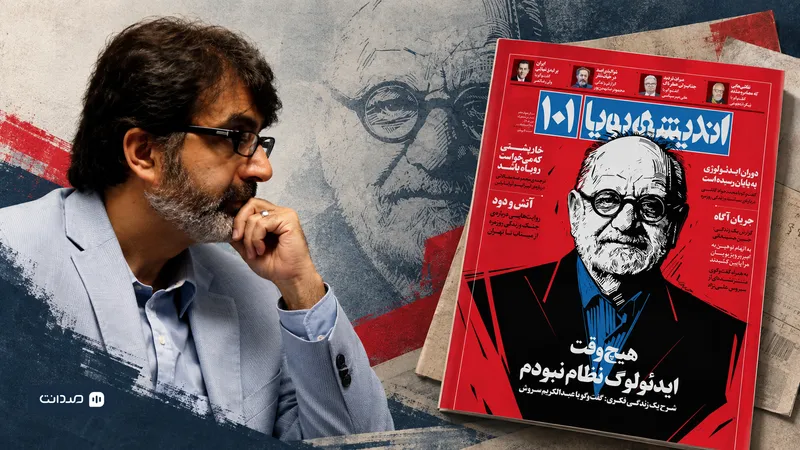

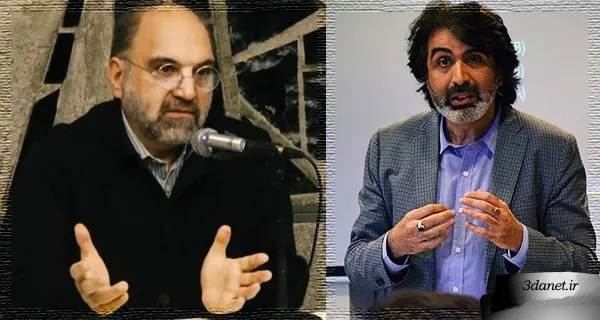
Arash Naraghi
نویسندهRecently, Mr. Abdolkarim Soroush, in an interview (Andisheh Pouya, issue 101), briefly referred to me and reminded his readers of two points: first, that he regards me as an “advocate and promoter” of a sexual minority group (namely, homosexuals); and second, that he reminded his readers that I had spoken before a “deviant sect.”
I have, of course, always taken pride in doing what little I can to fulfill my moral duty to defend the rights of minorities—including sexual and religious minorities—and in this respect I am pleased that my modest efforts in this area have not escaped the notice of eminent figures such as him. But regarding his remarks in that interview, I believe several points deserve attention:
First, he apparently takes offense at my characterization of the later version of religious intellectualism as a kind of “sect.” I have explained at length in my writings that the early Soroush’s program of “reforming religious thought” has, over time, turned into a project of “reconstructing religion.” In this latter project, new sources of legitimacy are added to the traditional sources of the parent religion. If the authority of these new sources is regarded as subordinate or roughly equal to the authoritative sources of the parent religion, the result is the emergence of a “sect” within the parent religion; but if the authority of these new sources subordinates and overshadows that of the parent religion’s original sources, then a new “religion” is born. Shiism and Sunnism, for example, are instances of two sects within Islam: the former adds the authority of the Imam’s word, and the latter the authority of the Prophet’s Companions, to Islam’s authoritative sources (namely, the Qur’an and the Prophetic tradition). These new sources of legitimacy, however, are defined alongside or as subordinate to the authority of the Qur’an and the Prophetic tradition, rather than as governing them. The emergence of Islam, by contrast, marked the emergence of a new religion, because here the new sources of legitimacy (namely, the Qur’an and the Prophetic tradition) subordinated the legitimating authority of earlier religious sources to themselves. (I have explained these points at length, among other places, in an article entitled “Religious Reformism in Three Acts.”) On this basis, the project of religious intellectualism in the later Soroush’s version can clearly be regarded as an instance of a “sect.” If Mr. Soroush considers this analysis mistaken, he must, naturally, state his reasons clearly. Whether I am an advocate or promoter of this or that sect (assuming this to be true) has no bearing on whether my argument about the sectarian character of religious intellectualism is sound or unsound.
Second, defending people’s rights does not necessarily mean defending or promoting their ideas. One of the most important pillars of tolerance is to distinguish between “having rights” and “being right.” Whether people’s beliefs are true or false has nothing to do with their human and social rights. The difference between “sectarian ethics” and “civic ethics” lies precisely here: under sectarian ethics—unlike civic ethics—people are regarded as possessing human and social rights simply because they belong to our intellectual or religious tribe or sect; if they fall outside the sect, they are deemed to fall outside the sphere of rights as well. Within sectarian ethics, defending a person’s rights makes sense only if we also regard that person’s beliefs as true. It is apparently on this basis that proponents of sectarian ethics construe the defense of minority rights as the “defense and promotion” of minorities’ beliefs or ways of life. Under civic ethics, however, individuals possess human and social rights regardless of their beliefs, and defending their rights is independent of whether those beliefs are true or false. Within civic ethics—unlike sectarian ethics—everyone is morally obliged to defend citizens’ human and social rights without regard to the truth or falsity of their beliefs. Any attempt to blur the boundary between defending minorities’ human rights, on the one hand, and defending or promoting their beliefs, on the other, is an unethical attempt to reduce civic ethics to sectarian ethics. Through this cold-blooded tactic, defenders of sectarian ethics seek to raise the cost of defending minority rights and intimidate those who defend them.
Third, traditional Muslims describe the Bahá’í Faith as “deviant” because, in their view, it has departed from many of Islam’s central teachings (including, in particular, the doctrine of the finality of prophethood). But if Mr. Soroush, in agreement with traditionalists, regards the Bahá’í Faith as “deviant,” he must answer this question: on that basis, can religious intellectualism be regarded as the “saved sect”? Compare the Bahá’í understanding of God, the prophethood of the Prophet of Islam, the nature of the Qur’an, the metaphysical status of heaven and hell, and the like with the views of religious intellectualism on these matters, and see which is closer to the Islamic tradition. If denying the finality of the Prophet of Islam makes followers of the Bahá’í Faith deserving of the label “deviant,” should religious intellectuals who claim a direct connection to revelation—or Shiism, which according to Mr. Soroush denies finality—be regarded as “deviant” on the same grounds?!
Fourth, and more importantly, the use of derogatory and dehumanizing expressions about minorities who are already under pressure and are victims of systemic violence is a clear instance of “hate speech.” We are, of course, entitled to regard other people’s beliefs as false or their ways of life as objectionable. But dehumanizing them not only makes violence against them easier; it is itself a form of violence. Mr. Soroush, who has himself been an advocate and promoter of the discourse of human rights in contemporary Iranian society, should take greater care than an ordinary citizen to preserve the moral integrity of his public language. Calling sexual minorities “dregs and trash,” or describing the followers of a religious minority as “deviant,” constitutes a discourse of hate that is worthy neither of him nor of those victims.
These considerations should alert readers to exercise greater care and scrutiny when assessing Mr. Soroush’s views on political and social matters, and to approach his claims concerning freedom and human rights with greater caution.
Mr. Soroush is, of course, entitled to lash me with the whip of reproach for the offense of criticizing some of his views; but is it fitting, in order to punish a critic or settle a personal score with him, to burn down the bazaar and sacrifice the common good?
Arash Naraghi
14 July 2026



Discussion0 comments
No comments yet; let yours be the first voice.