Political Science
Reza Zaman: A Critique of Arash Naraghi's Article “Religious Intellectualism and Its Role in Iran's Political Future”
Arash Naraghi has called Abdolkarim Soroush an opponent of liberalism. Yet a review of Soroush's views shows he believes in liberal democracy, human rights, and the principle of fallibilism; contrary to Naraghi's claim, he can indeed be considered a liberal.
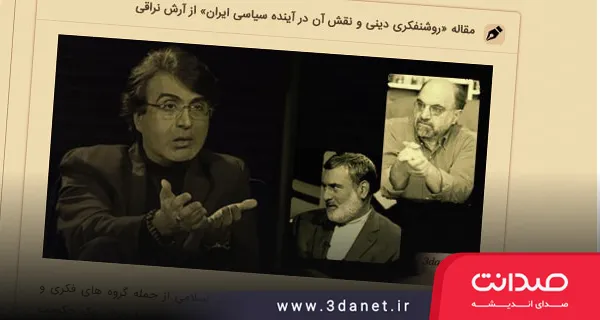
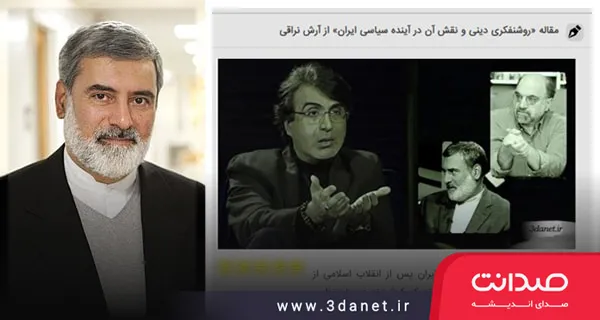
Arash Naraghi, an Iranian intellectual and reformist thinker, recently wrote a readable article entitled “Religious Intellectualism and Its Role in Iran's Political Future” in which, while presenting and examining the views and opinions of Abdolkarim Soroush and Mohsen Kadivar on politics and government, he claims that Soroush is opposed to liberalism and liberal democracy and that his ideal government is not liberal. In this article, Arash Naraghi has said: “The democracy Soroush envisions, although secular, is not liberal... Soroush has always spoken decisively of his opposition to liberalism... In recent years, he has also remained faithful to his negative view of liberalism, and believes that today clear signs of the sickness and decline of liberalism can be seen in the West.” The portrayal of Soroush’s ideal government in this article is open to discussion and dispute. I believe that Mr. Naraghi has erred in presenting Soroush’s opinion on government, and his claim about Soroush not being liberal and his opposition to liberalism does not seem justified. In this article, Arash Naraghi has neither correctly presented Soroush’s opinion on liberalism and liberal democracy, nor has he paid attention to his intellectual evolution and transformation.
Contrary to Arash Naraghi’s claim in this article, it can be shown that Abdolkarim Soroush is both a liberal and a believer in liberal democracy:
1- Abdolkarim Soroush has declared his position on his ideal government and has explicitly stated that he believes in liberal democracy in Iran (see Q&A session 16, question 20). It does not seem that Soroush’s view on government has changed from two years ago until today. Therefore, Soroush’s ideal democracy is both secular and liberal.
2- From Abdolkarim Soroush’s perspective, liberalism is a rights-oriented school. In his lecture “Islam and the Challenge of Liberalism,” he says: “Liberalism is a rights-oriented school. That is, its main emphasis is on rights, as opposed to duties... It searches for and discusses human rights... Liberalism is a school that revolves around human rights; not that it denies duties, but duties are secondary and subordinate. Paying attention to human rights, placing the human being at the center of affairs, ‘Individualism,’ and placing the right of the individual human being at the forefront of one’s demands, is clearly seen in liberalism.” Soroush, in this sense, is a liberal because he believes in human rights and is rights-oriented. In the same lecture (Islam and the Challenge of Liberalism), Soroush emphasized that: “For us to be a contemporary Muslim in the contemporary world, we must reconcile ourselves with human rights. And reconciliation is not just about giving human rights slogans; we must dig down to the depths of the concept of human rights and excavate.” He also believes in the lecture “The Record of Religious Intellectuals” that “religious intellectuals are rights-oriented.” Abdolkarim Soroush says in the article “‘Right’ and the Modernization of Iran”: “We have still not been able to become acquainted with the virtues of the element of right, and we have not allowed right to take root and become established; we have not permitted it to settle and we have not built a sacred concept from it, and we have not allowed that individuality which is built on the basis of the idea of right to be born. This problem is a cultural problem, meaning it comes to us later than science, just as science has come... Until this concept is born, its functions and consequences will not emerge either. That is, law will not sit in its proper place, politics will not find its meaning, ethics will not don a new garment, even our religious understanding will not be renewed as it should... If right finds the same value and sanctity among us that the concept of honor has found, then we can say that an important, auspicious, and blessed event has occurred.”
3- Soroush believes that in liberalism, life is superior to belief. In his lecture “The Theoretical Foundations of Liberalism,” he states: “The core tenet of liberal anthropology is that a person’s belief has no bearing on their humanity; in other words, belief is not superior to humanity… The message of liberalism is that the circle of human humanity is very broad. No one, by virtue of holding a particular belief, falls from humanity or becomes deserving of death and the deprivation of rights.” Soroush holds precisely this view and believes that humanity is superior to belief, and that one cannot take a person’s life because of their belief. In his article “Whose Heart Is in the Hands of an Infidel, Bow-Browed Beloved,” he points out that religious intellectuals “place life above belief.” Therefore, from this perspective as well, Soroush is a liberal.
4- Equality and equal rights for human beings is another pillar of liberalism. Soroush believes in the legal equality of human beings, the legal equality of Muslim and non-Muslim, religious and irreligious, woman and man. In the dialogue “Religiosity, Tolerance, and Civility” (Kiyan, No. 45), he says: “In truth, human beings are different, but in law, all are equal.”
5- From Soroush’s perspective, in liberalism, “the fallibility of the human being was taken seriously, sanctified, and emphasized, and this principle replaced all previous sacred principles: that the human being, in the realms of politics, knowledge, and religion, is fallible. Truth is in no one’s sleeve, and therefore, no one can speak infallibly or rule infallibly. We are all seated at one table and dwell in one lane” (The Theoretical Foundations of Liberalism). In his writings and works, Soroush has also consistently emphasized and pointed to the principle of human fallibility and the right to err. The fallibility of human knowledge is one of the points Soroush emphasized in “The Theoretical Contraction and Expansion of the Sharia”; one of Soroush’s presuppositions for the fallibility of human knowledge is the fallibility of the human being. Hossein Dabbagh, rightly, in his article “From Kantian Contraction and Expansion to Quinean Contraction and Expansion,” says: “The hidden foundation of Contraction and Expansion must be considered a wholehearted defense of epistemological liberalism, in the sense that it recognizes the right of human beings to be mistaken and stamps it with approval.”
6- In the introduction to the book “The Ethics of the Gods,” Soroush considers liberalism to carry this epistemological message that certainty is something elusive, indeed, unattainable. Soroush also believes that certainty is something elusive. He says: “Certainty is a very rare thing; we possess degrees of doubt and bewilderment” (Series of Lessons on Rumi’s Theology). It is for this reason that Soroush considers the truth of faith to be not certainty but hope, and places it not in opposition to doubt but to despair.
7- Soroush, both in his lecture “The Theoretical Foundations of Liberalism” and in his article “Liberation from Certainty and Certainty of Liberation,” has made this important point that in liberalism, nothing is sacred, meaning nothing is beyond scrutiny and examination, beyond criticism and analysis (sacred here means something that is beyond criticism, analysis, scrutiny, and examination, and is unquestionable). Abdolkarim Soroush is a liberal even in this sense. What is more sacred to a Muslim than the Quran? In his article “Arise, for a New Way of Thinking Is Needed,” Soroush explicitly states: “Believers must gradually come to accept that the scientific, ethical, and historical criticism of the Quran, Hadith, the prophets, and the successors is a requisite of rationality, and honoring criticism is the very essence of honoring reason. Lovers, too, should not fear that criticism will mar the face of their beloved; rather, by the decree of faith, they should expect that the pure gold of religion will emerge from the furnace of criticism purer and more refined, and like Siavash, pass safely through the fire of trial.” It seems that in recent years, Soroush has also taken a critical look at the text of the Quran.
8- Abdolkarim Soroush considers “the state’s neutrality toward various religions and various interpretations of a single religion” to be one of the pillars of liberalism. On this matter too, Soroush is in accord and sympathy with liberalism. The ideal government for Soroush is also one that maintains ideological neutrality and does not take the side of any particular religion (this is a point that Mr. Naraghi also mentions in his article). In his book The Etiquette of Power, the Etiquette of Justice, Soroush says: “Fundamentally, the government must be paternal toward different tribes and sects and achieve ideological neutrality… The government [must] look upon all religions and its subjects, of whatever faith, with an equal eye, and not grant rights and privileges to one group while depriving another; indeed, if it were otherwise, the social order would collapse and discontent would surge.”
9- Tolerance and the rejection of violence are also, in Soroush’s view, among the pillars of liberalism. I think there is no need to state that Soroush is a proponent of tolerance and an opponent of violence.
Based on what has been said, it can be understood that Abdolkarim Soroush is a liberal and believes in liberal democracy; to put it better and more precisely, Soroush is a liberal in the realms of politics, epistemology, and ethics. However, it seems that in the realm of economics, Soroush distances himself from liberalism and is not a liberal economically. His explicit opposition to capitalism is also for this reason. Although Soroush is a liberal, he also has a critical view and approach toward liberalism, and this is not at all strange. Has Soroush not criticized Islam? Did criticizing Islam make Soroush a non-Muslim, such that criticizing liberalism would separate him from this school? It can also be said that although Soroush is aware of the afflictions of liberal government, he has still not abandoned it and considers liberal democracy the best prescription for governance.
It should also be noted that today liberalism is broader than to allow all liberals to be placed in a single category, even though they all belong to the same family. The great liberal thinkers truly do not share a single understanding of freedom, nor do they hold a single position on justice. Today one can speak of liberalisms, each of which has its own particular opinion on individual freedoms, social interests, justice, the role of the state, and so on—opinions that sometimes stand in opposition to one another.
In this context, Abdolkarim Soroush can be considered a left-leaning liberal who has moved beyond classical liberalism and right-wing liberalism, adopting a critical approach toward them. In recent years, Soroush’s negative gaze has been directed more at those liberalisms that have aligned themselves with capitalism. It can also be said that Soroush’s liberalism is close to the liberalism of John Rawls, and one can speak of the similarities between Soroush and Rawls regarding the concepts of freedom and justice and their relationship (see the article “John Rawls and Abdolkarim Soroush” by Hossein Dabbagh).
But regarding religion and liberalism. In this article, Arash Naraghi considers the reason for Soroush’s opposition to liberalism to be the incompatibility of religion with liberalism (from Soroush’s perspective). Naraghi points to this statement by Soroush: “Liberalism is opposed to religion… no religious person can be a liberal.”
Of course, the author of these words is Soroush, but the Soroush of 1991. Both Soroush's understanding of religion and religiosity and his stance toward liberalism have undergone change and evolution, and without seeing this change and evolution, one cannot properly grasp what specific opinion Soroush holds today regarding the relationship between religion and liberalism. The later Soroush has realized that there is no single religion and no single Islam that possesses an essence of its own. Soroush says one must speak of religions and religiosities, Islams and Muslimnesses (see the article Essential and Accidental in Religions). In other words, there is no single reading of religion; rather, there are multiple and diverse readings of religion. Today, one can speak of traditional Islam, traditionalist Islam, fundamentalist Islam, and modernist Islam. Soroush has also spoken of types of religiosity and has distinguished three types of religiosity: pragmatic religiosity, epistemic religiosity, and experiential religiosity. Each of these religions and religiosities has its own specific ruling, and religions and religiosities do not have the same relationship with liberalism. That statement of the early Soroush can, with the help of the later Soroush, be understood as follows: Liberalism is incompatible with official and traditional religion, with maximalist and bloated religion, with ideological and jurisprudential religion. Liberalism opposes the common and conventional understanding of religion. But a religion can exist, an understanding of religion can exist, that is compatible with liberalism. As it happens, Soroush's understanding of religion is entirely compatible with liberalism.
Abdolkarim Soroush himself has spoken of the possibility of a liberal reading of religion and has defended such a reading (article Deliverance from Certainty and Certainty of Deliverance). Soroush, in the book "The Ethics of the Gods," rightly says himself that "pragmatic and Sharia-oriented religiosity may become lean and ailing under the shadow of liberal systems, but investigative and epistemic religiosity certainly gains strength and becomes lush and flourishing." Thus, from the perspective of the later Soroush, one can have a liberal understanding and reading of religion, and one can be both religious and liberal, and epistemic religiosity gains strength under the shadow of liberal systems.
.
.
A Critique of Arash Naraghi's Article “Religious Intellectualism and Its Role in Iran's Political Future”
Author: Reza Zaman
.
.

Discussion1 comments
بسیار عالی تشکر