Religion
Arash Naraghi’s Response to Abdolkarim Soroush’s Note in Andisheh Pouya 102
In his second response to Abdolkarim Soroush, Arash Naraghi examines Soroush’s remarks in issue 102 of Andisheh Pouya concerning the rights of Bahá’ís and homosexuals. While welcoming Soroush’s explicit recognition of these minorities’ rights, Naraghi raises questions about the scope of those rights, their relation to equal citizenship, and whether Soroush’s language and earlier positions are consistent with this claim.
Arash Naraghi
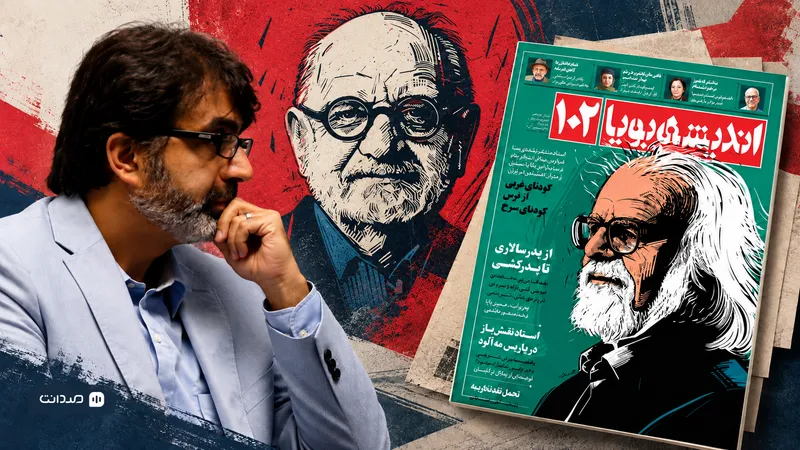
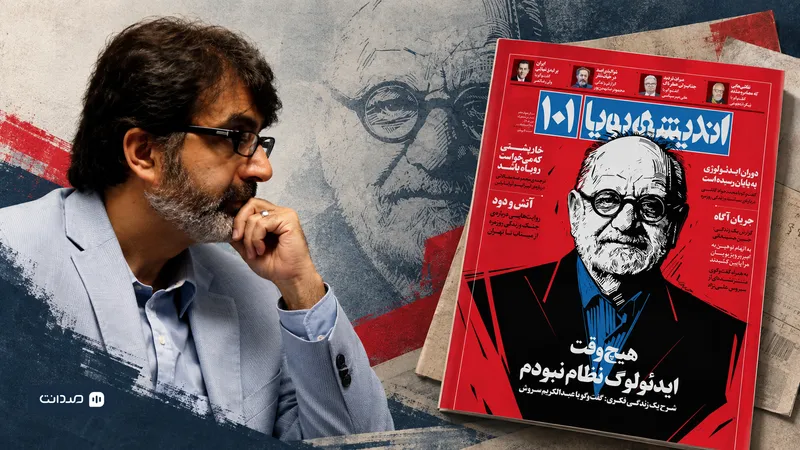
نویسندهIn his recent letter in Andisheh Pouya (issue 102), Mr. Abdolkarim Soroush once again made a brief reference to me, and perhaps it would be worthwhile to reflect on some of the points he raised. I would, of course, prefer to pass over the words “more delicate than a rose petal” that he has repeatedly directed at me on various occasions, and I hope that these exchanges can move beyond grievances and personal disputes to focus on broader issues more closely connected with the common good.
To my mind, the most important part of Mr. Soroush’s recent note is his emphatic statement that he recognizes the rights of Bahá’ís and homosexuals. I believe this explicit statement is a positive step in the right direction. In the past, he defined his preferred form of democracy solely in terms of majority rule, without taking minority rights into account. It is only in recent years that he has gradually begun to incorporate respect for the fundamental rights of minorities into his analyses (at least to some extent, albeit marginally). The distance from that starting point to this more or less explicit defense of the rights of Bahá’ís and homosexuals is a long one for Mr. Soroush, and I believe it should be welcomed.
For several reasons, however, I believe his statements about minority rights should be treated with caution:
First, the historical experience of contemporary Iran has taught us to view the claims of advocates of political Islam with skepticism. Iranians have not forgotten that, while outside the structures of power, the leaders of political Islam spoke of a republic modeled on France, but once they gained political power, they began playing the tune of the absolute guardianship of the jurist. This historical experience has, in my view rightly, made Iranians suspicious of religious believers who enter the realm of politics, whether with their actions or their pens. This does not necessarily mean that politically engaged religious believers are insincere in what they say, but it certainly means that the standards by which their theoretical and practical sincerity are judged have become more stringent. Thus, assuring ourselves of the integrity and sincerity of politically engaged religious believers requires something more than a simple “certainly not.”
Second, in some cases it appears that politically engaged religious believers conduct themselves like politicians when presenting their political views—that is, they deliberately wrap their statements in ambiguity and equivocation so that they can later bend them to suit different audiences. Let me give an example. It is good that Mr. Soroush considers himself someone who “recognizes” the rights of Bahá’ís and homosexuals—but he never makes clear exactly which rights he means. His statements on this subject generally remain broad and vague. On the rare occasions when his remarks become somewhat more explicit, it appears that respecting minority rights means only respecting their minimal rights. That is, for example, minorities should not be killed, nor should their children be prevented from receiving an education. The important point, however, is that within Mr. Soroush’s intellectual framework, possessing fundamental rights does not amount to legal equality among citizens. Many citizenship rights go beyond “fundamental or minimal rights,” and in Mr. Soroush’s view minorities—unlike the Muslim majority—do not possess those rights simply by virtue of being citizens. In other words, under the legal order defended by Mr. Soroush, the Muslim majority, in principle, enjoys certain citizenship rights simply by virtue of being Muslim (such as the right to propagate its religion) from which, for example, religious minorities or nonbelievers are excluded. Is Mr. Soroush’s insistence on the necessity and legitimacy of the Guardian Council within his preferred political order intended to guarantee precisely these kinds of discriminatory restrictions on citizenship rights?
Third, a defense of minority rights must manifest itself in both language and action. On the BBC program Pargar, when the presenter asks Mr. Soroush about his lack of concern for minority rights, including his silence in the face of violations of the fundamental rights of Bahá’ís, Mr. Soroush, after defending the actions of the Hojjatieh Society against Bahá’ís in Iran, immediately adds: Have the Bahá’ís defended my violated rights, that I should defend theirs?! Let me give another example. According to Mr. Soroush’s own account, after the fall of Saddam Hussein in Iraq, he was invited to a meeting in London to comment on the draft of Iraq’s new constitution. Apparently, the draft contained a clause requiring respect for the rights of sexual minorities. Mr. Soroush relates that he was the only person at the meeting who opposed that clause, and then adds: “I persisted in opposing that clause until they removed it from the draft.” (I have no independent knowledge of the meeting itself or of the discussions that took place there; what I am recounting is solely Mr. Soroush’s account of the meeting.) Reactions of this kind—at least at first sight—do not seem consistent with the conduct of sincere defenders of minority rights.
Fourth, Mr. Soroush’s language when referring to minorities—including sexual minorities and Bahá’ís—is not clean, and shows no sign of respect for the rights of those minorities. In his lecture “Armed Neoliberalism,” he calls homosexuals “dregs and trash,” and in his interview with Andisheh Pouya, he describes the Bahá’í Faith as a “deviant sect.” Worse still, in the same interview, when referring to homosexuals and Bahá’ís, he borrows the censorious language of the jurists, calling them “infidels” and calling me an “idolater” for the offense of defending their rights. I do not particularly mind being called an idolater. But by what logic of human rights can Bahá’ís and sexual minorities, who are already victims of appalling and systemic violence, be called infidels?
Finally, let me add a point about religious intellectualism being a sect. I believe I have sufficiently demonstrated that the project of the later Soroush (on a sympathetic interpretation) has taken the form of a “sect.” I have carefully explained what I mean by “sect” and clearly set out my reasons for the emergence of such a sect. Thus, if I am guilty of anything, it is merely of analyzing an existing phenomenon within the study of religion in contemporary Iran. But is sect formation a good thing, and is the sect of religious intellectualism the “saved sect”? These questions, though worthy of reflection in their own right, have not fallen within the scope of my analysis, and I have expressed no view on either of them, for or against. The history of religions—including the history of Islam—is replete with all manner of colorful sects, and I doubt that this bird’s alighting on that mountain would add anything to it.
Arash Naraghi
29 September 2026


Discussion0 comments
No comments yet; let yours be the first voice.