Why this book?
- To understand a newer generation of religious intellectualism after Abdolkarim Soroush.
- To gain a concise introduction to the thought of Abolghasem Fanaei, Arash Naraqi, and Soroush Dabagh.
- To understand the link between religious intellectualism, ethics, human rights, and modern life.
- To read a fluent account of one of the most debated intellectual currents in contemporary Iran.
About the book
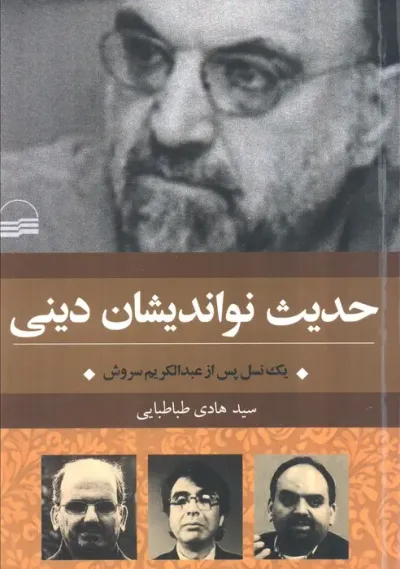
Hadith of Religious Intellectuals, written by Hadi Tabatabai, examines three contemporary religious thinkers who stand in continuity with, and also move beyond, Abdolkarim Soroush’s intellectual project. The book tries to show that religious intellectualism in its newer generation has moved past the question of religious knowledge and the contraction and expansion of Sharia toward fields such as ethics, human rights, violence, spirituality, tolerance, and ways of life.
The first chapter is devoted to Abolghasem Fanaei and explains his central idea: the priority of ethics over religion. In this chapter, Tabatabai shows how this idea can be used to critique religious violence, unethical jurisprudence, and the relation between the religious and the ethical. The second chapter discusses Arash Naraqi and examines his project of “critical traditionalism” in relation to revelation, bodily resurrection, human rights, violence, torture, tolerance, and religious experience.
The third chapter deals with Soroush Dabagh and discusses his relation to the legacy of Abdolkarim Soroush, Sohrab Sepehri, and Ludwig Wittgenstein. It examines topics such as modern mysticism, hijab, apostasy, civil marriage, Qur’anic interpretation, modes of faith, and the relation between religion and everyday life. The book is suitable for readers who want a clear and relatively systematic picture of the new generation of religious intellectualism in Iran.
Religious enjoining of good, when pursued through unethical means, is in fact itself one of the ethical wrongs.
From the table of contents
- 1Abolghasem Fanaei
- 2Arash Naraqi
- 3Soroush Dabagh