Religion
Can Unbelief Be a Path to Faith?
The experience of faithlessness is not necessarily a stance against God, but can sometimes be a path toward renewed faith; by defining faith as hope, this journey can lead to an authentic experience of religion and call believers to reconsider their judgments.
Can unbelief be a path to faith? If yes, why and how? And if not, why? In response to this important question, I attempt in this essay to argue in favor of the claim that: the experience of unbelief can be a path to (renewed) faith in God. On this basis, it can be claimed that unbelief, in some cases, is not a stance against God but may ultimately be a stance turned toward God. Furthermore, I argue that the experience of unbelief that leads to faith can, in some cases, result in one of the authentic types of faith experiences.
Can Unbelief Be a Path to Faith?
Yaser Mirdamadi[i]
"Abu Ma'shar the Astrologer" set out from Khorasan with the intention of performing the Hajj. At that time, he was not an astrologer and knew little of the science of astronomy, but having heard descriptions of the library of the "Khizanat al-Hikma," to which scholars from all corners of the world flocked, he went there and was astonished at the sight of such a magnificent library. He abandoned the Hajj and engaged in study and research there, and became so immersed in the science of astronomy that his religious beliefs were undermined, and he turned his heart away from the Hajj, Islam, and all religions, and abandoned them all.
Yaqut al-Hamawi[ii]
God moves in mysterious ways, and I believe that there are times when we seem to be rushing in the direction of turning away from God, while [in reality] God is at work guiding us toward Himself.
William Alston[iii]
Perhaps rebellion against God can often tell us as much about religion as worship of God. Rebellion against God may be a participation in the religious form of life. The rebel grasps the event of religion from within, although it is not an event that captivates him.
D. Z. Phillips[iv]
If the unbeliever knows what unbelief is, he is a monotheist.
Ruzbihan Baqli Shirazi[v]
Can unbelief be a path to faith? If yes, why and how? And if not, why? In response to this important question, I attempt in this essay to argue in favor of the claim that:
the experience of unbelief can be a path to (renewed) faith in God. On this basis, it can be claimed that unbelief, in some cases, is not a stance against God but may ultimately be a stance turned toward God. Furthermore, I argue that the experience of unbelief that leads to faith can, in some cases, result in one of the authentic types of faith experiences.
This claim can be generally termed the claim of "Unbelief as a Path to Faith," or, in its abbreviated letters, the "UAPF" claim. What conclusion can be drawn from this claim? One of the conclusions that can be drawn from this claim is that thoughtful and tolerant believers must fundamentally reconsider the common meaning of unbelief, according to which leaving religion is considered entirely morally and theologically reprehensible. This fundamental reconsideration entails that not only must the property, life, honor, career, social standing, and reputation of the unbeliever, as well as familial and friendly ties with them, be respected, but believers are also not permitted to pass negative moral and theological judgment on the experience of unbelief, always and under all circumstances—even if they never express this negative judgment and keep it only in the secret chamber of their hearts.
However, the aim of this piece is not to invite the abandonment of faith and the experience of unbelief (for those who find themselves in a state of faith); this is, among other reasons, because abandoning faith and experiencing unbelief, just like coming to faith, is not entirely within the control of the experiencing individual such that one could then be invited to faith or unbelief; rather, such experiences are, to some extent, an experience that, so to speak, befalls and descends upon the individual. This piece pursues two main goals: on the one hand, it seeks to bestow a new meaning upon the experience of unbelief, especially the experience of unbelief of those who still have an epistemic and/or existential concern regarding faith. To propose a new meaning concerning the experience of unbelief, I try to draw the reader's attention to an important possibility regarding the relationship between faith and unbelief. On the other hand, this piece seeks to propose a defensible ethical and theological relationship between believers and unbelievers.
1- What Are Faith and Unbelief?
Before defending my claim, let me first explain what I mean by faith and unbelief. Generally, the model presented for characterizing faith takes action and belief as the basis of this model, meaning it is claimed that faith possesses one of these two components or a combination of both:
1- Living according to a religious way of life (religious language, rituals, customs, and relations)—(the action component);
2- Belief in fundamental religious doctrines or the "acceptance" of these doctrines[vi]—(the belief-acceptance component).
However, it seems that taking the component of action and/or belief (or acceptance) as the basis for characterizing faith is not a successful model; rather, "hope" appears to be a more suitable model for this matter. According to the "faith as hope" model, someone who hopes that religious beliefs will turn out to be true or reasonable, and/or hopes for the usefulness (i.e., salvific nature) of the religious way of life and beliefs, and makes serious room for this hope in their life, is a believer. Based on this conception and more specifically, one who hopes for the existence of God and makes serious room for this hope in their intellectual approach and way of life is considered a believer, even if they do not believe in God and do not live faithfully in practice[vii] (I will speak more comprehensively about the proposed models of faith below in section 7).
This conception of faith can be called "hopeful faith." However, someone who possesses hopeful faith is a believer in a completely unconventional sense of the word. Because in the conventional sense of the word, faith is modeled based on action and/or belief. In this piece, I take faith to mean hopeful faith. Accordingly, someone who is entirely devoid of this hope is devoid of faith.[viii] Someone who has no hope for the truth or reasonableness of the central doctrine of religion, and/or no hope for the usefulness and salvific nature of religious belief and way of life, then such a person is entirely devoid of faith. Someone who still hopes for one of these two (hope for the truth or reasonableness of religious belief, or hope for the usefulness of religious belief and way of life) or for both is not devoid of faith.[ix]
Hope differs from belief and action. However, hope has a relationship with belief and action: hoping for something presupposes a certain kind of belief about that thing. In the sense that hope cannot be attached to the impossible or the highly improbable (although a wish may be attached to the impossible or highly improbable). Furthermore, reasonable and defensible hope is attached to something that is worthy of being hoped for. For example, normally, an ordinary person does not wish to become a murderer, because becoming a murderer is not a state worthy of hope. Therefore, in addition to its affective aspect, hope has at least two cognitive aspects, meaning it is epistemically evaluable:
1- That which is hoped for must be possible and probable. One cannot hope for the impossible or the highly improbable. 2- That which is hoped for must be worthy of hope.
These two aspects of hope make the epistemic evaluation of hope possible and prevent hope from being reduced to mere feelings and emotions. For example, in critiquing a hope, one can show that what was hoped for was not possible or not very probable, or that it is not something worthy of hope.[x]
1-1: Two Points on the Characterization of Faith
But let me, before proceeding with the discussion, raise two points related to this part of the discussion:
1- Since the main claim of this paper does not depend on any particular conception of faith, I will not argue in favor of my own conception of faith and will merely assume it in this paper. My claim is that even if we consider faith to be action, or belief (or any other conception of faith we might have), the main claim of this writing—that unbelief can be a path to faith—will still be defensible.
2- My claim is not that faith can be easily distinguished from unbelief in practice, or that such a thing should be done. The distinction between faith and unbelief is difficult in practice and, in some cases, impossible; moreover, drawing distinctions between believers and unbelievers in practice is, in many cases, morally impermissible; because, among other reasons, it has the problem that in many instances it entails violating individuals' privacy. What I claimed in this section is merely to determine the meaning of the two concepts of "faith" and "unbelief" and to draw a theoretical distinction between these two concepts.[xi]
In what follows, I will formulate the core of my claim. But if you do not have the patience for a dry and possibly somewhat complex formulation, you can skip this section and go directly to section 3. In that case, the overall claim will still be understandable to you.[xii]
2- Formulation of the Claim
Before arguing in favor of my claim, let me formulate the claim itself:
P: Person (any person)
S: The state of unbelief
G: The (re-)experience of faith
F: The state of faith
1- There exists a state S, which is the "state of unbelief" (in the sense mentioned above for "faith" and "unbelief")—and a person like P can be imagined who is in state S. State S—which the individual P experiences—can pave the way for the formation of state G, i.e., the "(re-)experience of faith" in P, such that state S is at least partly the groundwork (preparatory cause) for P's arrival at state G. In other words: S may pave the way for the formation of G in P.
2- The individual P—who, after experiencing state S, now finds themselves in state G—may have experienced one of the authentic forms of state F, i.e., the "state of faith."
But when I claim that unbelief may be a path to faith, what do I mean by "something being a path to something else"? Specifically, what do I mean by "path"? As I also indicated in the formulation of the claim, I mean that in the chain of things that may lead an individual to faith, unbelief can also play an important role. In other words, unbelief can become a "preparatory cause" for faith and prepare the individual for the (re-)experience of the state of faith.[xiii] In what follows, I will try to argue in favor of its "being a gateway."
3- Why might unbelief be a path to faith?
My claim, as I showed in the formulation above, actually has two parts. In the first part, I claim that a person, such as P, who is in the state of "unbelief" (state S), can enter the state of "re-experiencing faith" (state G). How can one argue in favor of the first part of "Bob-Man"'s claim? (I will speak about the second part of this claim below). To show the possibility of a person finding a way from the state of unbelief to the state of faith, and also to show that unbelief can pave the way for arriving at faith, it is sufficient to show just one case where a person believes they have found their way from the state of unbelief to the state of faith, and also believes that their state of unbelief paved the way for their arrival at faith. And since the possibility of unbelief paving the way for (renewed) faith cannot be overlooked, one can then conclude that unbelief may well pave the way for faith.
The example I will point to for this purpose is the experience of William Alston (1921–2009), the prominent American philosopher of language, epistemologist, and philosopher of religion.[xiv] In this piece, I will focus solely on a short essay by Alston, which Hooman Panahandeh brilliantly translated into Persian years ago under the title "A Philosopher's Way Back to Faith" (for the bibliographic details of this article, see footnote number 3). For reasons I will explain further below, this text is highly illuminating and of particular importance for defending the first part of "Bob-Man"'s argument, because it presents us with a possibility worth pondering regarding the relationship between faith and unbelief.
4- Alston and the re-experience of faith
Let me first give a brief account, in his own telling, of what happened to Alston's faith. Alston was born and raised in a Methodist (a branch of Protestant Christianity) family in America. What he recalls from that environment is "a perfunctory attitude and a lack of warmth and fervor in matters of religion" (p. 37). When he reaches the "age of reason and discernment," as he puts it, he abandons the "shipwreck of faith." However, after finishing his university studies (early 1950s), he feels within himself a desire to return to Christ, although he explains that his return to Christ was not because he had been convinced of the truth of Christianity through philosophical and theological arguments; rather, he wanted to test faith, or, in his own words, "I make an effort to see what happens." But he very soon jumps out of the ship again. Forty years after that incident, when he looks back at his jumping out of the ship of faith again at that juncture, he finds it to have been the right thing to do: "I had no real relationship with God. I had no good reason for believing in God, let alone for believing in something specifically Christian" (p. 38). In his view, sometimes to find and understand faith, one must distance oneself from it, that is, leave it, and he had distanced himself from faith.
He spends the next 15 years of his life far from faith. Although he later realizes that during these 15 years, in the substratum of his being, there were, as it were, stirrings of which he was unaware at the time. He describes these 15 years of his life, or in his own words, the "years of exile from faith," as follows: "I was never entirely comfortable in trying to live a life devoid of God. I was never an eager, ardent atheist. By the mid-seventies, a feeling was taking shape within me: I am ignoring something, something of fundamental importance" (p. 38). Nevertheless, he is not ashamed of his years of exile from faith, but rather sees them as a kind of spiritual preparation for receiving God's message: "God had to wait for me to pass through various life experiences [...] so that He could then deliver His message to me." (p. 38).
After 15 years, he comes to Oxford for a study opportunity. And at Oxford, what he himself felt had been secretly stirring in the substratum of his being over these years finally surfaces, breaks through, and reveals itself.[xv] He remained faithful to this turn to faith for the rest of his life.
4-1: Key Points of Alston's Narrative
In my view, the important points that can be found in Alston's narrative of his fateful turn to faith are as follows:
1- This turn occurred entirely gradually, and not, as in classical accounts of spiritual transformation of wayfarers, suddenly and as a result of a specific incident;
2- Personal decision also played a role in this; that is, it was not the case that a series of events occurred that dragged him, step by step, toward faith, such that he had no other path before him but submission and contentment in the face of these internal and external events. Rather, after much inner struggle and considerable hesitation and repeated reconsideration, he ultimately decides to board the ship of faith once again. I do not mean that his choice was entirely voluntary and arbitrary and that other factors (epistemic or otherwise) played no role in this; rather, I mean that the factor of decision also played an important role in his turn to faith.
But leaving these two points aside, there is another point in Alston's narrative that is so significant and so closely tied to the present discussion that it can be called the point of points. This point is that Alston does not say that he did not believe in God because he had not found reasons for God's existence at that time (at least the second time he leaped from the ship of faith, his problem was not a lack of reasons). Rather, at that time, he was in fact saying that he wished God did not exist, and even if, hypothetically, a God did exist, believing in Him was beneath the dignity of a mature, self-founded, autonomous human being. In other words, the reasonableness or unreasonableness of religious beliefs was no longer his issue; the worthiness or unworthiness of coming to believe in God was his main problem: "I got the feeling that if I were to seek God in Jesus and pursue connecting myself in some way to the ultimate source and orderer of things, such an act would stem from a feeling of fear and would be a betrayal of my dignity of maturity and adulthood." (p. 38) This is the most blasphemous type of unbelief, and perhaps unbelief is only this. As Miguel de Unamuno (1864–1936), the Spanish philosopher, theologian, and writer, said, the unbeliever is not the one who says there is no God; the unbeliever is the one who says, 'I wish there were no God.'[xvi]
The main point of the discussion here is that this very "most blasphemous unbelief" can also be a path to faith, and as we saw in Alston's case, according to his own narrative, this was so in practice.[xvii] Alston's key sentence, which considers unbelief as a groundwork for faith, is where he says God had to wait for me to undergo various experiences in order to convey His message to me. This means that, in Alston's view, his unbelief was ultimately a step toward his faith and not a path opposed to faith. It is precisely for this reason that Alston, as a believer, is not ashamed of his former unbelief, but rather considers it a path to his renewed faith. In what follows, I will formulate my argument in favor of the first part of the "Bāb-e-Mān." But if you do not have the patience for dry and possibly somewhat complex syllogistic reasoning, you can skip this section and go directly to section 6. In that case, the overall argument will still be understandable to you.
5- Formulation of the Argument in Favor of the First Part of "Bāb-e-Mān"
Before proceeding with the discussion, let me formulate my argument in favor of the first part of the "Bāb-e-Mān":
Premise 1: Alston's narrative of his turn to faith shows that he found his way from state S, "the state of unbelief," to state G, "the (renewed) experience of faith."
Premise 2: Since Alston is a distinguished philosopher and his life shows no sign of insincerity, there is no reason for reasonable doubt about the sincerity and accuracy of his account of his experience.
Premise 3: Alston's understanding of his turn to faith is that his unbelief was, at least to some extent, a preparatory ground (preparing cause) for his faith.
Premise 4: Alston's understanding of the preparing cause of his (renewed) faith is an understanding that is—at least—conceivable.
Premise 5: Anything that is conceivable is logically possible.
Premise 6 (Conclusion 1): Alston's understanding of the preparing cause of his (renewed) faith is an understanding that is—at least—logically possible.
Premise 7: Unbelief becoming a preparatory ground for (renewed) faith is a situation that, if possible, is possible for others as well.
Conclusion (2): Situation S, "the situation of unbelief," in which person P found themselves, can/may lead to situation G, "the (renewed) experience of faith," such that situation S is at least to some extent the preparatory ground (preparing cause) for P's arrival at situation G.[xviii]
5-1: Some Remarks on the Argument for the First Part of "Bābmān"
Paying attention to a few points is necessary for a better understanding of this argument:
1- It is important to note that for the soundness of this argument, assuming the truth or falsity of religious beliefs is not a condition (beliefs such as: the existence of God, or the knowability of God's essence and attributes, or the knowledge that God was the agent of eliciting a religious experience in a person). The first premise of the argument is merely a biographical premise. This premise states that an individual who had lost their faith now, after a long time, finds that they have regained their faith. The second premise is a kind of conventional, non-philosophical assessment regarding the sincerity and accuracy of this biographical account and merely states that we have no reason to believe Alston intended to deceive others or, merely in the psychological sense of the word, was delusional or fantasizing. This premise is neutral regarding the truth or falsity of religious beliefs; that is, on the one hand, it does not presuppose that there was definitely a God who was the direct or indirect agent of Alston's turn to faith. On the other hand, this premise does not presuppose that Alston is caught in self-deception and that there is no God or, if there is, God played no role in Alston's turn to faith; rather, it is neutral regarding the truth or falsity of religious beliefs, because there is no need to adopt a theological stance on this matter to advance the "Bābmān" argument.
The third premise is also a biographical premise because it states that the understanding of the person having the experience of their own experience was such that their unbelief was, at least to some extent, a preparatory ground for their (renewed) faith. The fourth and fifth premises merely demonstrate the possibility of unbelief being a preparatory ground for faith. The seventh premise merely claims that unbelief becoming a preparatory ground for (renewed) faith is something that is generalizable to others. The neutrality of the premises of this argument regarding the truth or falsity of religious beliefs carries with it, among other things, the important feature that both religious people and those independent of religion can reach an agreement on recognizing unbelief (in the broad sense of the word, which includes the moral and theological recognition of unbelief as well) through this argument.
2- This argument does not say: since Alston interpreted his experience of faith-transformation in such a way that his unbelief was the groundwork for faith, therefore unbelief is or can be the groundwork for faith; rather, the argument says that Alston's interpretation of his experience is an interpretation to which, so long as there is no obstacle to its possibility—and it seems there is no obstacle here (and this qualification is important)—attention must be paid in analyzing the relationship between faith and unbelief, as one of the important possibilities in this matter. In other words, the argument is not that: from "it seems to an individual that A," we then deduce "A" itself. Rather, two further premises are added showing that A is a possible experience and that there is no obstacle to the possibility of this type of experience, because this type of experience is conceivable.[xix]
3- This argument does not say that unbelief causes faith, but rather that unbelief can/may be the groundwork for faith. That is, firstly, it demonstrates the possibility of such a thing and not necessarily its actualization, and secondly, it does not negate the probable influence of other factors (God, reasoning, upbringing environment, etc.). Accordingly, it speaks of the ground-laying (preparatory cause) of unbelief for faith and not its causation (efficient cause).
6- The Faith-Turn and the Authenticity of Faith
In one sense, my work ends here. My aim was to show that the experience of unbelief may be a path to the (re-)experience of faith, and if the above argument is valid and sound, I have achieved my aim. However, someone might accept the above argument but still believe that the faith experience that emerges from the heart of the experience of unbelief, compared to the faith experience that has never emerged from the heart of the experience of unbelief and has always remained in the realm of faith, lacks authenticity. Faith after unbelief is faith, but it is not authentic faith. In what follows, I will try to argue against this view and show that the faith experience that has emerged from the heart of the experience of unbelief can also possess authenticity. But what kind of experience is an authentic experience? It seems that the authenticity of experience here has two meanings: 1- An experience is authentic if the preliminaries of its formation are—to a large extent, if not completely—free from hypocrisy and pretense and have a strong inclination toward singleness and straightforwardness,
and also:
2- An authentic experience is one in which the individual, in facing that experience, is not merely receptive, passive, and indifferent, but is at least to some extent selective and active. In other words, an authentic experience is one that, firstly, has occurred naturally, and secondly, its owner has taken it seriously.[xx]
6-1: Two Points Regarding the Second Part of the "Bab-Man" Claim
The second part of "Bab-Man" was as follows: "Individual P, who after experiencing situation S, i.e., 'the situation of unbelief,' now finds themselves in situation G, i.e., 'the situation of the re-experience of faith,' may have experienced one of the authentic varieties of situation F, i.e., 'the faith situation.'" Let me mention two points that help in precisely understanding the second part of "Bab-Man":
1- The claim of the second part of "Bab-Man" is not that the (re-)experience of faith after unbelief is the sole instance of an authentic faith experience. For one can imagine a believer who has spent their entire life in the experience of faith and has never leaped out of the ship of faith, yet their faith experience is entirely authentic.
2- The claim of the second part is not that the (re-)experience of faith after unbelief is necessarily an authentic instance of faith experience. For one can imagine someone who, after years of unbelief, merely out of impatience or weariness with the search for truth, or due to social pressure from not conforming with the community of the devout, (re-)takes refuge in the “safe” corner of faith, and through suggestion and indoctrination a faith-belief gradually (re-)forms in him. Such a person has undergone the re-experience of faith, but his experience can hardly be considered an authentic one. Now, after clarifying the intent and meaning of the claim of the second part of our “chapter,” I will argue in its favor.
7- Eight Models of Faith and the Place of the Will
My argument in favor of this part of our “chapter” is, in summary, as follows: however we analyze the nature of faith, the freedom of the human will and choice (and not being purely receptive and passive) is at least a necessary condition of faith—if not more than that. Hence, if we consider a faith-turn (in the sense of abandoning faith and returning to it again) as an instance of exercising free will and human elective agency, then a faith-turn can be one of the instances of authentic faith experience.
John Bishop, philosopher of religion and epistemologist, in the entry “Faith” in the Stanford Encyclopedia of Philosophy, enumerates seven models for characterizing faith:
1- Faith as purely affective states (affective model),
2- Faith as a special kind of knowledge (of revelation) (special knowledge model),
3- Faith as belief (belief model),
4- Faith as trust (trust model),
5- Faith as doxastic venture, i.e., believing beyond the evidence,
6- Faith as sub-doxastic venture, i.e., taking-to-be-true beyond the evidence (for the difference between “belief” and “taking-to-be-true,” see footnote no. 5),
7- Faith as hope (hope model),[xxi]
7+1- Faith as acting upon God’s command (the works of the limbs model).
For advancing my discussion, there is no need to enter into a detailed explanation of each of these models. I will only point out that in developing these seven models, Bishop has also, to some extent, taken the Islamic tradition into consideration and, specifically under the second model, makes a reference to al-Ghazali. However, the model of “faith as acting upon God’s command” (acting with the outward limbs, or jawāriḥ), that is, model number 7+1 which I have added to Bishop’s list, is a model that has traditionally had proponents among a segment of Muslims (the Khawārij, Ḥanābila, Shiʿa, and Muʿtazila; however, the Murjiʾa, Ashʿarīs, and Māturīdīs did not consider the works of the limbs as constitutive of faith)[xxii] and therefore, to make this list more comprehensive, this common model of faith among a segment of Muslims can also be added.
Whichever of these eight models (or any other model) we consider for characterizing faith, in order for faith to be attributable to a believer, the free will and agency of the believer is a necessary condition of faith. Without such a condition, faith would not belong to the individual and would have no relation to him.[xxiii] Let me briefly explain the role of agency and free will in each of the eight models, according to the order mentioned above; therefore, each of the following numbers refers to each of the faith models above:
1- Although the formation of feelings and emotions in an individual is not always within that individual’s control and power (or perhaps is fundamentally not within the individual’s control), at least part of the preliminaries that lead to the formation of feelings and emotions in the individual, as well as part of the individual’s reaction to feelings and emotions that may have formed in him involuntarily, is, at least to some extent, within the individual’s control.
2- It is entirely possible for a particular revealed datum to enter a person without their will and free agency; nevertheless, for such a datum to become knowledge and then faith, an appropriate response from the recipient is required. Otherwise, such a particular datum will not become faith.
To better understand this point, consider this example: someone involuntarily overhears a secret conversation between two lovers, but the matter holds no importance for them, and they even try to distance themselves from that place so as not to hear any of the conversation. In this case, the person in question has involuntarily received a datum, but because the person has not given a specific response to that datum, it plays no particular role in their life. Now, compare this with a time when the person is themselves a lover of that beloved, and the beloved's private conversation with a lover—a lover who is the person's rival—affects the entire life of this individual. In such a case, it is likely that the datum will give direction to the person's life and receive a significant response within it. It is for this reason that mere heartfelt influxes do not cause a person to become a believer; rather, the individual's free reaction to their heartfelt influxes is also a condition for faith to take shape in them. For example, according to common religious narrative, Satan also had a direct encounter with God, but this encounter did not make him a believer, because his reaction to this encounter was not a faithful one.
3- Even if belief itself is not within the domain of an individual's volition, at least part of the preliminaries for the formation of a belief, and also at least part of the type of reaction an individual has to a belief that has possibly formed in them involuntarily, is within the individual's volition.[xxiv]
4- Trusting is an inner action that seems to be more within the domain of an individual's volition than coming to believe. On this basis, a warning like: "Do not trust so-and-so!" appears meaningful, because if an action is not within the domain of an individual's volition, commanding and forbidding regarding that action is meaningless. However, even if, hypothetically, the act of trusting itself is not within the domain of an individual's volition, the preliminaries that lead the individual toward trusting, as well as the type of trusting and its intensity and scope, are, to some extent, within the volition of the trusting individual.
5- Risking of any kind is, at least to some extent, within an individual's volition. For example, under normal circumstances, an individual can risk serious injury or death by throwing themselves out of the window of a tall building. In such a case, risking is, at least to some extent, within the domain of the individual's volition.
6- Taking-to-be-true is more within an individual's volition than coming-to-believe. A brief explanation of this was given in footnote 5.
7- Even if hopefulness itself is not within an individual's volition, the preliminaries that lead the individual to hopefulness, as well as the response the individual gives to their hopefulness, are, at least to some extent, within the individual's volition.
7+1- Action with the external limbs is, under normal circumstances, at least to some extent within an individual's volition. On this basis, there is an important difference between the hand tremor of someone suffering from Parkinson's and the hand tremor of someone who, while listening to music, makes their hand tremble in time with the music.
If the above arguments are valid and sound, the conclusion reached is that no matter how we characterize faith, the free agency of the individual is an inseparable part of this characterization—if not more than that. If this is the case, then someone who finds no hope in themselves for the truth of religious beliefs and the salvific nature of the religious way of life is entirely justified (indeed, perhaps obligated) to abandon the ship of religious faith. Such a person, in such a state, has acted according to the exigency of their existential situation, and, in a sense, has been honest with their own self. Nevertheless, it is entirely possible for such a person, for any cause and/or reason, to later find themselves once again in a state of faith. On this basis, in a situation where an individual returns to a state of faith again, there is no reason to consider the faith of such a person as inferior to the faith of someone who has never left the state of faith.
In what follows, I will formulate my argument in favor of the second part of “Bab-Man.” But if you lack the patience for dry and possibly somewhat complex syllogistic reasoning, you may skip this section and go directly to section 9. In that case, the overall argument will still be clear to you.
8- Formulation of the Argument in Favor of the Second Part of “Bab-Man”
Let me formulate the argument in favor of the second part of “Bab-Man”:
Premise 1: However we model religious faith, the free agency of the believer is at least a necessary condition for faith.
Premise 2: Accepting a matter entails accepting the implications of that matter.
Premise 3: An individual may find themselves in a situation outside the situation of faith.
Premise 4: Among the implications of an individual’s free agency is that when an individual sees themselves outside a situation, the free abandonment of the lifestyle and common beliefs of those who see themselves inside that situation is, in principle, accepted and permissible for such an individual.[xxv]
Premise 5 (Conclusion 1): In a state where the individual finds themselves outside the situation of faith, then abandoning the common lifestyle and beliefs of believers is, in principle, permissible.
Premise 6: It is entirely possible for an individual who has lost their faith to find themselves once again in the situation of faith.
Premise 7: Such a person, as long as they have turned to faith once again through free agency, has adhered to the necessary condition of faith (choice and free will).
Premise 8: One who experiences a situation through free agency has adhered to the necessary condition of authentic experience.
Conclusion (2): If an individual has adhered to the necessary condition of faith, then this individual’s faith can be an authentic form of faith-practice.[xxvi]
9- Response to Six Objections
Before concluding, I will try to answer six objections that might be raised against “Bab-Man.”
1- My claim is not that non-believers are worthy of respect because their unbelief may be a path to faith.[xxvii] The respect of human beings is fundamentally independent of their lifestyle and beliefs and is an intrinsic matter; that is, humans, regardless of their lifestyle and type of belief, possess intrinsic dignity and rights. My claim is only that if the religiously devout wish to take religious faith (and not even anything else) seriously, they cannot wholly condemn unbelief from a moral and theological standpoint. For unbelief may well be a path to faith.
2- From the premises of the argument in favor of the first part of “Bab-Man,” it is inferred that: there is no reason to show that unbelief cannot serve as a preparatory ground (preparatory cause) for (renewed) faith, but such a reason does exist. For how can the negation of a phenomenon serve as the preparatory ground for a phenomenon? The negation of a phenomenon is the negation of that phenomenon, not the preparatory ground for the (re)formation of that phenomenon. Unbelief is the negation of faith, and the negation of a phenomenon cannot serve as the preparatory ground for the formation of that same phenomenon.
The answer that can be given to this objection is that unbelief can, from various aspects, pave the way for (renewed) faith. For example, someone who was previously a believer and then abandons faith may gradually feel the absence of something important and vital in their life. This "feeling of absence" is something that only comes to a person through abandoning faith. This very feeling of absence may pave the way for (renewed) faith for the individual. Let us return once more to the hero of this article, Alston. If you recall, he said that during his period of exile from faith, he felt inwardly that he was ignoring something important. This is the same feeling of absence that can pave the way for (renewed) faith. So it is not the case that abandoning faith cannot pave the way for (renewed) faith. Rumi has beautifully described the "unbeliever's" envy of the believer—which can pave the way for (renewed) faith for the "unbeliever"—as follows: The believer is one in the ebb and flow / From whose faith the unbeliever feels envy.
3- An objection might be raised that the main claim of this article, even if true, is a claim that is not a point of contention, and in fact, this piece has taken great pains to defend an uncontroversial and obvious claim. This severely diminishes the importance of this claim and the effort to defend it. In fact, it is like someone writing an article to prove that losing a job might be a path to finding that job again.[xxviii]
The answer I can give to this objection is that the primary audience—though not the sole audience—of this article is thoughtful and tolerant religious believers, that is, believers who believe in the legal equality between believers and unbelievers and do not believe in the legal superiority of believers over unbelievers. That is, they do not believe that faith should be a criterion for legal distinction between individuals, such that, based on this measure and criterion, believers would enjoy greater legal benefits in wealth, social status, etc., and their lives and honor would be more respected than those of unbelievers. But experience has shown that a portion of these thoughtful believers still have serious doubts about true equality. That is, they still believe—even if they do not state it explicitly—that unbelievers do not have a status equal to believers theologically and morally (though not necessarily legally). To put it more simply, they believe that "real" believers are better than unbelievers.
The effort of this article is to show that thoughtful and tolerant believers, if they take religious faith (and not even anything else) seriously, will not be able to defend the true inequality of believers over unbelievers either, and will not be able to rule on the true superiority of believers—even the true superiority of "real" believers—over unbelievers. Because unbelief may well be a path to faith. On this basis, the claim of this article is not a defense of an obvious and uncontested claim, but on the contrary, it is a defense of a claim that is—at least from the perspective of some believers—highly controversial.
4- The fourth objection, in direct contrast to the third, says that the main claim of this piece (i.e., "our thesis") is so controversial that it seems indefensible. Because the main claim of this article is something akin to this claim: the experience of violent rape and armed hostage-taking may be a path to the experience of living morally and tolerantly. Therefore, we should not morally condemn the experience of violent rape and armed hostage-taking, nor consider the possessors of this type of experience morally inferior to individuals possessing the experience of living morally and tolerantly, nor consider them legally different from those who lack such experiences. The main claim of this piece presupposes—in advance—that the experience of unbelief is not of the same kind as morally condemnable experiences, such as violent rape and hostage-taking. This is while this presupposition is the crux of the debate and must be defended in this piece; it cannot simply be taken for granted.[xxix]
It is a valid point that one of the presuppositions of this article is that the experience of unbelief is not of the same kind as condemned moral experiences such as rape and hostage-taking. The point, however, is that even from a religious perspective, the experience of unbelief cannot, in and of itself, be likened to condemned moral experiences such as rape and murder. The distinction between "the rights of God" (haqq Allāh) and "the rights of people" (haqq al-nās) is an accepted distinction in Islamic jurisprudence. Unbelief, in and of itself, is, from a theological perspective, a violation of "the rights of God," whereas rape and murder are violations of "the rights of people." And it is an accepted idea that a violation of "the rights of God" may be forgiven through repentance, but to compensate for the violation of "the rights of people," repentance alone is not accepted, and the violated right of the relevant individual or individuals must be redressed. Since, from a jurisprudential perspective, unbelief is closer to violating "the rights of God" and rape is closer to violating "the rights of people," unbelief cannot, even from a religious perspective, be considered of the same kind as morally condemned matters such as rape and murder.[xxx]
5- The fifth objection states that the entire claim of "unbelief as a path to faith" is based on a confusion between Christianity and Islam. This claim is influenced by the literature of Western philosophy of religion, which grew in a Christian context, and intends to impose an entirely Christian claim onto Islamic culture. But there is an important difference between Islamic culture and Christian culture. In Christian theology, faith is central, whereas in Islamic theology, action is central, and it is for this reason that Islamic culture is jurisprudence-nurturing, while in Christian culture, religious law holds no centrality. In Islamic jurisprudence, apostasy is an act that carries punishment, and an apostate, in some cases, is killed even if they repent. This entails that even if a jurist deems it probable that the apostate's repentance is accepted by God, and consequently the apostate will even reside in the highest paradise after execution, the apostate is still not exempt from the punishment of death from a jurisprudential perspective. This indicates that in Islamic jurisprudence, which is responsible for outward appearances, what matters is the action of the obligated individual, not their salvific faith. The centrality of faith is a Christian category, and this centrality is also found in the main claim of this article, whereas such a discussion is not implementable in the jurisprudence-centered, action-centered Islamic culture. The result is that even if unbelief is a path to faith, this matter, from the perspective of Islamic jurisprudence, which is action-centered, does not even lead to the legal equality of the believer and the "unbeliever," let alone their true (theological and moral) equality.[xxxi]
The response I can give to this objection is that the centrality of action and belief in the characterization of faith faces many problems, one of which is the entirely unjust ruling of apostasy. But as was mentioned earlier in section seven of the article, only one part of Islamic theology granted action centrality for characterizing faith, while another part of Islamic theology considered action not as the essence of faith but as one of its requisites. However, even if we consider action as a requisite of faith, the problem remains, because the ruling of apostasy might return in another way. It is for this reason that the meaning of faith must fundamentally be revised, and action is neither the essence of faith nor one of its requisites. But the fact that jurisprudence has gained more importance than theology in the Islamic world and, in its historical realization, has practically become independent of theology (and this itself has paved the way for the importance of action over faith), is perhaps merely the result of a chain of historical events and not something indicative of the nature of Islam. Some historians of Islamic theology believe that the event of the "Miḥna" (the inquisition launched by the Abbasid Caliph al-Ma'mun with the support of some Mu'tazilite and non-Mu'tazilite theologians in 218 AH / 833 CE) played a significant role in extinguishing the lamp of Islamic theology and, conversely, in the strengthening of the People of Hadith and the jurists, who suffered serious harm during the Miḥna event.[xxxii] Now, in our time, different historical reasons can contribute to the revival of theology in Islamic culture and critique the prevailing, action-centered conception of faith. Accordingly, although the jurisprudence-centeredness of the history of Islamic culture is a dominant and pervasive aspect of this culture, it can hardly be considered a permanent obstacle to constructing a modern Islamic theology.
6- The sixth objection is that someone might say that all "Bab-Man" can show is that: unbelievers who have (re)turned to faith should (once again) enjoy equal rights with believers, and believers must fundamentally revise their moral-theological judgment concerning them. But this argument does not logically demonstrate that unbelievers who have not returned to faith should also enjoy equal legal and true judgment with believers.[xxxiii] Yet, as it happens, "Bab-Man" wants to show precisely this. If unbelief can be a groundwork for faith, then no one's unbelief can, in and of itself, be faulted, sneered at, or subjected to negative theological judgment (e.g., that they are accursed by God) and negative moral judgment (e.g., that they are devoid of humanity and honor).
This is exactly like someone sneering at Alston's unbelief during his years of exile from faith and considering it a sign of God's wrath upon him or his being empty of moral sensibilities. But at least Alston's own understanding of his period of exile from faith is not like this. In those years, at least from his own perspective, he was, through his unbelief, on the path of traversing another route toward God. And of course, Alston's understanding of unbelief as groundwork for faith is an entirely possible understanding, and it cannot be overlooked in the analysis of faith. Such a matter, of course, also has a consequence for the legal superiority of the believer over the unbeliever. Because these legal distinctions and superiorities have traditionally been proposed for the safeguarding of believers' faith as well, and do not merely serve the purpose of regulating the secular affairs of believers in society. Hence, if it can be shown that for the safeguarding of faith, we might perhaps need to fundamentally revise our understanding of unbelief, then even from a faith-based perspective, it is no longer necessary, for the safeguarding of faith, for unbelievers to enjoy fewer rights.
10- Concluding Remarks
This article had two main claims: first, that the experience of unbelief may be a path toward (renewed) faith in "God." In the sense that unbelief becomes the groundwork for the (re)experience of faith. Accordingly, unbelief, in some cases, is not a stance against "God" but may ultimately be a stance turned toward "God." Second, that the experience of faith that emerges from the heart of unbelief can, in some cases, be an instance of an authentic experience of faith.
If these claims, the arguments in their favor, and also the responses to the objections raised against them are defensible, the conclusion reached is that not only must the religious fundamentally revise their legal judgment concerning unbelievers and set aside legal discrimination based on faith from the ground up, but also the religious—insofar as they take religious faith seriously—must fundamentally revise their true (theological-moral) judgment concerning unbelievers as well, because unbelief may well be a path to faith.
.
.
[i] I dedicate this piece to my dear Facebook friend Behzad Mehrani; it was he whose fleeting sharing of his personal transformation experience with this writer sparked the first idea for this piece in this writer's mind, and I am deeply grateful to Arash Naraghi, some of whose and my Tango-like conversations became the subsequent inspiration for this piece. I also thank the learned friends and esteemed professors who, out of kindness, reviewed the various drafts of this piece and benefited me in various ways with their critical opinions: Hassan Yousefi Eshkevari, Fatemeh Tofighi, Soroush Dabbagh, Mohammad Hossein Dabbagh, Mehdi Khalaji, Abdolkarim Soroush, Ali Sabouhi, Seyyed Ali Taleghani, Ali Tahmasebi, Babak Abbasi, Hossein Kamali, Mohammad Mehdi Mojahedi, Abdolrahim Marvdashti, Arash Naraghi, and Mohammad Reza Nikfar. It goes without saying that the responsibility for the views adopted in this text, as well as its possible errors and inaccuracies, rests solely with this writer.
[ii] Shihāb al-Dīn Abū ʿAbd Allāh Yāqūt ibn ʿAbd Allāh al-Rūmī al-Ḥamawī (d. 626 AH), Muʿjam al-Udabāʾ (Irshād al-Arīb ilā Maʿrifat al-Adīb); edited by Iḥsān ʿAbbās; publisher: Dār al-Gharb al-Islāmī, Beirut; first edition, 1414 AH – 1993 CE; number of volumes: 7. Volume 5, p. 2014. I am grateful to Abdolrahim Marvdashti, who found the original source of this quotation.
[iii] William Alston, “A Philosopher's Way Back to Faith,” translated by Houman Panahandeh, Kiyan 52 (1379): p. 38. This article was translated into Persian from this source (the original source is not mentioned in the translation; I am grateful to the learned friend Mr. Abdolrahim Marvdashti, who kindly guided me to the original source):
William P Alston, A Philosopher's Way Back to the Faith, in God And The Philosophers: The Reconciliation of Faith and Reason, Ed. T. V. Morris (New York: Oxford University Press, 1994), 19-30.
[iv] D. Z. Phillips, The Concept of Prayer, New York: Seabury, 1981, p. 28.
[v] Quoted from: ʿAbhar al-ʿĀshiqīn fī Aḥwāl al-ʿIshq. I am grateful to Abdolrahim Marvdashti, who suggested this quotation.
[vi] Some philosophers have drawn an important distinction between “belief” and “acceptance.” Belief may not be under the individual's control, but acceptance, compared to belief, is something more or less under the individual's control, and acceptance is also particularly linked to the individual's action within a specific context and setting, whereas belief, at least to the extent that acceptance is, is not context-bound. For example, a scientist is examining evidence in favor of two scientific theories and finds the evidence for neither to be conclusive. Nevertheless, to advance their research, they proceed on the basis that one of the theories is correct and carry out their research accordingly. In such a case, this scientist has accepted the correctness of that theory, although they may not necessarily believe it, nor may they come to believe it in the future. For a brief discussion on this matter, see section 2.5 of this entry:
Eric, Schwitzgebel. “Belief.” In The Stanford Encyclopedia of Philosophy, edited by Edward N. Zalta, 2015. http://plato.stanford.edu/archives/sum2015/entries/belief/.
In the field of philosophy of religion specifically, William Alston has also distinguished between “religious belief” and “religious acceptance,” see:
William P. Alston, “Belief, Acceptance, and Religious Faith.” In Faith, Freedom, and Rationality: Philosophy of Religion Today, edited by Jeff Jordan and Daniel Howard-Snyder, Boston: Rowman & Littlefield, 1996. pp. 3–27.
[vii] For a brief account of this type of conception of faith, see section nine of this entry:
John Bishop, “Faith,” ed. Edward N. Zalta, The Stanford Encyclopedia of Philosophy, 2010, http://plato.stanford.edu/archives/fall2010/entries/faith/.
[viii] One of the Quranic verses in which a close relationship is established between despair and unbelief is part of verse 87 of Surah Yusuf. This part of the verse reads: "إِنَّهُ لَا يَيْأَسُ مِن رَّوْحِ اللَّـهِ إِلَّا الْقَوْمُ الْكَافِرُونَ": "Only the unbelievers despair of God's mercy." Fakhr al-Din al-Razi (544–606 AH), the prominent Iranian jurist, theologian, philosopher, and exegete, writes in his commentary (Mafatih al-Ghayb or The Great Commentary) under the interpretation of this part of the verse: "Know that despair of God's mercy does not occur unless the individual believes that God is not omnipotent, or not omniscient, or not pure goodness, and belief in these three things is unbelief. And since despair does not occur except when one of these three beliefs occurs, and since each of these three beliefs is unbelief, it is established that despair occurs only for the unbeliever" [emphasis ours]. Here, al-Razi has considered the abandonment of belief as a necessary concomitant of despair. But it does not seem that such a necessary connection exists between the abandonment of belief and despair. For an individual may lose belief in something yet still not fall into despair regarding it. In other words, there is no necessary connection between abandoning belief and the emergence of despair. For one can easily imagine someone who, for instance, hopes that the proposition "God exists" might turn out to be true or reasonable, and that believing in that proposition might bring salvation, yet still not believe in that proposition.
[ix] I am grateful to Arash Naraghi, whose clarification led to the expansion and refinement of this section.
[x] I am grateful to Abdolkarim Soroush and Arash Naraghi, both of whom emphasized the elaboration of what is meant by hope in this essay.
[xi] I am grateful to Mohammad Hossein Dabbagh, whose raising of several useful points led to the addition of these points.
[xii] I am grateful to Soroush Dabbagh, whose reminder led to the addition of these caveats when formulating the claims and arguments in their favor.
[xiii] I am grateful to Ali Sabouhi, who showed me the importance of making this point clear.
[xiv] Alston's importance in analytic philosophy of religion is such that Daniel Howard-Snyder, an American philosopher of religion and specialist on Alston's works, believes that no one played a greater role than Alston in reviving the branch of philosophy of religion in the analytic tradition, which in 1940—when Alston entered university—was a dying branch:
Daniel Howard-Snyder, “William P. Alston.” In Twentieth-Century Philosophy of Religion: The History of Western Philosophy of Religion, Volume 5, edited by Graham Oppy and N. N. Trakakis, Durham: Routledge, 2014, p. 232.
This judgment seems to me somewhat exaggerated, for if one were to consider a single individual the most influential in this field, it is more likely that John Hick or Alvin Plantinga would be more suitable candidates. Nevertheless, Alston is undoubtedly one of the most influential figures in the revival of philosophy of religion in the contemporary analytic tradition over the past half-century.
[xv] An interesting marginal note here is that in Alston's account of his return to faith, church music also plays a role. It is a great pity that the experience of God through music is a precious experience almost entirely absent from the Muslim way of life. It is worth mentioning that Alston initially began his university studies in music and was also a player of several instruments such as the piano and clarinet:
Daniel Howard-Snyder, “Alston, William Payne.” Edited by John R. Shook. The Dictionary Of Modern American Philosophers. Bristol: Thoemmes, 2005, 1: 56.
[xvi] Unamuno's exact expression is as follows: "An anthropomorphic God—and we can only understand such a God—will not reject one who cannot believe in Him through reason, and it is the one who is wicked in his heart, and not in his reason, who says there is no God, and this statement is tantamount to wishing that God did not exist." Translation, with some editorial interventions, quoted from: Miguel de Unamuno, The Agony of Christianity, trans. Baha' al-Din Khorramshahi, Tehran: Nahid, 1383 [2004], p. 332. Also compare with these phrases from Abdolkarim Soroush: "Real unbelief consists of the conscious stance of a person who dislikes God, even if they are certain of His existence […] Investigative and non-malevolent opposition to religion and divine thought is by no means unbelief deserving of punishment. It is the requisite of the searching nature of the human logical mind." The Expansion of the Prophetic Experience, Tehran: Serat, 1378 [1999], pp. 293-4.
[xvii] Unbelief (kufr) is not the same as faithlessness (bi-imani). In other words, unbelief and faithlessness are not synonymous. The relationship between these two concepts might be outlined as follows: Not every faithlessness is unbelief, but every unbelief is faithlessness. Unbelief can be considered a kind of willful and knowing (deliberate and intentional) faithlessness mixed with moral vices (such as arrogance, obstinacy, and self-superiority). The best example of an unbeliever in religious texts is Satan. According to the common religious narrative, Satan practiced unbelief knowingly and deliberately, and also out of arrogance and self-superiority. However, some Muslim mystics, such as Ayn al-Qudat Hamadani, have a completely different interpretation of Satan's approach, according to which not only is Satan's act not an instance of unbelief, but it is the pinnacle of faith. This shows that any talk of unbelief and unbelievers is an extremely difficult task and must be undertaken with the utmost caution, and perhaps one cannot speak of the unbelief of anyone, not even Satan.
[xviii] I am grateful to Ali Saboohi, whose raising of an objection led to a fundamental reconstruction of the formulation of this part of the argument to resolve that objection.
[xix] I am grateful to Arash Naraghi, whose raising of objections led to the addition of these premises.
[xx] I am grateful to Mohammad Hossein Dabbagh, who pointed out the necessity of specifying the meaning of "authentic."
[xxi] John Bishop, “Faith,” ed. Edward N. Zalta, The Stanford Encyclopedia of Philosophy, 2010, http://plato.stanford.edu/archives/fall2010/entries/faith/.
[xxii] See the first section of this entry:
- Gardet, “Īmān,” Encyclopaedia of Islam, second ed. Brill.
[xxiii] For an account of the close link between faith and free will, see the first three chapters of this work: Mohammad Mojtahed Shabestari, Faith and Freedom, Tehran: Tarh-e No, 1379 [2000].
[xxiv] I am grateful to Ali Tahmasebi, whose raising of an objection led to the addition of some necessary qualifications in this section.
[xxv] I am grateful to Seyyed Ali Taleghani, whose raising of an objection led to the addition of this premise.
[xxvi] I am grateful to Arash Naraghi, some of whose objections led to the reconstruction of the argument's formulation.
[xxvii] Fatemeh Tofighi and Mohammad Reza Nikfar placed this objection before the author of this piece. I am grateful to them.
[xxviii] Mehdi Khalaji, Mohammad Mehdi Mojahedi, and Mohammad Reza Nikfar had raised this objection. I thank them.
[xxix] Seyyed Ali Taleghani had raised this objection. I thank him.
[xxx] For a detailed discussion on the difference between "Haqq Allah" (Right of God) and "Haqq al-Nas" (Right of People) and the criterion for distinguishing them from the perspective of Shiite jurists, see:
Mohammad-Baqer Reza, "The Criterion for Distinguishing Haqq Allah and Haqq al-Nas and Its Important Instances in the Jurisprudence of Islamic Schools of Thought." Tolu', Year 4, No. 15, Fall 2005, pp. 21-50.
[xxxi] Mehdi Khalaji had raised this objection. I thank him.
[xxxii] Josef van Ess. The flowering of Muslim theology. Cambridge, Mass.: Harvard University Press, 2006, pp. 31-3.
[xxxiii] Abdolrahim Marvdashti had raised this objection. I thank him.
.
.
Can Unbelief Be a Path to Faith?
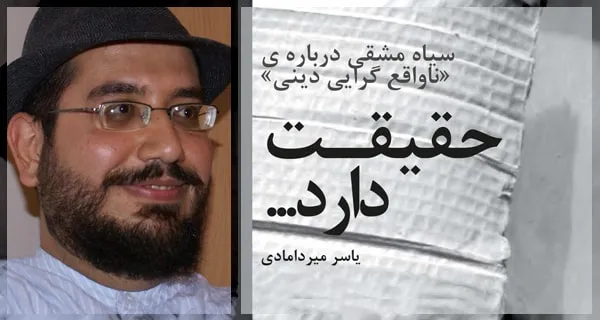
Author: Yaser Mirdamadi .
.




Discussion1 comments
مفید بود . تشکر فراوان جناب میردامادی