Environment
Climate Ethics: On the Virtue and Necessity of a Raw Vegan Diet in the Present Age
In response to criticisms by Dr. Nasser Karami, it is argued that given the water crisis and climatic conditions, a raw vegan diet is a moral imperative. An examination of six perspectives, from health to the environment, shows that a plant-based diet is a more defensible approach in the present era.

Climate Ethics:
On the Virtue and Necessity of a Raw Vegan Diet in the Present Age [1]
Mohammad Ali Tabatabaei (Mehrdad)
mataba2003@gmail.com
Introduction:
Some time ago, an article by Dr. Nasser Karami, a climatology professor at the University of Norway, was published on an internet site, containing sharp and fierce criticisms of vegetarianism from various perspectives. In this article, while responding to each of those criticisms, I endeavor to show that in our time, serious attention to the category of diet, especially considering climatic conditions, is part of our civic responsibility, and accordingly, a raw vegan diet, or ultimately a carefully considered vegetarian diet, in our temporal and spatial circumstances, is not merely a choice or a virtue, but an unavoidable moral necessity. This article compares vegetarianism with omnivorism from six different perspectives and demonstrates that, based on the latest scientific findings in all these areas, vegetarianism is a more defensible approach. Those six perspectives are: 1. The scientific consensus on the appropriate diet for the human species, 2. The impact on human health, 3. The impact on environmental preservation or destruction, especially on 4. The water crisis, 5. The impact on temperament, and 6. Finally, from an ethical perspective.
Introduction
Previously, in the article “On the Faults and Virtues of Environmental Intellectuals,” I argued that environmental experts and advocates in Iran, alongside all their criticisms of governmental structures, must at least equally consider the role of the people and their lifestyle in the improvement or deterioration of Iran's environmental situation, and with this in mind, strive to propose an environmental culture and ethic, and consequently an environmental lifestyle, to the people so that we can hope for an improvement in this situation, especially regarding the water crisis. There, I made references to the fact that the most important determining factor in this lifestyle is diet, the modification of which plays a very significant role in the amount of virtual water consumption. In this article, I will address this subject in much greater detail.
The initial spark for writing this article was struck by a piece by Dr. Naser Karami published last year, around this same time. Environmental advocates in Iran usually know Dr. Naser Karami for his very sharp and severe warnings about the future of Iran's environment, especially regarding the water crisis. As a climatologist, alongside other experts who issue very serious and alarming warnings about the imminent depletion of water resources in Iran, he typically does not limit himself to describing the dire state of Iran's environment and water, and has recommendations for preventing "Iran from turning into Somalia" that range from "shutting down agriculture in Iran" to "boycotting Iranian agricultural products by Iranians." Therefore, it is not far-fetched to consider him one of the most concerned Iranian experts in the field of Iran's environment and water, who has begun a diligent effort to raise awareness among Iranians about the great danger facing them and continues, through publishing various articles and numerous interviews with widely-viewed news networks, to try to increase Iranian society's awareness of this crisis. Even in these recent days, when unprecedented rainfalls led to the spread of rumors about the resolution of the water crisis in Iran, he was one of several experts who, in continuation of the project of "combating water superstitions," immediately reacted and reminded us all that one or two wet years do not mean the end of the drought period. His principles of greenism, among a multitude of other useful content he conveys to Iranian society, are among the most beneficial sets of guidelines for environmental living in the present age, from which I personally have learned a great deal and for which I am always grateful to him.
Since superstitions in any society, especially ours, are usually accepted by the public much sooner than scientific truths, the role of Dr. Karami and other experts who, like him, have taken on the task of demystification in the environmental arena is extraordinarily valuable and praiseworthy, and for this reason, I hold him in very high esteem. But this does not mean that Dr. Karami and his like-minded experts have so far openly waged their war against all superstitions; rather, in some cases, for reasons that are not necessarily clear to us, they may have not only remained silent in the face of a superstition but even written articles and defended it! This is precisely what has happened in Dr. Karami's article under discussion regarding vegetarianism.
Given my knowledge of Dr. Naser Karami's scientific standing, I am almost certain that, like any other environmental scientist, he knows well that the more diets shift from animal-based to plant-based, the more beneficial they are for the environment, and therefore vegetarianism is the greenest diet for humans; however, perhaps Dr. Karami's goal in writing that article was to once, in a single place and with sharp and biting language, raise the common unscientific objections circulating among the public against vegetarianism, so that they could all be answered at once with scientific language; otherwise, denying such scientific obviousness is something akin to Donald Trump denying global warming. In any case, since Dr. Karami's piece received no response over the past year, I finally decided to make a small contribution, within my own capacity, to advancing this discussion; perhaps it will open a door for more informed and knowledgeable individuals to enter this subject.
In this article, I will first respond to each of the objections he has raised against vegetarianism, and of course, my greatest attention and focus will be on his final objection, which relates to the important issue of the water crisis.
In that piece, Dr. Karami examined vegetarianism from a total of six different perspectives and critiqued it; I have arranged those six categories here in an order that allows them to connect to one another sequentially. In each case, I will first quote his exact words (in italics) and then proceed to critique them. Therefore, those who have not read that article will also become aware of the entire content of that piece by following this text.
1_ The Principle of the Necessity of Following Scientific Consensus
Dr. Karami:
First, a simple principle for thinking scientifically
In a subject in which you are not a specialist, follow the scientific consensus. Every established scientific rule may also have opponents and deniers. There is still a society in London of deniers of the Earth's roundness; they are not crazy, and most are educated.
Listening to the arguments of the dissenting minority, for someone who has no expertise in the field of discussion, is definitely a ground for misguidance and error. Casting doubt on a certain scientific matter is only within the capability of scientists in that very field. Yes, even the most certain scientific rules have opponents and may later prove to have been incorrect. But as long as the scientific consensus considers them correct, it is better for us to also assume the correctness of that consensus; otherwise, nothing will ever get done.
The scientific consensus says humans are omnivores; could this not be the case? Yes, it is possible. But for the time being, as long as the scientific consensus says this, let us defer and humbly accept that we are not Einstein or Darwin, and overturning the foundations of science is not our duty. At least, it is not our duty in a field in which we lack expertise. Let us remember that if humans were not omnivores, they could neither have lived across the entire globe in this way nor endured several periods of major climate change. The great beast of the vegetarians is the mammoth, which could not endure the Earth's average temperature warming by five degrees and became extinct, just ten thousand years ago.
Respected scientists say it is better for humans to be vegetarian? More power to them. But the reality is that they are in the minority. And science is not politics, art, or philosophy, where any deconstruction of its established foundations is immediately met with praise and acclaim. A principle that faces scientific consensus must be tested in a thousand ways before it changes. If it has not changed so far, then there is a flaw somewhere in the reasoning of the opponents and deniers.
The gist of Dr. Karami's argument in this section is entirely correct and acceptable: in any scientific matter, we have no choice but to either follow the scientific consensus or to have reached a level of expertise ourselves that allows us to present a different viewpoint based on a critique of the dominant paradigm. But the important question here is: What exactly is the view upon which the scientific community's consensus on human nutrition rests today?
What emerges from the study of scientific sources is that the species "human" is classified, in terms of diet, under the category of "omnivores"[2]; "omnivores" is a general title encompassing a wide spectrum of creatures, among which are classified animals that are over 70 percent carnivorous[3] to animals that are less than 30 percent carnivorous.[4] In the middle of these two ends of the spectrum are animals whose diet is between 30 and 70 percent meat.[5] But where does the human being stand in this? There is no doubt that humans are classified among those omnivores whose meat-based foods constitute less than thirty percent of their diet. But if we wish to speak even more precisely, humans are among the creatures that are omnivorous "biologically," and not "behaviorally"; that is, their digestive system can digest and absorb a very small amount of animal matter alongside plant matter. So, although the human body has the readiness to digest some meat as well, the natural behavior of humans in nature does not necessarily entail carnivorism. Therefore, the scientific community's consensus on humans being "omnivores" does not necessarily mean that humans must consume meat to stay alive and healthy. This particular ability of humans, acquired over the course of their evolution, is, of course, the very thing that has helped them successfully navigate various climatic periods (as Dr. Karami has written). But the fact that we humans are equipped, for emergency conditions, with an auxiliary system called the "ability to digest meat" does not necessarily mean we must use it under all circumstances, and it could even be said that there is a possibility that improper use of this system could lead to our own destruction. To put it allegorically, having a set of tire chains in the trunk of a car, while a great advantage, is only advantageous under specific conditions; under other conditions, it causes damage, harm, and even destruction.
With these considerations, for almost the entire twentieth century, proponents of vegetarianism were an almost invisible minority within the medical community, and thus the "consensus" of the scientific community was on the necessity of meat-eating; but as time passed, the number of researchers opposed to meat and animal products increased; to the point where the book Campbell Biology, in its latest edition (2017), while classifying humans biologically among omnivorous creatures,[6] explicitly states that regarding the ideal diet for humans, for many reasons, there is no consensus among scientists.[7] Perhaps for this reason, nowhere in this book is there an insistence on meat-eating or an opposition to vegetarianism. For instance, in the critical discussion of essential amino acids for the body, it explicitly states that vegetarians can obtain all the essential amino acids their bodies need through the consumption of diverse plant products, thereby refuting the old common belief among biologists about the necessity of meat consumption.[8] Therefore, at least by 2017 (one year before the writing of Dr. Karami's article), that carnivorous "consensus" was no longer in effect.
اما در آغاز سال نوی میلادی اتفاق جدیدی افتاد. ژورنال بسیار معتبرِ رشتۀ پزشکی، لنست، که همواره در فهرست معتبرترین مجلات پزشکی جزء سه مجلۀ اول است (ضریب تأثیر این مجله در سال 2017، 53.254 بوده است که این مجله را در رتبۀ دوم مجلات پزشکی قرار میدهد)، در اولین شمارۀ فوریۀ 2019 سرانجام نتایج کلانپروژۀ پژوهشی گسترده و فراگیرش را که با مشارکت 37 تن از بهترین متخصصان رشتههای مختلف، از جمله پزشکی و تغذیه، صورت گرفته[9] و هدف آن هم رسیدن به «اجماعی علمی» دربارۀ سبک تغذیۀ انسان امروز بوده است، منتشر کرد. پژوهشگران این پروژۀ عظیم بینالمللی، که انجام آن چندین سال زمان برده است، به این نتیجه رسیدهاند که انسان برای سلامتی خود و محیطزیستش نهتنها هیچ نیازی به هیچ محصول حیوانی ندارد، بلکه هم برای حفظ سلامتی خودش و هم سلامتی محیط زیست، ضرورتی اجتنابناپذیر ایجاب میکند که از همین امروز به سمت آن برویم که تمام مردم جهان یا گیاهخوار شوند و یا مقداری بسیار ناچیز از محصولات حیوانی را مصرف کنند (آنقدر ناچیز که میتوان آن را رژیمی شبهگیاهخواری نامید). بنابراین، بر خلاف تصور آقای دکتر ناصر کرمی، امروزه نهتنها اجماعی بر گوشتخواری نیست، بلکه دوران اجماع علمی بر ضرورت گیاهخواری آغاز شده است (البته ایشان مقالهشان را در سال 2018 نوشتند و نباید بر ایشان ایراد گرفت که از این اجماع جدید بیخبر بودهاند؛ اما این پرسش مهم باقی میماند که چرا پس از انتشار مقالۀ لنست و تغییر پارادایم علمی جهان دربارۀ رژیم غذایی مطلوب برای انسان، نه دکتر کرمی و نه هیچ یک از دیگر متخصصان این عرصه دراینباره اطلاع رسانی نکردند). از اینجا میتوانیم وارد بحث دربارۀ رابطۀ گیاهخواری و سلامتی شویم.
2_ گیاهخواری و سلامتی
دکتر کرمی:
میگویند گیاهخواران سالمتر هستند و گوشتخواری آدم را ضعیف تر میکند و بیشتر مستعد بیماری، واقعا؟ الان به طور متوسط اسکاندیناویاییها و استرالیاییها و کاراییبیها (گوشتخوارترین مردمان جهان) بیمارتر و رنجورتر از آن دسته از اهالی جنوب و جنوب شرقی آسیا هستند که گیاهخوارند؟
تا پیش از انتشار مقالۀ فوقالذکرِ لنست، من انبوهی از پژوهشهای منتشرشده در ژورنالهای معتبر پزشکی گرد آورده بودم تا نشان دهم که چگونه هر چه در قرن بیستم و بیستویکم به جلوتر میآییم، متخصصان بیشتری به نفع «ارتباط مستقیم بین گیاهخواری و سلامتی» رأی میدهند؛ اما با انتشار مقالۀ فوقالذکر به نظر میآید حجت تمام شد و دیگر نیازی به زیادهگویی در این زمینه نیست؛ زیرا اولا بخشی از نویسندگان آن مقاله از بهترین متخصصان پزشکی و تغذیه هستند و طبیعتا مرور آنها بر آخرین دستاوردهای پزشکی از مرورِ من قابل اعتمادتر است؛ ثانیا، آنها در یک کار گروهی (37 محقق از 16 کشور مختلف و با شش تخصص متفاوت) و چندساله و با امکانات و دسترسیهایی بسیار بیشتر از آنچه در اینجا برای امثال من فراهم است، دست به این مطالعه زدهاند؛ و ثالثا، نتیجۀ پژوهش آنها در یک مجلۀ پژوهشی معتبر منتشر شده که طبیعتا پروسهای از ارزیابی سختگیرانۀ علمی را هم پشت سر گذاشته است؛ قطعا یک ژورنال علمی با چنین اعتباری در سطح بینالمللی حاضر به قمار اعتبار خود بر سر یک مقالۀ ضعیف نیست. بنا به همۀ این دلایل، با خیالی آسودهتر میتوانیم ببینیم این متخصصان از بررسی آخرین دستاوردهای علم پزشکی و تغذیه به چه نتیجهای دربارۀ رژیم غذایی مناسب برای انسانها رسیدهاند.
The Lancet article opens with this thought-provoking sentence: “Food systems have the potential to nurture both human health and environmental sustainability; yet, currently, they threaten both.”[10] In the first part of this article, the researchers propose a reference diet that can meet all the body’s needs and bring us the greatest health. According to these researchers, this reference diet is a global framework that can be adapted to all food cultures around the world,[11] and they assure that this diet fully meets all the nutritional needs of every individual over the age of two.[12]
Based on the findings of these researchers, the typical diets in today’s world are considered lose-lose diets because they are high in calories and consist of sugar, saturated fats, processed foods, and red meat; that is, they threaten both our own health and the environment as a whole.[13]
In this article, each of the food groups required by the body is discussed separately and their best sources are introduced. Among these, perhaps the most important food group is protein, particularly because people usually consider meat and other animal products to be the source of this nutrient. Therefore, the researchers dedicate a significant portion to this topic and discuss separately the required amount of each animal food for maintaining health. First, the authors show that, according to the findings of nutrition and health researchers, vegetarianism has a direct relationship with health,[14] and conversely, red meat has a direct relationship with mortality and various deadly diseases; including cardiovascular diseases, which are directly linked to red meat consumption; but other dangerous diseases, including type 2 diabetes and stroke, are also completely associated with red meat. An examination of various diets has shown that the lower the amount of red meat consumption in a diet, the healthier its followers are. Furthermore, the link between red meat and cancer is so clear that the International Agency for Research on Cancer has classified processed red meat as a Group 1 carcinogen and unprocessed red meat as a Group 2 carcinogen;[15] while research has shown that the more plant-based protein sources replace animal sources, the lower the mortality rate.[16] Finally, after reviewing the body of scientific findings on the impact of red meat on health, the researchers state: “Since red meat intake is not essential for health and, indeed, has a direct relationship with increased mortality…, the optimal intake of this food is zero grams per day, especially if red meat is replaced by plant-based protein sources.”[17] Therefore, the researchers suggest that if someone insists on consuming meat, they should consume a maximum of 28 grams per day or settle for an average of 14 grams per day. This is equivalent to one hamburger per week or once every two weeks. The same situation applies to chicken and poultry: the optimal consumption is zero grams per day; but ultimately, they have permitted a consumption of 58 grams per day, and an average of 29 grams per day.[18]
اما دربارۀ لبنیات، محققان نشان میدهند که بر خلاف آنچه در سطح جهان معروف شده، مصرف لبنیات رابطۀ مستقیم با پوکی استخوان دارد و در کشورهایی که بیشترین مصرف لبنیات را دارند، بیشترین آمار پوکی استخوان و شکستگی لگن مشاهده میشود؛ درست بر خلاف کشورهایی که کمترین مصرف لبنیات و در نتیجه کمترین میزان پوکی استخوان را دارند.[19] همچنین افزایش مصرف لبنیات هیچ تأثیری در بهبود آمار مرگومیر نداشته؛ درحالیکه جایگزین کردن لبنیات با مواد گیاهی موجب کاهش مرگومیر شده است.[20] از مجموع تحقیقات علمی نتیجه گرفته میشود که حتی مصرف لبنیات کمچرب هم سالم نیست و بهتر است اینها هم جای خود را به منابع گیاهی بدهند.[21] بنابراین نتیجۀ محققان دربارۀ لبنیات چنین است: «چون ریسک ابتلا به بیماریهای قلبی-عروقی با مصرف روغنهای گیاهی غیراشباع، کمتر از مصرف چربی لبنیات است، بهترین میزان دریافت لبنیات صفر است»؛ اما در اینجا هم محققان حد میانگین 250 گرم در روز و بیشینۀ 500 گرم در روز را به عنوان راه گریز برای شیردوستان قرار میدهند تا رژیم مرجع بتواند قابل انطباق با هر نوع رژیم غذایی در سطح جهان باشد.[22]
دربارۀ ماهی هم پس از بحث دربارۀ جنبههای مختلف تأثیر این مادۀ غذایی بر سلامتی، میگویند اگر بتوان امگا3 مورد نیاز بدن را از منابع گیاهی تأمین کرد، برای بدن بهتر خواهد بود.[23] بنابراین، در اینجا هم مقدار پیشنهادی برای مصرف ماهی بین صفر تا صد گرم در روز است.
به همین ترتیب، دربارۀ تخم مرغ هم نتایج نشان میدهند که جایگزین کردن تخم مرغ با گیاهان خطر ابتلا به بیماری غیرواگیردار را کاهش می دهد، مگر در کشورهای کم درآمد که قوت غالبشان سیبزمینی است و بهتر است مقداری از آن را با تخم مرغ جایگزین کنند. بنابراین برای تخم مرغ هم مقدار صفر تا 25 گرم در روز، و حد متوسط 13 گرم در روز (یا یک و نیم تخم مرغ در هفته) پیشنهاد میشود.[24]
محققان سپس به سراغ مغزیجات میروند و نشان میدهند که چگونه در این رژیم غذایی مصرف روزانه 50 گرم مغزیجات (مخصوصا بادامزمینی) جایگزین پروتئینهای گوشتی میشود.
نهایتا محققان اشاره میکنند که اخیرا جایگزینهایی مثل حشرات، جلبکها و گوشتهای مصنوعی هم به عنوان منابع پروتئینی پیشنهاد شدهاند؛ اما چون هنوز آثار مصرف بلندمدت آنها مورد مطالعۀ جدی قرار نگرفته، در این رژیم بر آنها تکیه نشده است.[25]
به این ترتیب بحث دربارۀ پروتئینها به پایان میرسد و معلوم میشود که اساسا برای تأمین پروئتین مورد نیاز بدن هیچ نیازی به هیچ نوع محصول حیوانی نیست؛ اما اگر دوستداران این محصولات به هیچ عنوان نخواهند از این خوراکیهای محبوبشان دست بکشند، حد مجاز نهایی آن بسیار بسیار بسیار کمتر از چیزی است که امروزه در اغلب کشورهای جهان (از جمله ایران) رایج است. دستکم دربارۀ گوشت قرمز باید به یکدوم الی یکپنجم مقدار کنونی کاهش پیدا کند؛ چون الان سرانۀ مصرف گوشت روزانه حدود 34 گرم در روز است که باید به میانگین 7 گرم یا بیشینۀ 14 گرم در روز برسد. سرانۀ مصرف مرغ هم از 71 گرم در روز فعلی، باید به میانگین 29 گرم در روز برسد.
اما دربارۀ منابع کربوهیدراتها، یعنی غلات، محققان نهایتا مقدار 232 گرم غلات در روز و 50-100 گرم سبزیجات نشاستهای در روز را تجویز میکنند که باز به این معناست که ایرانیان باید در چگونگی مصرف نان و برنج تجدیدنظر اساسی کنند.
The manner of supplying other food groups, which are unrelated to animal sources, is specified in the table below. The researchers explicitly state that in the practical implementation of this diet, it was observed that all nutritional factors, including iron, zinc, folate, and vitamin A, were supplied in a manner better than expected, and only in some cases was there a need for B12 supplementation.[26] According to this study's estimate, adopting this diet will reduce global mortality by about 11 million people per year.[27] Those interested in the details of the scientific analyses related to this diet and how the body's nutritional needs are met can refer to the original article file (pp. 3-15) as well as the supplementary file of that article.
Table of the reference diet (Lancet) compared to the current Iranian diet
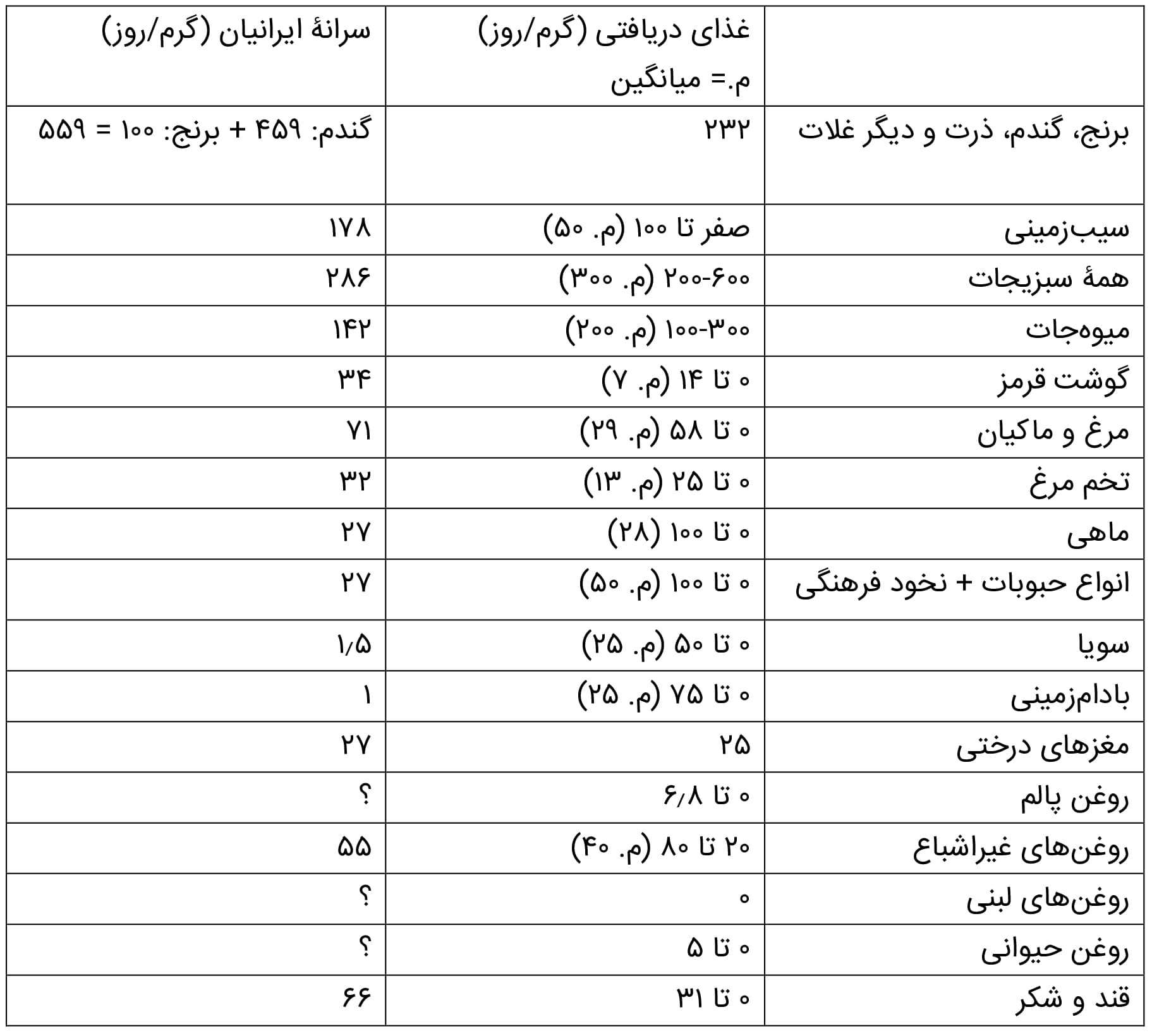
According to the table above, we Iranians not only have a serious and urgent need to limit animal products in our diet, but we must also more seriously reconsider how we consume plant-based foods. Our record-breaking consumption of certain items like bread, rice, and sugar on a global scale has earned us the title of the most wasteful people in the world. I will discuss this further later on.
3_ Vegetarianism and Environmental Conservation
Dr. Karami:
Is vegetarianism better for the environment?
Perhaps, but this is only an assumption. We have established principles for environmental conservation. For example, reducing carbon dioxide and other greenhouse gas emissions, combating desertification, controlling soil erosion, preserving biodiversity, etc.; vegetarianism is not among these principles. In none of the fundamental and overarching environmental documents is vegetarianism mentioned as an established and definitive principle for environmental conservation.
Of course, changing consumption patterns, and especially consuming less meat, is recommended, but that humanity must become entirely vegetarian is not an environmental rule. There are many articles on this, but there are even more articles refuting this assumption. For those of us whose scientific expertise and specialization do not allow us to confirm or deny this assumption, it is more scholarly to accept the scientific consensus: make our food lower in calories, eat less meat too, but do not become absolutely vegetarian.
Apparently, Dr. Nasser Karami, a climatology professor at the University of Bergen, is certain that nutrition, and especially vegetarianism, has no connection to environmental conservation, and at most, "changing consumption patterns, and especially consuming less meat, is recommended; but that humanity must become entirely vegetarian is not an environmental rule"; however, contrary to Dr. Karami's dismissive view of nutrition's role in improving the environmental situation, the researchers in the aforementioned article explicitly state that "food production is the largest cause of global environmental change."[28] As briefly mentioned, the diet proposed in the table above is the best possible way not only to improve human health but also to improve the state of the environment. To the extent that they say if we want to provide the possibility of feeding the entire human population of 10 billion on Earth by 2050, "this requires the rapid adoption of widespread changes and unprecedented global cooperation and commitment: a Great Food Transformation, without any concession."[29] In this article, it is, of course, emphasized that everything stipulated in international agreements like the Paris Agreement for governments and producers must be carried out without any shortfall; but for those activities to yield results, this dietary change must also be appended to them; therefore, the failure of any of the parties in this matter (whether governments, producers, or consumers) will lead to our failure in preventing the destruction of nature.[30]
The researchers of the aforementioned study examined the impact of their proposed diet on 5 important environmental factors and concluded in all cases that adopting a plant-based diet has the best effects on the state of the environment. Those 5 factors are:
- Climate change
- Water consumption
- Nitrogen and phosphorus pollution
- Biodiversity[31]
- Deforestation
Since Dr. Karami discussed water independently in his writing, we will also pursue the topic of water separately. But overall, it must be said that according to the 37 researchers involved in the Lancet project, "studies concur on one point, and that is that plant-based foods have less harmful environmental impacts than foods of animal origin; whether per unit weight, per meal, per unit of energy, or per unit of protein."[32] In their view, "most studies on the environmental impacts of diets have concluded that the more we reduce the share of animal foods and replace them with plants, the fewer environmental consequences we will have."[33] Vegan (fully plant-based) and vegetarian (meat-free) diets have the least consequences in terms of greenhouse gas emissions and deforestation, and vegetarian diets have the greatest savings in water consumption.[34] These researchers explicitly state: "Our results show that each meal of foods of animal origin [compared to each meal of plant-based food] has enormous environmental impacts in terms of greenhouse gas emissions, deforestation, water consumption, and the creation of nitrogen and phosphorus pollution."[35] Therefore, the researchers recommend three essential and urgent changes to escape today's environmental crisis: dietary change, improvement of agricultural production systems, and reduction of food waste and loss.[36] Of course, of these three, the first has an 80 percent effect in reducing greenhouse gases; whereas the second and third each reduce greenhouse gases by only 10 and 5 percent, respectively.[37] Thus, it becomes clear what an irreplaceable role consumers play in this regard.
In summary, according to the special Lancet commission for finding a solution to overcome the current environmental crisis, by any measure we calculate, plant-based diets are the greenest diets imaginable. Of course, what was presented above was only a very brief report of the Lancet article's content, and it is hoped that this article will be fully translated and made available to the entire Iranian scientific community as soon as possible. But for now, to clarify on what research the above points are based, it may not be amiss to refer to some other studies.
For example, a study recently published in the journal Science as "the largest analysis of the impact of food products on the environment" clearly states that the complete or near elimination of animal products is the only truly effective way to save the planet. According to this extensive study, which examined the production process of 40 essential products in 119 countries, while animal products occupy 80 percent of the world's total agricultural land, they provide only 18 percent of our calories and 35 percent of our protein; yet they are responsible for 58 percent of greenhouse gases, 57 percent of water consumption, and 56 percent of air pollution. The authors of this article, in the section concerning consumer responsibility, say:
“A shift from current diets toward a diet that excludes animal products has the potential for major changes, including: reducing land use [for livestock feed cultivation] by up to 3.1 billion hectares (a 76% reduction), cutting greenhouse gas emissions by up to 6.6 billion tons of carbon dioxide equivalent (a 49% reduction), reducing terrestrial acidification by up to 50%, reducing eutrophication by up to 49%, and reducing freshwater withdrawals by up to 19%. … Communicating the impacts of food products leads to dietary change and should be pursued. Although dietary change is possible and realistic for any individual, given the short window remaining to control global warming and prevent further damage, widespread behavioral change on a global scale appears difficult.”[38]
Professor Joseph Poore of the University of Oxford, who led this research, says in an interview with The Guardian:
“A vegan diet is the single most effective way to reduce our human impact on the planet, not only in relation to greenhouse gases, but also in addressing acidification, eutrophication, land use, and water use. It is far, far more effective than cutting down on flights or buying an electric car … it is really animal products that are responsible for this level of harm to the planet. Avoiding the consumption of animal products yields far better environmental outcomes than trying to achieve a sustainable meat and dairy diet … even the most sustainable method of meat production uses 36 times more land and generates 6 times more greenhouse gases than producing peas.”[39]
In this context, even researchers who acknowledge the highly destructive impacts of animal products but are unwilling to adopt a vegetarian diet propose their alternatives as follows: “insects, lab-cultured meats, and alternative proteins.” This is part of the innovative solutions proposed in the project “Opportunities and Challenges for Research on Food and Food Security and Agriculture in Europe.”[40] Therefore, one point is certain: the culprit behind our present and future misery is the consumption of animal products; the solution is also clear: either move toward alternative proteins (such as insects and artificial meats) or turn to vegetarianism! Of course, I prefer the second solution in this regard; but if giving up meat is so difficult for some, they should at least accept that for now (until research on the consequences of consuming artificial meat reaches a conclusion) they should replace beef and lamb with locust and beetle meat, so that at least something remains for future generations; because livestock farming produces eighteen percent of greenhouse gases.
In another study conducted by seven researchers at the University of Oxford, the results of which were published in 2014 in the journal Climatic Change (one of the most prestigious journals in this field),[41] the diets of thousands of people from different groups—meat-and-plant eaters, fish-and-plant eaters, non-meat vegetarians (vegetarian), and non-animal vegetarians (vegan)—were examined in terms of greenhouse gas emissions. The result of this study, based on the amount of carbon dioxide emissions (in kilograms per day), is as follows:
High meat-eaters: 7.19
Medium meat-eaters: 5.63
Low meat-eaters: 4.67
Fish-eaters: 3.91
Non-meat vegetarians (vegetarian): 3.81
Strict vegetarians (vegan): 2.89
The differences are so significant that they seem to require no further explanation. As researchers state, “a meat-based diet averaging 2000 kilocalories per day results in 2.5 times the greenhouse gas emissions of a fully plant-based diet.”[42] It is noteworthy that in this study, daily diets were not compared in real terms; rather, an effort was made to compare all diets at the same caloric level; this means that what likely happens in the real world is far greater greenhouse gas emissions due to animal-based diets; because, under current conditions, meat-eaters typically consume far more meat and animal products than their bodies need. In this study, for comparison, the researchers show us that if we were to drive a 10-year-old, worn-out family car the five-thousand-kilometer distance from Tehran to London, the carbon produced would be comparable to the annual carbon that would not be emitted simply by two English individuals becoming vegetarian![43]
Similarly, research by Saxe and colleagues shows that the pollution from a semi-vegetarian diet is 27 percent lower than the typical Danish diet, when both contain the same amount of protein.[44]
We recall that Dr. Karami suggests that to improve the state of the environment, we should consume foods with fewer calories and eat less meat; but not eliminate meat. This seems like a good suggestion; provided that a healthy diet can be designed on this basis anyway; while scientific research shows that if we are to design a healthy diet while retaining meat (even in small amounts), we will ultimately not help preserve the environment. For example, research by Vieux and colleagues has shown that healthy meat-based diets, the healthier they are, the more they lead to greenhouse gas emissions![45] The reason for this is clear: in healthy meat-based diets, to neutralize the negative effects of meat, more vegetables and fruits must be consumed, and this means more pollution; whereas if we eliminate animal products from our diet entirely, there is no need for excessive consumption of fruits and vegetables.
Now the question truly remains: on which credible scientific research did Dr. Karami rely to claim that vegetarianism has no place in scientific recommendations for protecting the earth? Worse, Dr. Karami goes a step further and claims that vegetarianism worsens the water crisis. Therefore, we must now proceed to verify the accuracy of this claim.
4_ Vegetarianism and the Water Crisis
Dr. Karami:
They say a kilo of meat has this much hidden water and causes this much carbon dioxide emission. Yes, these are alarming numbers. But if we compare the amount of calories in that one kilo of meat with the calories obtained from, say, lettuce, we see that to obtain the same amount of calories, lettuce actually consumes three times as much water. This is a complex discussion and I will address it in detail another time, I have some expertise here.
We now arrive at the most important and perhaps most sensitive topic in this discussion. In the paragraph above, Dr. Karami claims that based on his expertise in this subject, he can show that a plant-based diet overall leads to greater water wastage than a meat-based diet. I would personally be very happy to see the calculations that led to such strange results; but since he has not yet published anything to substantiate his claim, we reserve the right to take a critical look at this assertion.
His claim is primarily based on a likely deliberate fallacy, namely comparing the most calorie-dense product of an animal-based diet with an almost calorie-free product of a plant-based diet; whereas, fundamentally, vegetarians consume vegetables like lettuce not for calories, but to supply the vitamins and fibers needed by the body. Nevertheless, even if we compare the virtual water content of meat and lettuce on this same incorrect basis, we by no means arrive at Dr. Karami's desired conclusion. The table below, taken from the "Water Footprint" website, the most important online reference on virtual water, shows that among foodstuffs, even vegetables, which are among the lowest-calorie foods, consume less virtual water to deliver each kilocalorie of energy to our bodies compared to animal products; this result does not change even when using protein content as the basis. In the table below, the first column represents the major food groups; the second column shows how much water it takes to produce one kilogram of each of those products. The third column is exactly what Dr. Karami is looking for; that is, how much water each kilocalorie these products provide us has consumed. We see that, for example, vegetables consume about one liter of water for every kilocalorie they deliver to our bodies; but chicken meat consumes 3 liters, sheep meat about 4 liters, and beef about 10 liters of water. The fourth column shows that the same situation holds true for protein. Even in terms of fat, vegetables are not much different from beef; whereas the source of fat for vegetarians is oilseeds, not vegetables (compare the water consumption of oilseeds per gram of fat with various animal products).
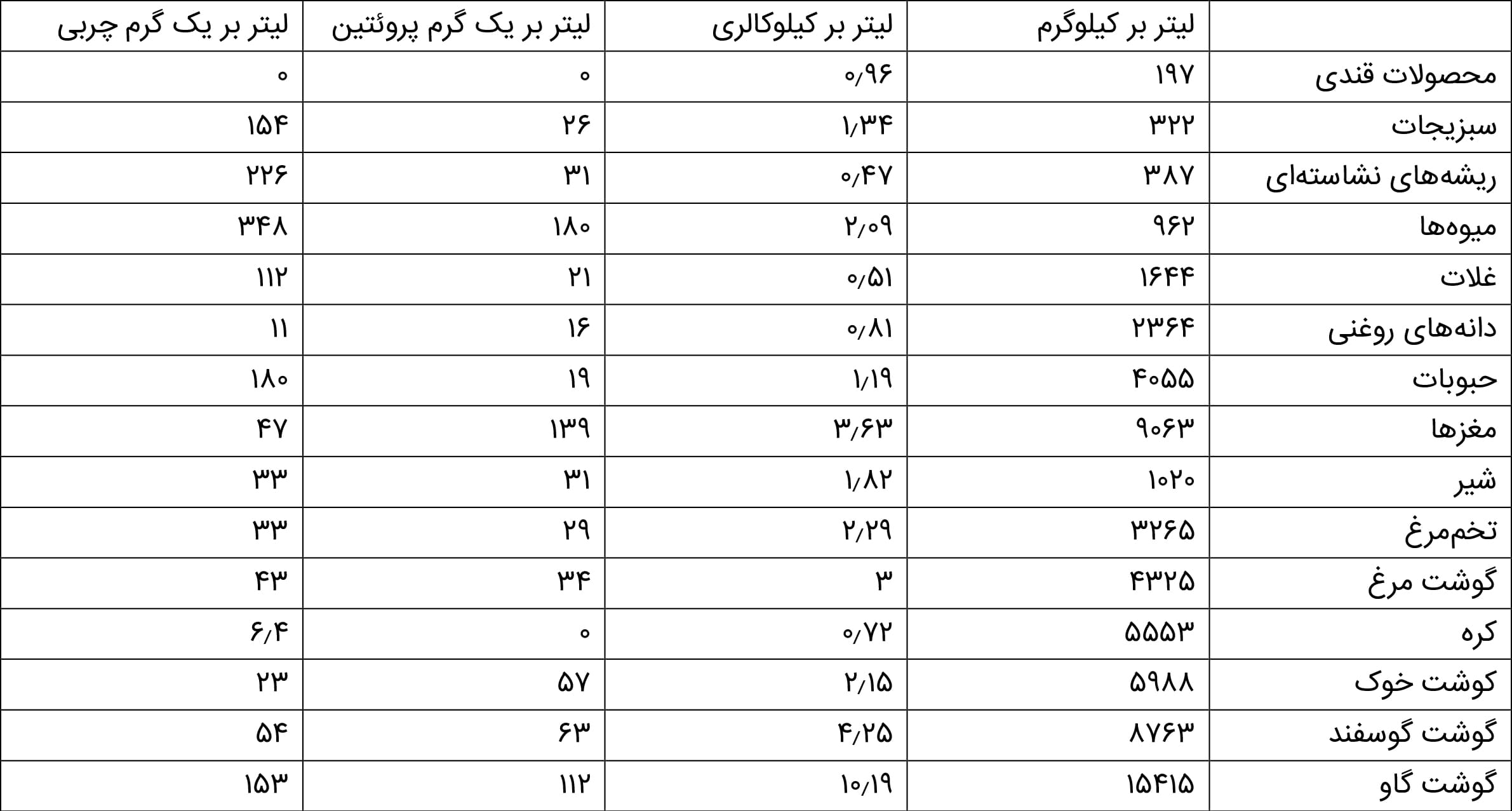
Source: Mekonnen and Hoekstra (2010)
In practice, too, when someone becomes a vegetarian, the only significant change that occurs in their diet is the elimination of meat (and/or other animal products), and it is not the case that vegetarians consume tens of kilograms of fruits and vegetables at every meal to meet their body's needs; they simply eliminate meat and/or animal products and, at most, may add N grams of legumes to their food in place of the N grams of eliminated meat, the production of which is far more efficient in terms of water consumption compared to meat, and because legumes are also high in carbohydrates, their consumption can simultaneously replace the consumption of foods like rice and bread. Whereas Dr. Karami's fallacious and incorrect calculation in the paragraph above would require a vegetarian human to consume several tens of kilograms of lettuce (and presumably tens of kilograms of fruits, etc.) per day. Thus far, it has been proven in the simplest possible terms that Dr. Karami has made a false claim, and scientific sources attest to its falsehood.
Nevertheless, it may not be amiss to once again turn to scientific research and see what conclusions have been reached by scientists who have investigated this very issue with precisely this concern; for numerous scientific studies have been conducted to date on the impact of diet on water consumption, and we can now avail ourselves of their findings with peace of mind. Here again, the recently published Lancet article, in which a large team of the world's foremost specialists in various fields have collaborated, simplifies our task. As mentioned earlier, this research demonstrates that plant-based diets are not only more beneficial for our health, but it also explicitly states that "overall, all studies agree that plant-based foods, compared to animal-based food sources, reduce adverse environmental impacts in every respect, whether per unit weight, per unit of food, per unit of energy, or per unit of protein."[46] "Many studies have assessed the environmental impacts of various dietary patterns, and most have concluded that the more we replace animal-based foods with plant-based foods, the more negative impacts are reduced; vegan and vegetarian diets lead to the greatest reductions in greenhouse gas emissions and land use, and vegetarian diets have the greatest impact on reducing water consumption."[47] Conversely, regarding animal-based diets, they emphasize: "Our results show that each unit of animal-based food sources has enormous environmental footprints in terms of greenhouse gas emissions, land use, water consumption, and nitrogen and phosphorus application."[48]
Although, in the view of these researchers, dietary change has only a 1 to 9 percent positive impact in the discussion of water consumption[49] (compared to reforming production methods, which has a 30 percent effect, and reducing agricultural product waste, which has a 13 percent effect)[50], two points must nonetheless be noted:
First, in a dry and populous country like Iran, changes, even at the epsilon level, are significant, let alone percentages; we note that every one percent saving in Iranians' water consumption is equivalent to saving at least one billion cubic meters of fresh water (i.e., one-third of Iranians' total annual drinking water consumption), which is a very large figure. Compare this figure, for example, to the at most a few million cubic meters that are to be achieved through savings such as modifying behavioral patterns in showering, washing dishes and cars, changing evaporative coolers, and so on. By implementing all these recommendations, we are still a very long way from that one percent. Therefore, if a change in dietary patterns has even a one percent effect, it is an extraordinarily large impact that we, the drought-stricken, cannot afford to overlook.
The second point is that the researchers of the Lancet project repeatedly state in this article that the basis for these comparisons is a global norm, and therefore, policymakers in each region must adapt and modify this plan according to the consumption patterns of the people in that region.[51] This means that this 1 to 9 percent impact is stated solely in comparison to the global norm and may be less or more in a country like Iran. For this reason, the Lancet researchers suggest that policymakers in each region search within their own food culture and pursue the indigenous food culture closest to the reference diet in their local communities.
این همان کاری است که من از حدود چهار سال پیش بدان مشغول بودم. با اینکه من و همسرم از سال 1391 وجترین بودیم (یعنی هیچ نوع گوشتی مصرف نمیکردیم)، کمکم به این آگاهی رسیدیم که گرچه مصرف آب مجازی ما با حذف گوشت کمتر شده، هنوز راه زیادی تا رسیدن به رژیمی ایدئال بر اساس شرایط آبوهوایی ایران داریم؛ زیرا همچنان در سبد غذایی ما محصولات بسیار آببری مثل لبنیات و تخممرغ، در کنار نان و برنجِ فراوان بود و همین باعث میشد که همچنان بابت رژیم غذاییمان در برابر طبیعت ایران احساس شرمندگی کنیم. اما حتی به فرض که وگن میشدیم (و لبنیات و تخممرغ را هم حذف میکردیم)، مگر راهی برای حذف نان و برنج وجود داشت؟ درحالیکه تنها گندم و برنج مصرفی ایرانیان در سال حدود یک پنجم منابع آبی ایران را میبلعد. در جستوجوی پاسخی برای این پرسش نهایتا من با گروه بزرگی از گیاهخواران ایران آشنا شدم که نهتنها محصولات حیوانی در سبد آنها صفر است، بلکه سهم گندم و برنج نیز در سبد غذایی آنها آنقدر کم است که میتوان آن را نزدیک به صفر حساب کرد. این گروه در ایران با عنوان خامگیاهخواران، و در جهان با عنوان Raw Vegans شناخته میشوند. اساس این برنامۀ غذایی بر مصرف محصولات گیاهی در طبیعیترین شکل ممکن است و بنابراین تلاش میکنند هر مادۀ غذایی را حتیالامکان بدون پختوپز یا با کمترین حرارت ممکن مصرف کنند. فرمول کلی این رژیم غذایی برای کل سبد غذایی روزانه چنین است: هشتاد درصد انواع میوهجات و سبزیجات خام (یا سبزیجات بخارپز)، ده درصد غلات و حبوبات، ده درصد مغزها و دانهها.[52]
اگرچه آمار دقیقی از خامگیاهخواران ایران در دست نیست، با توجه به گستردگی انجمنهای تغذیه طبیعی در بسیاری از شهرهای کشور، تخمین زده میشود که چنددههزار نفر در ایران پیرو این رژیم غذایی باشند که در میان آنها چهرههای مطرح و شناختهشدهای چون دکتر غلامعلی بسکی به چشم میخورد. انگیزۀ اولیه در تقریبا تمام این افراد، خلاصی از بیماریهای سخت یا لاعلاج و دستیابی به سطحی از سلامتی نزدیک به صددرصد بوده است؛ بااینحال، اکثر این افراد پس از مدتی بهبود حالات روحی و نیز احساس نزدیکی بیشتر با طبیعت را تجربه و گزارش کردهاند.[53] در این مدت، شخصا با بسیاری از این افراد نشست و برخاست کردم و دیدم که چگونه زندگی آنها از وضعیتی رقتبار (مخصوصا از لحاظ سلامتی جسمی) به وضعیتی رؤیایی و آرمانی (چه از لحاظ جسمی، چه از لحاظ روحی، و حتی از لحاظ اخلاقی) ارتقا پیدا کرده است.
با اینکه همۀ اینها فوقالعاده جذابند، اما آنچه برای من مهمتر از همۀ اینها بود، متمایز بودن این رژیم غذایی از سایر رژیمهای معمول، از لحاظ میزان مصرف آب مجازی بود. بنابراین، سرانجام من و همسرم هم تصمیم گرفتیم به سمت این رژیم کوچ کنیم. زمانی که نوشتۀ دکتر کرمی منتشر شد، ما تقریبا شش ماه بود که کوچ تدریجی خود به سمت این رژیم را آغاز کرده بودیم. با انتشار مقالۀ دکتر کرمی، من مصممتر شدم که پیش از واکنش سریع به آن نوشته، به مدتی نسبتا طولانی این رژیم را دنبال کنم و با دقت تأثیر آن را هم بر سلامتی و هم بر مصرف آب در زندگی شخصی خودم و همسرم زیر نظر بگیرم. البته من و همسرم بیماری خاصی نداشتیم؛ اما امکان این را داشتیم که آزمایشهای قبل و بعد از تغییر رژیم را با هم مقایسه کنیم. پس از حدود یک سال از آغاز این تغییر، در پاییز 1397، نتایج آزمایشهای پزشکی کاملا راضیکننده بود؛ از لحاظ مصرف آب نیز، با اینکه نتایج بسیار بهتر از برنامۀ قبلی بود، همچنان به دنبال راههایی برای بهبود وضعیت بودم. مشخصا به این نتیجه رسیدم که خامگیاهخواری اگر صرفا مبتنی بر میوهجات باشد، در زمینۀ مصرف آب هیچ مزیتی ندارد؛ اما اگر مقدار بیشتری سبزیجات به علاوۀ مقداری حبوبات و مغزها و دانهها به برنامه اضافه شود، نتایج مرتبط با مصرف آب مجازی بسیار بهتر میشوند.
Therefore, based on the same basic formula of 80 percent fruits and vegetables and 20 percent legumes, nuts, and seeds, I arrived at a combination that I believe is in a more optimal state. We can now compare this raw vegan combination with the Lancet recommended diet and with the typical diet in Iran to clarify how impactful a widespread dietary change could be.
I should note that to maintain a standard and consistency of calculation in this comparison, I am using the global average virtual water consumption as the benchmark; because the amount of virtual water consumption in Iran is unclear for many products. However, another advantage of this criterion is that it specifies that even if, hypothetically, the state of agricultural production in Iran were to approach the global average in terms of virtual water consumption, we would still need to change our diet. The criterion for calculating daily food consumption for the typical diet in Iran is the per capita consumption of major food products in Iran, as announced by official authorities. Naturally, food waste also plays a role in this per capita figure; but it should be noted that eighty percent of food waste in Iran is related to fruits and vegetables, for which the net per capita consumption is given in the table below, and therefore the waste factor has been subtracted from it. For other items, the waste figure is negligible; especially considering that what appears in the columns related to the Lancet and raw vegan diets includes "all" consumable food items; whereas what appears in the typical Iranian diet column includes only the most important items, and for example, in its grains section, the calculation is limited to wheat and rice, and other grains like barley and corn have not been included at all; just as high-consumption items like tea, soft drinks, and other snacks have also not been calculated. Therefore, the virtual water consumption in the typical Iranian diet is undoubtedly somewhat higher than what has been calculated here.
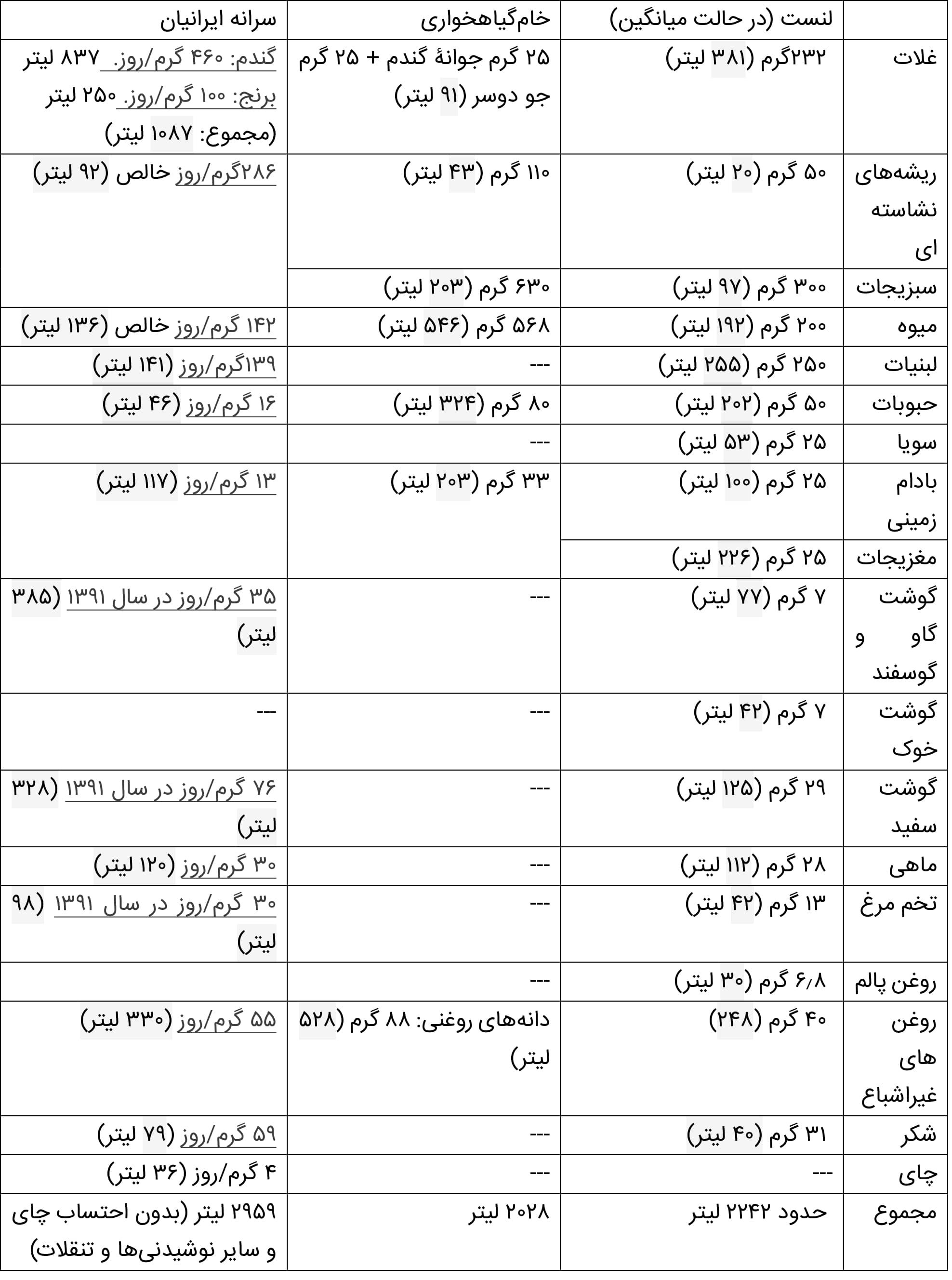
Based on the data above, the raw vegan diet, which is now prevalent in many Iranian cities, is on par with the Lancet recommended diet in terms of water consumption; to reach more precise results, I entered the information of a sample daily raw vegan meal plan into the calculator on the Nutrition Value website to determine to what extent this diet can meet the body's daily needs in every respect. The table below is the list of foods for one day according to this diet. I have also added information on the virtual water consumption of each product to the table below to specify exactly how much water this one-day plan consumes, and then I obtained its nutritional information from the site.
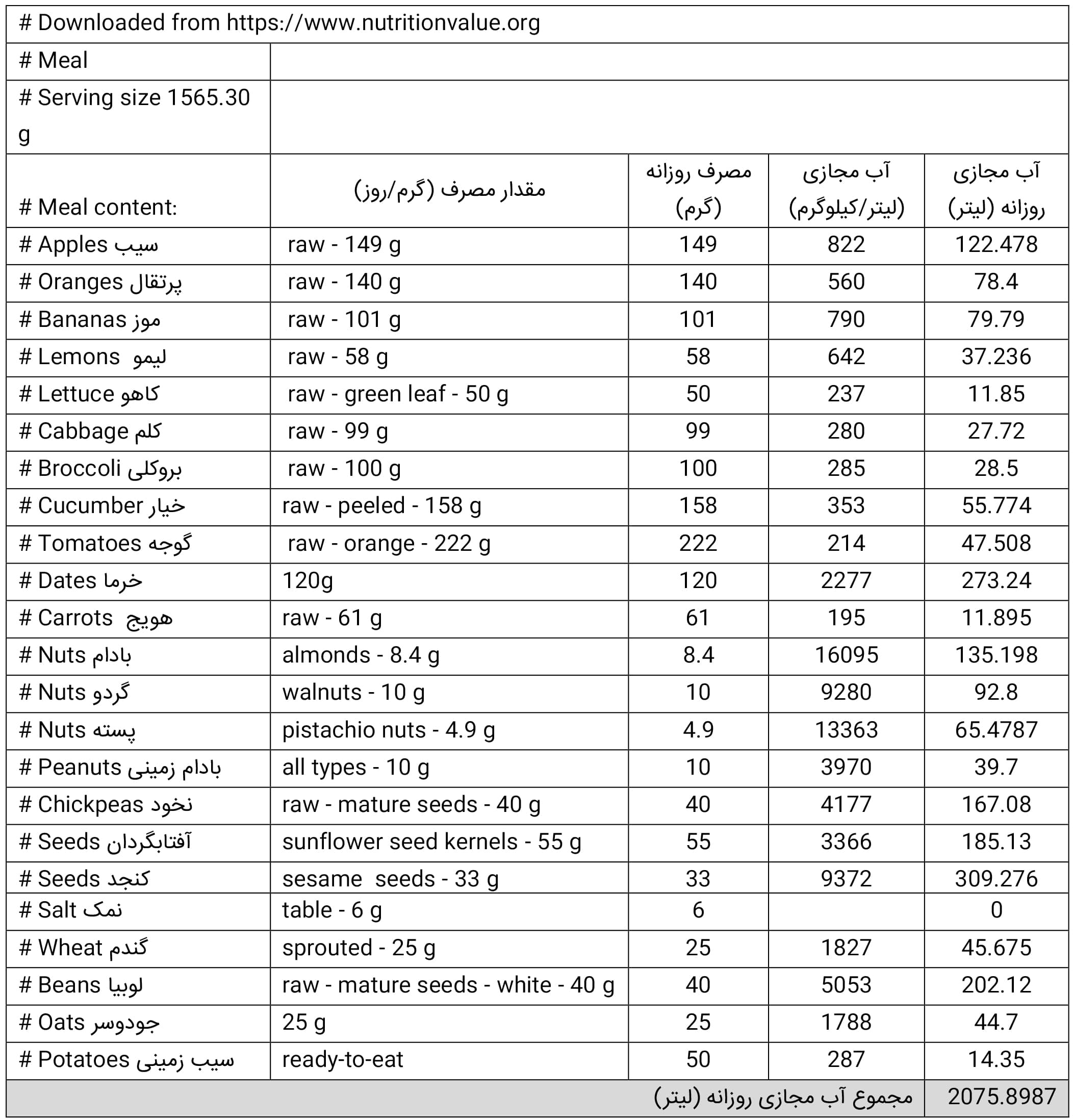
The Nutrition Value website shows that the above meal plan, which consumes about 2076 liters of water in one day, meets the daily needs of an adult human weighing 61 kilograms[54] as follows:
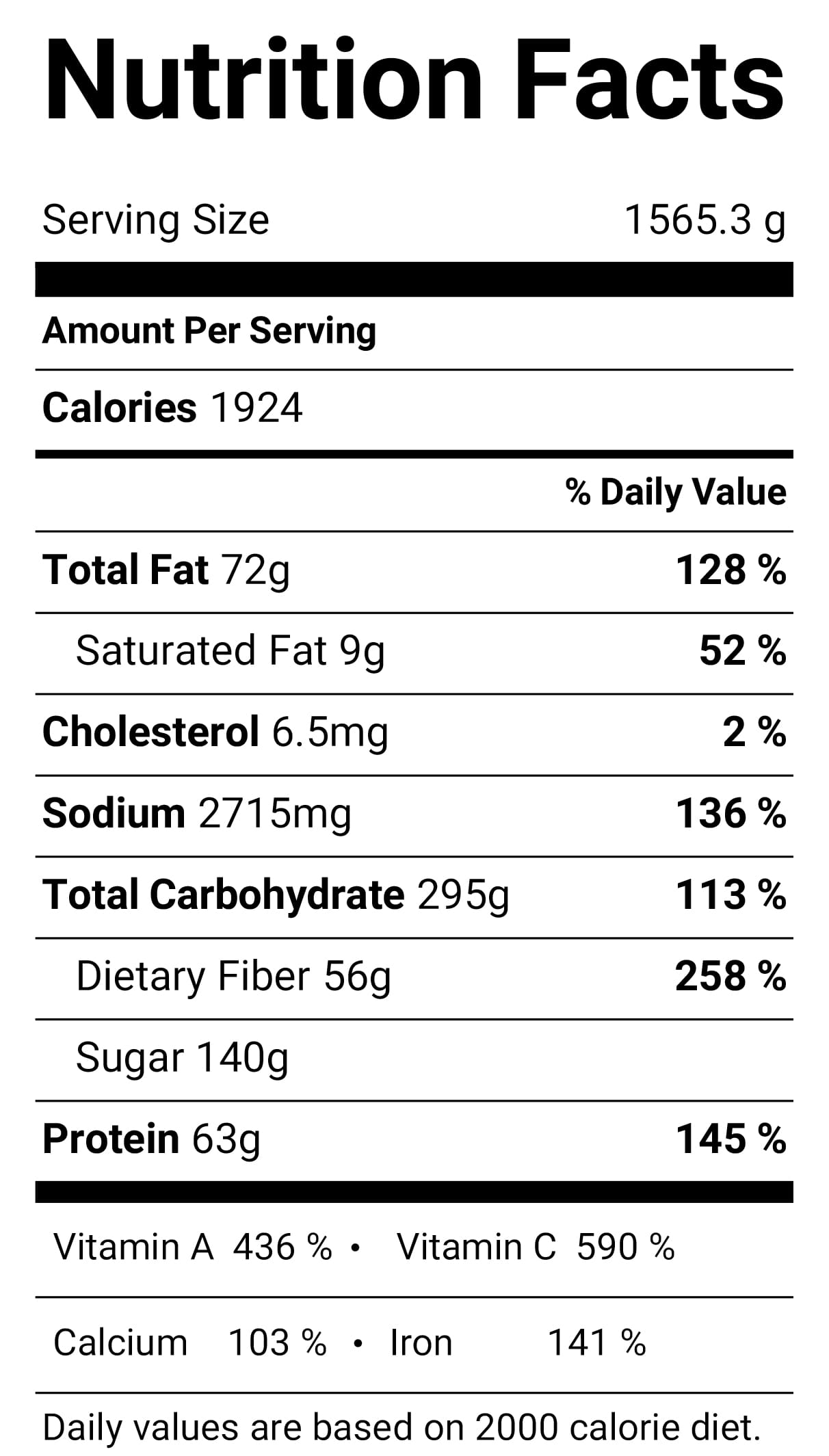
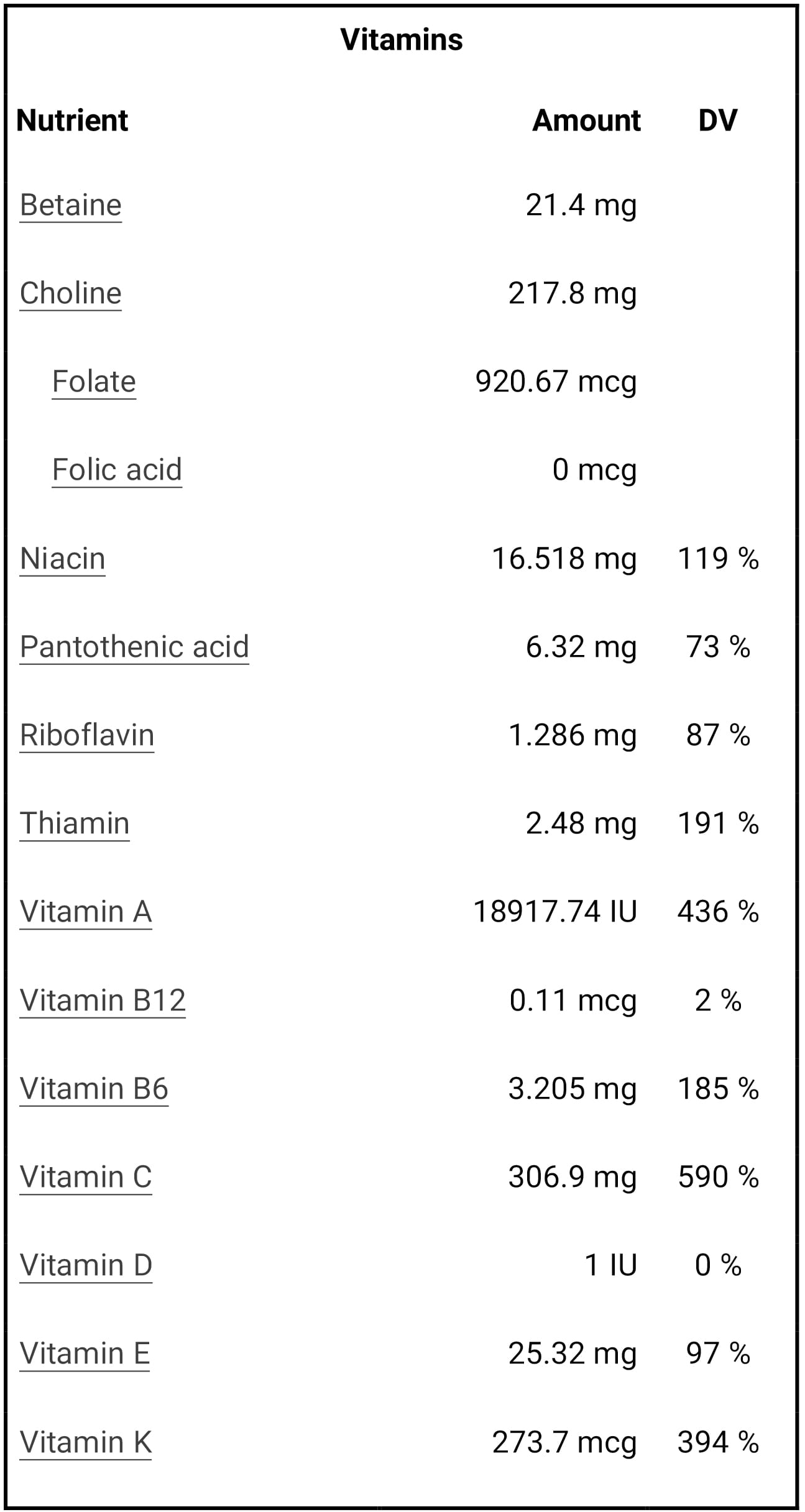
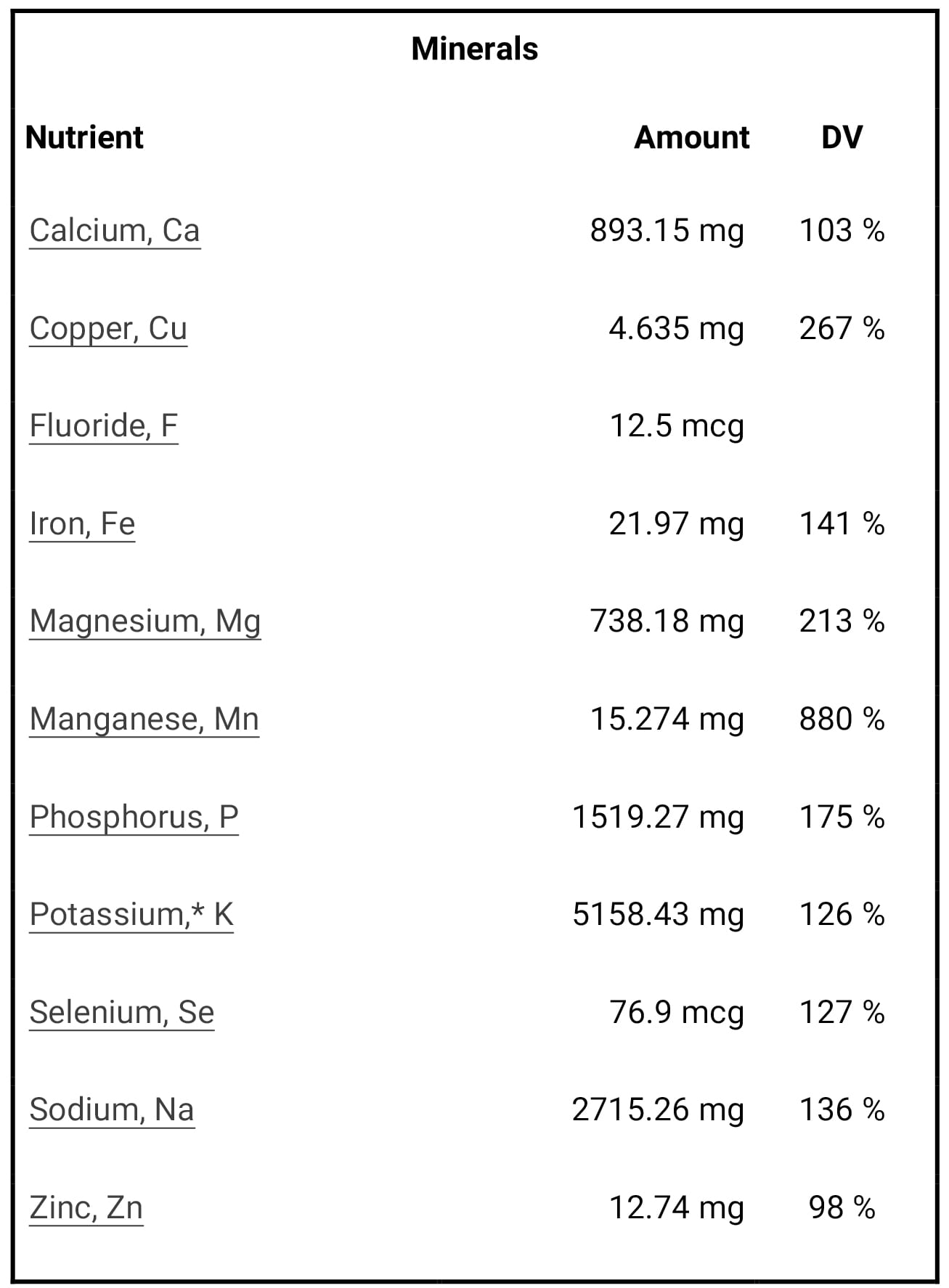
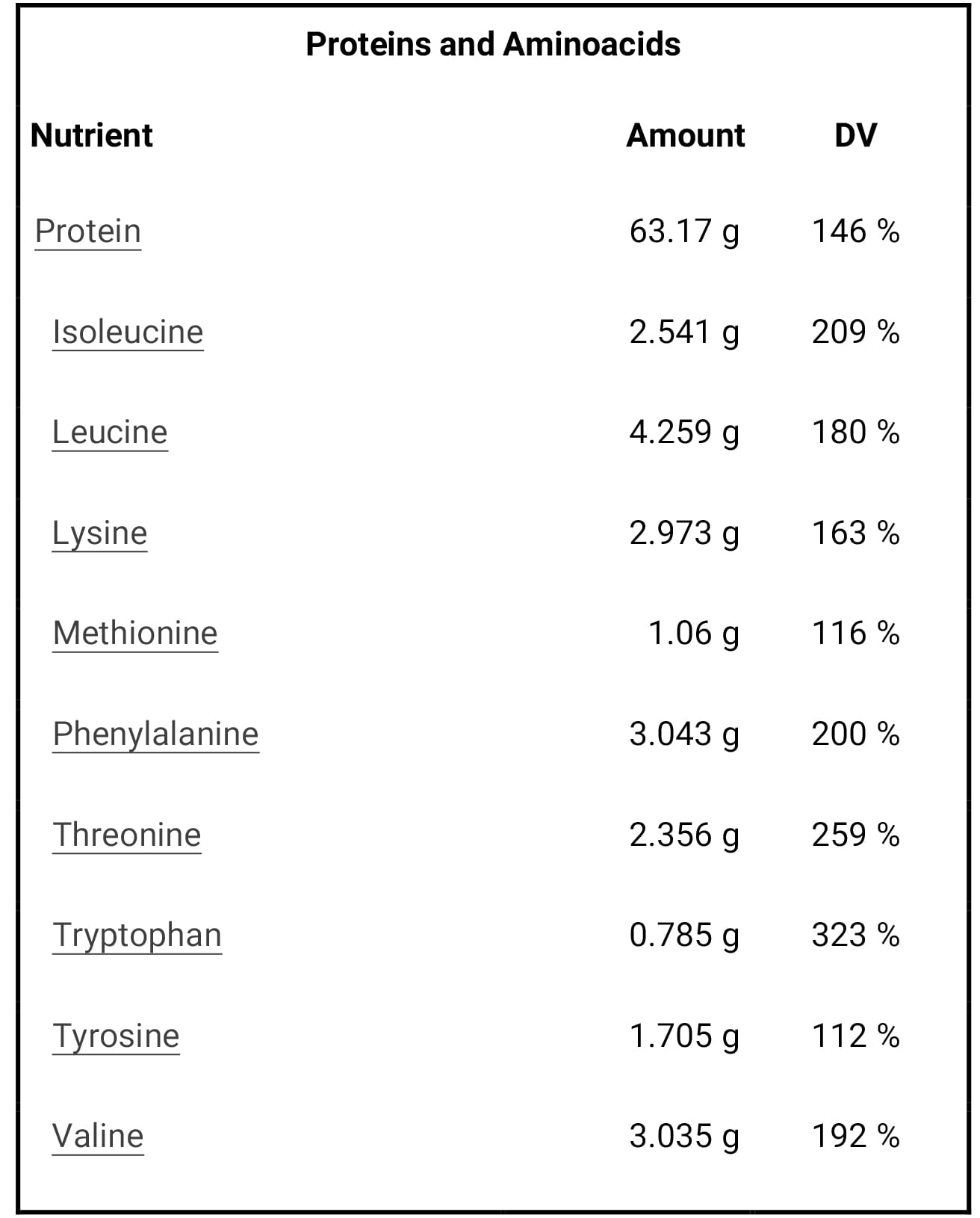
It can be observed that all needs, including fats, protein, and vitamins, are fully met, and conversely, undesirable elements such as saturated fats and cholesterol are present in very small amounts in this plan. More details can be seen in the tables below, which show that all vitamins (except vitamin B12, the method of obtaining which in raw vegans is a matter of discussion), minerals, and even all essential amino acids are fully supplied (note the percentages mentioned against each substance):
All the daily required minerals are supplied in this way:
How proteins (including all types of essential amino acids) are supplied is shown in the table below:
Now that we are assured regarding the supply of nutrients, let us return to the discussion of water. The (raw) vegan diet proposed in the table above, compared to the typical diet in Iran, results in at least a 30 percent saving in virtual water consumption. It now becomes clear why, at least in Iran, the role of the people is almost as important as that of the government and producers, and even more so, and must be attended to; for we saw earlier that according to Lancet researchers, improving production has a 30 percent effect and reducing waste a 13 percent effect on decreasing virtual water consumption. Of course, we note that these latter two figures may also be larger in Iran; but in any case, a 30 percent saving in water consumption through dietary reform is by no means a small or negligible matter. To make the issue more tangible, we can do a simple calculation: with this method, every Iranian saves about 931 liters of virtual water daily and 339,815 liters annually, which, if multiplied by the hypothetical figure of 80 million people (Iran's population), amounts to an annual saving of approximately 27 billion cubic meters. If we assume the current over-extraction from Iran's renewable water resources is 60 billion cubic meters, it can be said that dietary reform alone compensates for about half of this over-extraction, leaving the other half for reforming cultivation methods and reducing waste.
Of course, all the items mentioned in the "raw vegan" column can also be consumed cooked, which, although it does not change water consumption, cannot bring about that "ideal" level of health we see in raw vegans; but it is undoubtedly still far healthier than a diet based on omnivorism. The raw vegan diet appears to have the greatest potential for reducing virtual water consumption for at least three reasons:
1_ Since there is no cooking to destroy some of the nutrients in foods, meeting the body's needs is possible with a smaller volume of food; less food consumption equals less virtual water consumption.
2_ Since foods are not cooked, they are less prone to spoilage and decay and naturally have a longer shelf life than cooked foods (except compared to canned goods, which are at the lowest possible level health-wise); this leads to a reduction in food waste. Reducing food waste equals less virtual water consumption.
3_ Since foods with a high glycemic index (such as wheat, rice, and sugar) have a low presence in the raw vegan diet, followers of this diet do not experience false hunger and eat only as much as their body needs.[55] Naturally, again, less food consumption and less virtual water consumption.
Of course, I am well aware that it is extremely naive to think that Iran’s 80 million people will one day become raw vegans; but at least now there is no longer any excuse for avoiding cooked vegetarianism. It should also be noted that we are discussing equations on paper here, and in this context we must consider everything in its ideal state; otherwise, it is obvious that the expectations scientists have of governments and producers are never realized in the real world as we calculate them on paper. Moreover, there is no doubt that reforming consumption patterns is a far more reasonable and practical method compared to the approaches proposed by Dr. Karami and his colleagues; methods such as shutting down agriculture in Iran entirely or having Iranians boycott the consumption of Iranian agricultural products. These methods are neither possible nor desirable; their impossibility is clearer than daylight, but their undesirability stems from the devastating economic, political, and cultural consequences they would leave behind. Climatologists themselves have spoken enough on this matter, and there is no need to repeat what has already been said.[56]
However, regarding how to change dietary habits across such a broad target population, the Lancet researchers have devoted a significant portion of their article to finding scientific and practical solutions for implementing the new diet, and by drawing on previous successful experiences in similar fields, they have demonstrated how people can be encouraged to adopt this new diet.[57]
5_ Vegetarianism and Temperament
Dr. Karami:
The idea that vegetarians have gentler souls and shun violence is also just a myth. It has never been scientifically proven. Being trapped in a cage with a buffalo is just as dangerous for you as being in a cage with a lion (and of course, Hitler was a vegetarian too!).
I live in Norway, where barbecue, grill, and steak are the most important dietary styles of the people, and they even eat meat for breakfast. Salty, crispy bacon. But I do not imagine that Norway, due to its excess of meat-eating, is a more unsafe place than India, Myanmar, Cambodia, and so on. Norwegians are so kind and calm that you really imagine at every moment they want to hug and kiss you (no joke).
Dr. Karami speaks with such absolute certainty about the "myth of vegetarians' aversion to violence" as if dozens of scientific studies have ruled in favor of this theory; but the truth is that scientific facts tell us something quite different. To date, a great deal of research has been conducted by nutritionists and psychologists showing that there is a clear link between vegetarianism and improved mood. I will refer here to just a few examples of this research; but first, I must provide an introduction.
Dr. Karami, like any other academic, surely knows that natural phenomena are generally the result of various causes, and reducing a natural phenomenon solely to one cause (reductionism) is an unscientific approach. The good or bad temper of the people of a society can also be the result of thousands of different causes; therefore, unlike him, I do not imagine that Norwegians must necessarily be ferocious people because of excessive meat-eating. Completely different factors, such as cultural, geographical, and economic factors, can turn the descendants of savage and plundering tribes like the Celts and Vikings into such calm and kind people; regardless of whether Norwegians today eat less meat than their warrior ancestors or more. So, if we want to speak scientifically, we cannot compare the temperament of Norwegians with, say, Iranians or Indians who are afflicted with hundreds of cultural, geographical, economic, etc., problems; but we can compare the inhabitants of a country or even a specific city, who have similar conditions in various aspects and differ only in terms of nutrition, and see whether vegetarianism has made the vegetarians of that city more aggressive or gentler in spirit compared to the omnivores of the same city. Some scientific studies have been conducted precisely with this approach (the so-called cross-sectional approach[58]), and we will have a quick review of the results of these studies here.
One of the studies that escaped Dr. Karami's notice is an article published about 9 years ago in the Nutrition Journal.[59] Three nutrition specialists from Arizona State University, part of whose research interests involve studying the health of vegetarians, examined the mental health status of 138 healthy Seventh-day Adventist men and women, all residing in the southwestern states of America. Of these 138 individuals, 60 are vegetarian and 78 are omnivore. We know that Seventh-day Adventists are world-renowned for their healthy diet and longevity and generally have a similar lifestyle. However, the researchers tried to account for possible differences from various aspects (such as level of physical activity, or even education) in this study, and to prevent the influence of subjective biases on the research results, they did not inform the participants of the study's objectives; therefore, the vegetarian participants in this study had no idea that the researchers' goal was to study the vegetarian diet. Considering these research precisions, it is interesting to see what difference there is in the mental health status of vegetarians compared to omnivores among these individuals. The summary of this study's findings is as follows: Negative emotions are significantly lower in vegetarians than in omnivores. Based on the "Depression Anxiety Stress Scales"[60] test, the status of vegetarians is twice as good as that of omnivores (approximately 8 versus 17), and based on the "Profile of Mood States"[61], the status of vegetarians is approximately 15 times better than that of omnivores (approximately 1 versus 15). By analyzing the foods consumed by the two groups, the researchers explain the reason for this difference as follows: Vegetarians receive a large amount of alpha-linolenic acid and linoleic acid, and in contrast, receive a small amount of eicosapentaenoic acid and docosahexaenoic acid; the situation for omnivores is completely reversed, and therefore the researchers attribute the difference in the mood status of the two groups to this difference in intake.
In another study, the results of which were presented at the annual conference of the American Public Health Association in 2009, the same researchers tested a group of omnivores for two weeks. This was done in such a way that one group continued their usual diet; one group eliminated red meat and poultry from their diet, and one group eliminated all types of meat (both red and white). This study showed that after two weeks, the third group, which consumed no meat at all, experienced an improvement in their psychological state.[62] The results of this study were also evaluated through open peer review in the Nutrition Journal in 2012 and published along with the reviewers' critiques.[63]
In addition to these, other studies have reached similar conclusions. For example, one can point to the research by Schweiger and colleagues, published in the journal Neural Transmission 67 (1986), which shows that the group placed on a vegetarian weight-loss diet had a significantly better psychological state than the others during the final three weeks of the experiment.[64] Another study, published in 1994 in the journal Rheumatology, demonstrated the positive effect of a vegetarian diet on the psychological state of rheumatoid arthritis patients.[65] A 24-week study on 74 male and female diabetic patients showed that a vegetarian diet improves quality of life, mood, and eating behaviors.[66]
In another study conducted by five researchers from the Washington Clinical Research Center and the George Washington University School of Medicine on the acceptance and impact of a vegetarian diet on overweight or type 2 diabetic patients, they concluded that, both in terms of acceptance and impact on physical and mental health, the group that chose the vegetarian diet was in a better condition after 22 weeks compared to the other group.[67]
A multitude of other scientific studies of this kind exist; but the above cases, all published in the most reputable scientific journals in the field of nutrition and medicine, seem sufficient as examples. Those interested in obtaining more detailed information about the biological mechanism of vegetarianism's positive effect on psychological state and mood can refer to the short article by the Physicians Committee for Responsible Medicine titled "Food and Mood: Eating Vegetarian to Fight the Blues."[68]
But we know that on the other side, there are studies that have reached results contrary to those above. Among the most important of these is the article by Michalak from the University of Hildesheim and colleagues, which, by investigating a large statistical population of German people, concludes that vegetarianism is definitely directly associated with mental problems such as depression, psychosomatic illnesses, and eating disorders.[69] The authors of this article criticize other articles that had previously reached similar results, arguing that they were not conducted on a proper statistical population and cannot be representative. To address this problem, they explain how a large and real statistical population was examined in this study (a population consisting of 4,181 participants in the German National Health Interview and Examination Survey (GHS) in 1998-1999). Naturally, in this large statistical population, about one percent of the participants were completely vegetarian (54 people) and about four and a half percent were predominantly vegetarian (190 people). Of course, vegetarianism in this study only means not consuming red meat.
Fortunately, these researchers themselves noticed a significant problem in this statistical population that makes using it to evaluate the impact of vegetarianism on mental health problematic: the small vegetarian community in this database, even without considering their diet, possesses factors that increase their likelihood of developing mental disorders; such as gender (about 70 percent of vegetarians are women), age (the average age of vegetarians is lower than that of omnivores), education (the German vegetarian community has higher education levels), place of residence (most German vegetarians are urban dwellers), marital status (most are single, and the statistics for separated individuals are also higher among them). This means that the population studied by these researchers, even without considering diet, is exposed to a set of other factors, each of which alone could justify the higher rate of mental disorders in the German vegetarian community; let alone the fact that all these factors are combined in this community. This is akin to someone, ignoring the differences in factors like climate, nutrition, lifestyle, etc., between rural and urban life, concluding that the higher literacy rate among city dwellers is effective in their contracting more illnesses!
Fortunately, the researchers themselves noticed this problem and, to address it, created a control group of omnivores (consisting of 242 individuals) that matched the vegetarian group on the above factors. Therefore, by comparing the two groups—vegetarians and omnivores—whose other factors are similar, any difference in the rate of mental disorders would be expected to be attributable solely to diet. However, what casts the results of this study entirely under suspicion is that, despite all these measures, the findings ultimately turned out to be mathematically and logically unreasonable; for in the final table concerning mental disorders, the rate of mental disorders in the omnivore control group (i.e., omnivores who have higher disorder-inducing factors) turned out to be lower than that of the entire omnivore population; whereas, as a rule, the omnivores in the control group should have had more mental health problems. This fact, which the researchers themselves acknowledged, indicates a fundamental problem in this database: either the questions were not properly designed, or the respondents did not answer correctly, or the statistical analyses are flawed; perhaps there is another issue at play. But in any case, it is by no means logical that, in a standard statistical population, an increase in disorder-inducing factors would be accompanied by a decrease in disorders.
Another problem with this study is that, according to the researchers themselves, the word “meat” in German refers only to red meat, and therefore many of those identified as vegetarians in this study simply did not consume “red meat” (because the questionnaire only asked about this subject); but they did consume chicken and fish (according to the researchers’ own estimate, 52 percent of those who said they were completely vegetarian consumed fish!). Now, considering the research by the University of Arizona researchers, which I mentioned at the beginning, it is natural that fish consumption, given the abundance of eicosapentaenoic acid and docosahexaenoic acid, would cause mental disorders.
Now, add to the above points the fact that all three researchers involved in this study are psychology specialists and, as a rule, have no expertise in nutritional science; this is why their research is fundamentally based on a general, non-specialized database whose questions about nutrition are naturally very broad and imprecise. For example, while the University of Arizona study used a standard food frequency questionnaire[70] with over 125 food items, the database used by these researchers (GHS) employed a food frequency questionnaire that included only 35 food items. It is clear that the results of such a database (no matter how large its statistical population) cannot be reliable.
The upshot of the above discussion is that, contrary to what Dr. Karami has said, the mental health of vegetarians is not only not a myth, but a scientific reality that many scientific studies have both proven the existence of and explained its mechanism in a scientific manner.
6_ Vegetarianism and Ethics
They say killing animals to eat them is inhumane and no different from murder. Now, what is the human’s role in all this? Is he God? A prophet? A human is also a living being like other living beings on Earth; he too has the right to eat other creatures for the struggle for survival.
Anyway, if we want to look at the universe with that same romantic gaze, why shouldn’t our hearts ache for plants? For bananas that travel thousands of kilometers from their birthplace so we can stuff them into our damned stomachs? Or for mountains whose hearts we split open to run tunnels through them? Or seas whose nightly slumber we disturb with the passage of ships? Shall I continue with this same saccharine, sentimental tone?
The above arguments, which are commonly heard from the general public and unfortunately sometimes repeated by a few in academia, are precisely, as Dr. Karami has stated, “flimsy and weak”; but they are by no means the arguments that moral philosophers rely upon in defense of vegetarianism; these are merely a fabricated scarecrow that opponents of vegetarianism typically raise—since they cannot provide a convincing response to the ethical arguments of vegetarians—in order to attack this instead of the actual evidence. But the truth is that Dr. Karami, as a scientist, and all of us, as beings possessed of reason and conscience, realize with a simple reflection that among all the entities of existence (whether inanimate objects, plants, or animals), only animals, like us humans, possess a nervous system and feel pain and suffering just as we sense them. No scientist has confirmed the existence of a nervous system and the perception of pain in plants, nor in mountains, nor in seas, nor in any other element of nature, and therefore no vegetarian harbors such sensitivities toward them (of course, the discussion of the necessity of refraining from unnecessary manipulation of nature is a separate issue, one for which Dr. Karami himself has fortunately argued extensively in favor, and there is no need for additional debate on it here). Therefore, if we wish to look at the matter from an ethical perspective, the story of animals is a story entirely different from that of other entities in this universe and entirely similar to us humans, and just as we humans have ethical sensitivities regarding gender and racial discrimination, we must also be ethically sensitive about this discrimination.[71]
But after this point, Dr. Karami’s main argument remains noteworthy: if we have no choice but to eat animals in order to survive, our action is certainly not unethical. He has stated: man “has the right to eat other living beings for the struggle for survival.” That is correct. There is no doubt about this. We even have the right, in cases of emergency and to stay alive, to eat the rotting carcasses of animals. But does this mean that we “must” eat meat and carcasses “under any circumstances”? Certainly not. Have the millions of humans who, over the past thousands of years, have never touched meat or even any animal products from the beginning to the end of their lives, lived shorter lives than others? Let us not go far; I personally know dozens of people who, by eliminating animal products, not only have not encountered any problems, but have also been freed from the scourge of many of their previous illnesses; any other Iranian can also, by visiting one of the natural nutrition associations throughout Iran, see remarkable examples of such individuals up close and examine their records.[72] Therefore, now, in addition to Peter Singer’s ethical argument based on the rejection of discrimination, we have another ethical argument based on our moral responsibility to preserve our own health. We are morally responsible for avoiding foods that lead to the weakening of our physical faculties; otherwise, we have wronged both ourselves and the small or large community around us, who will be forced to expend costs (of time, energy, money, emotional strength, etc.) for our incapacity.
Therefore, in conclusion, I say: Yes! If I or any other vegetarian were to find ourselves in a temporal and spatial situation where we had no choice but to eat meat in order to survive, we would certainly do so only to the extent necessary (just as all the prophets, mystics, and philosophers of past eras, who, due to the geographical conditions of their lands and the limitations of those times in securing plant resources with the quantity and quality of today, needed to consume a small amount of animal products to obtain the essential nutrients for their bodies, did so to the extent necessary); but the point is that today, with easy access to plant materials in the most diverse possible spectrum, there is practically no need for meat or other animal products to supply the body’s essential nutrients; as the experience of millions of people proves. Beyond this, it has been proven that the greater the consumption of animal products, the greater and ultimately more fatal the consequences, both for the individual and for all terrestrial life.
This was the simplest expression of the ethical and theological arguments of vegetarians, which, due to its clarity, seems to require no further elaboration; however, one can delve into the minute details of these discussions and, by citing real figures and data pertaining to the current state of the world, demonstrate that we are obligated, both in terms of conventional morality and even religious duty, to change our dietary habits toward vegetarianism. I hope in the near future to be able to present these arguments in independent articles with greater detail in the two domains of ethics and theology (in which, as Dr. Karami says, “I have a bit of expertise here”).
Conclusion
This article, in full agreement with the view of Dr. Karami and other climatologists and environmental specialists regarding the necessity of adopting the most minimalist possible lifestyle in today’s world to avoid environmental consequences, demonstrated that, contrary to Dr. Karami’s perception, nutrition and environmental specialists today are moving toward a broad consensus on the necessity of vegetarianism for all humans to simultaneously preserve bodily, mental, and planetary health.
In a time when environmental intellectuals in the West were encouraging people to eliminate one or two meat-based meals from their weekly diet, we, due to the critical state of our environment, needed to call upon people to adopt vegetarianism or, at most, one or two servings of meat per week. Now that Westerners are calling upon people to adopt vegetarianism or, at most, one or two meat-based meals per week, what course of action should we pursue given the dire state of our water, soil, and environment? This article showed that the best option is a raw vegan diet, and the minimum desirable participation is a cooked vegetarian diet.
This conclusion does not mean lifting the burden of responsibility from the shoulders of governments and producers; rather, it means that alongside all those responsibilities, each and every one of us as consumers also has an undeniable role. According to the consensus of nutrition scientists in the new paradigm, all other solutions, which are mainly directed at governments, are doomed to fail without a change in the human diet; because with a multi-billion human population on Earth, each epsilon of movement toward optimal or suboptimal consumption is multiplied by several billion, and thus improper human nutrition will ultimately neutralize all other efforts. Hence, a consensus is forming among scientists from various disciplines that, in addition to all the commitments governments have made for macro-level policies to reduce greenhouse gases and realize other solutions, it is necessary for people worldwide to move toward full vegetarianism or quasi-vegetarian diets so that all these solutions can be effective together. The result will be that the rate of global warming will decrease, the consumption of fresh water will be reduced, less land will be used for agriculture, we will have less soil and water pollution, and we will prevent deforestation and desertification; not to mention that we ourselves will be healthier.
In a word, every day more scientists are signing onto this slogan: Be vegetarian so that both you and the Earth remain healthy. Therefore, under these circumstances, not only do we not need a violent, bloody, and unethical carnivorous diet to stay healthy, but we urgently need to move away from this destructive and ruinous diet.
By reviewing the latest scientific achievements in various fields, this article showed that a dietary change is a necessity for Iranian society far beyond what researchers have prescribed for the entire world population; because Iran’s climate and environment are in a far more acute state compared to most countries in the world, and therefore, to reach a stable state, both environmentally and in terms of physical health, we need an effort beyond the recommendations proposed at the global norm level. The calculations of this article demonstrated that beyond the vegetarian diets that scientists today strictly recommend to all people worldwide, we Iranians, out of an urgent necessity, must turn to a raw vegan diet to distance ourselves somewhat from the apocalyptic crisis point that scientists have predicted for our near future.
According to these data and calculations, even if the most environmentally-minded government possible were to come to power in Iran, the moral burden of this duty would still not be lifted from the shoulders of each and every one of us Iranians; because in the most ideal scenario, a government's efforts can at most contribute to a 30 to 40 percent reduction in water consumption; whereas, to overcome the current so-called "post-normal" situation, we must reduce our virtual water consumption by 60 to 80 percent, and this is by no means possible unless Iranians turn to a diet that can result in at least a 20-30 percent saving in virtual water consumption. The investigations in this article indicate that the only diet that offers such savings is a raw vegan diet, and for this reason, adhering to such a diet is morally obligatory for every Iranian; whether an environmentally-minded government is in power, or whether, like current governments, it is passive and indifferent to the state of water and the environment.
However, my primary audience in this article, for now, is not the entire Iranian society; rather, it is only two groups of thinkers: one is Iranian intellectuals, especially environmental intellectuals, who need to understand what an urgent and pressing need there is to set aside, as quickly as possible, this misplaced courtesy towards Iranian society and to frankly share the scientific truths with them; just as in the lush, water-rich, and developed European countries, intellectuals have taken this same path; so in our dry and crisis-stricken country, this necessity is a hundredfold. The second group is all those who are concerned with living ethically on this earthly sphere; for eating meat, however pleasurable it may be, is not worth all these devastating consequences by any justification. It can be argued in detail and demonstrated that, whichever of the three famous ethical schools we follow—namely virtue ethics, deontology, and consequentialism (in its negative interpretation, of course)—we will be morally obligated to surrender to this scientific consensus on abandoning meat and animal products and turning to an optimal diet (both in terms of health and the environment), and at the very least, if we are meat-eaters, to accept that in the history and geography in which we live, one can be nothing more than a shamefaced meat-eater.[73] In other words, the only people who might still desire to eat meat despite all these emphases from scientists in various fields on the necessity of turning to vegetarianism are hedonists (in the most vulgar sense of the word); that is, those who prefer the fleeting pleasure of the palate over their own physical and mental health, the rescue of hundreds of millions of hungry people from death, and ultimately, the overall health of terrestrial life.
If only these two groups (intellectuals and ethicists) accept the results of this article, the future of Iranian society will be remarkably brighter; because the intellectual community, especially in this era when official propaganda and educational institutions have either lost their function or turned into their opposite, is still considered one of the authoritative educational institutions in Iranian society. If this reference group has the courage to make people aware of the benefits of changing their lifestyle and diet, in the face of their pleasure-seeking desires, one can hope that a change will occur in Iran's dark future.
Alongside these, every single person who is concerned with living ethically, if they understand that changing one's diet to preserve the earth is an individual obligation (wājib 'aynī), not a collective one (wājib kifā'ī), a positive event for Iran's suffering environment will occur to the extent of that one person. Individual obligation here means that "I," as a moral human being, have no need to wait for the day when the "whole" of Iranian society changes; rather, each person, as soon as they understand this matter, is duty-bound to change their own lifestyle (regardless of what others do). As soon as each of us fulfills this moral duty, we will be proud before our own conscience and before the court of nature, and of course, we can hope that with the gradual spread of this view, a day will come when we proudly celebrate these solo roles in saving the earth.
Personally, ever since I stepped out of the realm of theory and put this awareness into practice in my life, and specifically since joining the small community of raw vegans in Iran a year and a half ago (although for much of this time I have been an eighty-percent raw vegan; that is, I have also consumed one meal of cooked legumes per day), my level of satisfaction with my life in the arid climate of Iran and my hope for the future have increased, and I no longer feel ashamed before existence, nor am I despairing and fearful of the future; just as my pleasure in eating has multiplied several times over; for I now know well that in such an arid climate, there is no more optimal way than this to simultaneously preserve body, soul, and world; a perfect instance of living in the manner of those who are "light in burden, abundant in aid." It is for this reason that I emphatically call raw vegans the "most saintly" human beings on earth in the present age. I also wish for the other eighty million Iranians to taste this beautiful feeling; although with a carefully planned cooked vegan diet, one can also experience a feeling close to this.
.
.
[1] Prior to publication, this article was sent to a number of specialists and experts in various fields related to the present discussion. The author considers it his duty to sincerely thank the following professors and thinkers who undertook the trouble of reading a draft version of this article. I sincerely thank Dr. Zarrin Azar (subspecialist in gastroenterology and liver diseases) and Mostafa Malekian (professor of philosophy and ethics), who, by reading a version of the article, warmly honored the author and encouraged its publication. From among environmental activists, Mohammad Darvish (faculty member of the Research Institute of Forests and Rangelands of Iran), despite all his preoccupations, responded positively to my call to read the draft of the article and, by reading it, endorsed its general content, for which I am grateful to him. I am also thankful to Dr. Reza Haghparast (associate professor, deputy of the Dryland Agricultural Research Institute), who was my consultant during the writing of the article and offered valuable suggestions for its improvement. My brother, Dr. Morteza Tabatabaei (philosophy graduate and lecturer at the University of Tehran), also assisted me with his insights throughout the writing of the article; for this, I am grateful to him.
I must also thank my dear friend, Engineer Mohammad Javad Samiei (graduate of Natural Disaster Management at the University of Tehran), who, in addition to spending time in conversations I have had with him about water over the past few years, also read a draft version of the article and, with the questions and challenges he raised, pushed me further in refining the text. However, in this context, my special thanks must be dedicated to my scholarly wife, Zahra Abbasi, who, throughout the duration of this research, with her patience and deep understanding of the importance of this article's subject, was my encourager and companion in practice, and helped me to practically experience and study the challenges of the proposal put forth in this article on the scale of a small family. Nevertheless, I must clarify that the responsibility for any remaining errors or weaknesses in this article rests solely with the author.
[2] Omnivores
[3] Hypercarnivores
[4] Hypocarnivores
[5] Mesocarnivores
[6] See Campbel Biology, p. 909-910, 917.
[7] Campbel Biology, p. 900: “Determining the ideal diet for the human population is an important but difficult problem for scientists. As objects of study, people present many challenges. Unlike laboratory animals, humans are genetically diverse. They also live in settings far more varied than the stable and uniform environment that scientists use to facilitate comparisons in laboratory experiments. Ethical concerns present an additional barrier. For example, it is not acceptable to investigate the nutritional needs of children in a way that might harm a child’s growth or development.”
[8] See Campbel Biology, p. 897.
[9] See Willett, W., Rockström, J., Loken, B., Springmann, M., Lang, T., Vermeulen, S., ... & Jonell, M. (2019). Food in the Anthropocene: the EAT–Lancet Commission on healthy diets from sustainable food systems. The Lancet, 393(10170), 447-492 .
[10] Ibid, p. 1.
[11] Ibid.
[12] Ibid, p. 7.
[13] Ibid, p. 4.
[14] Ibid, p. 9.
[15] With each passing day, more research is published in support of this view; a recent example is a study by Oxford University researchers which showed a direct link between meat consumption and cancer risk, while an inverse relationship exists between the amount of grain consumed and cancer risk. See:
Kathryn E Bradbury, Neil Murphy, Timothy J Key, “Diet and colorectal cancer in UK Biobank: a prospective study,” International Journal of Epidemiology, dyz064, Published: 17 April 2019, https://doi.org/10.1093/ije/dyz064
[16] Willett, W., et al, 2019, p. 9.
[17] Ibid, p. 10.
[18] Ibid.
[19] Ibid.
[20] Ibid, p. 10-11.
[21] Ibid, p. 11.
[22] Ibid.
[23] Ibid.
[24] Ibid.
[25] Ibid, p. 12.
[26] Ibid, p. 14.
[27] Ibid.
[28] Ibid, p. 3.
[29] Ibid, p. 2.
[30] Ibid, pp. 2, 5.
[31] In the most recent research published in this field, the result of three years of study by a group of scientists from the United Nations-affiliated Intergovernmental Science-Policy Platform on Biodiversity and Ecosystem Services (IPBES) on biodiversity, the results of which were published on 6 May 2019, it was declared that “humanity has had a devastating impact on land, seas, and air, and now one million animal and plant species are at risk of extinction.” The final report of this research amounts to 1,800 pages and is based on 15,000 scientific sources, which has not yet been made available to the public; but from the published 40-page summary of this report, it appears that these researchers, too, are inclined toward replacing animal protein with plant-based materials to reduce the risk of extinction of animal and plant species. See:
Sandra Díaz et all, “Summary for policymakers of the global assessment report on biodiversity and ecosystem services – unedited advance version,” p. 30 .
[32] Willett, W., et al, 2019, pp. 24-5.
[33] Ibid, p. 25.
[34] Ibid.
[35] Ibid.
[36] Ibid, p. 26.
[37] Ibid.
[38] J Poore, T Nemecek, “Reducing food’s environmental impacts through producers and consumers,” SCIENCE 360: 6392 (01 JUN 2018): 991 .
[39] See: The Guardian website
[40] Opportunities and challenges for research on food and nutrition security and agriculture in Europe, German National Academy of Sciences Leopoldina, December 2017, p. 35, available at: https://mta.hu/data/EASAC_FNSA_report_complete_Web.pdf
[41] Scarborough, P., Appleby, P.N., Mizdrak, A. et al. “Dietary greenhouse gas emissions of meat-eaters, fish-eaters, vegetarians and vegans in the UK,” Climatic Change (2014) 125: 179-192. https://doi.org/10.1007/s10584-014-1169-1 .
It is worth noting that of the seven researchers involved in this study, only one (Timothy J Key) has vegetarian leanings. This research was conducted with the support of the British Heart Foundation, the Oxford Martin School, Cancer Research UK, and the UK National Institute for Health Research.
[42] Ibid, p. 186.
[43] Ibid.
[44] H Saxe, TM Larsen, L Mogensen, “The global warming potential of two healthy Nordic diets compared with the average Danish diet,” Climatic Change (2013) 116: 249-262. https://doi.org/10.1007/s10584-012-0495-4
[45] See: F Vieux, L-G Soler, D Touazi, N Darmon, “High nutritional quality is not associated with low greenhouse gas emissions in self-selected diets of French adults,” The American Journal of Clinical Nutrition (2013), 97:569–583, available at: https://academic.oup.com/ajcn/article/97/3/569/4571517 . See especially the figure 4 in p. 577.
[46] Willett, W., Rockström, J., Loken, B., Springmann, M., Lang, T., Vermeulen, S., ... & Jonell, M. (2019). Food in the Anthropocene: the EAT–Lancet Commission on healthy diets from sustainable food systems. The Lancet, 393(10170), p. 24.
[47] Ibid, p. 25.
[48] Ibid.
[49] Bear in mind that the greatest impact relates to the proposed diet in its low-calorie state (without animal products), and the least impact relates to the same diet in its high-calorie state (with a small amount of animal products). See: Table 7 on p. 29 of the Lancet article).
[50] Ibid, p. 28.
[51] Ibid, pp. 6, 14, 28, ….
[52] Of course, there are various other formulas, including strict fruitarianism, which are not my concern in this article. Specifically, a diet like strict fruitarianism has no advantage whatsoever, at least in terms of virtual water consumption, and may even be more consumptive in this regard than an omnivorous diet.
[53] See: Seyed Mohammad Hani Sadati and AbouAli Vedadhir, “Raw Veganism as a Culture,” Iranian Journal of Anthropology, Vol. 10, No. 16, 2012, pp. 67-115.
[54] The number 61 was chosen on this basis: the average height of Iranian men is 173 cm and the average height of Iranian women is 160 cm. Therefore, the average height of Iranians is about 166 cm. If we consider a desirable BMI of, for example, 22 (the recommended range is 18.5 to 25), then the desirable average weight for Iranians would be 61 kg.
[55] See: Reza Haghparast, Chickpeas Superior to Meat (Tehran: Shalan, 2018), p. 92.
[56] For example, see: Kaveh Madani’s interview titled “Shutting down agriculture due to water scarcity is the most erroneous decision” on the Khabaronline website.
[57] See: Walter Willett et al, “Food in the Anthropocene,” Lancet, pp. 31-9.
[58] Cross-sectional
[59] Bonnie L Beezhold, Carol S Johnston and Deanna R Daigle, “Vegetarian diets are associated with healthy mood states: a cross-sectional study in Seventh Day Adventist adults,” Nutrition Journal 2010, 9: 26, available at: http://www.nutritionj.com/content/9/1/26.
[60] Depression Anxiety Stress Scale (DASS)
[61] Profile of Mood States (POMS)
[62] See: https://apha.confex.com/apha/137am/webprogram/Paper206464.html.
[63] Bonnie L Beezhold, Carol S Johnston, “Restriction of meat, fish, and poultry in omnivores improves mood: A pilot randomized controlled trial,” Nutrition Journal, 11:9 (2012).
[64] U Schweiger, R Laessle, S Kittl, B Dickhaut, M Schweiger, KM Pirke, “Macronutrient intake, plasma large neutral amino acids and mood during weight-reducing diets; Randomized controlled trial,” J Neural Transmission, 67:1-2 (1985), pp. 77-86, available at: https://link.springer.com/article/10.1007/BF01243361.
[65] J. Kjeldsen-Kragh, M. Haugen, Ø Førre, H. Laache, U. F. Malt, “Vegetarian Diet for Patients with Rheumatoid Arthritis: Can the Clinical Effects be Explained by the Psychological Characteristics of the Patients?,” Rheumatology, 33: 6 (1 June 1994), pp. 569–575, available at: https://academic.oup.com/rheumatology/article-abstract/33/6/569/1777341.
[66] H. Kahleova, T Hrachovinova, M. Hill, T. Pelkanova, “Vegetarian Diet in Type 2 Diabetes - Improvement in Quality of Life, Mood and Eating Behaviour,” Diabetic Medicine 30:1 (2013), pp. 126-129 .
[67] HI Katcher, HR Ferdowsian, VJ Hoover, JL Cohen, ND Barnard, “A worksite vegan nutrition program is well-accepted and improves health-related quality of life and work productivity,” Annuals of Nutrition and Metabolism, 56 (2010), 245-252 .
[68] See: https://www.pcrm.org/sites/default/files/2018-09/Food-and-Mood.pdf
[69] See J. Michalak, X Chi Zhang, F Jacobi, “Vegetarian diet and mental disorders: results from a representative community survey,” International Journal of Behavioral Nutrition and Physical Activity, 9:67 (2012), available at: https://ijbnpa.biomedcentral.com/articles/10.1186/1479-5868-9-67#Sec2.
[70] Food Frequency Questionnaire
[71] For a detailed philosophical discussion in this area, see Peter Singer’s valuable book, Animal Liberation, translated by Behnam Khodapanah, Phoenix, 2017.
[72] For accounts of a number of these individuals, see: Seyed Mohammad Hani Sadati and Abu Ali Vedadhir, “Raw Veganism as a Culture,” Iranian Journal of Anthropology, Vol. 10, No. 16, 2012, pp. 67-115.
[73] As another wake-up call, one can point to Peter Singer’s ethical arguments, who believes that in today’s world, even having one gram of excess weight is an immoral act. He argues this from specific perspectives, of course, all of which are important (environmental pollution, imposing costs on society, etc.); but I want to look at this issue from the perspective of water. I have never seen a raw vegan who is overweight; on the contrary, we know many people who were overweight, even weighing up to 180 kilograms, who reached a normal weight level after adopting a raw vegan diet. Let us recall that the average Body Mass Index of Iranians is now above the normal range (around 25.5), and this means that Iranians, despite their arid climate, eat far more than they need and naturally consume much more virtual water. Therefore, looking at the matter from this perspective as well, an ethical person would not accept having even one gram of excess weight due to an improper diet; rather, they would even strive to be near the lower end of the standard BMI range (i.e., around 18.5), not its upper limit of 25. So, it can be argued that the most ethical BMI for any Iranian, given the amount of water available to us, is the lowest level of the standard BMI, i.e., the 18.5-23 range, which is the boundary between human health and the health of Iran’s climate; the argument for this claim, in brief, is that we are collectively permitted to withdraw a maximum of 40 billion cubic meters of water from Iran’s nature, and this amount of water for 80 million Iranians means that each Iranian is permitted a maximum daily use of 1,370 liters of Iranian water; the rest must be imported from abroad. Let us recall that according to the calculations in this article, even with a raw vegan diet (which is the most water-efficient diet possible), if we consider each Iranian’s Body Mass Index to be 22, the daily water consumption per person exceeds 2,080 liters. Therefore, as long as we have not been able to steer our statesmen’s policies towards importing our surplus water needs from abroad, our moral duty requires us to be content with that minimal raw vegan diet with a Body Mass Index of 18.5 or slightly higher. In other words, in our age, thinness (within the permissible health range) is a moral virtue, and having even one gram of excess weight is morally a cause for shame.
.
.





Discussion14 comments
درود بر شما و همه انسانهای نیک اندیش کاملا درست می فرمائید. بویژه اشاره ای که به نام اندیشمندان و فرهیختگان کردید بسیار بجا است. باید افرادی مثل شما با برگزاری همایش هایی برای جامعه پزشکان و مهندسان و فرهنگیان جامعه نسبت به روشن کردن موتور آگاهی اقدام کنند. تا این اقشار ذهنشان خانه تکانی نشود بقیه جامعه تاثیری ندارند. آگاهی چیزیه که خدا به هر کسی که لایق بداند عطا میکند. انجمن خامگیاهخواری اراک09188618242
آفرین. چه بسیار دقیق و با حوصله با استفاده از منابع علمی با بهترین قلم و بهترین استدلال نشان دادید که همکاران و عزیزان محیط زیستی هرچه هم که بخواهند از موضوع اهمیت و نقش تغذیه درمحیط زیست طفره روند و فرارکنند راهی جز پذیرش این ندارند که برای بشر از همه نظر راهی باقی نمانده جز اینکه رژیم غذاییو سبک زندگی گیاهخواری سالم بخصوص خامگیاهخواری را درپیش گیرد. مقاله ای که باید آنرا بسیار جدی گرفت. درود و آفرین.
مقاله بسیاردقیق و محققانه ای بود.البته وضعیت سلامت گیاهخواران می بایست در طولانی مدت و در زمان کهنسالی هم بررسی شود.
بنظر می رسد که اینگونه قضاوت کردنها ساده سازی موضوعات پیچیده و نوعی یکطرفه به قاضی رفتن است.از این عزیزانی که در رابطه با گیاهخواری و ضرورت آن گزاره های عاطفی و اخلاقی صادر می فرمایند و برای حیوانات دلسوزی می کنند می پرسم که چرا در مورد هزاران هزار حیوانی که هر روزه به بهانه تدریس در دانشگاه ها و یا در آزمایش داروها بنحوی سبعانه شکنجه و نابود می شوند چیزی نمی گویید یا چرا در مورد استفاده از سموم برای نابودی حیوانات باصطلاح موذی که در واقع همان بکار بردن سلاح شیمیایی بر علیه حیوانات است اعتراض نمی کنید؟ اصلا اینکه ما انسانها خود را مرکز جهان می پنداریم و حکم خود را بر سایر موجودات تحمیل می کنیم چه وجهی دارد؟ البته بنده هیچ قضاوتی نمی کنم و ذکر این موارد تنها برای نشان دادن این واقعیت بود که این بزرگواران چگونه موضوعاتی پیچیده را با رویکردی عامیانه ساده سازی می کنند تا به نتیجه دلخواه و مورد نظر خودشان برسند.
در دکترین گیاهخواری در این موارد هم بحث شده است. علی الخصوص امروزه که آزمایش بر روی بافت کشت شدهٔ خود انسان بسیار بسیار دقیقتر و پر بازدهتر است، تشریح و همچنین dissection و vivisection حیوانات کاملاً بر ضد و در تضاد کامل با گیاهخواری و حقوق حیوانات و جانداران است.
سلام ما که جزو همه چیزخواران حلال هستیم و از این دعواها سر در نمی آوریم، فقط برای این آیه چه پاسخی دارید؟! يَا أَيُّهَا الَّذِينَ آمَنُوا لَا تُحَرِّمُوا طَيِّبَاتِ مَا أَحَلَّ اللَّهُ لَكُمْ وَلَا تَعْتَدُوا (مائده: 87). ای کسانی که ایمان آوردهاید! چیزهای پاکیزه را که خداوند برای شما حلال کرده است، حرام نکنید! و از حدّ، تجاوز ننمایید!
دیگه همین مونده بود که وسط یک بحث علمی بیاییم به یک حرف دینی استناد کنیم. اصلا بهتره به همه مجامع علمی دنیا این آیه رو نشون بدیم تا تعطیل کنن و به قول شما برن دنبال همه چیزخواری حلال.
هرموقع خواستید به قران استناد کنید یاد آیه 9سوره جمعه بیافتید که باتاکید بسیار به مردم امر میکنه به نماز جمعه بشتابند ولی فقهای شیعه قرنها اونو تعطیل کردند.مثال دیگه الغای برده داریه که عملا حلالی رو حرام کردیم.
با استناد به این آیه چرا موهای زیبای زنان که حلال هست را بر آنها حرام کرده اید و زیر چادری سیاه می پوشانید. زیاده روی نکنید. با عرض پوزش از اساتید بزرگوار هر چند اینجا جای این حرفها نیست منتها دوستمون هم مطلبی نوشتند که در این بحثهای علمی جایی نداشت.
سلام. مقاله از لحاظ علمی بسیار غنی و مفید است. ظاهراً مقاله دکتر کرمی نه به این اندازه محققانه است و نه تا این حد مسئله گیاهخواری برایشان جدی بوده. احساس میشود خواستهاند در یک مقاله کوتاه، بگویند دوستان گیاهخوار، در حد و حدود اهمیت گیاهخواری مبالغه نکنید. من خودم فکر میکنم اگر هدف از این بحث، تأثیرگذاری باشد (نه صرفاً یک احتجاج علمی)، مواردی مثل بحران آب، حفظ محیط زیست و حتی اخلاق، کمتر بر مخاطب عام تأثیر می گذارد. اما مسئله سلامتی قطعاً اثرگذار است، آن هم برای کسانی که واقعاً به اهمیت سلامتی پی برده باشند و معمولاً این التفات، در سنین میانسالی پیدا میشود که رفته رفته سلامتِ افراد تضعیف میشود. اما برای جوانتر ها، دو مسئله دیگر که میتواند ترغیبکننده به سمت گیاه خواری و بویژه خام گیاهخواری باشد، دو انشقاق از همین مسئله سلامتی است. یکی مسئله زیبایی اندام است. این روزها با توجه به شبکه های اجتماعی و تصویرهایی که در آنها منتشر میکنیم، مسئله زیبایی اندام و رها شدن از شرّ چربی ها و کیلوهای اضافی، بسیار مهمتر از قدیم شده است. اگر مردم بدانند که با رژیم خام گیاهی، با چه کیفیت و سرعتی میتوانند به بهترین بی ام آی ممکن برسند و بدنی داشته باشند که به آنها حس اعتماد به نفس و غرور بدهد، قطعاً بیشتر برای خام گیاهخواری ترغیب میشوند تا مثلاً برای نجات جهان آینده از بحران آب. در واقع، ما انسانها همانند همه موجودات دیگر اولاً خودگرا و ثانیاً لذت گرا هستیم. وقتی قرار است از لذتی مثل گوشت و غذای پخته دست بکشیم، حتماً باید یک لذت مادی دیگر جایش بنشیند؛ و این لذت مادی، میتواند بهره مندی از اندام زیبا و موزون باشد. دلیل دوم درباره مسئله سلامتی، اقتصاد خانواده است. رژیم خام گیاه خوارانه، از سلامت دندان گرفته تا رفع چربی خون و تنظیم قند خون، شدیداً به ما از لحاظ اقتصادی کمک میکند؛ آن هم با این وضعیت وخیم اقتصادی کشور و وضعیت نابسامان بیمه های درمانی. بنابراین کسانی که میخواهند آنچه را درآورده اند، به زودی زود، خرج درمان خود نکنند و حتی وقت و اعصاب خود را نیز از فرایند درمان نجات دهند و به قول حافظ شیرازی «تنشان به ناز طبیبان نیازمند نشود»، بهتر است الگوی تغذیه خود را اصلاح کنند. حال یکی از این شیوه های اصلاح هم خام گیاه خواری است و قطعاً بدنشان سالم تر و شاداب تر خواهد بود.
با سلام آیا با فرض صحت نتایج پروژه ذکر شده لنست می توان نتیجه گرفت که اجماع علمی در رابطه با گیاهخواری شکل گرفته است؟ اگر این مقاله را از نوشته وزین و مودبانه شما حذف کنیم انصافا استدلال های شما کم قوت نمی شوند؟ البته این مناقشه میان دو طیف را می پسندم و نتایج آن هرچه که باشد برای سلامت بشریت بسیار مفید خواهد بود.
شاید این پرسش من بدلیل ساده بودن قدری عوامانه بنظر بیاید اما می خواهم بدانم که اگر با یک تحول انقلابی همه ما گیاه خوار بشویم با این میلیاردها دام اعم از گاو و گوسفند و مرغ و خوک و... چه میکنید؟آیا در طبیعت رها میکنید؟آیا این عمل اخلاقی است که حیوانی که در طول زمان رام شده و عملا امکان دفاع از خود در طبیعت وحشی را ندارد به امان خدا رها شود؟بعلاوه آیا این کار موجب نابودی اکوسیستم نخواهد شد؟... ضمنا به نظر بنده توجیه ایشان در مورد گیاه خواری و استدلال ایشان در مورد رنج نبردن گیاهان به هیچ وجه قانع کننده نیست.امروزه ثابت شده که کثیری از گیاهان دارای احساساتی شبیه به حیوانات هستند و نسبت به رفتارهای خشن و یا دوستانه عکس العمل نشان می دهند.با این وجود حتی اگر بپذیریم که علت روی آوردن ایشان به گیاه خواری رنج نبردن گیاهان باشد می توانند بدنبال روش های بدون رنج در ذبح دام باشند.اما اگر مسئله ایشان حق حیات باشد هیچ تفاوتی بین گیاه و حیوان نیست و اگر این ضد اخلاقی باشد آن نیز هست!
باسلام ببخشید امکان دارد منبعتون بر اینکه گیاهان دارای احساسات هستند را ذکر کنید؟
این موضوع جزو مغالطات معروف ضد گیاهخواریست که در گیاهخواری جوابهای متنوع که هر کدام به حد کفایت قانع کننده و مانع هستند به آن داده شده است. خلاصهترینهایی که میتوانم برای شما بربشمارم این است که ۱. احتمال این موضوع بسیار نزدیک صفر است و نتیجتاً نگرانی در موردش تقریباً بیهوده. ۲. اگر حتی در یک آن و روز این اتفاق بیافتد، با رها سازی آنها، ما شاهد یک فصل زودگذر افزایش حیوانات شکارچی این دامها، و سپس کاهش جمعیت سریع دامها، و سپس کاهش جمعیت افزایش یافتهٔ سریع آن شکارچیان خواهیم بود.