Sociology
Culture: A Barrier to Progress!
Sediq Qotbi: The customs and habits our ancestors acquired for survival under political and social pressures—what we call culture—have become obstacles to progress. Habits rooted in fear or poverty are perpetuated under the guise of respect, blocking the path of critique.
Mr. Sedigh Ghotbi, in his Telegram channel (Blue Reason), wrote in a short text titled: "What is your main point?" that every poet or writer has only one main point. One point that is replicated throughout all their works, and upon reading it, I realized that for over twenty years I have been repeating a single idea in two books and more than twenty articles in various forms. And that idea is as follows:
"The individual and social behaviors, customs, habits, and traditions that our ancestors acquired in the course of their struggle for survival under the triple pressures of politics, economics, and society—which I call culture—have today become a barrier to the progress of our society."
Dariush Shayegan, in his book Under the Skies of the World, touches upon this point as follows: In countries like ours, there exists a kind of sociology of real failures. Count the number of failures that have accumulated in our history for over a hundred years. Where did these failures come from? To hold a certain person responsible for a particular failure—as is often said—is the height of naivety, because the failures repeat themselves with utter stubbornness and clockwork regularity, as if born of an untamable destiny: the failure of the Constitutional Revolution (1906), the failure of Khiabani (1920), the failure of Mossadegh (1953). When failure repeats itself in this manner, it speaks of an illness deeply lodged in our culture.
In the author's opinion, many of our cultural traits, customs, habits, and traditions are rooted either in fear (silence and compromise, inability to oppose someone more powerful, excessive praise and flattery, lying, distrust, inability to perform collective tasks, etc.) or in poverty (saving face, social obligation, taarof, hospitality, generosity, etc.), or in both.
These traits become an obstacle to our progress when the reason for their existence—namely, fear and poverty—has disappeared, at least among certain strata of society, yet they persist in the form of habit and the preservation of culture. The insistence on safeguarding this culture can be seen with even greater intensity among Iranians living abroad.
One of the reasons, and perhaps the most important reason, why we cannot set aside these traits and habits—and which is repeatedly discussed in the book In the Captivity of Culture—is the substitution of the word "respect" for "fear."
Meaning that since the word "fear" conjured, from the superior's perspective, the ugly image of a "terrifying" being, and from the inferior's perspective, the image of a "cowardly" and weak-spirited being, and both these images were unpleasant, we replaced it with the word "respect." Thus, from the superior, we made a "respected" individual, and from the inferior, a "polite" person, and as a result of this substitution, all our behaviors appeared justified.
The perception of these actions as respect meant that, firstly, such behaviors spread to the entire society, regardless of the superior-inferior relationship, because everyone considers themselves deserving of respect.
And secondly, any frankness of speech, honesty, critique, and being "more delicate than a flower" came to be seen as disrespect, which no one would tolerate. Thus, intolerance of criticism became one of the most prominent features of our culture.
Here, I will confine myself to the role of one of these traits in our backwardness and defer the examination of the cause or causes of our countless other characteristics and habits, and their role in our present backwardness, to future writings.
The Role of Preserving the Sanctity of Bread and Salt in the Backwardness of Us Iranians
From childhood, I remember that when someone knocked on our door, my mother would hand us leftovers or some bread and cheese, send us to the door, and say that a poor person had come looking for food; and in most cases, this was true.
To relieve the shame of poverty, we invited the poor as guests and said, "A guest is God's beloved," and whoever loves God's beloved, God will love them. Thereafter, we considered anyone who knocked on our door a guest, drew them inside, and gave them something to eat and drink even if they were not hungry or thirsty, and we called this act of ours hospitality.
This obsessive compulsion toward hospitality, which is one of us Iranians' prides, becomes more noticeable when we reside in modern countries and encounter people who do not have these behaviors or abandoned them long ago.
But in contrast to the advice given to people regarding feeding the poor, the recipients of food were also expected to cherish the kindness of their benefactors, an act referred to as "preserving the sanctity of bread and salt." A good deed that holds true not only for food but for any other kindness and service, at any time and in any place.
With a single glance, one can see that today, preserving this sanctity has even gone far beyond thanking the host dozens of times and reciprocally inviting them to dinner or lunch. This means that if we do not remain silent in the face of the host's irrational behavior and speech, do not unfairly side with them in an argument, and generally do not look out for them, we are accused of "eating salt and breaking the salt cellar."
In this way, it becomes clear why, when we decline food offered to us, we hear the phrase "Don't worry, it has no salt," meaning you will not be obliged to make an unusual compensation for it, and we utter the phrase "My hand has no salt" when someone has not reciprocated our kindness as we expected.
Naturally, the sanctity maintained in this manner prompts some to silence individuals, buy their votes and opinions, and achieve their own goals by giving a lunch or dinner, offering a gift, or paying a bribe, and it is obvious that when a nation's mouth is shut with a lunch and dinner, it will not see the color of freedom and justice.
This issue holds true not only for bread and salt but for many of our cultural traits. Among these traits, one can mention consideration for friends and neighbors, preserving family dignity, respect for elders, and maintaining the sanctity of the teacher, professor, the white-haired, and so on, all of which were originally in line with a simple and sincere appreciation. Traits that, although we take pride in them, have changed their nature over time due to the excess we have practiced in carrying them out, leading to law-breaking and the trampling of rights and justice in society.
And so it is that opposing a friend's request is interpreted as violating the sanctity of friendship, disobeying an unprincipled order from a father or teacher as breaking the sanctity of the father and teacher, and finally, objecting to an unjust word spoken by an elderly person as breaking the sanctity of white hair.
It is preserving sanctities in this style and manner that drives our society toward suffocation and silence, blocks the path of protest and criticism, and ultimately turns human beings into a powder keg that explodes with the slightest spark.
The fact that in our country, whether under previous regimes or the current one, all state officials have kinship ties is rooted in this very cultural trait. By appointing their kith and kin to positions, they uphold a culture in which the sanctity of family, relatives, tribe, and bread and salt supersedes the sanctity of rights and justice. Therefore, one should not hope that if so-and-so or such-and-such sits at the helm of government, our situation will improve, for few can stand against their millennia-old tribal culture, and if they attain a post, refrain from taking the hand of their brother, uncle, nephew, a certain close friend, and a certain old comrade, finding them a position, and preserving the sanctity of the bread and salt they have shared.
By this reckoning, one can see why in our country, those become national heroes who have not yet managed to assume a position of authority.
Some time ago, I asked a group of close friends, all of whom were cultured, well-read, skilled with the pen, and dissatisfied with the current state of affairs: let us suppose that all of us were placed in important positions in the country and one of us committed an error; which of you would expose, condemn, and prosecute him? A silence fell, and glances were exchanged. In practice, none of us could turn our backs on our culture and break the sanctity of our long-standing friendship!
In my opinion, we have no more than two paths ahead: if we wish to remain faithful to our cultural standards, we must forgo equality, social justice, and freedom; and if we seek to achieve a society with social justice, equality, and freedom, we must undertake an extensive and long-term cultural housecleaning, perhaps then we can open a way out of this closed circle.
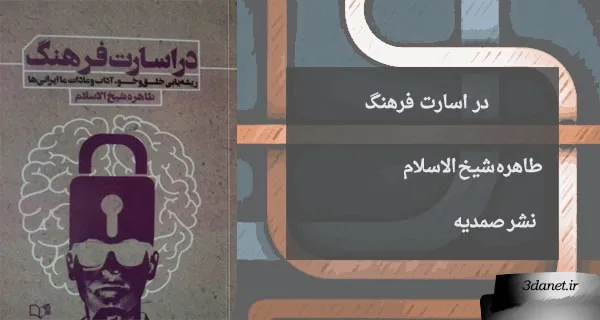
Adapted from the book In the Captivity of Culture, Samadieh Publications, 2014
.
.
Author: Tahereh Sheikholeslam
Contact tarashey@gmail.com
Author's Telegram Channel
.
.





Discussion1 comments
جای شگفتی بسیارست که امروزه آنچنان مُجِدانه و به صورت واجبِ عینی، با هر تصور شخصی به جان اجزای فرهنگ افتاده ایم و حتی آنچه که نبوده و نیست را افترا می بندیم و نامش را هم اصلاحگری و ژرف نگری می گذاریم.