اندیشهفلسفهخردگفتگوحکمتمعناپرسشفرهنگ
Religion
Emadeddin Baghi's essay 'Muharaba and Ifsad'
The verse on muḥāraba prescribes severe punishments, but is every mufsid a muḥārib? Emadeddin Baghi writes that a mufsid per se is not the subject of the ruling, and jurists have stipulated bearing arms as a condition for muḥāraba. The relationship between the two is one of absolute generality and specificity: not every act of 'corruption on earth' warrants execution.
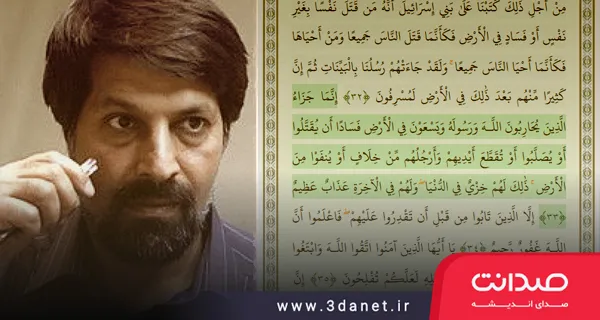
The verse known as the Muharaba and Ifsad verse states: "The punishment of those who wage war against Allah and His Messenger, and strive with might and main for mischief through the land is: execution, or crucifixion, or the cutting off of hands and feet from opposite sides, or exile from the land: that is their disgrace in this world, and a heavy punishment is theirs in the Hereafter" (Al-Ma'idah, verse 33). This verse explains the ruling of execution for the crime of ifsad (corruption on earth), which was introduced in the preceding verse. The important question is: why such severity? Although perhaps in its own temporal context it was a punishment proportionate to the punitive system of the time, a severe punishment has nonetheless been prescribed. Why? This matter will be addressed in the following lines. From the placement of the Muharaba verse immediately after verse 32 of Surah Al-Ma'idah, it is understood that the permissibility of killing a muharib (one who wages war) is because muharaba is an instance of ifsad, and in truth, "ifsad" is the criterion and subject of the ruling.
Muharaba and Ifsad and their Correspondence to Genocide and Crimes against Humanity:
There are two questions regarding the Muharaba verse: first, does ifsad in this verse have a direct bearing on the punishment, or is it merely a pathway to it? That is, is ifsad per se the subject of punishment, or are the specific criminal titles to which it is appended? Second, does a mufsid fi al-ard (corrupter on earth) in all cases carry the ruling of a muharib?
What is understood from the verses, narrations, statutory laws, and reason is that punishments are never established for general and ambiguous titles; rather, punishments must be considered for specific titles of crimes: such as the ruling: "The woman and the man guilty of adultery or fornication,- flog each of them with a hundred stripes" and the ruling: "As to the thief, Male or female, cut off his or her hands."
In all human laws, legislation is of the same nature, and nowhere is it seen that a legislator says a mufsid must be executed; rather, they say a murderer must be punished because they are a mufsid, or a muharib must be punished because they are a mufsid. Therefore, "mufsid fi al-ard" is not itself the subject of the ruling, nor is a mufsid per se, but rather a mufsid qua adulterer, or qua sorcerer, or qua muharib is what becomes the subject of the ruling. In this case, the adulterer, sorcerer, and muharib are the subjects of the ruling. In no instance in jurisprudence is it seen that a mufsid independently becomes the subject of any ruling, and considering that a mufsid cannot in itself be the subject of punishment, there is no need to define it either, because something needs to be defined only if a legal or religious ruling is contingent upon it, and a mufsid is not such.
During the period of the Islamic Republic's governance in Iran, the words muharib and mufsid were often used interchangeably, and what caused this confusion is an incorrect understanding of verse 33 of Surah Al-Ma'idah, based on the notion that two subjects are mentioned in the verse: 1. Muharaba. 2. Ifsad fi al-ard.
If we accept that a mufsid per se can, in terms of applicability, be the subject of a specific punishment, this cannot be the case regarding this particular verse, because it would necessitate that the mention of muharaba be rendered redundant. If the ruling for a "mufsid muharib" and the ruling for an "absolute mufsid" were the same, the qualification of muharaba in the verse would be superfluous. Also, considering the caution the Lawgiver has enjoined regarding blood (lives), such an expansive interpretation cannot be accepted.
For this reason, jurists have also considered bearing arms a condition for the applicability of the title ifsad in this verse. Ayatollah Montazeri stated: In the title "muharib," based on what has been explicitly stated in the narrations of the Ahl al-Bayt (AS) and the fatwas of the jurists, bearing arms is stipulated. He then cites narrations from Imam Baqir and the fatwas of Sheikh Tusi in the book Qutta' al-Tariq, and of Muhaqqiq al-Hilli, Muqaddas Ardabili, Sahib al-Jawahir, and several others in support of this view, and after discussion and reasoning, he states: "The gist of the matter is that verse 32 of Surah Al-Ma'idah does not indicate that every instance of ifsad fi al-ard permits execution" (Montazeri, Answers to Questions...: 512).
The author of Jawahir also interpreted ifsad fi al-ard (corruption on earth) as the taking up of arms, and Ayatollah Khomeini also stated: “A muharib is anyone who takes up arms or prepares them to frighten people and intends ifsad fi al-ard,” meaning that ifsad fi al-ard in the verse is not absolute corruption but rather complements the meaning of muharaba. Those who have not taken up arms but are corrupt are not subject to such a ruling, such as those who acted as lookouts during highway robbery and provided peripheral assistance but were not direct perpetrators. From the statements also cited by others, such as Muhaqqiq in Shara’i‘ and Shahid in Lum‘a, it is well understood that those who collaborate with muharibun but are not armed, yet are corrupt, are not subject to the ruling of a muharib. Therefore, a mufsid (corrupter) does not receive the ruling of a muharib, and the term mufsid is broader than the title muharib.
According to this fatwa, if individuals have committed bombings, only those who carried out the act are instances of this ruling of muharaba, and the ruling for someone who filmed it, gave them shelter, etc., is not the same as theirs.
The relationship between ifsad fi al-ard and muharaba is one of absolute generality and specificity; that is, everything to which muharaba applies, ifsad fi al-ard also applies, but in some cases, ifsad fi al-ard (they strive in the land to cause corruption) applies, yet muharaba does not correspond. Ayatollah Montazeri states: “Regarding whether the relationship between the two titles muharaba and ifsad fi al-ard is one of mutual exclusivity, absolute generality and specificity, or generality and specificity in some respects, and whether each of the two aforementioned titles is an independent subject for the rulings mentioned in the muharaba verse, or whether both titles together constitute a single subject and each is a part of the subject, there are various possibilities and opinions. It may be said: since the relative pronoun ‘alladhina’ (those who) in the clause ‘wa yas‘awna fi al-ardi fasadan’ (and strive in the land to cause corruption) is not repeated, the apparent meaning of the verse is that this clause is a qualifier for the clause ‘yuharibuna Allaha wa rasulahu’ (wage war against God and His Messenger). Therefore, both titles together constitute a single subject for the mentioned rulings, and each is a part of the subject; consequently, the rulings are not for an absolute muharib but for a muharib who is a mufsid. However, it is possible to say: the subject of the rulings mentioned in the noble verse is ‘striving for ifsad fi al-ard.’ This title itself is the complete subject, and muharaba, in the sense that was mentioned, is one of its prominent instances, and its mention in the noble verse is to indicate the occasion of its revelation. In other words, the relationship between the two titles is one of absolute generality and specificity, and muharib is the more specific term. Thus, the meaning of the verse becomes: ‘Indeed, the recompense of those who wage war against God and His Messenger, since they are strivers for ifsad fi al-ard, is that…’” (Montazeri, Answering Questions...: 509).
Two other important qualifications:
Another important discussion, in addition to the existence of the words “mufsid,” “muharib,” and the “conditions for their realization,” is the presence of the two words “yas‘a” (strives) and “fi al-ard” (in the land) in the verse. These points are clear examples of the existence of carefully considered words in the text of the Quran. To understand whether the presence of these words, and even their precedence and succession, is deliberate or not, it suffices to remove one of them from the text and then observe how the meaning of the entire text is transformed.
Yas‘a: meaning to endeavor in carrying out the act of corruption and muharaba. From the word yas‘a, repetition of the act and persistence in it is derived. Ayatollah Montazeri paid attention to this subtle literary point and states: “The root ‘sa‘y’ indicates striving and running to cause corruption, and the form of the imperfect verb indicates insistence and continuity; and such an expression is never customary for recounting the commission of an ordinary sin; rather, it is incorrect” (Montazeri, Answering Religious Questions, 509). Just as we, in defending those accused under the article of “propaganda against the system” in the Islamic Penal Code, argue that continuity is a condition, and committing a criminal act once, although wrong, is not sufficient to prove the crime because it is subject to various possibilities such as lack of intent, being a reaction, negligence, etc. Moreover, the principle is not that we should constantly be striving to discover criminal intent and punish citizens, for in that case, a police and judicial apparatus equal to the entire population would be needed. Therefore, a single commission of an act is not taken as grounds for punishment, and it is passed over with a warning, etc., because persistence and repetition are the criteria for establishing a crime.
Fi al-ard (in the land): In legal scholarship, there is the concept of the "territory of the crime," which pertains to jurisdiction within a geographical area. Another concept can be added, for sometimes committing an act within the "territory of the home" is a crime, sometimes within the territory of a city, sometimes a country, and sometimes the world. An act may be a crime in one city and not in another, and must be adjudicated according to local laws. Here, because the punishment for muharaba is very severe, it states that the territory of the crime must also be extensive. That someone takes up a knife or even a weapon and intimidates a few people (the title of muharaba being applicable with the description of ikhafa and tashhir) is not sufficient for such a heavy punishment; rather, it must be fasadan fi al-ard, meaning its territory must be very vast. If mere ikhafa and tashhir were the criterion, then the stipulation of ifsad fi al-ard would not be necessary, and if frightening a few people were sufficient for the title of muharaba to apply, then fasadan fi al-hayy (corruption in a locality) would suffice, or at most, fasadan fi al-madina (in a city) would be said; therefore, this crime must have a broader scope. Ayatollah Montazeri states: It is clear and evident that in the instances of the aforementioned verses, the issue of using a weapon or ikhafat al-nas was not at hand. The word "fasad" stands in contrast to salah and salamah (rectitude and well-being), and apparently, the meaning of "ifsad fi al-ard" is the performance of any act that disrupts the normal course and the security, moral, or economic well-being of society and causes ruin in its order. Although causing any corruption is a sin and a crime and naturally entails the entitlement to a hadd, ta'zir, or reprimand according to the Sharia (Montazeri, Answers to Religious Questions, 508).
The phrase "wa yas'awna fi al-ardi fasadan" (and they strive in the land to cause corruption) specifies the intended meaning from the phrase "yuharibuna Allaha wa rasulahu" (who wage war against God and His Messenger), which is ifsad fi al-ard through disrupting the security of society and highway robbery, not absolute muharaba with Muslims.
But in the author's opinion, considering the totality of the discussions and the two words yas'a (strives) and fi al-ard (in the land), the reason for the severity of action in the verse becomes clear, and in this respect, muharaba can be mentioned among the crimes listed in the Statute of the International Criminal Court, which encompass the crimes of genocide and crimes against humanity and for which strict measures have been taken; actions that create insecurity in a vast territory. That is, the killing of people through fasad fi al-ard, which is raised in this verse, is the same thing mentioned in the following verse: "Wa la taqtulu al-nafsa allati harrama Allahu illa bi al-haqq, wa man qutila mazluman fa qad ja'alna li-waliyyihi sultanan fa la yusrif fi al-qatli, innahu kana mansura" (And do not kill the soul which God has forbidden, except by right. And whoever is killed unjustly – We have given his heir authority, but let him not exceed limits in [the matter of] taking life. Indeed, he has been supported [by the law]) (Al-Isra, verse 33).
What astonishingly demonstrates the correspondence of the reality of muharaba with the crimes listed in the Statute of the Criminal Court is verse 205 of Surah Al-Baqarah, which raises the discussion of striving for corruption in the land and considers corruption to include the crime of genocide and the destruction of nature: "Wa idha tawalla sa'a fi al-ardi li-yufsida fiha wa yuhlika al-hartha wa al-nasla, wa Allahu la yuhibbu al-fasad" (And when he turns away [from you], he strives in the land to cause corruption therein and to destroy crops and progeny. And God does not love corruption).
Interestingly, international documents consider the crime of muharaba, with the characteristics mentioned, to be more attributable to governments, and then to rebellious, rogue, or terrorist groups, and the aforementioned verse, in the word "tawalla," which means guardianship and governance, points to this same meaning. Thus, if "tawalla" means governance, it refers to the reformist pretensions of the hypocrites before attaining power, and their corruption after reaching governance.
In Tafsir-e Rahnuma, it is stated: "Wa min al-nasi man yu'jibuka ... wa idha tawalla sa'a fi al-ard" (And among the people is he whose speech pleases you... and when he turns away, he strives in the land). Thus, if "idha tawalla" means he turns away, it means that destroying agriculture and committing genocide are among the most prominent types of corruption in the land.
In "li-yufsida fiha wa yuhlika al-hartha wa al-nasl" (to cause corruption therein and to destroy crops and progeny), if the phrase "wa yuhlika al-hartha wa..." is an interpretation of the phrase "li-yufsida fiha," it conveys the value and importance of agriculture and human resources and their role in the stability of society. From the fact that the destruction of these two (crops and progeny) is introduced as corruption in the land, their importance and value are derived.
Destroying agriculture and committing genocide are detested by God (wa idha tawalla ... wa yuhlika al-hartha wa al-nasla wa Allahu la yuhibbu al-fasad). And it is narrated from Imam Sadiq (AS) that: "Inna 'al-hartha' fi hadha al-mawdi', al-din wa 'al-nasla' al-nas" (Indeed, 'al-harth' in this context is religion, and 'al-nasl' is people) (Hashemi Rafsanjani, Tafsir-e Rahnuma, under verse 205 of Surah Al-Baqarah).
Imam Sadiq also understood ḥarth as meaning generation, but since ḥarth lexically means cultivation and agriculture, it can also be a metaphor for nature and the environment; and because agriculture was the foundation of the economic system of that era, destroying and annihilating ḥarth and generation—that is, destroying the economic infrastructure—also ranks as a crime of genocide. This crime is committed primarily by governments, which hold power; if tawallī means governance, then verse 205 of al-Baqara refers to governments, and if it considers the hypocrites, it encompasses both governments and destructive groups. Secondarily, this crime is committed by rebellious, arbitrary individuals and groups, and terrorists, to which verse 33 of Sūrat al-Māʾida, concerning ʿUrayna, refers.
Despite muḥāraba’s correspondence with the crimes set out in the Statute of the International Criminal Court, the punishment prescribed for muḥāraba appears harsh. Such punishments, of course, remained current for centuries after the prophethood of Muhammad in the Christian, Confucian, Eastern, and Semitic worlds within non-religious systems. In the Middle Ages, severe punishments or harsh executions in ways similar to or worse than what appears in the muḥāraba verse were customary and prevalent in Iran, the Arab lands, and the Far East (the yellow race), such as pouring molten lead down the convict’s throat, branding with iron spikes, tearing open the belly and impaling with candles, cutting off the hand, quartering or splitting the body in two with an axe, tearing off the head by tying it to an ox, placing the convict before a cannon’s mouth, and putting them inside a wall—many of these punishments being common in some European countries and Iran until the seventeenth and eighteenth centuries (see: Harsh Execution, 1392, passim, and Tāj Zamān Dānish, illustrations from p. 44 onward). But since religions came to negate violence, one cannot expect them to endorse or prescribe such punishments. For this reason, not only today, when humanism has become the dominant global value and everyone strives to offer a humanistic interpretation of traditions, religions, and rites, but also thirteen centuries ago, at the very dawn of Islam, it has been said that the Prophet abrogated this punishment after the affair of the people of ʿUrayna.
In the following lines we shall also see that even if muḥāraba takes the form of striving and corruption on earth, still, if no killing has occurred, one cannot sentence anyone to death, and other punishments must be prescribed.
In verse 32, after the phrase “whoever kills a soul,” the phrase “or corruption” appears, and after “or corruption” it states, “it is as if he had killed all mankind.” Hence the corruption mentioned here is corruption connected with killing, and it can be said that the particle “aw” in “aw fasādin” (or corruption), by the contextual clue of the two words before and after, is a conjunctive and copulative particle, not a disjunctive one, because after this verse it proceeds to state the ruling on muḥāraba, and before it, it has made clear what kind of muḥāraba warrants such a punishment.
Given these clear Qurʾanic indications, several important points merit attention regarding verse 33 of Sūrat al-Māʾida:
First: According to Shaykh al-Ṭūsī, “All jurists have said that what is meant by this verse is highway robbers—that is, brigands who draw weapons against people and terrorize them on roads, at sea, and in deserts” (al-Mabsūṭ, Kitāb Quṭṭāʿ al-Ṭarīq, cited from Silsilat al-Yanābīʿ, vol. 40, pp. 121–122); and essentially all jurists have placed this discussion in the Book of Highway Robbery. Second: Some Qurʾanic commentators say, under this very verse, that the fact that after mentioning muḥāraba against God and His Messenger it brings “and they strive in the land to cause corruption” makes it understood that what is meant by muḥāraba against God and the Messenger is causing corruption on earth by disrupting public security and highway robbery, not absolute warfare against Muslims. The Messenger of God, with those groups of disbelievers who waged war against the Muslims, after he triumphed over them, did not treat them as muḥāribs—that is, he did not sentence them to death, or crucifixion, or amputation of opposite limbs, or banishment—and this itself is proof that what is meant by the phrase under discussion is not absolute warfare against Muslims (Makārim Shīrāzī, vol. 4, p. 533).
Third: Tafsīr-i Nimūna says that after some individuals killed three of the Messenger of God’s innocent shepherds, the muḥāraba verse was revealed, and the Prophet ordered that their feet be cut off (ibid., p. 542).
Regarding the fact that a muḥārib and an apostate deserving of death is one who has also committed murder, it is stated in Ṣaḥīḥ Muslim, in the chapter “The Ruling on Muḥāribīn and Apostates”: ...Eight men came to the Messenger of God, may God bless him and grant him peace, and pledged allegiance to him upon Islam. They found the land unsuited to them and their bodies fell ill. They complained of that to the Messenger of God, may God bless him and grant him peace, and he said, “Will you not go out with our shepherd among his camels and avail yourselves of their urine and their milk?” They said, “Yes.” So they went out and drank of their urine and their milk and became well. Then they killed the shepherd and drove off the camels. News of that reached the Messenger of God, may God bless him and grant him peace, and he sent after them. They were overtaken and brought back. He gave orders concerning them, and their hands and feet were cut off, their eyes were put out, and they were cast into the sun until they died (Ṣaḥīḥ Muslim, p. 471, ḥadīth 1671).
The story of the death penalty for muḥāraba is that eight men from the ʿUrayna tribe came to the Prophet of Islam, embraced Islam, and pledged allegiance to him. They then complained of the unwholesomeness of the journey they had undertaken and their illness. The Prophet (according to the Arab custom of the time, which prescribed drinking camel’s milk for that illness) said to them, “Would you like to go with our shepherd and drink camel’s milk?” They welcomed this, went out with the shepherd, drank the camel’s milk and urine, and recovered. But afterwards they killed the shepherd, violated him, mutilated him, and harmed the camels. When this horrific and painful news reached the Prophet, he ordered that they be found, their hands and feet cut off, and their eyes put out (the same thing they had done to the innocent shepherd).
Ibn Kathīr, in his commentary on the verse concerning muḥāraba, says: These individuals were from the ʿUrayna tribe in Bahrain. When the news reached the Prophet, he ordered that they be found, their hands and feet cut off, and that they be left in the sun to die. Of course, the narration states “wa sumirat aʿyunuhum,” meaning their eyes were put out, but some have doubted its authenticity (Ibn Kathīr, pp. 528–531).
However, it is stated in two narrations that “The Messenger of God never practiced mutilation before or after, and he forbade mutilation, saying, ‘Do not mutilate anything.’” That is, the Prophet put out their eyes only this one time in retaliation for their putting out the shepherd’s eyes, and he never did so before or after, and he forbade mutilation. For this reason, some have said that mutilation is fundamentally abrogated by this verse: and they claimed that it contains a reproof of the Prophet, as in His saying, “May God pardon you; why did you give them leave?” (Al-Tawba / verse 43) (Ibn Kathīr, p. 531). And some have said that this story occurred after the revelation of the verse, not before it (ibid., p. 532).
Ibn Kathīr also quotes Imam Mālik as saying: This is muḥāraba, and his blood is for the sovereign, not for the guardian of the slain, and his pardon is not considered in carrying out the execution (ibid., p. 532). That is, in muḥāraba, retaliation for the shed blood belongs to the sovereign, not to the avenger of blood; therefore, even if the avenger of blood grants pardon, the ruler can still exact retaliation and is free to choose between execution and pardon.
Another important point is that Ibn Kathīr says, “The majority say this verse was revealed concerning various circumstances... If they kill and take property, they are killed and crucified. If they kill but do not take property, they are killed but not crucified. If they take property but do not kill, their hands and feet are cut off from opposite sides (they are not killed; only one hand and one foot are cut off). And if they terrorize the road but do not take property, they are banished from the land” (pp. 532 and 533). In another narration from the Prophet, it is stated: ...And whoever kills, then kill him; and whoever kills, terrorizes the road, and violates the forbidden private parts, then crucify him (p. 533).
Another important point is that in three of the narrations cited in Ibn Kathīr’s commentary, after recounting the story of the ʿUraynīs coming to the Prophet and the Prophet sending them with the shepherd to drink camel’s milk after they pledged allegiance and said they had fallen ill, it is stated: “They apostatized from Islam, killed the shepherd, drove off the camels, terrorized the road, and violated the forbidden private parts” (pp. 525, 533, and 530).
For this reason, the death sentence for apostasy, based on these narrations, is also related to the crimes committed after apostasy, not to the act of apostasy itself; just as, in the case of someone who apostatizes and commits muharaba, it is said that if they have not committed murder and have only caused terror (ikhafa), they are to be exiled (nafy al-balad), not killed. Fourth: The above explanations show that in the Quran, the death penalty is prescribed only for someone who kills a person, provided that the victim had not committed corruption on earth (fasad fi al-ard) or murder. For this reason, although the verse on muharaba is a title independent of qisas (retaliation), since a number of jurists have made the execution of the death sentence for a muharib conditional upon the actual occurrence of murder, the ruling for the muharib in a sense falls under the heading of qisas, and this general Quranic ruling governs it: "Whoever kills a soul unless for a soul or for corruption [done] in the land – it is as if he had slain mankind entirely" (Al-Ma'idah, verse 32). In the author's view, the conjunction "or" (aw) in this verse is conjunctive (muttasila), not disjunctive (munfasila), and it follows the phrase "kills a soul," especially since it immediately states that this crime is as if "he had slain mankind entirely."
And if someone has committed murder or corruption (highway robbery and terror leading to death) on earth, their punishment is only possible at the hands of a just ruler and after legal procedures have been followed. For this reason, the Quranic verses repeatedly state: do not kill a soul which God has made inviolable, except by right (illa bi al-haqq). The manner of establishing "by right" is determined by other rulings and the custom of each society.
Fifth: Although the execution of a muharib is due to the commission of murder and crime, it has two important differences from qisas (retaliation) that make its application even less likely than qisas. The first difference is that qisas involves three options, whereas the punishment for muharaba involves four options (indeed, five options). That is, the execution of a muharib who has committed murder and engaged extensively in corruption and highway robbery is not a mandatory (ta'yini) matter but is elective (takhyiri), and the execution can be commuted to exile or the individual can even be pardoned. If we add pardon ('afw)—which appears in the Prophet's tradition, narrations, and the words of jurists and exegetes—to the four options stipulated in the verse (execution, crucifixion, amputation, and exile), we are faced with five options in the ruling of muharaba.
The second difference is that qisas is a private right, whereas in muharaba, despite some jurists stating that sentencing a muharib to death is only permissible if, in addition to causing corruption and terror, the muharib's actions have led to the killing of a person—otherwise, the other options among the four, which include exile and pardon, will be utilized—the murder committed is not a private right like qisas; rather, it is a public right at the discretion of the ruler, who can enforce it as they see fit or pardon the muharib. Of course, in international human rights documents, the way is open for life imprisonment for crimes subject to the Statute of the International Criminal Court (which is comparable to muharaba), but pardoning is prohibited. However, from the perspective of Islamic law, the pardon (not the punishment) of a muharib by the ruler is emphasized and recommended, as the author of Dirasat fi Wilayat al-Faqih states:
"It is permissible for the Imam of the Muslims to pardon the army of disbelievers or armed Muslim rebels who fall under the ruling of muharaba, even though they have caused the killing of many Muslims, provided that he has defeated them in war and deems this decision beneficial and effective for Islam and the Islamic Ummah." He adds: "The Messenger of God pardoned the polytheists of Mecca, even though they had killed many Muslims in various battles such as Badr and Uhud, or were complicit in their blood. He even pardoned the killer of his uncle Hamza ibn Abd al-Muttalib without seeking the consent of his daughter or his heirs. Similarly, he forgave Malik ibn 'Awf, who had caused the killing of many Muslims at Hunayn" (Montazeri, Dirasat..., vol. 2, pp. 796-797).
Therefore, since the punishment for muharaba that results in murder is not a private right but a public one, and is not a determinative obligation but an elective one, and the tradition of the Prophet, the juristic reasoning of the jurists, and the opinion of the exegetes favor and emphasize pardon, the non-application of the death penalty, and the non-application of amputation, the Quran itself, as well as the consensus of the jurists and the traditions, have opened the way for disregarding execution in this case. Abolishing the death penalty in this regard by the government not only has no conflict with religion, but is entirely compatible and in agreement with religion and human rights. The only remaining case is the issue of qisas (retaliation) for life, which is considered a flexible, pardonable private right.
.
.
Emadeddin Baghi's essay 'Muharaba and Ifsad'
(Excerpted from the first volume of 'The Right to Life,' published in 2007, a new edition of which will be published soon)
Baghi's Discourses Channel
Website
.
.


Discussion0 comments
No comments yet; let yours be the first voice.