Religion
Islamic Jurisprudence and the Faltering Pace of Religious Intellectuals
Distinguishing between religion, sharia, and jurisprudence, Emadeddin Baghi criticized the rejection of jurisprudence by some religious intellectuals, arguing that it is a subset of sharia and not identical to religion itself. He stressed the necessity of measured critique of jurisprudence and fatwas without causing social discord.
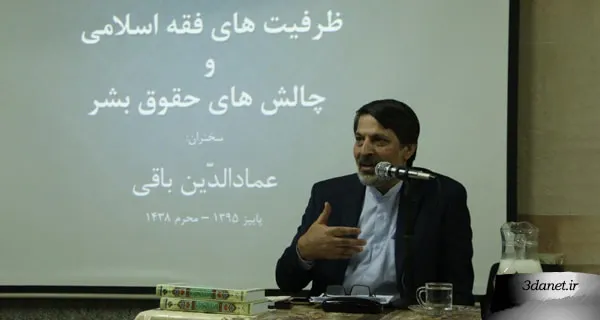
On the occasion of the fourth anniversary of the passing of Professor Ahmad Qabel, a group of students and cultural figures in Shiraz invited Emadeddin Baghi to their gathering. In his speech at this gathering, titled “The Capacities of Islamic Jurisprudence and the Challenge of Human Rights,” he discussed the encounter of Islamic jurisprudence with human rights laws. He defends the discipline of the principles of jurisprudence (usul al-fiqh) and considers it to be a path-opener for new human laws as well. He believes that the science of usul should not be confined to the discipline of jurisprudence, because it has the capacity to be generalized to some other branches of science. In this speech, Emadeddin Baghi also levels criticisms at the deniers and disparagers of Islamic jurisprudence. He points the finger of criticism at some religious intellectuals, without mentioning them by name.
We are marking the anniversary of the passing of the eminent scholar, the late Ahmad Qabel, whose absence will not soon be filled. The choice of this discussion topic befits the concern he held and is a continuation of his path and his work. For years, various approaches—from exaggeration to outright negation—have been put forward regarding jurisprudence. If these attitudes are not examined precisely, they can bring about a cascade of harmful consequences. Past experience shows that, often, due to certain considerations and cautions, some positions and viewpoints have gone uncriticized, only for regret to follow later. It is for this reason that we must try, on certain issues, to set aside dissimulation (taqiyya) and engage in critique. On the other hand, however, there is the concern that power structures will exploit this, and that in society these discussions will induce a sense of fragmentation and discouragement. These matters, of course, compel us to act more judiciously in our critique. The Distinction between Religion and Sharia The basis of my discussion rests on a definition of "religion" and "sharia." The first issue that must be clarified at the outset of this discussion is recognizing the distinction between religion, sharia, and jurisprudence, which in our society many mistakenly use as equivalents. The late Qabel also began his rational sharia by articulating this difference. When we say "religion," this concept encompasses all sharias. For instance, where it is stated in the Quran: "Indeed, the religion in the sight of Allah is Islam" (Aal-e-Imran/19), or where He says: "And whoever desires other than Islam as religion—never will it be accepted from him, and he, in the Hereafter, will be among the losers" (Aal-e-Imran/85), what is meant in these verses is "conceptual Islam," not "terminological Islam." That is, "Islam" in these verses means submission to God. One piece of evidence is that in other verses, including verse 64 of Aal-e-Imran and verse 78 of Surah Al-Hajj, Prophet Abraham is referred to as a Muslim. This shows that the expression "Islam" in the aforementioned verses does not mean terminological Islam; rather, what is meant by it is the creed of submission before God. Therefore, Islam here includes all sharias. Fundamentally, religion has three foundational principles. These three principles are "faith in God," "faith in the Hereafter," and "righteous action." The verses of the Quran have repeatedly mentioned these three principles. For example, the verse: "Indeed, those who believed and those who were Jews or Christians or Sabeans—those who believed in Allah and the Last Day and did righteousness—will have their reward with their Lord" (Al-Baqarah/62), says that all those who have faith in God—whether Jews, Christians, or even star-worshippers—who believe in the Day of Resurrection and perform righteous deeds will be rewarded by God. That is, the followers of all these religions who accept the three main pillars of religion have a reward with God. So, there is only one religion, and that is submission to God and righteous action, but in the Holy Quran, when "sharia" is spoken of, the plural form is sometimes used. There are numerous verses in this regard. As an example: "To each of you We prescribed a sharia and a way" (Al-Ma'idah/48). We appointed for every community a sharia and a method. Thus, "religion" is only one, but "sharia" is multiple. Sharia is something that takes on the color of a people, their culture, regional norms, and the exigencies of the time, and it also has a direct relationship with the level of intellectual and social development. Of course, this discussion has very important consequences. If I may briefly allude to the results of this discussion, as an example, one can say that this discussion bears its fruits in the issue of "apostasy." You see that our jurists over the past centuries have said that apostasy means a person turns away from the religion of Islam and inclines toward another religion. Some have even narrowed its scope to such an extent that they considered turning away from Shiism as an instance of apostasy. But if we have a correct understanding of the intent and meaning of the Quran, the discussion of apostasy in the Quran means apostasy from religion, not apostasy from sharia. Let alone the fact that in no verse of the Quran is a punishment prescribed for apostasy, and only the promise of punishment in the Hereafter is given. Essentially, apostasy means denying those very three foundational principles. On this basis, turning to any of the religions does not cause apostasy. This is one example of the results of separating religion from sharia. The late Ayatollah Montazeri, both in his book "Islam, the Religion of Human Nature" and in his book "Lessons from Nahj al-Balagha," when he comes to the word "shar'" and "sharia," explains that sharia means "a stream that branches off from a great river." This very literal meaning shows that, as the late Qabel put it, religion is like a mighty river from which the sharias branch off.
The subject of our discussion in this session is the capacities of jurisprudence and the challenges of human rights. The first point we must pay attention to is that jurisprudence is considered a subset of Sharia and a part of Sharia. So it can be understood that jurisprudence is not religion itself, but rather expresses the details of practical duties that must be in harmony with the thrust of religion, meaning it cannot contradict the three fundamental principles of religion. The late Ayatollah Montazeri, in one of his discussions, says that jurisprudence is not a sacred fabric that cannot be criticized. Therefore, jurisprudence is not religion itself; a fatwa is also not Sharia itself. A fatwa is the inference of jurists. This inference may correspond with the real ruling or the divine ruling in actuality, and it may not. One of our main discussions is the conflation of fatwa and Sharia, which we must somehow separate from each other. Especially since in the history of jurisprudence, we are faced with the problem of fatwas without evidence. Such fatwas have become very widespread in jurisprudence. Recently, I sent a letter to Ayatollah Makarem Shirazi. It was a detailed letter regarding his recent fatwa on the issue of hijab, and of course, he has also responded, and I hope it will have the chance to be published soon. In this extensive student-like letter, I said that your fatwa, although it has a positive aspect, is problematic in terms of the method of ijtihad. For instance, if someone performs an act and you feel that this is a desecration of Islam and you declare this act permissible or forbidden without stating a reason, this is a fatwa without a basis. A fatwa must necessarily be reasoned and documented. It must be based on the foundation, not on the superstructure. I have also mentioned examples. Absolute denial of jurisprudence is not scientifically acceptable As a result of the numerous intellectual waves that have emerged in the contemporary era, viewpoints have also arisen in denial of jurisprudence. The outcome of some of these viewpoints is that a red line must be drawn through jurisprudence and it must be consigned to the museum of history. This opposition to jurisprudence has been expressed in various tones and forms. For example, Ayatollah Montazeri wrote a text on "conflict." Mr. Soroush responded to this text and said that the new world is a world of new principles, not new branches. Mr. Soroush told the late Montazeri: "These patch-up jobs cure no pain; this jurisprudence and jurisprudential interpretations are like a worn-out garment that, however you try to mend it, tears from another place; this edifice must be overturned from its very foundation and basis." This discussion is an independent topic, and I refer you to the detailed text I wrote at that time entitled "Two Notions in the Balance." This discussion appears in the book "Contemporary Religious Discourses." In Ayatollah Montazeri's book "Socio-Political Philosophy," this discussion is also raised in another form. I have criticized and evaluated this view of Dr. Soroush and have stated to what extent his opinions have a scientific basis. But there are other approaches to confronting jurisprudence as well. Some respected individuals, in their recent writings, argue that the Quran is fundamentally not a jurisprudential book and that no jurisprudential verse and no law can be extracted from it. According to these individuals, we fundamentally have no verse in the Quran that indicates law or rights. Another discussion they have raised is that this existing jurisprudence is a jurisprudence belonging to the past era and is of no use for us today. These esteemed individuals somehow fall into the guise of "religious intellectualism." Of course, I have recently observed that some others among these individuals express displeasure with the title "religious intellectualism." At one time, these esteemed individuals were called "intellectuals," but after a while, "intellectuals" came under criticism, and they said that we are not intellectuals, but rather "religious intellectuals." That is, we are not among those intellectuals who sit in ivory towers, are alienated from society, and do not know its culture and language. Later, when religious intellectualism came under criticism, the term "religious new-thinker" emerged to distinguish its differences from religious intellectualism with this title. Now, for some time, some of those former religious intellectuals have been embarrassed by this religious suffix and avoid being labeled religious intellectuals. In some of their recently published articles, they have said that we are not characterized by any of these tribes. But what is astonishing is that their comments are about religion, religious reform, and the critique of religion. That is, they enter the domain of religion, criticize jurisprudence, criticize the Quran, but they are neither religious intellectuals nor religious new-thinkers. Not only jurisprudence but also the Quran, in some of their recent writings, they have said: the Quran is a book that belongs to the era of ignorance (Jahiliyyah), and the Prophet of Islam came and made some ethical corrections to those very rulings, customs, and traditions of the ignorant Arabs, and these corrections were later compiled and turned into the Quran. In the belief of these individuals, the Quran and the laws mentioned in it are nothing but a reflection of the same rulings and regulations of the Bedouin era, and its commands are ineffective in our time and belong to that same time and era; and for us to organize our own contemporary Iranian life, we must see what human reason says; the pain of modern humanity is human rights, and we must take that as our foundation and criterion. This group of intellectuals goes beyond the sphere of jurisprudence and says that even from the Quran, one cannot derive legal interpretations for today. Elaborating on the details of this view and its scholarly caliber requires another occasion. Here, I will only point out that these statements are made while non-Muslim thinkers, who may not even accept the revelation and prophethood of Muhammad (PBUH), have a different narrative, such as 'Benedikt Koehler,' the prominent Swiss economist, who, in his highly readable research, speaks of the precedence of Medina over Venice and the bourgeois movement of the Hejaz, and traces the roots of the free economy, the growth of capital, and consequently modern civilization and the Industrial Revolution to the teachings of Muhammad (PBUH), and says that this view was expressed before him by two prominent liberal and Marxist thinkers in the 19th century. It can be said that the dominant and characteristic approach of religious intellectualism today is precisely these opinions negating jurisprudence, and some of them have even gone so far as to declare the Quran invalid. But one of the problems with this kind of perception is that they do not apply the same view to jurisprudence that they apply to other human achievements. My main contention with them is methodological. One of the criticisms that can be leveled at these views is that in your encounter with other sciences and texts, you never have such a negating perspective, because all fields of science, especially the humanities, have had many ups and downs. This very 'human rights' has undergone metamorphoses over time. What we recognize today as human rights is not at all comparable to human rights 200 years ago. Fundamentally, the statements of the founders and masters of the Enlightenment era and human rights regarding women's rights, or slavery and the death penalty, are in no way comparable to what we have today. Yet, regarding human rights, you would never adopt such a negating stance because they defended slavery, the death penalty, or the denial of voting rights for women, workers, and the underprivileged. You never say that because human rights in its earlier versions contained such anti-human rulings, we therefore declare it null and void. But you do not apply this same behavior towards jurisprudence. Jurisprudence is also a human product. We do not view jurisprudence as a sacred matter. Jurisprudence must also be refined and critiqued. It is interesting to point out here that this radical and negating view towards the capacities of the Quran and also the capacities of jurisprudence is being raised, and they consider it to belong to an ancient and expired era, while this very civil code that we have today—which, in the words of one writer, can be called a legal masterpiece—was compiled about 90 years ago by a group of mujtahids and jurists. At that time, when the late Ali Akbar Davar was the initiator of this work, he deliberately intended that this law not be a copy of Western civil law. A group of prominent mujtahids such as Sadr al-Ashraf, the late Firouzkouhi, Fatemi Qomi, Nasrollah Taqavi, Assar, and Adl compiled this law. Some of them had studied in Najaf. This civil code has such solidity that it has remained standing for 90 years. After the Islamic Revolution, only some of its articles have undergone amendments. How should a jurisprudence that had the capacity for one of the best civil codes to be deduced from it be disregarded? This is while this civil code was established under a secular government. That is, when Reza Khan came and overthrew the Qajar dynasty and seized power, at that time the civil code was compiled by mujtahids, and this law has still maintained its solidity and durability. This demonstrates the high capacities of jurisprudence. Neglect of the Science of Usul al-Fiqh When we speak of jurisprudence, we cannot fail to speak of 'Usul al-Fiqh' (Principles of Jurisprudence). Because Usul al-Fiqh is a key and a logic for jurisprudence. That is, it is the method of deduction and the foundations of jurisprudential inference. The science of Usul al-Fiqh is one of the special Islamic sciences that has the capability for global presentation.It was 1364 (1985) when I gave a lecture at Arak University—the full text of which was published at the time in Kayhan newspaper—in which I said the flaw in our work is that we have confined the principles of jurisprudence (uṣūl al-fiqh) to jurisprudence, whereas these are principles that can be abstracted and generalized. The topic of expressions (mabḥath al-alfāẓ) is the first discussion in uṣūl al-fiqh. When you enter uṣūl al-fiqh, it is one of the most fascinating discussions. Today our intellectuals raise Wittgenstein’s philosophy of language. It is evident that Wittgenstein, with the achievements of humanity today, has richer views, but the topic of expressions in uṣūl al-fiqh, with its long history, contains some of the very same discussions that Wittgenstein raised and that have received so much attention in today’s world. Fascinating and strategic issues and topics such as “istiṣḥāb” (presumption of continuity), which is expressed by the maxim “lā tanquḍ al-yaqīn bi-l-shakk” (certainty is not invalidated by doubt) or “lā tanquḍ al-yaqīn al-sābiq bi-l-shakk al-lāḥiq” (prior certainty is not invalidated by subsequent doubt); or the discussion of “ʿadam ḥujjīyat al-ẓann” (the non-authoritativeness of conjecture); the discussion of “sīrat al-ʿuqalāʾ” (the conduct of the wise). These are matters that are also useful for modern sciences. The discussion of sīrat al-ʿuqalāʾ is something that is raised in the world today, has affinities with “collective wisdom,” and is referred to by other expressions. This discussion has a thousand-year history in the science of uṣūl. Or the discussion of “real and apparent rulings” (al-aḥkām al-wāqiʿīya wa-l-ẓāhirīya) is very much worth pondering, and we have had this in our own tradition. When Mr. Soroush raised the idea of the theoretical contraction and expansion of the Sharia in 1365 (1986), I wrote a detailed article at that very time criticizing his remarks, which appears in the book Contemporary Religious Discourses. Of course, the theory of contraction and expansion is attributed to Gadamer, although Mr. Soroush has said in his interviews that when I raised the discussion of the theoretical contraction and expansion of the Sharia, I had not read Gadamer at all. This was a question for everyone: how could he not have known him when he was studying in England and Gadamer was one of the prominent professors there and was famous? He said that I did not read Gadamer and it is my own invented idea. In that critical piece, I pointed out that the discussion you are raising, namely the theory of the theoretical contraction and expansion of the Sharia, has a thousand-year-old root. Real rulings and apparent rulings are another formulation of the very same thing you are raising today. Why do we not tie these ideas back to the tradition so that, instead of conformity, we do not provoke all this unnecessary reaction and opposition? We have abandoned our own uṣūl al-fiqh, and when the discussion of the theoretical contraction and expansion of the Sharia is raised, it becomes so fascinating and is presented as an idea that provoked many challenges. Or we have another topic in the science of uṣūl concerning “the dependence of rulings and laws on benefits and harms” (tabaʿīyat al-aḥkām wa-l-qawānīn li-l-maṣāliḥ wa-l-mafāsid). This discussion is also very key and is raised not only in jurisprudence but also as one of the legal principles in the world. The topic of “taʿādul wa tarājīḥ” (balancing and preponderance) in uṣūl al-fiqh, which is about weighing reports and the criteria for preferring some reports over others, or the sciences of “dirāya” and “riwāya” are very rich sciences, but their problem is that they have been confined to the limited sciences of narration or religious narrations. In reality, for several centuries in our intellectual tradition, there has existed a science called “the science of the principles of criticizing historical reports and narrations.” Something that probably has a history of seventy or eighty years in the West, we have benefited from in our thousand-year tradition. These narrations that are sacred to our scholars as “qāla al-Ṣādiq” and “qāla al-Bāqir” are, in fact, historical reports. If you set aside their sanctity, they are exactly like the reports that Achaemenid inscriptions and the histories of “Herodotus,” “Xenophon,” and “Ctesias” recounted in the centuries before Christ. They are like what all other historians have said and say. These are historical reports. These principles that have been used regarding the criticism of the sayings of great figures and historical reports, we have had in our own intellectual tradition, and they have the capacity to be presented as the valuable science of the principles of criticizing historical narratives. The discussion of abrogation (naskh) in uṣūl al-fiqh can serve as one of the most important foundations of modern law. The abrogation of a ruling or the abrogation of a law, which appears in the Quran: “mā nansakh min āya aw nunsihā naʾti bi-khayrin minhā” (Whatever verse We abrogate or cause to be forgotten, We bring one better than it) (al-Baqara/106), means that it says We do not abrogate any ruling or law unless We bring something better than it. This discussion can be a basis for legislation and today’s laws. The discussion of justice is also one of the key discussions of the science of uṣūl. Numerous verses and narrations have been transmitted in this regard, and many narrations say that the foundation of religion is “tawḥīd” (monotheism) and “ʿadāla” (justice). But the justice that has been raised in the Iranian and Islamic intellectual tradition is different from the justice that has been raised in the recent century and after the penetration of Marxist ideas in Iran. در مقاله ای تحت عنوان« شریعت و مشروطیت» در مهرنامه شماره 43 مصادیقی ذکر شده که نشان می دهند عدالتی که در دوره مشروطه در ایران مطرح بود با عدالت پس از آن مشترک لفظی است یعنی لفظ واحد و معنا مختلف است. عدالت در دهههای اخیر به معنای عدالت اجتماعی یعنی مساوات اقتصادی است. عدالتی که مبتنی بر تفکر مهندسی کردن جامعه از بالا است و دولت در همه شئون سیطره دارد. از دل تفکر مهندسی کردن جامعه چه توسط دولتها و چه کارتل ها و تراستها، به قول هایک، فاشیسم و توتالیتاریسم بیرون میآید. خواجه نصیر الدین طوسی ازعلمای اواخر قرن ششم هجری و نیمه اول قرن هفتم در این خصوص ایدههای بسیار جالبی دارد. از جمله اینکه او بحث "عدالت مدنی" و "جور مدنی" را مطرح میکند و این عدالت مدنی در مقابل عدالت اجتماعی مهندسی شده و مساوات اقتصادی مارکسیستی قرار میگیرد. خواجه در بحث عدالت مدنی توضیح میدهد که منظور از عدالت مدنی، "عدالت قضایی" است. این حرف را خواجه نصیر قرن ها پیش مطرح کرده در حالی که امروز وقتی "هایک" این حرف را میزند در دنیا ولوله میکند. هایک دقیقاً میگوید منظور ما از عدالت، یک عدالت حقوقی است نه عدالت اجتماعی. این عین کلام خواجه نصیر است که عدالت مدنی یعنی عدالت قضایی. او میگوید شاهین عدالت، عدالت قضایی است. عدل در میان بسیاری از قدما و متأخران هم به عنوان یک ملاک و مبنا در قانونگذاری مطرح بوده است. علامه طباطبایی در المیزان و مرحوم مطهری پس از بیان اهمیت عدالت می گویند فقها در بیان احکام، این ملاک را مورد توجه قرار نداده اند. آیت الله خمینی هم در کتاب البیع میگوید: عدالت روح اسلام است. اوج کاربرد مفهوم عدالت توسط مطهری با استفاده از مباحث اصولی این است که می گوید: «عدالت مقیاس دین است نه دین مقیاس عدالت» یعنی هر چه عادلانه باشد، دینی است نه اینکه هر چه دینی باشد عادلانه است. این عبارت، شالوده قانونگذاری پیشرفته است و امروز با همین گزاره می توان بسیاری از قوانین جاری در ایران را نقد کرد. یا بحث درباره «مقاصد الشریعه» که در اصول فقه مطرح شده است، یک مبحث مبنایی و راهگشا است. گرچه بعضی سابقه کمتر از 100-150 سال برای آن قایل بوده و کسانی مانند ابن عاشور را مبدع نظریه می دانند اما در فقه شیعه از قرن چهارم به بعد کتابهایی با عنوان "علل الشرایع" داریم و این بحث در سنت ما سابقهای دیرین دارد. این بحث عنوان میکند که هدف از دین و غایت دینداری چیست؟. بحث بسیار مهمی است که اگر به آن توجه میشد، جامعه را از مناسک گرایی نجات میداد. بر همین مبنا من کتاب مفصلی دارم با عنوان "حق حیات". در آنجا نشان دادهام که وقتی شما با دیدگاه مقاصدی وارد فهم قرآن شدید همه چیز را جور دیگری میفهمید. از جمله توضیح دادهام که حکم "قصاص" که ما از آن اعدام را استنباط میکنیم، با یک دیدگاه مقاصدی فهمی از همان آیه به دست میآید که اعدام و کشتن را ممنوع می دارد. با بحث مستقلات عقلیه که از شاهکارهای اصول فقه است، امروزه تحت اصطلاح "عقل عرفی" یا "عقل مستقل از شرع" مطرح است. بحث اصل احتیاط یا اصاله الاشتغال نیز از مباحثی است که سابقه هزار ساله در فقه ما دارد. از 30 – 40 سال پیش، این بحث به عنوان یک نظریه در غرب مطرح و در سازمانهای بین المللی طرح شد. اصل احتیاط در اجلاس ملل متحد ریو در 1992میلادی که با موضوع کره زمین تشکیل شده بود به کار رفت و در مارس 2005 در قانون اساسی فرانسه به عنوان ماده 5 راجع به محیط زیست درج شد. بحث "حجیت عقل" در اصول فقه که مرحوم آیت الله منتظری از آن به عنوان "ام الحجج" یاد میکنند، یعنی بزرگترین حجت ها؛ مادر برهان ها. ایشان اشاره میکردند که اساساً پذیرش اصل دین با عقل است؛ چه برسد به فروع دین. یعنی اگر شما اصل دین را با عقل تان نپذیرید، دیگر به فروع نمیرسید. اساس دین، عقل است. روایات مجعولی مانند «ان دین الله لایصاب بالعقول» هم وجود دارد که برساخته جریانات ضد عقلگرایی است یا تأویل دیگری از آن باید کرد. برخلاف کسانی که این روزها مدعی شده اند قرآن و آموزههای آن متعلق به عرب های عصر حضرت محمد(ص) بوده و دورهاش تمام شده، من میگویم که در همین قرآن، تعداد زیادی اصول حقوقی وجود دارند. اصول حقوقیای که امروز در عصر مدرن جزو مهمترین اصول حقوقی محسوب میشوند. تمام نظام های حقوقی دنیا بر مبنای این اصول استوار شده است. قرآن نیز برای هر کدام از آنها آیات صریح و متعددی دارد. اصل تفسیر به نفع متهم در آیات متعدد از جمله: «جزاء سیئه سیئه مثلها فمن عفی و اصلح فاجره علی الله». اصل پرهیز از تکلیف به ما لایطاق در آیات متعدد مانند:«لایکلف الله نفسا الا وسعها». مسئله جهل به قانون به عنوان رافع تکلیف و رافع مجازات. The principle of presumption of innocence (barāʾa), as a general and fundamental principle, has been the subject of extensive discussion in the Quran and in jurisprudence over the past hundreds of years. The principle of permissibility (aṣālat al-ibāḥa), which jurists have dealt with extensively in theory but, in the words of the late Ahmad Qabel, have become proponents of the principle of prohibition (aṣālat al-ḥaẓr) in practice. The principle of permissibility means that everything is permissible unless the Lawgiver has prohibited it, and the number of such prohibitions is very limited, negligible, and in some cases, their rationale is explicitly stated in the texts (manṣūṣ al-ʿilla), so that when the rationale ceases, the ruling also ceases. The principle of prohibition, however, means that everything is forbidden unless the Lawgiver has permitted it. Islamic jurisprudence advocates the principle of permissibility, but jurists have, in practice, become proponents of the principle of prohibition. The discussion of the rights of God (ḥaqq Allāh) and the rights of people (ḥaqq al-nās), which is one of the foundations of modern law. Civil rights and what falls under the rights of the nation are part of the rights of people and have a long history in our intellectual tradition. The primacy of peace (aṣālat al-ṣulḥ), which is explicitly stated in numerous verses and will have important consequences for international law and international relations. For example, this verse: when you are at war with an aggressor enemy, if they incline to peace, it is obligatory to make peace with them, even if you have the power to continue the war: "And if they incline to peace, then incline to it [as well]" (wa in janaḥū li-l-salmi fa-jnaḥ la-hā). Many other principles exist, and I have contented myself here with mentioning a few examples. Each of these titles has the value and potential for an extensive and fascinating discussion, but here only a list of them is mentioned. The discussion of the confirmatory (imḍāʾī) nature of rulings—some say over 90 percent, and others say the majority of rulings are confirmatory—is another important topic in jurisprudence and legal theory (uṣūl). The late Ayatollah Khoei states that confirmatory rulings are not invented by the Lawgiver; rather, they are customary inventions that people have devised to manage the affairs of their lives, and the Lawgiver has confirmed them. This discussion has important implications and consequences for legislation according to the needs and exigencies of the time. Other important principles in the disciplines of legal theory and jurisprudence, which have been discussed and relied upon and are derived from the Quran, include: "the principle of legality of crime and punishment," the very thing our legal theorists discuss under the title "the repugnance of punishment without declaration" (qubḥ ʿiqāb bi-lā bayān). This principle is based on numerous verses, such as the verse "We would not punish until We had sent a messenger" (mā kunnā muʿadhdhibīna ḥattā nabʿatha rasūlā) (Al-Isra/15). This verse sets forth the rule of the repugnance of punishment without declaration, meaning that until a law is enacted for an act and it is criminalized, that act is not a crime. Or "the principle of personal criminal responsibility," which has numerous verses in the Quran, including the verse "No bearer of burdens will bear the burden of another" (lā taziru wāziratun wizra ukhrā) (Az-Zumar/7), which is repeated several times. Another is "the principle of personal criminal responsibility": "Every soul, for what it has earned, is held in pledge" (kullu nafsin bi-mā kasabat rahīna). This principle is considered one of the fundamental principles of legal science. These are all principles that exist in the legal systems of the world and are also explicitly stated in the Quran. How can one deny these principles and laws in the Quran and condemn it to obsolescence? A Critique of Religious Intellectuals As these esteemed religious intellectuals say about jurisprudence, it is as if jurisprudence is entirely a reflection of pre-Islamic ignorant (Jāhilī) traditions. One of our points is this: "And argue with them in a way that is best" (wa jādilhum bi-llatī hiya aḥsan), meaning that you should accept some premises from your opponent, even if you dispute them, in order to find a basis for dialogue. If we bracket the revelatory and sacred aspect of the Quran, we say: do you at least accept this text as a human text that has been history-making and civilization-building? Basically, look at this text as an ordinary human text, just as you look at the books of Aristotle and Plato. Some of our intellectuals are not even bound by scientific logic. For example, Aristotle in his book "Politics" speaks of the rule of the aristocracy. When Aristotle speaks of democracy, he has in mind the rule of the aristocracy, and not even male and female aristocrats, but only male aristocrats. Plato in "The Republic" speaks of the rule of the "philosopher-king." Yet, despite the fact that these are the core ideas of the aforementioned texts and today are only discussed in the history of thought and have no actual value, you never destroy these works or consign them to the museum of history. Even now, these ancient texts hold a high status and, after more than three thousand years, are the subject of attention, reflection, and dialogue. To crush the merits and strengths of a text because of its flaws is an unscientific and unethical method. If you are bound by scientific logic and consider the Quran at least a human text, is it truly fair, scientific, and ethical to rule that the Quran belongs to primitive, ignorant tribes and has nothing to say to us today? While many of the principles I mentioned have a universal and contemporary aspect.Of course, if these esteemed individuals had studied the literary and social texts of that same Age of Ignorance, they would have a different understanding of that historical period. I say with certainty that they are not even aware of the existence of these texts, and in Iran, I have not yet seen any researcher or writer even allude to these works in a way that indicates they know of their existence. In truth, they have no knowledge of what they are judging. The Unfortunate Dualism of the Sacred and the Profane The conclusion I wish to draw from this discussion is that Islamic Sharia and Islamic jurisprudence are perhaps the only legal system that has not erected a wall between religion and the world, between reason and revelation, and between the sacred and the profane. It presents an intertwined relationship of these. I first raised a discussion in 1998 in the quarterly "Hozour," then in the magazine "Jame'eh No," and subsequently elsewhere, regarding the critique of the customary-sacred dualism, and I have said this is a false dualism that has unfortunately pervaded the entire realm of thought, from politics and sociology to theology. Émile Durkheim, as the founder of sociology and the sociology of religion, defines religion as the sacred in opposition to the profane. This statement became a foundation for sociology, and from this religious-secular dichotomy, secularism emerged and also conquered the political sphere. I have sought to demonstrate that this is a false dualism and have been engaged in expounding and proving it through empirical methods, not subjective and philosophical methods that lead to a balance of evidence. Explaining this discussion requires another time, but with reference to this theory regarding the mentioned dichotomy, I believe that Islamic jurisprudence is the only jurisprudence among all schools and religions that has not drawn this wall and is, in fact, very secular. The jurisprudence that some intellectuals so disparage deals entirely with the worldly and daily life of people. Its nature is completely secular, worldly, and this-worldly. The topics of sale (buying and selling), transactions, trade, earnings, contracts and unilateral obligations, lease, loan, usury, khums, zakat, crop-sharing, irrigation contracts, partnership, deposit, endowment, judgment, agency, will, inheritance, rulings on foods and beverages, marriage and divorce, dowry, breastfeeding, and hundreds of other worldly issues. Jurisprudence Must Be Updated Our problem with jurisprudence is that it has not been updated. That is, jurisprudence suffered a kind of stagnation from a certain period and did not advance further. Because it became stagnant, we reached the point where various flaws are now found in it. If jurisprudence had been updated, many of today's challenges would not exist. From this perspective, I believe the position of Ayatollah Montazeri is very important. He is the first jurist who introduced a series of these new concepts (new in the sense of becoming paradigmatic, not in the sense that they had no precedent in our intellectual tradition), such as the concept of human dignity and human rights, in their paradigmatic sense, into jurisprudence and ijtihad. He established ijtihad based on human dignity. If this had been done in earlier times, we would not be facing the gaps in jurisprudence that we encounter today. Little attention is paid to this important point that what caused Ayatollah Montazeri's divergence during his period of responsibility were these very legal sensitivities rooted in his jurisprudential disposition, which differs from a political and mystical disposition. Instead of burying jurisprudence, it must be refined and updated. The philosophy of ijtihad and the validity of the fatwa of a living, contemporary marja' is precisely this: that jurisprudence, unlike an ideology, is not a set of fixed and immutable rulings but must respond to people's questions in accordance with newly arising issues. To do this, one must recognize modern problems and challenges. In 2005, I published a piece in a special issue titled "The Focal Points of Conflict Between Islam and Human Rights," and it is now being prepared for publication as one of the chapters of a book under the same title. There, it is stated that the major challenges currently existing as focal points of conflict between Islam and human rights can be listed as follows: 1- The death penalty. There is an explicit text in the Quran regarding qisas (retribution), and we must clarify our position on it through ijtihad. 2- Elections and majority rule. Some jurists do not believe in majority rule and have jurisprudential grounds for this view. 3- The right to freedom of changing one's belief. In jurisprudence, there is the issue of apostasy, the content of which contradicts the right to freedom of changing one's belief. 4- Freedom of expression. In jurisprudence, there are red lines for expressing opinion. For example, the discussion of misleading books, which does not conform to the principle of freedom of expression, but if all these issues are reviewed and subjected to ijtihad using a completely intra-religious and intra-jurisprudential method, we will arrive at completely different results. 5- Equality of rights between men and women.It is said that in matters of divorce, inheritance, testimony, guardianship, judgment, and leadership, the rights of women and men are not equal, and all of these are patriarchal in jurisprudence. 6- Slavery. Although it is not a practical issue today, it is said that slavery is recognized in the Quran and in jurisprudence. 7- Children's rights, where human rights treaties conflict with jurisprudential rulings in some instances. I have presented the arguments of traditionalists and secularists on these matters, and have expressed, to the best of my ability, their rejection, acceptance, or a way of reconciling and resolving the issue. These are issues that must be subject to discussion and ijtihad, not a pretext to disparage and deny the achievements of hundreds of years of research and discussion, some of which have global value. No cultured nation does this with its cultural achievements. Some sanctify jurisprudence and deem human rights invalid as a human construct, while others, conversely, negate the sanctity of jurisprudence and merely replace it with human rights, believing in the sanctity of human rights as if this collection was revealed to humanity from the very beginning as a codified and final package, unaware of its course of evolution and development. These two groups share similarities; both substitute one religion for another. We, however, consider both jurisprudence and human rights to be human products, capable of evolution. Intellectuals whose knowledge is lacking in both religious and human rights learning Some say, "For worldly life, we—whether Iranian, Egyptian, or any other people—cannot prescribe a formula as Muslims. We must turn to human rights as the contemporary achievement of humanity. Not, of course, that natural and inherent human rights which has become obsolete, but human rights in its modern sense." When one hears this statement, one realizes that these individuals, with all the respect I hold for them, seem to be lacking in knowledge both in the field of religious learning and in the field of modern learning. This very short statement shows that they also lack sufficient knowledge in the field of human rights, because someone who says and emphasizes, "I mean not that natural, inherent human rights which has become obsolete, but contemporary human rights," reveals an unawareness that from the very Enlightenment era when human rights concepts were introduced, all these discussions were present. Both the theory of natural rights and Bentham's utilitarian theory were discussed; there were those who said human rights are valid because they are inherent and innate, and there were those who opposed them. For example, Jeremy Bentham and after him John Stuart Mill said human rights are valid not because of their inherent nature, but because of their utility for humanity. That it is the only prescription that can save humanity from war and conflict. They established this law as the best prescription and the best way of life. There is no need for us to first consider an inherent nature for it to make it valid. Hume, too, as a defender of human rights, attacked the foundation of the philosophy of natural rights and its methodology, creating a crisis in natural rights. These theories have been discussed for the past 200 years, but if one is not familiar with the history of these ideas, they encounter such errors. Although they appear familiar with modern knowledge, some statements cast doubt on the adequacy of this familiarity. Let alone that this very school of natural rights was the basis of the French Declaration of the Rights of Man and of the Citizen, the American Declaration of Independence, and many international human rights documents. Such statements indicate that what they have done to jurisprudence, they have also done to modern thought. The approach of non-contradiction between Islam and human rights In my opinion, Islamic jurisprudence has the possibility and capacity to reach at least a state of non-contradiction with human rights. In the discussion of religion and human rights, there are several approaches. First is the integrationist approach. Some speak as if human rights are another expression of the religion of Islam, but this is not the case at all. Claiming the identity of religion and human rights is an exaggerated theory. Second is the contradiction approach. Part of this consists of fundamentalist secularists, and another part, fundamentalist traditionalists, who believe in contradiction. Third is the compatibility theory, which tries to reconcile the two. Although my approach resembles the third, if I want to categorize more precisely, I can say it is a fourth approach that seeks to demonstrate non-contradiction. I believe that if we establish non-contradiction, we can pave the way for the advancement of human rights. From this point onward, I speak no longer as someone whose field of study has been Islamic jurisprudence, Islamic studies, and human rights, but as a student of sociology: if someone is concerned with the advancement of human rights and adopts a conflict-based perspective, they have done no service to the advancement of human rights. The result of such views is to stir up and incite public opinion and the religious and traditional community against human rights, making people feel alienated from human rights—making them feel that human rights have come to take away their religion and morality. These approaches create a barrier against human rights and cripple both religion and human rights. But the non-conflict approach facilitates the advancement of human rights. In the Quran and in Islamic jurisprudence, this capacity to demonstrate non-conflict exists, and whether as a Muslim, as an Iranian, or as a believer in human rights, we must make use of these capacities..
.
Audio of Emad al-Din Baghi's lecture titled The Capacities of Islamic Jurisprudence and the Challenge of Human Rights
.
.
Emad al-Din Baghi
First published in the sixth issue of Taqrirat magazine
Important note: The Q&A session was not recorded, and Mr. Baghi has edited the text himself and answered the questions within the text presented here.
.
.




Discussion1 comments
جناب باقی عزیز کاش به خود زحمت می دادید و قدری در باب اندیشه های اصلاحی اقبال لاهوری، غور می کردید. فقه امروز با هیچ چسبی به حقوق بشر و آزادی و کرامت انسانی، جوش نمی خورد مادام که در انسان شناسی و خداشناسی و اخلاق شما تحولی عظیم رخ ندهد. پیشنهاد دیگرم، مطالعه مجدد آثار دکتر سروش هست بدون پیش داوری. موفق باشید