Political Science
Greek Heritage and the Image of Iran in Rubio’s Defense of Western Leadership
In his speech in Athens, Marco Rubio presents the legacy of ancient Greece as a foundation for restoring Western power and leadership. Examining this narrative in light of Greek history and political thought, Hamidreza Saadat-Niaki asks whether a civilizational heritage and values such as freedom and heroism can justify America’s global supremacy and its war policies. The article also examines the image of Iran within this narrative and the need for powers to answer for the consequences of their policies.

حمیدرضا سعادت نیاکی
نویسندهThe Greek Legacy and the Image of Iran in Rubio's Defense of Western Leadership⁕
In a speech delivered in Athens on October 7, 2026, US Secretary of State Marco Rubio presents America as the heir to a civilization whose roots he locates in ancient Greece. He begins with the past, but his speech is about the present condition of the West. In Rubio's view, the West faces a historical test, and to keep its position it must recover the creative spirit and self-confidence that, in his account, moved the Greeks to build their world and defend it. Can an appeal to the Greek legacy justify America's program of increasing its own power? What role does the image of Iran play in Rubio's defense of Western leadership?
Greece in the Political Memory of the West
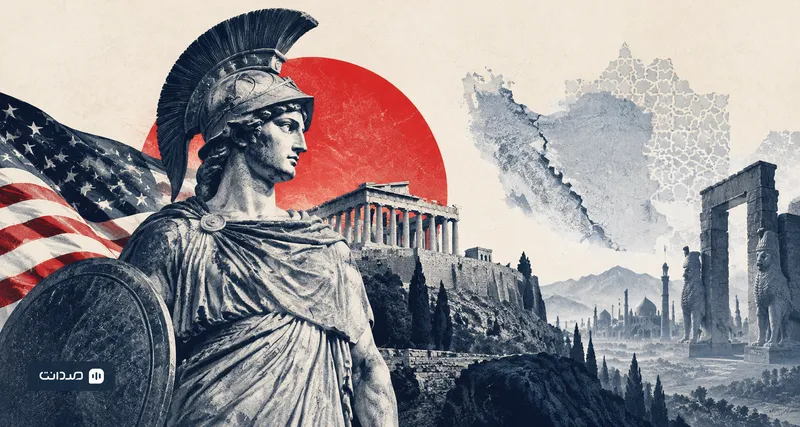
Rubio spoke on the Pnyx hill, where the assembly of Athenian citizens used to gather. The Parthenon was visible behind him.[1] A place like this could call to mind the dispute and decision-making of citizens. Rubio opens his remarks with the story of the Acropolis and draws the listener's attention to a civilization that survived destruction.
He sets the Acropolis apart from the many ruins of the world. In his words, at many such sites history seems to have ended, and all that remains of their culture lies outside living memory. The Acropolis has no such fate, because the civilization that raised it is still alive in the Western imagination of the world and of its own past. Rubio places the ancient Greeks in the shared past of his Western audience.[2]
Greece and Rome have an enduring presence in European political thought and art, and one can speak of a cultural inheritance from them. Such an inheritance is compatible with criticism of the past and does not oblige the heirs to follow everything their predecessors did. Rubio expresses this relationship in the language of descent, calling the descendants of the builders of the Parthenon "the sons of Athens and Rome."[3] At the close, speaking of "the greatest Americans of every generation," he refers to forebears "born in Athens, formed by Rome."[4]
In praising the Greeks' curiosity, Rubio says they "gave us history itself."[5] Herodotus is a fitting example for him in this respect. In the preface to the Histories, he names the preservation of the memory of the great deeds of both Greeks and non-Greeks among the aims of his inquiry.[6] Yet in his work Greece is also a recipient of the achievements of others. Herodotus writes that the Greeks adopted the Phoenician alphabet and gradually changed the shape of its letters. By his account, keeping the Phoenician name for these letters was a way of acknowledging those who had brought them to Greece.[7] For Herodotus, admitting this debt did not diminish the standing of the Greek achievement.
In later centuries, Greek works made their way into other languages. In Abbasid Baghdad, between the eighth and tenth centuries CE, a vast movement arose to translate Greek scientific and philosophical works into Arabic.[8] If the continued intellectual life of these works is the measure of inheritance, then their Arabic readers and translators have a share in this legacy as well.
Participation in the government of Athens was a right of qualified male citizens and did not extend to women, slaves and resident foreigners. The same polity collected tribute from its allies and gradually came to dominate them.[9] To take Athens as a model, one must distinguish between the citizens' right to participate and domination over others.
Xerxes and the Memory of Athens's Defense
At the start of his speech Rubio recalls the attack of Xerxes' army on Athens in 480 BCE. He speaks of the resistance of those who had taken refuge on the Acropolis, whose sanctuaries were finally plundered and burned when the Persian army prevailed. He then describes how the Athenians, on returning, buried the remains of the old Acropolis on the same hill. The report of the Acropolis Museum likewise speaks of damaged statues and offerings being buried in pits.[10] Rubio follows this story with the building of the Parthenon in the age of Pericles. The Parthenon standing behind him is, in this account, the product of reconstruction after destruction. Rubio speaks of the Parthenon's splendor, and by recalling Xerxes' attack he stresses the necessity of defending the Greek heritage.
Rubio begins the story of the war with the arrival of Xerxes' army in Athens and says nothing of the events before it. The Greek cities of Ionia had risen against Achaemenid rule, and Athens and Eretria had helped them by sending ships and troops. In Book Five, Herodotus describes how these forces attacked Sardis. A soldier set a house on fire, and the flames spread to other houses. The sanctuary of the local goddess also burned. According to Herodotus, the Persians later used this very event as a pretext for burning Greek sanctuaries. In Book Seven he also attributes to Xerxes speeches in which revenge on Athens is joined with the wish to expand his realm.[11]
This background does not justify Xerxes' attack, but it shows that the defenders of Athens had earlier intervened militarily in the conflict.
Sympathy with the defenders of Athens lends credibility to Rubio's warning about the future of the West. In the political part of the speech he speaks of keeping the West "at the head of the world" and portrays the alternative as a future of weakness and servitude. He then defends the American government's decision to strengthen national power.[12] A society's loss of global primacy does not necessarily destroy its independence. A society may reach parity with other powers and still safeguard its security and political institutions. Rubio says that rivals grow bolder as the West grows weaker. This warning still does not make clear why the West's independence is possible only if it keeps its place at the head of the world. Nor does the Athenians' right to defend themselves supply a reason for the continuation of Western global primacy.
From Institutions to Character
After recalling Athenian democracy and the philosophy of Plato and Aristotle, Rubio says that the West's debt to Greece runs deeper than these achievements. He regards Greek institutions and ideas as the "outward expressions" of more fundamental traits that showed in the Greeks' life and conduct. In describing this character he stresses their desire to discover the unknown and their effort to outdo others. In his view, it was this spirit that produced Greece's achievements, and the West today needs it to regain its strength.[13]
The survival of political institutions depends on the character and conduct of citizens. But the role of competition and ambition in producing Greek achievements is not a sufficient reason to revive them in today's politics. Ambition can drive a person to strive for power and, once he has it, encourage him to break the limits that law places on that power. In such a situation, preserving a political institution depends on the ability to restrain that very ambition.
Thumos and the Necessity of Judgment
To explain this character, Rubio speaks of "thumos,"[14] which he calls "the fire of passion, energy, courage, and pride." In his words, nations without this force lose the will to fight and to strive for survival. He then rebukes Westerners for having become ashamed of their achievements and no longer thinking themselves worthy of their greatness.[15] He explains the West's present weakness by this shame and links the recovery of strength to the revival of civilizational pride.
In Book Four of the Republic, in examining "thumos," Plato gives the example of a man who believes he has been wronged. His anger gives him the strength to resist and may go as far as killing or being killed, unless reason calms him. Plato regards this part of the soul as the natural ally of reason, unless bad upbringing has corrupted it.[16] The sense of being wronged may spring from a mistaken judgment, since a person can fight with his whole being for something he wrongly takes to be his right. So the intensity of his anger and his readiness for sacrifice do not prove that his judgment is correct.
In politics, too, a sense of humiliation may go together with a mistaken judgment. A society can regard the loss of a privilege as a trampling of its rights and mobilize to take it back. If objection to this demand is treated as disloyalty, strengthening national pride leaves less room for reconsideration. Rubio's call to recover the West's self-confidence faces the question whether that self-confidence leaves any room for admitting error.
In the Nicomachean Ethics, in his discussion of courage, Aristotle mentions people whom anger drives to face danger. He grants anger a role in the conduct of the courageous person, but he does not count fighting to relieve pain or to enjoy revenge as courage. Courage requires choice and a noble end.[17] Readiness to fight and to bear casualties, without examining the aim of the war, is no reason for praise. Rubio calls on the West to maintain its primacy. To judge this call, it must be made clear what good the maintenance of that primacy contains and why human lives should be put at risk for it.
Socrates, the Spartans and Achilles
To explain a sense of duty, Rubio invokes Socrates and the three hundred Spartans, and then comes to the story of Achilles. Socrates is unwilling to give up the pursuit of truth to save his life. The Spartans do not abandon their position, and Achilles prefers staying at Troy and dying in pursuit of undying fame to returning home and living long. Rubio regards these examples as part of the legacy that has shaped the Western idea of heroism.[18]
In the Apology, Socrates shows that fidelity to duty can lead to opposition to the will of one's fellow citizens. He supposes that the Athenians offer to free him on condition that he give up philosophy, and says he will not accept this condition. He declares his affection for them, but puts the god's command first and regards questioning as a duty he will continue as long as he lives. He also reproaches the Athenians for being so intent on wealth and reputation and caring so little for truth and the cultivation of the soul.[19] Socrates regards his questioning as service to Athens, even if his fellow citizens are offended by it. Criticism of civilizational pride can likewise spring from the very love of truth that Rubio admires in Socrates.
The Image of Iran against Western Heroism
After describing the loyalty of Western heroes, Rubio speaks of "Iran's radical mullahs" and their "death cult." In his words, they call child suicide bombers national heroes and treat martyrdom as an end in itself. He presents Western heroes as people who die for their principles and who hold life to be precious. This statement concerns the radical leaders and is not an explicit judgment on all Iranians. Even so, Rubio places it in a discussion of cultural difference and says that the Western conception of heroism is not shared across all cultures.[20] Rubio measures the conduct of the Islamic Republic's leaders against the ideal examples of Western heroism and takes respect for life as the criterion of distinction. The West's own policies must be judged by the same criterion. Belonging to a tradition that praises sacrifice for the sake of life does not, in itself, show that a decision to go to war is right.
In Rubio's speech Xerxes is identified with the destruction of Athens, whereas Alexander is set beside Caesar, Charlemagne and Cortés to show the continuity of conquerors' traits in Western history.[21] Alexander's victories alone are not enough to take him as a model in today's politics. The aim of his conquests must also be defensible. In the story of Xerxes, the suffering of Athens's defenders is before the listener's eyes, but when Alexander is mentioned we hear nothing of the peoples whose lands his army reached, though their defense of their own land should be judged by the same standard applied to the Athenians.
Arrian, the Greek historian, in reporting the burning of the palace at Persepolis, writes that Alexander meant to take revenge for the destruction of Athens and its sanctuaries. Arrian himself regards the decision as ill-considered and does not accept that the Persians of a bygone age were punished by it.[22] The memory of Xerxes' attack explains the motive for revenge but is not enough to justify it. One still has to show why a building that came into Alexander's hands more than a century later was a legitimate target for such revenge.
The Greek Legacy and the Claim to Western Leadership
According to Rubio, the Trump administration has chosen to increase national power and does not apologize for this choice. Rebuilding industry and strengthening the military, together with an effort to win primacy in the technologies of the future, is the administration's practical program.[23]
To defend this choice, Rubio turns to the Greek understanding of politics. In his words, the Greeks recognized the necessity of statecraft and diplomacy and knew that if these paths failed, they must both have the capacity to use force and make their readiness to use it credible. The Trump administration wants to revive such an understanding for "our entire civilization."[24][25] By appealing to ancient Greece, Rubio presents the Trump administration's program as a way of rebuilding Western power.
Rubio also finds a precedent for this return to Greece in American history. He points to the architecture of Washington and the founders' fascination with the ancient world, and recalls the references to Plutarch in The Federalist Papers.[26] These essays were written by Alexander Hamilton, James Madison and John Jay in 1787 and 1788 in defense of ratifying the Constitution. In No. 9, Hamilton speaks of the small republics of Greece and Italy, which were perpetually caught between tyranny and anarchy. In his words, the progress of the science of politics had provided means of reducing the defects of republican government, among them the separation of powers and the representation of the people.[27] Hamilton wanted the new republic to be safe from the defects he had seen in the history of earlier governments.
Daniel Webster, who later became US Secretary of State, was at the time of the speech Rubio cites a Massachusetts representative in the House. On January 19, 1824, he was defending a proposal to fund the dispatch of an agent to Greece. In that speech he pointed to the freedom of debate in the chamber and the columns of the building in which the representatives had gathered as reminders of America's debt to Greece. Rubio quotes this passage and calls on Americans and Europeans to relearn the lessons of their forebears. In the next paragraph Webster explains that he had not proposed sending an agent to Greece to repay America's cultural debt to the ancient Greeks. He then discusses the effect of the politics of the European powers on the independence of nations and explains how the matter bears on America's duty and interests.[28]
Rubio asks Europeans to join America in rebuilding Western power and regards the increase in their defense capacity as a sign of awakening. He allows the defense of national interest "above all else" and presents the aim of alliances as the defense of members' sovereignty.[29] States may unite to secure their interests, but when a European country considers a different program to be in its own interest, its alignment with Washington requires a reason. A shared past does not give America an exclusive right to determine its allies' interests.
The speech was delivered in the context of the US-Iran war. With the Parthenon behind him, Rubio spoke of Xerxes' attack and the destruction of Athens's sanctuaries. Later he spoke of the "death cult" of Iran's present rulers and, at the close, called today's threats as real as those of antiquity.[30] The listener may already have placed the Western side in the position of Athens's defenders before examining the present war.
For an Iranian, opposition to the Islamic Republic creates no obligation to endorse Washington's policy. When his life and security are harmed by a decision, he has the right to ask for an explanation of its necessity. If America justifies its policy by defending freedom and the value of life, it must show how this policy is consistent with those values. The claim to deserve leadership must be tested against such a question. A debt to Greece does not exempt America from answering to the peoples who pay the cost of its policy.
Notes
⁕ Marco Rubio's way of turning to Greece in his October 7 speech in Athens caught my attention. His praise of courage and power brought me back to Plato's and Aristotle's questions about virtue and the end of action. I wrote this essay to examine his account in light of those questions and to address the role that the image of Iran plays in his argument.
[1] U.S. Department of State, “Secretary of State Marco Rubio Remarks,” The Pnyx, Athens, Greece, October 7, 2026.
The text of the speech, titled “In Defense of Western Civilization,” has also been published on the State Department's official account:
https://statedept.substack.com/p/in-defense-of-western-civilization.
On the Pnyx as the meeting place of the assembly of Athenian citizens, see:
University of Sydney, Chau Chak Wing Museum, “The Pnyx,” section “Overview,” https://www.sydney.edu.au/museum/whats-on/exhibitions/impressions-of-greece/the-pnyx.html.
[2] Marco Rubio, “In Defense of Western Civilization,” passage beginning “There are great ruins all across the world,” official transcript, October 7, 2026,
https://statedept.substack.com/p/in-defense-of-western-civilization.
[3] Marco Rubio, “In Defense of Western Civilization,” October 7, 2026, paragraph beginning “For 25 centuries since, the Parthenon has stood,”
https://statedept.substack.com/p/in-defense-of-western-civilization.
Original wording:
“the progeny of the men who built it—the sons of Athens and Rome”
[4] Marco Rubio, “In Defense of Western Civilization,” October 7, 2026, paragraph beginning “The greatest Americans of every generation,”
https://statedept.substack.com/p/in-defense-of-western-civilization.
Original wording:
“born in Athens, formed by Rome”
[5] Marco Rubio, “In Defense of Western Civilization,” October 7, 2026, paragraph beginning “What blossomed here in this place,”
https://statedept.substack.com/p/in-defense-of-western-civilization.
[6] Herodotus, The Histories, proem, trans. George Rawlinson, Internet Classics Archive, https://classics.mit.edu/Herodotus/history.1.i.html.
In the preface to his work, Herodotus names the preservation of the memory of the great deeds of both Greeks and non-Greeks, and the identification of the cause of their conflicts, among the aims of his inquiry.
[7] Herodotus, The Histories, V.58, trans. George Rawlinson, Internet Classics Archive, https://classics.mit.edu/Herodotus/history.5.v.html.
This passage concerns the Greeks' adoption of the Phoenician alphabet, the gradual change in the shape of its letters, and the retention of their Phoenician name. Herodotus regards keeping this name as a way of acknowledging those who had brought the letters to Greece.
[8] On the movement to translate Greek scientific and philosophical works into Arabic in Baghdad in the early Abbasid period, see:
Dimitri Gutas, Greek Thought, Arabic Culture: The Graeco-Arabic Translation Movement in Baghdad and Early ʿAbbāsid Society (2nd–4th/8th–10th Centuries) (London: Routledge, 1998). Introduction, pp. 1–2.
[9] On the tribute of the allies and the expansion of Athenian domination:
Thucydides, History of the Peloponnesian War, I.96–99, trans. Richard Crawley, ToposText, https://topostext.org/work/52
On the conditions for enjoying political rights in Athens:
Aristotle, The Athenian Constitution, 42.1, trans. Sir Frederic G. Kenyon, Internet Classics Archive,
https://classics.mit.edu/Aristotle/athenian_const.2.2.html.
On the exclusion of women, slaves and foreigners from political participation:
University of Sydney, Chau Chak Wing Museum, “The Pnyx,” section “About the exhibit,” https://www.sydney.edu.au/museum/whats-on/exhibitions/impressions-of-greece/the-pnyx.html.
[10] On Rubio's account of the attack on Athens and the rebuilding of the Acropolis:
Marco Rubio, “In Defense of Western Civilization,” October 7, 2026, paragraphs beginning “480 years before Christ” and “They were eventually overwhelmed,”
https://statedept.substack.com/p/in-defense-of-western-civilization.
On Herodotus's report of the capture of the Acropolis and the burning of the sanctuaries:
Herodotus, The Histories, VIII.50–55, trans. George Rawlinson, Internet Classics Archive, https://classics.mit.edu/Herodotus/history.8.viii.html.
On the evidence for the burial of damaged statues and offerings:
Acropolis Museum, “The Dedications,”
https://www.theacropolismuseum.gr/en/archaic-acropolis-gallery/dedications.
The museum's report is evidence for the burial of damaged remains and does not by itself confirm every detail of Rubio's account.
[11] On the help from Athens and Eretria, the attack on Sardis, and the burning of the city and the sanctuary:
Herodotus, The Histories, V.97, 99–102, trans. A. D. Godley, vol. III (1922), LacusCurtius,
https://penelope.uchicago.edu/Thayer/E/Roman/Texts/Herodotus/5d%2A.html.
On revenge and the expansion of the realm in the speeches attributed to Xerxes:
Herodotus, The Histories, VII.8, trans. A. D. Godley, vol. III (1922), LacusCurtius,
https://penelope.uchicago.edu/Thayer/E/Roman/Texts/Herodotus/7a%2A.html.
The speeches attributed to Xerxes here are part of Herodotus's narrative and should not be taken as a verbatim report of conversations at the Achaemenid court.
[12] Marco Rubio, “In Defense of Western Civilization,” October 7, 2026, paragraphs beginning “And now, today, we find ourselves at a crossroads” and “Under President Trump, the United States has made its choice,”
https://statedept.substack.com/p/in-defense-of-western-civilization.
For Rubio's remark that rivals grow bolder as the West weakens, see also the paragraph immediately preceding the section on the crossroads facing the West's future.
[13] Marco Rubio, “In Defense of Western Civilization,” October 7, 2026, passage beginning “Now, much has been written and said” and ending “To know them is to know ourselves,” and the paragraph beginning “Together, we must now rediscover that spirit,”
https://statedept.substack.com/p/in-defense-of-western-civilization.
[14] The Greek form of this word is θυμός. In Latin letters it is usually written thumos or thymos; the published text of the speech has thumos. In Greek texts the word, depending on context, means life, spirit, courage or anger. See the entry θυμός in Liddell, Scott and Jones's Greek-English Lexicon (LSJ), online edition in the Perseus Digital Library:
[15] Marco Rubio, “In Defense of Western Civilization,” October 7, 2026, passage beginning “The thumos, as the ancient Greeks called it” and the following paragraphs beginning “Today, too much of the West has forgotten this quality” and “The word ‘nationalism’ became a dirty word,” https://statedept.substack.com/p/in-defense-of-western-civilization.
[16] Plato, Republic, IV, 440b–d, 441a–442c, trans. Benjamin Jowett, Internet Classics Archive, https://classics.mit.edu/Plato/republic.5.iv.html.
[17] Aristotle, Nicomachean Ethics, III.8, 1116b23–1117a9, trans. W. D. Ross, Internet Classics Archive,
https://classics.mit.edu/Aristotle/nicomachaen.3.iii.html.
[18] Marco Rubio, “In Defense of Western Civilization,” October 7, 2026, section beginning “They believed—fiercely—in the ideal of the great man” and ending with the paragraph beginning “It is from the Greeks that the West inherited its sense of duty,” including the paragraphs on Socrates, the 300 Spartans, and Achilles,
https://statedept.substack.com/p/in-defense-of-western-civilization.
[19] Plato, Apology, 29c–30e, trans. Benjamin Jowett, Internet Classics Archive, https://classics.mit.edu/Plato/apology.html.
[20] Marco Rubio, “In Defense of Western Civilization,” October 7, 2026, three consecutive paragraphs beginning “This is wholly different,” “Our heroes,” and “They are the product,” https://statedept.substack.com/p/in-defense-of-western-civilization.
[21] Marco Rubio, “In Defense of Western Civilization,” October 7, 2026, https://statedept.substack.com/p/in-defense-of-western-civilization.
For the description of Xerxes' attack, see the paragraph beginning “480 years before Christ.” The reference to Alexander, Caesar, Charlemagne and Cortés appears in the paragraph beginning “The hunger for new knowledge.”
[22] Arrian, Anabasis of Alexander, III.18.11–12, trans. E. J. Chinnock (London: Hodder and Stoughton, 1884),
https://en.wikisource.org/wiki/The_Anabasis_of_Alexander/Book_III/Chapter_XVIII.
[23] Marco Rubio, “In Defense of Western Civilization,” October 7, 2026,
https://statedept.substack.com/p/in-defense-of-western-civilization.
See the section on the West's shame about its past and the two paragraphs on the Trump administration's program, beginning “Under President Trump.”
[24] for the whole of our civilization
[25] Marco Rubio, “In Defense of Western Civilization,” October 7, 2026,
https://statedept.substack.com/p/in-defense-of-western-civilization.
See the two paragraphs beginning “Now for all their lofty ideals” and “This is the classical understanding.”
[26] Marco Rubio, “In Defense of Western Civilization,” October 7, 2026.
https://statedept.substack.com/p/in-defense-of-western-civilization.
See the paragraph beginning “The history of America” and the two paragraphs after it on the architecture of Washington, the founders' familiarity with the ancient world, and the reference to Plutarch.
[27] Alexander Hamilton, The Federalist, No. 9, “The Union as a Safeguard Against Domestic Faction and Insurrection” (1787), Avalon Project, Yale Law School.
https://avalon.law.yale.edu/18th_century/fed09.asp.
See the opening paragraphs on the republics of Greece and Italy, and then the discussion of the progress of the science of politics, the distribution of power and the representation of the people. Hamilton presents these devices as ways of preserving the advantages of republican government and reducing its defects.
On the authors, date of publication and purpose of the collection, see:
Library of Congress, “Federalist Papers: Primary Documents in American History,” section “Introduction.”
https://guides.loc.gov/federalist-papers.
[28] Daniel Webster, “The Revolution in Greece,” speech delivered in the U.S. House of Representatives, January 19, 1824, in The Great Speeches and Orations of Daniel Webster, Project Gutenberg, eBook no. 12606.
https://www.gutenberg.org/cache/epub/12606/pg12606.html.
The text of the motion to fund the dispatch of an agent to Greece appears at the beginning of this same section. For Webster's remarks on America's cultural debt to Greece, see the paragraph beginning “This free form of government.” His explanation of the basis of his political proposal begins in the next paragraph, with the words “But I have not introduced this motion.” Webster does not deny the cultural debt to Greece, and says that he has not made his proposal in order to repay an inherited debt to the Greeks of his own day. He goes on to connect the matter to the independence of nations, free government, and America's duty and interests.
On Webster's service as a Massachusetts representative in the House from 1823 to 1827, and his later terms as Secretary of State, see:
U.S. Department of State, Office of the Historian, “Biographies of the Secretaries of State: Daniel Webster (1782–1852).”
https://history.state.gov/departmenthistory/people/webster-daniel.
For the quotation of Webster in Rubio's speech and the call that follows it to Americans and Europeans to relearn the lessons of their forebears, see the closing section of
Marco Rubio, “In Defense of Western Civilization,” October 7, 2026.
https://statedept.substack.com/p/in-defense-of-western-civilization.
[29] Marco Rubio, “In Defense of Western Civilization,” October 7, 2026.
https://statedept.substack.com/p/in-defense-of-western-civilization.
See the section calling on Europe to awaken and increase defense spending, and then the paragraph on the primacy of national interests. “Above all else” is the translation of “above all else” in the original. See also the closing paragraph on rebuilding institutions and alliances, in which Rubio presents their purpose as the defense of the sovereignty of member states.
[30] Marco Rubio, “In Defense of Western Civilization,” October 7, 2026.
https://statedept.substack.com/p/in-defense-of-western-civilization.
For the account of Xerxes' attack, see the paragraph beginning “480 years before Christ”; for the remarks on Iran's leaders, the paragraph beginning “This is wholly different”; for the comparison of the reality of today's threats with those of antiquity, the paragraph beginning “The threats we face today.”





Discussion0 comments
No comments yet; let yours be the first voice.