Political Science
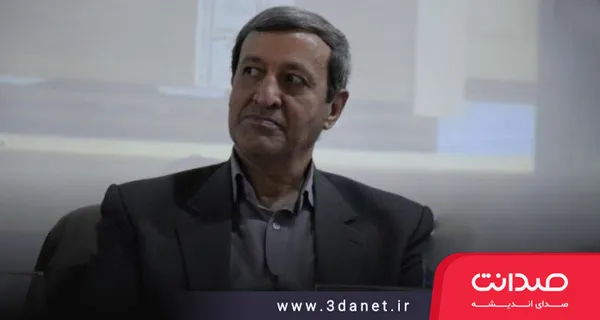
Farshad Momeni at the Session “A Review of Social Justice, Development and Freedom in Contemporary Iran”
At a session reviewing the book Social Justice, Development and Freedom in Iran Today, Farshad Momeni described justice as the key to the system's legitimacy. Critiquing the rentier economy and the elimination of rivals, he argued that the main bottleneck for development is not a lack of resources but the marginalisation of thought.
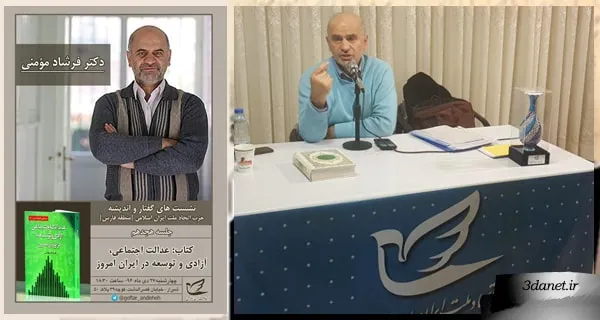
Dr. Farshad Momeni, in a re-reading of the book Social Justice, Development and Freedom in Contemporary Iran, which was held at the Speech and Thought session of the Union of the People Party of Fars region on Wednesday, January 17, 2018, elaborated on his views...
.
.
Audio of Dr. Farshad Momeni's lecture on the introduction of the book "Social Justice, Development and Freedom in Contemporary Iran"
Audio of Dr. Farshad Momeni's lecture on the analysis of the 2018 budget
.
.
Report from the Mobareze website on this lecture:
Dr. Momeni recalled that Martyr Motahhari considered three factors as challenges for a society. The first issue is social justice; he says that in a society where social justice is not addressed, science, reason, and ethics will not flourish. He considers the second to be technology or the issue of the machine, and the third to be the issue of capitalism and the passive, partial approach of jurists towards it, while he believes capitalism is a newly emergent issue. In the fourth decade of the revolution, everyone still believes that the event that should have occurred in society as a result of the revolution has not occurred. For this reason, they say we should Islamize the humanities. If we were to say, you who have all the facilities and power at your disposal, tell us what to do in the university, the ruling establishment still feels it has an epistemological void because it knows what it does not want but does not know what it wants. That epistemological void is resolved by explaining and working on social justice. While justice is among the principles of our religion, if we are asked what social justice is, we cannot provide an answer.
The issue of social justice is directly related to the legitimacy of the Islamic Republic system.
In the fourth decade of the revolution, it is necessary to re-read Michel Foucault's letter to Engineer Bazargan. In that letter, Foucault says that the issue of social justice is of such high importance that revolutions will collapse from the very point at which they are formed.
According to sociological studies, it has been determined that ninety percent of the slogans in the revolution were in opposition to manifestations of injustice, discrimination, and poverty.
Unlike Europe, political injustice in Iran leads to economic injustice. Despotic relations and the unjust distribution of power suffocate the economy and do not allow it to grow.
Iran's economic relations have always been rent-based, but with the expansion of the oil economy, our economy became even more rent-based.
In the Sepanta Niknam case, Mr. Yazdi and the spokesperson for the Guardian Council said they were worried about the domination of non-Muslims over Muslims, whereas if we truly knew what domination means—which in definitions is described as the confrontation of two unbalanced powers—the Guardian Council should be worried about political and economic inequalities, because the Guardian Council itself, by disqualifying candidates, creates the greatest domination through inequality in the distribution of power.
The Majlis Research Center, in October 2013, compared the economic performance of Mahmoud Ahmadinejad's government with that of Seyyed Mohammad Khatami's government. This analysis stated that in Ahmadinejad's government, producing one unit of GDP cost five times as much as in Khatami's government, while at that time the harshest words against America and Israel were being spoken by the government. That is, the Guardian Council's performance in making the ruling establishment monolithic caused unprecedented levels of corruption, inequality, and dependency to occur in Iran.
In the Fifth Plan, for an annual economic growth of eight percent, 16.5 billion dollars in oil currency was needed, but in the Sixth Plan, according to the government spokesperson's interview, two hundred billion dollars in oil currency is required for the same eight percent annual economic growth. This means our most humiliating dependence on the world and the system of domination has taken shape. This institutionalist economist continued: In Iran's political economy, in every period where oil rent has expanded, political conflict based on eliminating rivals has increased. This is while the inequality spoken of in the world is based on production and creativity, and despite that, they say it will lead to conflict, but inequalities in Iran stem from rent.
The study of people's basic goods basket in recent years shows to what extent economic pressures have penetrated the depths of people's lives. In a five-year period during the Ahmadinejad administration, per capita milk consumption, as one of the basic goods, decreased by fifty percent; this means the knife has reached the bone, and in 2014 I said people are enduring poverty with noble forbearance. [It is unclear how long this forbearance will last.]
Dr. Farshad Momeni, referring to his views on the 2018 budget, said:
Last year, when the draft of the Sixth Plan's orientations was published, I studied the privatization of the education system and saw that in the most privatized education system in the world, which is the United States, 48 percent of its educational space is public, but in Iran this figure is 16 percent. I asked there, tell me what is left that you want to privatize?
The rentierization of the state will lead to the rentierization of the nation. Even the criticisms of the 2018 budget are objections to the manner of rent distribution. While matters that would lead to the principle of economic vitality and growth are not addressed at all.
The budget must be the document for operationalizing long-term development goals. We must see how the budget deals with the issues of poverty, inequality, technology, and corruption. We are faced with the estrangement of development thought in Iran. The paradox of developmentalism in a rentier economy has led to a short-sighted approach and the preference of short-term goals over long-term ones. For 50 years, our budgets have been formulated short-sightedly.
Recently, the World Bank published a study. The economic performance of the world's countries in the period from 1965 to 2014 was examined. In this study, it says that in this fifty-year period, the size of Iran's economy grew 6.6 times. But we must examine to what extent this amount is sufficient and meaningful. Numbers must be meaningful; otherwise, the current government has reduced inflation growth by nearly thirty percent, but it is not felt at all. Because we must examine how this reduction and this figure were created and from what source.
Dr. Mosaddegh's national government created extraordinary figures in its economic indicators, but unfortunately, our educational system has not gone to examine with what paradigm this growth occurred, which, if paid attention to, we would understand that some of Dr. Mosaddegh's legacies are more important than the nationalization of oil.
That 6.6-fold growth must be compared with our peers to understand its meaning; for example, India grew 13 times in the same period, Malaysia 20 times, South Korea 34 times, and China 68 times. Now we understand what the numbers mean.
The question is, were we unable to grow as much as we should have due to a lack of resources? Studies say we have by no means lacked resources. Our main bottleneck has been in the realm of thought. The knowledge reserve we applied in economic orientations shows whether our problems are from America or our own performance!
During Mr. Ahmadinejad's administration, they had approved allocating two million tomans' worth of Justice Shares to every Iranian. If we consider this figure for seventy million people, it amounts to one hundred and forty thousand billion tomans in assets. We asked them to provide us with three pages of studies for this measure, which involves the transfer of one hundred and forty thousand billion tomans of government assets. Unfortunately, even those three pages did not exist. Whereas if they had used the four basic arithmetic operations, they would have realized that such a quantity of shares simply does not exist to be offered. These events, unfortunately, occur in the twenty-first century. Later, when they realized this, they reduced the number to forty million and the shares to five hundred thousand tomans! Then we said, bring the list of one hundred profitable state-owned companies; it turned out that the average annual profit of the top one hundred companies is between three and half a percent. If this amount were to be given to each individual according to their share, it would be fifteen thousand tomans a year, which is about one thousand two hundred tomans a month. Is this plan not a mockery of justice? Is justice distributed among the people by receiving one thousand two hundred tomans a month?! These superficial and thoughtless views are not limited to one government; that is why the 2018 budget has also not been sufficiently scrutinized.
If this situation is not stopped, things will get even worse. We will transform from a government that sells raw materials to a government that sells the future, because the government is becoming accustomed to taking out loans to cover its daily affairs. This is far more dangerous than the current situation.
In Iran, advocacy is interpreted as sycophancy; otherwise, the one who shows the right path is essentially helping. The problem here is that in our country, the power of science is less than the power of rent-seeking. Facts in Iran are manipulated in the direction of rent-seeking interests. I am willing to offer a three-credit course in our own faculty called 'The Economic Wonders of Iran' so that you may know that what is presented as the economic realities of Iran is 180 degrees different from what the truth is.
The solution is that we must move towards scientific management. This path took two hundred years in England to achieve development, one hundred years in America, and forty years for recently developed countries, but if we truly want to change, we can implement this change in at least 25 years.
.
.
From the series of Goftar va Andisheh Sessions | 17 January 2018
Bibliography: Social Justice, Development and Freedom in Contemporary Iran
Author: Farshad Momeni / Naghsh va Negar Publications
Shiraz – Qasrodasht Street, Alley 39, No. 50, Office of the Ettehad-e Mellat Party, Fars Region
.
.


Discussion0 comments
No comments yet; let yours be the first voice.