Sociology
Hedayat Alavitabar in an interview with Eghtesad newspaper: Diploma-mill parasites in the university
In Iran, the thesis is more an economic exercise than a scholarly one. In an interview with the newspaper Eghtesad, Hedayat Alavitabar diagnoses the shortage of research resources, obstacles to study trips, and the lax standards that distinguish a graduate from a specialist.

Diploma-mill parasites in the university
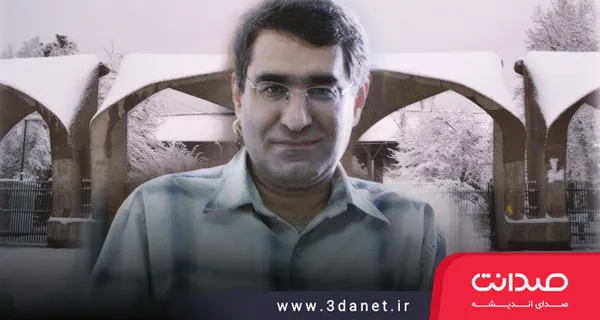
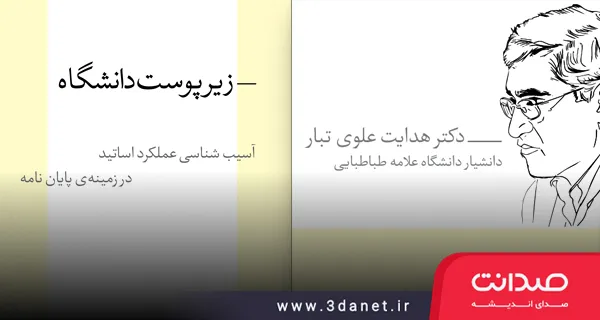
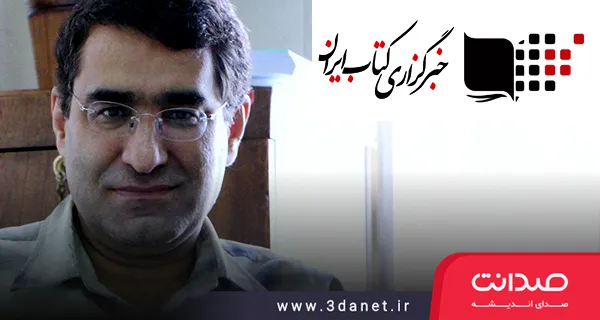
Dr. Hedayat Alavitabar Associate Professor, Department of Philosophy, Allameh Tabataba'i University
Interview with Eghtesad newspaper (2016)
Eghtesad newspaper: The education system is a predetermined process in which many of us, without having any role in it, are cogs that enter its various stages. Planning and policy-making regarding us is done from above, and therefore, most of the time, we do not properly understand our duties and responsibilities within this system and are unaware of the necessity of the actions we perform. This lack of awareness of duties, responsibilities, and the reasons for doing things, alongside structural deficiencies, has caused the education system to be unable to have efficient cogs at its disposal and to achieve the goals it has previously defined for itself. In this conversation, Dr. Hedayat Alavitabar has answered the questions of “Donya-e-Eqtesad” regarding the conditions of thesis or dissertation writing in Iran and has explained the roles, expectations, actions, and existing shortcomings in this regard. Dr. Alavitabar is an associate professor in the Department of Philosophy at Allameh Tabataba'i University and has previously addressed the pathology of professors' performance in the field of thesis writing in an article.
Before we enter into the discussion of pathology, it might be better to ask about the nature of the thesis. Fundamentally, what is the role, status, and importance of thesis writing in the higher education system?
First, I should point out that the “Donya-e-Eqtesad” newspaper's addressing of the thesis topic is entirely appropriate and timely because today, in our country, the thesis is more of an economic activity than a scientific one. But in answer to this question, I must say that a part of our university system is dedicated to education. In this part, professors teach students material in class, but since the university units are limited and these units are also offered in semesters that are limited in terms of time, if a student were to suffice with what is taught in class, they would not gain much. This is why professors give their students research assignments in their classes, and graduate students are required to write a thesis to graduate. Therefore, the purpose of writing a research paper or thesis is for students to become familiar with sources and gradually acquire the ability to infer content from various sources. In this way, they can add to what they have learned in class through research.
What is the expectation usually held of a student within the education system regarding thesis writing, and what facilities does the university provide them with in this regard?
The expectations of the educational system are clear. The educational system desires that the student submit a thesis of acceptable quality. But one must see whether the resources we provide to the student are commensurate with the expectations we have of them. The resources provided to students in Iran are truly limited. These resources amount to using the university library and, through the Ghadir project, the libraries of other universities. Given that most sources for writing a thesis (especially a doctoral thesis) are in foreign languages and many of them are not found in domestic libraries, students face difficulties in this regard. The resources of our universities are not comparable in this respect to those of reputable universities in the world. Those universities have contracts with certain research databases. To write a thesis or any other research, a student first visits one of these databases and searches for their research topic. The database lists all sources on that topic, including books, articles, films, theses, interviews, etc., a list that can be rearranged in various ways based on the student's needs. In the next stage, the student orders whichever sources they need from the university library, and the university is obliged to provide all those sources free of charge. If some of these sources are not available within the country, the university must procure them from abroad. For writing my own doctoral thesis, I went to McGill University in Canada, but that university provided many of the sources I needed from American universities. The interesting point is the speed of procuring sources. Sources within that country are provided to the student within a few days, and sources from abroad within a maximum of two weeks. Such universities are a paradise for any researcher because whatever they need for research is provided to them.
Another resource provided to doctoral students in developed countries is a study trip to another country. In our country, this possibility has been available for doctoral students for many years, but instead of these trips being facilitated as time goes on so that a greater number of students can benefit from them, we are moving in the opposite direction, and in recent years, cumbersome regulations have been enacted in this area. Also, the financial support that reputable universities around the world provide to students, especially at the doctoral level, is far greater than that of our universities.
What is the gap between a graduate of an academic discipline and a specialist, and where does this potential void originate?
If we limit the discussion to the field of humanities, it must be said that most graduates in this field are not specialists in their disciplines. This has various causes, and due to the limited time of this interview, I will only point to one of the most important ones: laxity in the country's educational system. In the past, it was said that our universities are like a funnel, with one end—entry into the university—being narrow and the other end—exit from the university—being wide. Today, due to mass student admissions, this funnel has turned into a cylinder, with both ends wide. In our universities, unlike reputable universities in developed countries, the necessary rigor for a student to become a specialist does not exist. Our work at the university is more akin to "assembly-line production," and we imagine that we must turn a pupil into a student and a student into a graduate as quickly as possible. In developed countries, many of those who enter university cannot complete the difficult path of education, but in our country, a student can learn almost nothing and still graduate. Of course, many students are not unhappy about this because they did not come to university to learn something and become specialists; rather, they came to graduate.
To what extent do you consider the relationship between professor and student in the thesis-writing process to be a function of the effort to develop knowledge?
Students who enter university with scholarly motivation base their choice of thesis advisor on the professor's erudition. One can expect that such theses will contribute to the advancement of knowledge. However, students whose sole aim is to obtain a degree—and unfortunately, it must be acknowledged that they constitute the majority—are drawn to professors who are not strict and with whom the student can easily pass a weak thesis with a high grade. For this reason, the market for lenient professors is hot, and they are busy on the graduate production line.
In your view, is the current state of thesis writing more a result of flawed laws and weak decision-making institutions, or the conduct of academics?
Both factors are influential. I pathologized the performance of professors in the area of theses in an article published around this time last year. Here, I will briefly address some of the incorrect laws:
1- In the past, the total of required teaching, extra teaching, and thesis supervision and advising for each professor per semester was a maximum of 20 hours, but in the previous administration, this amount was increased to 30 hours. If we also account for 9 hours in the summer, it totals 69 hours in a year. This is a significant number and allows a professor to take on the supervision and advising of a large number of theses. This is while thesis examinations are not included in these 69 hours and are accounted for separately. To these, one must add the theses a professor takes on outside their own university. If the university wants theses of desirable quality, it must revert this law to its former state so that professors cannot simultaneously be the supervisor and advisor for a large number of theses. Last year, I read in a university's newsletter that a faculty member of that university had been selected as an exemplary national professor. The newsletter wrote that the said professor, in addition to a large number of books, research projects, and 541 domestic and international scientific-research articles, "has 1,500 instances of student thesis and dissertation supervision in their record." I think these numbers speak for themselves and need no explanation.
2- Recently, retired professors with the rank of full professor have been permitted, in addition to 10 hours of teaching, to take on the same amount of thesis work. Given that this amount of teaching and thesis work is at the level of employed professors and, in some cases, even exceeds it, the question arises: what does retirement mean in this context? Would it not be better, instead of enacting such laws and encouraging retired professors to take on teaching and theses, to allow them to use the remainder of their lives to write their final theories and leave them as a legacy for the current and future generations? As far as I know, in reputable universities around the world, retired professors are not permitted to take on theses.
3- According to current regulations, out of the 20 points for a master's thesis, 1 point is allocated to the article, and the article's point is awarded to the student only if the defense takes place by the fourth semester at the latest. Considering that the student must complete their coursework in the first three semesters, how can we expect them to both write a thesis and an article in the fourth semester? This is an unreasonable expectation, and its result has been that very few students have been able to receive the article's point.
4- Last year, a regulation was passed requiring doctoral students to select their supervisor in the first semester and their dissertation topic in the second semester. There are several flaws with this regulation: Firstly, selecting a supervisor without determining the topic is meaningless, because how can a student specify a supervisor before reaching an agreement with a professor on the subject? Secondly, in the first semester, the student only takes courses with a few professors and likely does not know the professors who are scheduled to teach in subsequent semesters. Therefore, their familiarity with the department's faculty is insufficient for choosing a supervisor, and the likelihood of them changing their mind in later semesters is high. Thirdly, this regulation will cause conflict among professors. Because if the supervisor is chosen in the first semester, the probability of professors teaching in the first semester being selected will be much higher, and professors teaching in later semesters will likely receive no share of doctoral dissertations. I have heard that for this very reason, disputes have arisen among professors in some academic departments over teaching in the first semester, and it can be predicted that if this regulation continues, we will witness more conflicts in the future. Therefore, the lack of effective regulations is one of the factors contributing to the undesirable state of dissertations.
Some time ago, I was speaking with the head of an academic department. In an interesting analogy, he said that just as the country faces phenomena like land-grabbing, mountain-grabbing, and forest-grabbing, in universities we also face a phenomenon called "dissertation-grabbing." The financial motivation of professors on one hand, the deficiencies in regulations and the weakness of supervisory institutions on the second hand, and the credentialism of most students on the third hand have caused some professors to become "dissertation-grabbers."
Discussion0 comments
No comments yet; let yours be the first voice.