Philosophy
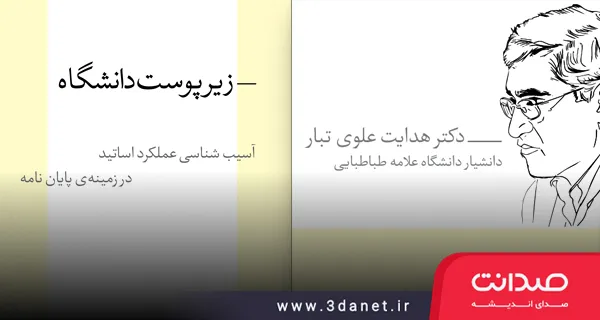
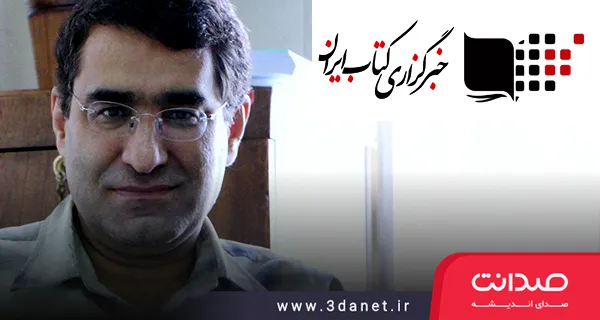
Academic Smuggling: An Interview with Hedayat Alavitabar
Hedayat Alavitabar outlines the pathologies of the university, from the compulsion to publish articles to professors extracting credit from students' work. A shortage of specialists and IranDoc regulations are factors in the decline of theses and academic smuggling.
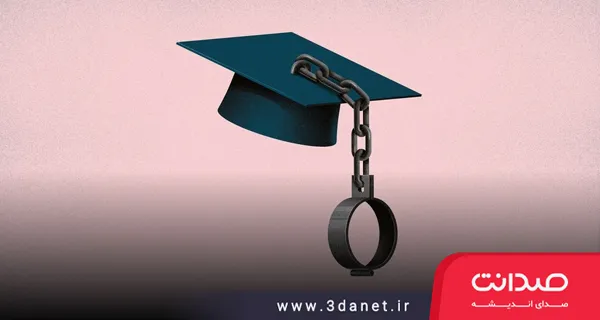
Academic Smuggling
Interview with ILNA News Agency (2019)
ILNA: Following the publication of Seyyed Javad Tabatabai's book Considerations on the University, the debate surrounding the issue of the university and the processes governing it has once again intensified. These discussions have taken place both in terms of questioning the very idea of the university and in terms of criticizing the prevailing trends in the university, fueling a wave of commentary.
Hedayat Alavitabar, a faculty member in the Philosophy Department at Allameh Tabatabai University, addressed some of the unscientific and flawed relations in the research processes of students, the promotion system for faculty members, and the quid pro quos between professors and students in a detailed article a few years ago. Now, after several years, we have approached him again to see whether what he noted in that article is still prevalent or not.
The current process for implementing theses and dissertations faces serious problems. From the sale of dissertations and theses to students who write other people's theses to make a living, and to violations by faculty members that in some cases lead to a division of labor among the defense and examination committee for maximum benefit from the thesis and dissertation process. Do you confirm these shortcomings, and if so, how widespread do you consider the dimensions of these inadequacies to be?
These problems and violations exist, and four years ago, in an article, I explained some of them in detail, including the collusion among professors. Here, I will point out a few other harms concerning theses.
1- Out of the twenty points for a thesis, one point is allocated to the publication of a scientific-research article derived from the thesis. Of course, doctoral students must also publish another scientific-research article as a condition for their defense, in addition to this one. Considering that, on the one hand, the process of publishing an article in such journals is lengthy, and on the other hand, students have a specific deadline for their defense and must pay a penalty if they defend late, the student has no choice but to cobble together some material midway through their work—when the thesis has not yet taken its final form—and submit it to a journal to be placed in the review queue. This diverts the student's time and mind, which should be focused on writing the thesis, from the main task. I have never seen or heard of a student receiving that one point for the article, which indicates there is a serious obstacle in this path. Therefore, the only result of this rule is that students are deprived of receiving a full score for their thesis. Fundamentally, the pressure our universities exert on students and professors to publish as many articles as possible is unjustified. It is true that these articles raise the university's ranking, but it must be noted that excessive pressure, on the one hand, lowers the scientific level of the articles, and on the other hand, may push students toward plagiarism or buying articles, and professors toward plagiarism or co-authored articles.
2- Until 2016, thesis supervision was considered part of professors' educational activities, and on the promotion form, it received points under educational activity. However, after that, it was converted into a research activity and received research points. Given that the student writes the thesis, not the professor, and the professor's role is merely to guide the student, and on the other hand, many theses have no research value and their fate is to gather dust in the library, it is unclear why a professor should be awarded research points for a thesis. Interestingly, the professor receives research points for supervising the thesis and then also earns research points from the co-authored article derived from this same thesis and published jointly with the student. In this way, a professor can obtain the necessary research points for their annual promotion solely based on the work the student has done, without having written a single line themselves! Of course, in calculating points, the criterion is the quantity of works, not their quality, as if the works are placed on a scale and points are awarded after weighing them.
3- Some students lack the necessary academic ability or sufficient time to write a good thesis, and the result of their work is merely ruining the topic. Unfortunately, officials do not pay attention to this issue and assume that if a thesis has already been written on a topic, the next student does not have the right to choose the same topic and must think of a new one. For this reason, before a topic is approved, students are asked to consult IranDoc and, by tracing the topic's history, prove that it is not repetitive. Thus, if a weak student writes a thesis in a subject area, they effectively block the path for subsequent strong students who are interested in the same topic. In such cases, the correct approach is for the academic department to review the previous thesis, and if it determines that it lacks the necessary quality, allow the new student to write a thesis on the same topic.
4- Some academic departments admit students in specializations for which there are not enough specialists within the said department. This creates problems for students not only regarding courses but also concerning theses. Because the student does not have an open hand in choosing a supervisor and advisor and has a limited right of choice. In this situation, the student may be forced to either abandon their topic of interest and take on a thesis in a subject area in which the professor has expertise or at least interest, or keep their topic of interest and undertake a thesis with a professor who has no expertise in that subject area. In the first case, the student proceeds with the thesis with disinterest and only to obtain the degree, and in the second case, during the thesis preparation process, the student teaches the professor more than they learn from them.
If I were to give an example, I must refer to the situation of the philosophy of art in our own department. For years, our department has been admitting students in the philosophy of art specialization not only at the master's level but also at the doctoral level, and this is while there is only one philosophy of art specialist in the department! And the department does not recruit another specialist either. Here the question arises: if among the doctoral graduates of philosophy of art, someone had the knowledge and qualifications to be recruited into the department, why were they not recruited, so that both the department's problem and their employment problem would be solved? And if no one had this qualification, what necessity is there to admit philosophy of art students and deliver underqualified doctors to society? The issue of the shortage of specialists has caused the aforementioned problems for students in this specialization and has also damaged the department's reputation, but no one thinks of a solution, and it seems that the department members have become accustomed to this situation.
Observations and hearsay indicate that some professors make many privileges, including job positions, research opportunities, etc., conditional upon undertaking a dissertation with them. Or they even publish students' authored and translated articles and books under their own name, using pretexts such as reporting on the dissertation process or classwork. Do you fundamentally confirm these instances, even if few?
Some professors, due to their various occupations or excessive teaching loads, are left with no time to engage in scholarly work; others simply lack the literacy for high-level academic work, especially those who entered universities through connections. Such professors, both to secure promotion and advancement and to make a name for themselves in the academic community, are compelled to publish works. Some resort to plagiarism, passing off another person's ready-made work as their own or assembling several works. Since this path carries its own risks and may be exposed, others choose a safer route and use students as academic laborers. Of course, the regulations of the Ministry of Science have also paved the way nicely for them. In the past, a student could publish their article solely under their own name, but some administrators in this ministry, who were likely among the professors who lacked time to write articles due to executive work, enacted the ill-fated 'joint article' rule and forced students to publish their articles with the professor's name. After a while, a note was added to this law, and journals were required to list the professor's name as the corresponding author. In effect, the professor must take responsibility for an article they did not write!
This law was exactly what some professors wanted. Thereafter, the market for joint articles heated up, and the aforementioned professors resorted to every trick to draw students toward them for publishing articles and to exploit the fruits of their labor for their own benefit. Naturally, the more connections a professor had, the freer their hand was in publishing joint articles. After some time, joint articles constituted the majority of articles in scientific-research journals. Of course, a few professors were not inclined to publish joint articles, but the law tied their hands, and if a student wanted to publish an article from their thesis, they had to include the professor's name. The issue is not just articles derived from theses; gradually, it reached a point where some professors forced doctoral students to turn their course research into a joint scientific-research article and made the announcement of grades contingent upon presenting the article's acceptance letter. Perhaps this is why some professors do not announce doctoral course grades even up to a year after the class ends.
It has also been observed that the editor-in-chief of a scientific-research journal published their master's student's course research as a joint article, while the student themselves admitted that their research was not scientifically at a level worthy of being published as an article. In fact, the professor abused the privilege of editorship, although they pretend their goal was to help the student and even act as if they are doing the student a favor. In some cases, a scientific-research article has four or even five authors, and the student includes not only the supervisor's name but also the advisor's name or other professors or even their friends alongside their own, so that everyone may benefit from this feast. Sometimes we see a professor's name on a joint article where there is no connection whatsoever between their expertise or even their knowledge and the subject of the article. Conversely, sometimes a student's name appears on a joint article who has no knowledge in the field of the article's subject, and it is clear that the professor wrote the article but included the student's name alongside their own for a specific purpose! Or a professor publishes an article they wrote themselves jointly with their child to give them morale and credibility.
At present, many professors co-author one or two papers a year and obtain the necessary credits this way, and for this reason they have lost the motivation to write independent articles. Given that the vast majority of co-authored papers are written by students, and in some cases the professor does not even read the article, one can conclude that this situation has practically led to academic stagnation among professors. When a student can write a paper for the professor, why should the professor tire himself out? Years ago, one of the students who had completed his thesis with me and wanted to publish a chapter of it in a journal informed me that the journal would only publish the article if the supervisor's name was also mentioned. A few days later, one of the professors who had learned of the matter and, of course, had played no role in the thesis, called me and said: "I know someone at a journal and can get the article published quickly, but my name must also appear on the article!"
One of the members of the review board said that usually, most of the articles by professors applying for promotion are co-authored. Recently, news came that our own university's review board granted an incentive rank to a professor solely based on his co-authored articles! In this way, students write the articles, but promotions, advancements, and incentives go to the professors. The issue is not just articles; sometimes a thesis that a student has written, and in which the professor had little role, is published as a book under the names of both the student and the professor. Sometimes a professor publishes a book, but the main work was done by a group of students, and the professor merely assembled the results of their work in a mosaic fashion and turned it into a book. All these instances are examples of freeloading and can be termed "academic smuggling," because the professor rides on the student's back and reaches his destination and goal.
To what extent is the recent plan seeking to eliminate the "thesis" from the master's program effective? Will this plan essentially succeed in achieving its goals?
The elimination of the master's thesis has a history. In the past, for a time, alongside regular students who had to complete a thesis, we had education-oriented students who chose from the beginning to take several course units called a seminar instead of a thesis. Unfortunately, due to opposition, the aforementioned plan did not continue. It was said that this opposition had academic motivations, because a student must undertake serious research work to graduate, but a more important motivation was that eliminating some theses meant eliminating part of the professors' income. In my view, eliminating the thesis for all master's students is not right, because some students have the academic ability to write a good thesis and this opportunity should not be taken away from them. However, others do not have this ability and essentially did not come to learn anything; rather, their goal is merely to obtain a degree. These students themselves are not inclined to undertake a thesis, and even if they were, they should not be given such permission, because ultimately they only ruin the topic and make it difficult for good students who want to write a thesis on the same topic in the future. Regarding which student should undertake a thesis and which should not, both the student's opinion and the opinion of the academic department should be considered. The academic department can make a decision on this matter based on the student's GPA or other criteria. Of course, in that case, those who have completed a thesis should have an advantage over those who have not for continuing their studies at the doctoral level, because they were both better students and put in more effort to graduate.
It seems that what is rather unnecessary and should be eliminated is the advisor. Currently, master's theses have one supervisor and one advisor, but the advisor usually does not contribute much to the thesis and, in most cases, merely plays a decorative role in the defense session. On the other hand, the student also usually does not take the advisor seriously and does not consult them. The presence of an advisor alongside the thesis benefits the professor more than the student, because one and a half hours of teaching pay is calculated for them, and thus they profit from the thesis. Doctoral dissertations, in addition to a supervisor, have two advisors and one internal examiner; it would be better if at least one of the advisors were eliminated.
At the doctoral level as well, changes have been made to the thesis approval process in recent years. How do you evaluate these changes?
In the past, the student would write their proposal under the supervision of their supervisor and submit it to the academic department for review and approval. However, for a few years now, eighteen worksheets have been designed, and the student and professor are required to proceed with the thesis work based on them. Although these worksheets have merits in some cases, they have created problems in others, and for this reason, some of their clauses are practically not implemented. I will mention a few instances: 1. In the first worksheet, the student must introduce three professors, and the academic department selects one as the supervisor, but in practice, only one professor is introduced to the department. 2. The first worksheet must be approved by the department by the end of the first semester at the latest, the second by the end of the second semester, and the fourth by the end of the third semester. However, some students are in their third semester and have not yet submitted the first or second worksheet to the department, and some are in their fourth semester and have not approved the fourth worksheet. 3. The first and second worksheets must be approved by the department with a one-semester interval, but in some cases, it is seen that the student submits both worksheets together, and both are approved in a single session. It seems that this regulation needs revision: some worksheets should be merged, and the timeline for their approval should also change. Unfortunately, some officials think that if they make the process lengthy and complicated, they will reap a better product, whereas cumbersome regulations lower the quality of the work.
Do you envision a way out of the chaotic state of theses?
To solve any problem, one must eradicate its root. In my opinion, the corruption existing in the field of theses, whether on the part of students or professors, is largely rooted in economic issues. The university is a part of the country, and the macro-level problems of society affect the university and the performance of students and professors. On the students' side, I must say that we are faced with two groups: those who are studying and those who have graduated. The first group, especially in the humanities, does not have a bright future awaiting them, and most of them cannot find a job related to their specialization even after obtaining a doctoral degree. This very issue can cause them despair and hopelessness and reduce their academic motivation. Some of these students see no reason to spend a lot of time writing a good thesis and prefer to buy a thesis and spend their time on things they consider more important. Others, knowing they will not be able to find a job in their field in the future, secure a job, even a menial one, from their student days and only want the university degree for a salary increase in that job. Due to their work commitments, these students have no time at all to write a thesis, and it is natural that they turn to thesis sellers. The second group consists of unemployed graduates who must somehow earn a living, and since the first group are good customers, they set about writing and selling theses. As long as the society's economic problems are not resolved, one cannot expect the thesis buying and selling market to be dismantled. However, as a temporary solution, the best way is serious supervision by the professor over the thesis writing process. If the professor holds regular meetings with the student and engages them in discussion about the topic, they will certainly realize whether the student is writing the thesis or someone else is writing it.
On the professors’ side, the economic factor is also the root of the problem. A professor who accepts a large number of theses and, in some cases, supervises or advises more than twenty theses just at the university where they serve, is not doing this for God’s sake or the advancement of science and knowledge; rather, financial gain is their aim. It is clear that such a professor cannot devote sufficient time to each thesis. These professors usually teach more than other professors, and because they do not have enough time to write articles, they have more co-authored articles than other professors. The interesting thing is that most of these professors are not among the newly hired ones who do not have high salaries, but are experienced professors with high salaries! A few years ago, I asked the head of one of the academic departments: “Why do you take on so many students?” They replied: “We have to take on many students to have many theses, because the children of most of the professors in our department have reached marriageable age, and the professors need money to settle their children!” I, who thought the goal of writing a thesis should be the scientific advancement of the country, realized that the main goal, at least in some academic departments, is something else.
Regarding professors, the solution is to set a cap on the number of theses a professor can supervise, advise, and examine. This has been done in some departments, but it seems that, firstly, the cap should be lowered, and secondly, all departments must observe the cap. Of course, I have heard that universities, following the University of Tehran, plan to eliminate extra teaching and thesis supervision fees and instead pay professors a monthly performance-based sum. At present, one cannot judge this plan; we must wait and see in practice whether it can reduce some professors’ thirst for extra teaching and taking on theses or not.
Shouldn’t an independent body be formed to verify the theses and dissertations of students, as well as the articles and books of professors?
Regarding theses, the first authorities are the supervisor and advisor, and they must properly evaluate the thesis in exchange for the money they receive. In the final stage, an examiner joins them, and as the name suggests, their duty is to examine and evaluate the thesis. The problem is that these individuals sometimes do not perform their duty correctly. My opinion is that the thesis examiner should be anonymous, like the reviewer of a scientific-research article; that is, the names of the student, supervisor, and advisor should not be disclosed to the examiner, nor the examiner’s name to the student, supervisor, and advisor. In this case, the examiner can do their work with complete freedom. Of course, if they approve the thesis overall, they will attend the defense session and give their opinion on the details, but if they reject it, their name remains confidential.
The existence of an organization for evaluating scholarly works has its own problems. A private organization would not undertake such a task because it would not generate income from it. A government organization is also subject to the cultural approach of the incumbent government and cannot be expected to act impartially. The best way is to entrust the critique and evaluation of scholarly works to the scholarly community. People of the pen should evaluate each other’s works, and if this is done widely, a work that has merit will gradually establish itself. The obstacle in this path is that critique has not yet taken root in our scholarly community, and some consider finding fault with others’ works to be an unseemly act. If the culture of critique spreads and, as a result, every work is properly evaluated, good work will be separated from bad, and no one will be able to gain false fame for themselves by mass-producing low-quality works, conceal their meager knowledge with the pages of their numerous works, and set up a buy-and-sell racket in the world of science.

Discussion2 comments
با هیچکدام از راه حلهای ایشان مشکلات دانشگاههای ایران حل نخواهد شد. بهترین روش جلوگیری از سرازیری پول به دانشگاه است. راه و روش کشورهای پیشرفته را در پیش بگیرید. هر کسی با توجه به کاری که قبلا کرده است گرنت دریافت کند فاندها رقابتی باشند. و پروژه ها نسبت به تاثیرگذاریشان پول دریافت کنند. واریز پول نفت به طور مستقیم به هرجایی موجب فساد است.
درود در دنیا وضع پژوهش چگونه است؟