Religion
Hossein Souzanchi's Critique of the Book “Hijab in the Time of the Prophet”
Hossein Souzanchi critiques the book Hijab in the Age of the Prophet, challenging its claim that covering the torso and arms was sufficient by drawing on Quranic verses and hadiths, and examines the transformation of Arab culture during the prophetic era.
We Muslims, both Shia and Sunni, although we have differences of opinion on some legal rulings (such as ablution), the teachings that have reached us through verses and traditions have left no doubt for us that the religiously required hijab for a Muslim woman is covering the entire body except for her face and hands (up to the wrists); and this matter has been so clear that today, not only among Muslims, but throughout the world, wearing this hijab is considered a sign for identifying a Muslim woman, to the extent that across the globe, governments that are not on good terms with Islam do not tolerate this style of dress in their schools and offices, because it is a sign of a woman's Muslim identity; that is, this hijab, in addition to helping preserve the moral fabric of society, today plays the role of a flag to display the identity of a Muslim woman.
The esteemed author of the book “Hijab in the Time of the Prophet (PBUH)” has sought to challenge this perception of the Muslim woman's hijab, and his hypothesis is that the religiously required hijab at that time was not to this extent, but rather something on the level of covering the torso, thighs, and arms, and that Islam does not insist on a woman covering herself in front of non-mahram men.
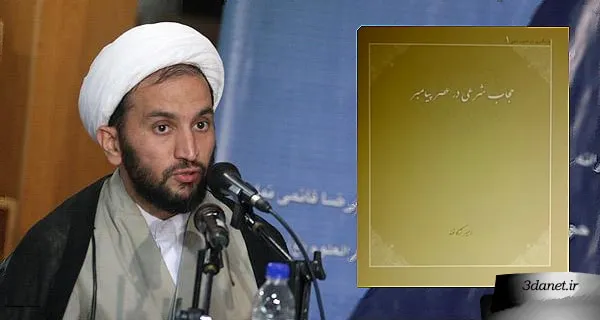
The book “Hijab in the Time of the Prophet” is a work of about 1,000 pages by Mr. Amir Torkashvand, which, as mentioned on its index page, was apparently completed in 2010, and with revisions, was published online in 2011. This book gradually spread among non-specialists and came to be regarded among a specific segment of society as an important document against the religiously required hijab; this very matter became a motivation for writing an article to examine its degree of credibility. Although the attached article is primarily written as a critique of the book “Hijab in the Time of the Prophet,” with a secondary look at the analyses conducted using verses and traditions, the reader can become familiar with the Quranic and traditional citations and implications of the hijab discussion.
.
In the Name of God, the Most Gracious, the Most Merciful
Hijab in Verses and Traditions
A Critique of the Book “Hijab in the Time of the Prophet”[۱]
Hossein Souzanchi
Introduction
The book “Hijab in the Time of the Prophet” is a work of about 1,000 pages by Mr. Amir Torkashvand, which, as mentioned on its index page, was apparently completed in 2010, and with revisions, was published online in 2011. Although the esteemed author stated on the book's index page that:
“This book has been presented solely for the use and examination of you, the religious researcher![۲] Refrain from reflecting the book's contents and publishing news about it, except in research books and dissertations.”
But gradually, this book spread among non-specialists and came to be regarded among a specific segment of society as an important document against the religiously required hijab; this very matter became a motivation for writing an article to examine its degree of credibility.
The esteemed author says about his goal:
“The entire effort of the book is precisely to initially show which parts of their bodies people covered with garments and clothing, and which parts were bare and unclothed, in the pre-prophetic era, in order to finally obtain the reaction of the Islamic society, headed by the Quran, towards it.” (Hijab in the Time of the Prophet, p. 4)
For this purpose, in the first part of the book, he goes into the state of dress in the Age of Ignorance; and in the second part, he examines the Quran's perspective, and after opposing conventional interpretations of some verses of the Holy Quran, he expresses his conclusion as follows:
«From the explicit statements, allusions, and between the lines of the verses, I extracted the following three objectives (as the Quran's purpose for observing hijab and covering). First: protection from heat and cold. Second: complementing the beauty of creation. Third: sexual safeguarding, and declaring abstinence from pollution. The third objective can indicate that the covering requested by the Quran was not an end in itself, but rather, firstly, aimed at controlling the lustful men of that land, and secondly, so that believing women (who had the experience of living in the pollution-ridden era of Jahiliyyah) could, by improving their hijab, practically declare that they had distanced themselves from corruption.» (p. 16)
In the third section, the author turns to the opinions of jurists regarding hijab, and although he acknowledges that the well-known view of jurists regarding a woman's religiously mandated hijab is «covering all body parts except the face and hands,» he considers this opinion incorrect. In his view, the necessary extent of a woman's hijab is «covering the torso, thighs, and upper arms,» and he attempts to provide evidence for this claim from the statements of some jurists of the tenth and eleventh centuries. Of course, in this context, he states that the fatwa of one of the jurists of the fourth century was that the necessary religious hijab for a woman was limited to covering the private parts!
The question of the present article is whether the author's reasons have the power to prove the aforementioned interpretations of the verses and narrations, and whether the necessary precision has been exercised in examining and reporting the opinions of the jurists? In other words, in the book's introduction, he has requested that:
«When studying, one must empty the mind of the characteristics of contemporary hijab, due to its significant difference from the hijab of the Prophet's (PBUH) era, so that the difficulty of believing unfamiliar content may be somewhat reduced.» (p. 19)
But will his expectation be limited to just this, that we empty our minds of presuppositions, or does he expect that to accept his view, we should also disregard valid research methods in the fields of linguistics and historical studies?
The undeniable reality, the principle of which everyone accepts (and which he tries to portray very prominently in 270 pages), is that in the era of Jahiliyyah and before the advent of Islam, there existed a degenerate situation regarding covering and sexual relations. However, the esteemed author's presupposition is that «it is impossible that the Holy Prophet (PBUH) could have gradually reformed this situation during the 23 years of his prophethood.» The question is whether a Prophet who, with divine grace, was able to elevate the illiterate and uncultured society of that time within a short period to a point where it not only considered the pursuit of knowledge among the highest values but also became the greatest civilization of its time, could also have brought about a significant change in the covering situation of that society or not?
Relying on the aforementioned presupposition, the author seeks to prove this hypothesis[3] that Islam had no concern for such a reform and that its recommendations regarding the hijab of men and women were mostly limited to covering the private parts, upon which it often did not insist much; and if it proposed this level of covering, or at most, a covering of the torso, thighs, and arms for women, its concern was solely to prevent the occurrence of free sexual relations, not any point regarding chastity, modesty, and so on. In other words, the summary of their view is that, from an Islamic perspective, there is no reason for women to have a covering beyond the private parts (or at most the torso, thighs, and arms); and in Arab culture, such a covering was not valued, and Arab culture was such that changing it within a period of 23 years by the Prophet (PBUH) is impossible. In the author's view, one of the main roots of today's perception of hijab is the actions of the Second Caliph (pp. 877-886), who took over the government shortly after the passing of the Prophet (PBUH). Of course, a question that is never addressed is why the Second Caliph – who, based on the author's foundations, whether Islamically or in terms of Arab prejudices, had no motive for this – insisted on this matter to such an extent and was able to realize in society, five years later, something that, in the author's view, was impossible for the Prophet of God (PBUH) to do in 23 years? And how is it possible that in this grand conspiracy, the wives and companions of the Prophet (PBUH), and later all the narrators, hadith scholars, and jurists, would go along with him and, in their terms, collaborate in fabricating hadiths and issuing false fatwas, and no one, not even Imam Ali (AS) and the rest of the Pure Imams (AS), would not only make the slightest objection, but they too would go along with this current?!
In any case, when one is faced with such a picture, one expects credible historical evidence to be presented for it; and the aim of the present article is to examine their evidence. For this purpose, in the first chapter, some of the hypotheses that form the basis of their grand theory will be pointed out in detail, and the arguments for these hypotheses will be evaluated; and in the next chapter, their main theory, which is also their most controversial statement (namely, that: the majority of jurists have erred and been excessive in understanding the religiously prescribed hijab) will be examined in greater detail. Meanwhile, for ease of study, more specialized discussions and citations are mentioned in the footnotes. But before entering the discussion, it is appropriate to point out three points:
1) The necessity of avoiding insults, profanity, and vulgar expressions in scholarly discussions: Unfortunately, the respected author, in cases where they disagree with an opinion, uses all kinds of insulting expressions about the holders of that opinion and also uses many vulgar words in their text that are not suitable for a research text, and if, in the continuation of the article, due to direct quotation, we are forced to bring some of them, we apologize to the respected readers in advance. Of course, there are cases where the author, although using vulgar expressions, but considering the status of the person in question [for example, the Holy Prophet, may God bless him and his family and grant them peace],[4] it is unlikely that they intended to insult; however, their manner of expression is such that if the reader does not consider it an insult, they at least feel a sense of unfairness.
2) Avoiding unnecessary discussions: One of the reasons that has caused the book to become excessively long and detailed is that the author sometimes elaborates on a matter that no one cites in the discussion of religiously prescribed hijab; but they discuss it in such a way as if this matter were one of the important reasons for the discussion of religiously prescribed hijab, and by refuting its implication, it is as if one of the important proofs for the conventional religiously prescribed hijab has been refuted. For example, one of the deviations of the Age of Ignorance was that some polytheists would circumambulate the Kaaba with naked bodies, and in some verses of the Holy Quran, this behavior is condemned. Although it is clear that these verses have nothing to do with the discussion of the religiously prescribed hijab of Muslims, and no jurist has used these verses in the discussion of women's hijab; the author has devoted lengthy discussions to it just to prove that the limit of obligatory covering for women cannot be determined from these verses! Such discussions will not be addressed in the present article.
3) Inaccuracy in translating material: Naturally, the vast majority of the texts examined in the matter under discussion are Arabic texts; and the first requirement for such research is adequate familiarity with the Arabic language. In numerous instances, it appears that the author's analysis stems from errors in translating phrases, and at times these errors have led to the attribution of insulting or obscene statements about certain great Islamic figures, such as Hazrat Zahra (peace be upon her)[5] or some of the esteemed wives of the Holy Prophet (PBUH)[6].
A. Examples of the Hypotheses and Arguments in the Book
As mentioned, in this chapter some of the author's most important hypotheses about the historical situation of that time and the meaning of the verses and narrations will be examined, and the discussion of the jurists' opinions will follow in the next chapter. In each case, their hypothesis is first briefly reported, then the validity and strength of the arguments are evaluated:
1. The phrase in verse 31 of Surah An-Nur: "وَلْیضْرِبْنَ بِخُمُرِهِنَّ عَلَى جُیوبِهِنَّ" [they should draw their veils over their bosoms], does not indicate covering the head and neck; rather, what is meant is that women should cover the clefts of their bodies with a piece of cloth, i.e., the intended meaning of the verse is covering the cleft of the private parts (and perhaps, in addition, the cleft between the breasts). Of course, as a third possibility, it might mean covering the openings of the garment (through which women's private parts would become visible). The reason for this translation is that, firstly, the word "khimar" does not denote a headscarf, but can be any kind of clothing (especially a loincloth used to cover the lower body), and secondly, "jayb" does not mean "bosom/collar," but rather any kind of cleft or opening; and the clothing of that time was completely unstitched, and from the opening of the single piece of cloth that women used to cover their private parts, the private parts were sometimes visible; therefore, the verse asks women to cover the clefts of the body (the private parts, and possibly between the breasts) or the openings of their garments that reveal the private parts, with a piece of cloth. (pp. 562-581)
Critique and Review
Regarding whether there is convincing evidence that the general clothing of that time was "unstitched" or not, this will be discussed in the following paragraphs; but their main argument for rejecting the meaning of this verse (which all commentators have translated in the manner mentioned in the brackets) is new translations of the two words "khimar" and "jayb." Specialized books that discuss Arabic and Quranic vocabulary have all explicitly stated that the word "khimar" meant "a covering with which a woman covers her head,"[7] which is translated into Persian as "rusari" (headscarf); and regarding "jayb," they have all considered it to mean "the collar/opening of a shirt" and have explained that although the root of this word goes back to "splitting and cutting," as the word "jayb," it is only used in the case of "qamis" (=shirt).[8] In the Holy Quran, it has also always been used in this sense; as in the story of Prophet Moses, he is told to "put your hand into your 'jayb' (=collar/opening of your shirt), and when you take it out, it will be shining." (Surah An-Naml, verse 12; Surah Al-Qasas, verse 32). But what is the author's reason?
Regarding the word "khimar," from the beginning of the book, they repeatedly and without any evidence, state that according to some jurists, "khimar" in the narrations means "loincloth" and is used for covering the lower body (e.g., p. 41). When they come to the word "khimar" in the discussion surrounding the relevant verse, as one of the topics to be discussed in the following pages, they repeat their claim as follows:
Many consider it a headscarf and head-covering, some others consider it equivalent to a rida' (which is for covering the upper half), and from the content of some narrations, it can also be considered equivalent to an izar and loincloth (which is for covering the lower body), but perhaps its original and more general meaning is clothing and a means of covering, regardless of the area it covers." (p. 542)
Regarding the first view (headscarf and head-covering), which is the view of all lexicographers, numerous documents are presented both in the preceding pages (p. 540) and in the following pages (p. 563); but however much the reader waits for a document for the subsequent statements, they get nowhere; while shortly after the above claim, they encounter this sentence: “The word khimār carried a comprehensive meaning and, as I explained earlier, means garment and clothing in general” (p. 562), and two pages later: “It is not clear that khimār means headscarf and head-covering, for it may well be, as I said, the equivalent of a man’s ridāʾ” (p. 564). Incidentally, here he objects to all the commentators in strongly-worded terms, asking why they translated and interpreted the verse under the influence of their own preconceptions?! Of course, after about 160 pages and in a different discussion, he brings the promised narration (and not narrations). The narration is: “lā yaqbalu Allāhu ṣalāta ḥāʾiḍin illā bi-khimār” [God does not accept the prayer of a woman who has reached the age of menstruation except with a khimār]. How does this narration indicate that the word “khimār” means “lower body covering”? From the fact that Shahīd Awwal cited this narration among the narrations concerning “covering the ʿawra during prayer,” he concludes that “Shahīd Awwal used this narration as evidence for covering the ʿawra and the lower body.” (p. 729) Whereas Shahīd Awwal himself, a few lines after the sentences cited by the author—which the author unfortunately did not mention—explicitly states: “What is meant by the term ‘ʿawra’ [in the preceding discussion] regarding a woman is her entire body and head, except for the face and the hands.”; meaning his use of this narration is in line with the ordinary meaning of the narration, not that he is using khimār for covering the ʿawra in its contemporary idiomatic sense.
Regarding the word “jayb,” the respected author’s view is that since the root of the word “jāba” means to cut and split, the meaning of the word “jayb” is not the opening of a garment at the chest, but any kind of split, and perhaps what the verse means by the split that must be covered is the woman’s ʿawra (and perhaps the cleavage between the breasts or the slit in the clothing through which the ʿawra was visible)! This is like someone saying that the word “jawāb” (answer), because it comes from the same root, also means “split,” and when we say: “Give Hasan a jawāb,” perhaps we mean “Split Hasan”! In other words, although it is by virtue of the opening at the chest having the state of a slit or split that the opening of a shirt has been called “jayb,” this does not mean that when it is said “cover your jayb,” it means “cover your split”!
2. The word “sāq” (leg) at that time meant “thigh,” and Arab women wore “khalkhāl” (anklets) on the upper thigh, not on the ankle; and therefore, the emphasis in verses and narrations, and indeed in the fatwas of early jurists, on covering the “sāq” was intended to mean covering the thigh, not more. (p. 594)
Critique and Analysis
This is a hypothesis that has been repeated many times in the book, and one must see what his evidence is for such a hypothesis, which is contrary to the view of all lexicographers and also contrary to the usage of this word in the Holy Quran. What is it? The first time he proposes this hypothesis, he frames it as an inference from the words of Ayatollah Makarem Shirazi, who would probably be distressed if he learned that such an inference had been drawn from his words. Of course, the author promises that “I intend to explain this word in the final section (the eighteenth factor)” (p. 86); but when the reader refers to the promised location, after observing a list of words, among which the word sāq also exists, they encounter this sentence: “Since I have explained each one during the discussions of the book, I will suffice with those and bring the final title of the book to a close” (p. 995), and the book ends! He also, on page 152, with the phrase “it may well be,” makes this same claim, again without evidence. Again on page 258 he says, “Considering the doubts I raised earlier about this matter, it may well be that at least sāq can be considered equivalent to the entire leg,” and finally on page 594 the aforementioned claim is repeated with this explanation: “An explanation was given about this in the first part of the book (the fifth topic of the first chapter)” [i.e., that same p. 86], and he concludes: Consequently, Arab women wore anklets not on the ankle, but on the thigh!
In any case, with this reasoning! the esteemed author has accepted a hypothesis by which not only has he deemed the conventional religious hijab unlikely and numerous documented narrations fabricated, but he has also repeatedly used it to demonstrate the normality of Muslim women's nudity; for example, when it is narrated that during the Battle of Uhud, two women came to help the wounded and while running to assist, someone saw the anklets on their legs (أری خَدَم سوقهما؛[۱۵]ص۸۸), he concludes that their thighs were exposed and from this infers the normality of nudity and the carelessness of Muslim women in covering their lower body! It should be noted that the Battle of Uhud took place years before the revelation of the hijab verse, and this very account shows that, contrary to the author's view, the covering of Muslim women, even before the religious hijab became obligatory, was such that even a woman's ankles were concealed, so much so that when someone saw the anklet on a woman's ankle that had become visible due to running on the battlefield, it remained in his memory and he recounted it to others.
۳٫ The term «رأس» (= head), which women are required to cover, does not mean the "physical head," but rather the "head of the garment"; meaning that women's garments reached their mid-torso and they were asked to cover its head (i.e., the front of the chest) as well! (pp. 788-793)
Critique and Analysis
This statement is one of his main arguments for proving the non-obligation of covering a woman's head and neck, and the author, relying on this statement, interprets all narrations and even the fatwas of early jurists regarding a woman's head covering as referring to covering the chest. But what is his reasoning for such a translation? From the beginning of the book, «رأس» is repeatedly taken to mean the above without any explanation, and his main argument comes near the end of the book. This argument is a historical quotation about an action by the second caliph, who "forbade slave women from covering their heads so they could be distinguished from free women" (p. 790). But this historical account, even if true, what does it have to do with his claim? He places this alongside another historical account and writes:
Abdullah ibn Anas quotes his grandfather, Anas ibn Malik, who said: "Umar's slave girls, while serving us, had their breasts shaking: «کن إماء عمر یخدمننا کاشفات عن شعورهن، تضطرب ثدیهن». The reason for the shaking of the breasts was the lack of an upper garment, and the reason for the lack of an upper garment, which led to the breasts being visible, was compliance with Umar's order of revealing the head (kashf al-ra's), which I mentioned above." (p. 791)
The translation of the mentioned Arabic sentence is: "Umar's slave girls, while serving us, had removed the veil from their hair [= their hair was visible] and their breasts were shaking" (p. 791). Although in this quotation, Anas considered only the hair to be visible, not the chests; the esteemed author, as can be seen, first concludes from this account that the chests of Umar's slave girls were also bare! And then, without any evidence, considers the reason for this to be "the lack of an upper garment," meaning he concludes their entire upper body was bare! And in the next step, he extends this incident (which, even if real, probably pertains to the house of Umar ibn al-Khattab and it is also unclear whether it occurred before or after the revelation of the hijab verse) to the entire Islamic society and to the time of Umar ibn al-Khattab's own caliphate, and without any evidence, considers the cause of this situation of the slave girls to be compliance with the governmental decree of the second caliph (the revealing of the slave girls' heads), which was probably issued years after this incident! That is, when Umar ibn al-Khattab said, "They must not cover their heads," he meant that they are not allowed to use a garment to cover their upper body and must necessarily have their chests bare and visible! In fact, the summary of his view becomes that at that time, in public thoroughfares, "slave women" were only permitted to cover from their waist to their knees and were thus distinguished from "free women," who only covered down to their chests!
With such reasoning, the esteemed author restricts numerous narrations (and even fatwas) that clearly indicate the obligation of covering a woman's "head" (excluding the face) to covering the chest alone; and what is more astonishing is that he, who attributes such an action to the second caliph, later spends about 10 pages explaining that one of the main causes for the mandates of head and neck covering was the actions and strictures of the second caliph regarding women's covering! (pp. 877-886)
Of course, the respected author, in cases where he has deemed it expedient, has taken “ra’s” not only to mean the physical head, but has even defined it as “the upper part of the head that is covered by the turban”; as when he wants to propose, regarding the meaning of the word “jilbab” (in verse 59 of Surah al-Ahzab, which is also about women’s hijab), the notion that the meaning of jilbab is not a headscarf, but something like a turban! He cites this narration from Umm Salama (though without any translation or explanation) who said: “al-jilbab: miqna‘at al-mar’ah, ay yughattīna jibāhahunna wa ru’ūsahunna” (p. 515) [= the jilbab is the woman’s veil, meaning they cover their foreheads and heads with it.] (ru’ūs is the plural of the word “ra’s,” which the author, here without any reason, has taken to mean “the top of the head”).
4. Women at home can appear completely naked before strangers and acquaintances because what is meant by “al-qawa‘id min al-nisa’” in verse 60 of Surah al-Nur—which states: “wa-al-qawa‘idu min al-nisa’ al-lati la yarjuna nikahan fa-laysa ‘alayhinna junahun an yada‘na thiyabahunna ghayra mutabarrijatin bi-zinah wa an yasta‘fifna khayrun lahunna wa-Allahu sami‘un ‘alim” [And as for women past child-bearing who have no hope of marriage, there is no sin upon them if they put aside their garments, without displaying adornment; but to refrain is better for them, and Allah is All-Hearing, All-Knowing]—is not women who are menopausal and elderly, but, most likely,[16] women who are at home and do not consider nakedness objectionable; and what is meant by putting aside garments is not removing the religious hijab, but being completely naked at home, even in front of non-mahrams! (pp. 611-613)
Critique and Examination
Anyone familiar with the Arabic language (and thus all Shi‘i and Sunni exegetes and jurists throughout history) understands that the intent of this verse is that the hijab of the head and neck for elderly women who are no longer objects of sexual desire, although closer to chastity, is not obligatory: the word “qawa‘id” is the plural of “qa‘id” or “qa‘idah,” which, although derived from the root “qu‘ud” (= sitting), as the general body of lexicographers have said, when used for women, means elderly women who no longer menstruate (menopausal).[17] The respected author, setting aside the correct meaning of this word, and claiming that “qawa‘id” means “women who are at home”! opens a section with the heading “Exemption of All Women Present at Home from Covering,” and therein reaches the conclusion that the meaning of the verse is that:
“Women can, inside their homes, even if it lacks a door and sufficient concealment, take off [all] garments from their bodies, but they must not, after removing the clothes, start standing in front of the door and window (and consequently displaying the beauties of their bodies).” (p. 613)
The respected author, by adding the material in brackets (which interprets “garment” as “all garments”), and using the expression “even if it lacks a door and sufficient concealment,” emphasizes that even if others from outside the house can see them completely naked, it is still not a problem! In simpler terms, the Holy Qur’an, which in verse 58 of the same Surah advises about mahrams who frequent the house, that during the private times of husband and wife, when they might not be wearing appropriate clothing, they should not enter their bedroom unannounced and must seek permission to enter,[18] two verses later, permits women at home, in general (not just in the bedroom and with the husband), even if they are in the view of strangers outside the house, that it is permissible to appear completely naked and only not to go in front of the house door in this naked state!
اما دلایل ایشان برای نسبت دادن چنین ترجمهای به ساحت قرآن کریم چیست؟ ایشان ابتدا به سراغ یکی از ترجمههای معاصر میرود که عبارت ابتدای آیه را به صورت «زنان فرونشستهای که امید آمیزشی ندارند» ترجمه کرده است. اگر انسان پیشفرض خاصی نداشته باشد، از این ترجمه همان معنایی را میفهمد که در ترجمهای که ما (به تبعیت از عموم مترجمان و مفسران) در ابتدای بحث برای آیه ارائه کردیم، آمده است. اما وی این ترجمه را همان معنای موردنظر خود میداند! برای اثبات این مدعا، ابتدا اظهار میدارد که «قواعد» میتواند جمع «قاعد» یا «قاعده» باشد، و آنگاه بدون هیچ استناد لغوی یا تاریخی، و برخلاف سخنان صریح لغتشناسان قدیم و جدید،[۱۹] ادعا میکند که اگر «قواعد»، جمع «قاعد» باشد، به معنای «زنان نشسته» است، لذا «القواعد من النساء» به معنای «حضوروقرارگرفتنزناندرخانه» میباشد (ص۶۱۲) و سپس به عنوان شاهدی برای اینکه نشان دهد آیه وظیفه «زنان در خانه» را نشان میدهد با مراجعه به یکی از تفاسیر اهلسنت، یک اظهارنظرشخصی (نه حدیث) از ابنعباس را بدون ترجمه آورده (ص۶۱۲)[۲۰] که ترجمه آن این است: «ابنعباس در مورد «القواعد من النساء» گفته است که مقصود این است که اشکال ندارد زن در خانه خود با «درع» (= پیراهن زنانه) و خمار (= روسری) بنشیند و جلباب (= چادر) را کنار بگذارد، مادام که قصد تبرج (= خودنمایی) نداشته باشد». حتی اگر همه روایاتشان نزول و نیز روایات ائمه اطهار (ع) درباره این آیه را کنار بگذاریم، باز سوال این است که چگونه از سخن ابن عباس، «برهنگی کامل زنان در خانه در مقابل نامحرمان» فهمیده میشود؟[۲۱]
۵٫ [یکی از اشتباهات پرتکرار در این کتاب، درآمیختن دلالتها و کاربردهای مختلف یک واژه (مثلا حقیقت و مجاز) است که، علاوه بر مورد مذکور در پاورقیهای ۱۰ و ۱۳ و ۲۱، به مورد مهم دیگری که برای ارائه تصویر وضعیت پوشش قبل از اسلام مطرح شده، اشاره میشود:] مردان و زنان، پیش از ظهور اسلام، عموما از نیمه ران به پایین را برهنه میگذاشتند زیرا برخی اهل لغت در مورد واژه «معاری» (جاهایی از بدن که افراد غالبا نمیپوشانند) گفتهاند عبارت است از «الوجه و الید و الرِجل»؛ و این نشان میدهد که در عرب، زن و مرد، در قسمت پایین تنه، فقط عورت را میپوشاندهاند؛ زیرا کلمه «پا» (الرِجل) «از انگشت تا بیخ ران» را شامل میشود! البته چون با پوشاندن عورت، خودبخود بالای ران پوشیده میشده، پس عموما از نیمه ران به پایین در زنان و مردان برهنه بوده است. (ص۷۳-۷۴)
نقد و بررسی
فکر نمیکنم نیازی به توضیح باشد که کلمه «پا» همیشه به معنای «از انگشت تا بیخ ران» به کار نمیرود؛ بلکه همانگونه که در زبان فارسی هم رواج دارد، گاه با توجه به شواهد و قرائن، مقصود از آن، قسمتی از این محدوده است. حتی وقتی نویسنده عبارات عربی اهل لغت را نقل میکند، آنها در توضیح معاری و عبارت (الوجه و الید و الرجل) گفتهاند: مقصود، محدودهای است که همیشه آشکار است (إنه بادٍ أبداً) و زن [در زندگی روزمره و برای رفع حاجات عادی خود] چارهای جز آشکار کردنش ندارد (لابد مِن إظهارها) (ص۷۰-۷۱). آیا آنچه بناچار بیرون میماند و عادتاً پوشاندنش دشوار است، «از انگشت تا نیمه ران» است؟ اگر توضیح فوق را در کنار روایات متعددی (که خود نویسنده هم در مواضع مختلف کتاب خویش آورده) قرار دهیم که در آنها حکم پوشش «الوجه و الید و القدم»، در کنار تعبیر «محلهایی که غالبا نمیپوشانند» آمده، معلوم میشود که مقصود از «الرِجل» (پا) در این بحث، همان «قدم» (محدوده از مچ تا سرانگشتان) بوده است؛ و اتفاقا در قرآن کریم نیز (به عنوان متنی که با همین مردم جاهلی سخن میگفت و واژهها را با معنایی که آنها میفهمیدند به کار میبرد) غالبا «رِجل» در مورد محدوده «انگشت تا مچ» به کار رفته، که معروفترینش آیه وضو است (سوره مائده، آیه۶)[۲۲]و حتی در پایان آیه ۳۱ سوره نور که به بحث حجاب شرعی مربوط میشود، «رِجل» به معنای «کف پا» به کار رفته است؛ درآنجا به زنان هشدار میدهد که: «در هنگام راه رفتن، پاهایشان (أرجُلهن) را بر زمین نکوبند تا مبادا صدای خلخالهای مخفیشان جلب توجه کند» واضح است که مقصود از پا بر زمین کوبیدن، کوبیدن کف پاست، نه کوبیدنِ «از انگشت تا بیخ ران»!
6. In the time of the Prophet (PBUH), sewn and tailored shirts were not common, and the people were so backward[23] that instead of sewn garments, they used only one or at most two pieces of cloth; and therefore, under such conditions, recommending the religious hijab as we know it today is not possible. His most important reason[24] is that at that time, the terms izār and ridā’ were used for clothing, which are terms used for unsewn garments; and the hadith scholars also doubt whether the Prophet (PBUH) ever used sewn clothing (pp. 232-249 and 288-294).
Critique and Review
Perhaps this statement can be considered the most important evidence for his presupposition (the impossibility of obliging women to observe conventional religious hijab). But even if we disregard the incompatibility of the claim of "the prevalence of cloth in a society where tailoring is not common" with discussions of the history of civilization,[25] and ignore the implication of "the existence of diverse words for clothing in a culture" indicating "the existence of diverse clothing in that culture,"[26] it must still be said that not only is his exposition incapable of justifying this claim, but numerous pieces of evidence refuting this matter can be found in his own text:
(1) Inability to justify the claim: The author first attributes to the hadith scholars that they doubt regarding the Prophet's sewn clothing (p. 243). But not only does he not cite the statement of any hadith scholar who expressed such doubt, he also brings dozens of hadiths about the Prophet's (PBUH) use of sewn clothing, such that it becomes clear there are numerous narrations even about the length and shortness of the Prophet's (PBUH) sleeves; and, strangely, he dismisses all of them without any examination of their chains of transmission, solely with the justification that sewn clothing was not common in the time of the Prophet (PBUH) (i.e., the very point he is supposed to prove) (pp. 243-248).
But his main justification is that he thinks the only garments of that time were ridā’ and izār, and that the meaning of ridā’ is "overgarment" and the meaning of izār is "loincloth," and both are used for unsewn cloth.
Regarding the word "ridā’," in authoritative lexicographical books, there is no discussion about it being sewn or unsewn, and most suffice with explaining that this word means the well-known garment called "ridā’."[27] Only Ibn al-Athīr has pointed out that "ridā’ is a garment or a burdah that individuals throw over their other clothes, upon the neck and shoulders."[28] If we consider this very meaning, its implication is that individuals who wore a ridā’ wore it over their clothes; meaning, firstly, they had other clothes (so their clothing was not only ridā’ and izār), and secondly, if they removed the ridā’, they would not become naked (the respected author, to prove the normality of the Prophet (PBUH) becoming naked before others, relies on narrations stating that the wind threw the Prophet's (PBUH) ridā’ to the ground or that the Prophet (PBUH) threw his ridā’ over someone's shoulder or over a corpse).
Regarding the word "izār" as well, in most specialized books of Arabic lexicography, there is no mention of the "izār" being unsewn.[29] Of course, al-Zabīdī (d. 1205) has mentioned a quotation about it being unsewn (ghayr mukhīṭ), but then, quoting some other lexicologists, he states that "izār is used for anything that covers a person."[30] If one investigates the various usages of this word, one finds that what can be said about izār is that even if it is unsewn, it is a garment that was often used together with another garment and sometimes even worn over other clothes,[31] and in the iḥrām of Hajj, where the terms ridā’ and izār are used and men's (not women's) clothing must be unsewn, it is emphasized that men should not wear any sewn garment along with it. All of this indicates that izār and ridā’ were common alongside other garments, not as the only clothing.
(2) The evidence in his book against his own claim: Firstly, in his discussion of the situation of the pre-Islamic aristocracy, he himself speaks at length about their long and luxurious garments (pp. 42–49). Is a luxurious garment (which, according to the author's own account, is sometimes referred to by the very word "izār" and regarding which the Prophet (PBUH) emphasized shortening its "sleeve") not a sewn garment? Moreover, in the verses and narrations he cites, not only are other terms such as "libās" and "thawb" used (and no lexicographer or historian has ever claimed that these are used exclusively for unsewn clothing)[32], but there are also words like "qamīṣ" [shirt] and "sirbāl" [likely trousers], which lexicographers have explicitly stated are sewn garments. Interestingly, both of these latter words appear in the Quran, and he himself, in various parts of the book, cites numerous narrations, especially regarding "sirbāl" (also recorded as "sirwāl"), and even sometimes tries to present it as "shorts" (not trousers) (p. 248). This shows that the Arabs of that time were fully familiar with and used both of these types of clothing.[33] Beyond all this, the dozens of hadiths alone that he has included in his book regarding the sewn garments of the Prophet (PBUH), in which he has been unable to show any flaw in their chains of transmission (pp. 244–248), are sufficient to refute his claim.
It seems, contrary to his assumption, that the use of the needle (and hence sewing and tailoring) was so prevalent in that society that the Holy Quran, to illustrate that arrogant disbelievers will never enter Paradise, uses the analogy that "they will enter Paradise only when a camel passes through the eye of a needle" (Surah Al-A'raf, verse 40). And in the face of this verse, he raises the possibility that they used thread and needle for patching fabrics, not for sewing garments (p. 294). But is it possible for patching to be common in a society while sewing is not? (Further explanation was provided in footnote 25.)
7. In Islam, only looking at the private parts of the opposite sex (not the same sex) is forbidden; and the narrations that indicate the prohibition of looking at the private parts of the same sex have been altered during the copying process, with most of the changes related to diacritical marking; that is, the narrations that say "fa-lā yaḥillu li-l-rajuli an yanẓura ilā farji akhīhi wa lā yaḥillu li-l-marʾati an tanẓura ilā farji ukhtihā" [A man is not permitted to look at his brother's private parts, and a woman is not permitted to look at her sister's private parts], the dots of the "yāʾ" and "tāʾ" in "akhīhi" and "ukhtihā" have been mistaken; meaning, the man was cautioned about looking at women's private parts, and the woman was cautioned about looking at men's private parts. (p. 531)
Critique and Examination
Faced with such a statement, one expects to encounter discussions of manuscript studies and the like, but the reason he provides to prove the above statement is that: the nakedness of believers in front of the same sex was completely normal in early Islam; and besides, how is it possible for an individual to be responsible before the same sex but not be cautioned about their responsibility toward the opposite sex? (pp. 530–532)
Firstly, one of the important pieces of evidence he presents for "the normality of believers' nakedness in front of each other" is narrations stating that in early Islam, men would appear completely naked in the bathhouse and the Prophet (PBUH) forbade them from doing so. These narrations indicate, at most, that this mistake existed among some Muslims and that Islam opposed it, not that Islam condones it. Especially considering the gradual revelation of the verses, the occurrence of such issues is completely normal: such practices existed among the pre-Islamic Arabs, and when individuals became Muslim, they did not know all the rulings on the first day, and/or many rulings were revealed gradually. Incidentally, these very hadiths show that even if such a thing existed, it was forbidden by the Prophet (PBUH).
Regarding mutual responsibility, it must be said: is it expected that when men are being cautioned about going to the bathhouse, they should also be cautioned about men and women looking at each other's private parts?
Beyond all this, even if we accept this justification for this narration, what do we do with the dozens of narrations mentioned in this very book in which, instead of "ukhtihā" and "akhīhi," the expressions "al-rajul" and "al-marʾah" are used,[34] or which equate the indecency of looking at the private parts of the same sex with the indecency of looking at the private parts of the opposite sex?[35]
***
What has been mentioned is only a small portion of the debatable statements in this book, which have been critiqued because they form the basis for many of the author's other analyses; and if all such statements were to be presented and examined, it would become a seventy-man *masnavi* of paper. Although this much suffices to indicate the level of scholarly credibility of this work, since the author has devoted a large volume of the book—and unfortunately, with numerous insults and profanities—to denouncing the general understanding of jurists on the issue of hijab, it seems necessary to address this matter in greater detail and independently.
***
B. The Jurists' View on Religious Hijab
The consensus of all Shiite and Sunni jurists throughout Islamic history regarding the obligatory religious hijab for a woman in front of a non-mahram has been the covering of the entire body except for the face and the hands up to the wrists,[36] and of course, a few jurists have also deemed it permissible for women not to cover the feet (from the ankles down). The author of the book claims that there have been three opinions on this matter among Shiite jurists. That is, in addition to the above view, which he acknowledges is the well-known one but considers erroneous and contrary to fact, he claims that some jurists [namely: Muhaqqiq Ardabili (d. 993 AH), Mulla Muhsin Fayd Kashani (d. 1091 AH), and Mulla Ahmad Naraqi (d. 1244 AH)] issued fatwas stating that the obligatory hijab for a woman was only covering the “torso, thighs, and upper arms”! (pp. 685-780) And that one jurist [Ibn Junayd Iskafi (d. 381 AH)] issued a fatwa that the obligatory hijab for a woman in front of a non-mahram was only covering the private parts! (pp. 780-830)
Naturally, the basis for this assertion must be material found in their books; but it seems that his unfamiliarity with jurisprudential texts has led to such interpretations. Therefore, some points necessary for understanding the texts of the jurists are first mentioned:
1) Shiite jurists use four sources for issuing fatwas: the Quran, narrations, consensus, and reason; and therefore, in every issue, they discuss whether there is sufficient evidence in each of these four sources to prove the matter in question. Naturally, sometimes a religious ruling cannot be proven by a Quranic verse (for example, the number of rak'ahs in prayer) or cannot be proven by narration alone, and so on. Furthermore, what Shiite scholars mean by “consensus” is not merely “agreement among scholars” but rather “an agreement from which the opinion of the Infallible Imam is understood”; that is, they accept a consensus that is, technically speaking, “revealing of the statement of the Infallible.” So, where a jurist says, for instance, “This ruling is not proven by this verse, but I accept it based on consensus,” it does not mean that because everyone has said it, I will not oppose it; rather, it means that this consensus indicates the existence of hadiths upon which this ruling is established, even though the text of those hadiths has not independently reached us. The esteemed author's mistake has been that when a jurist rejects the implication of a verse or hadith regarding, for example, the covering of the head and neck, he has assumed that the jurist issues a fatwa for not covering a woman's head and neck, whereas if one carefully examines the very passages that appear untranslated in the esteemed author's book, one realizes that the said jurist, citing the evidence of consensus, has issued a fatwa for covering a woman's head and neck.
2) Unlike the practical treatises of legal rulings (tawḍīḥ al-masāʾil), where religious rulings are presented without any argumentation, in jurisprudential (fiqh) books, all matters are discussed and examined with the utmost seriousness. Therefore, the fatwas of two jurists in their respective treatises may be entirely similar, yet, for instance, one may have based his primary reasoning on a verse of the Qurʾan, while the other jurist did not accept the implication of that verse and derived the same ruling using a narration (ḥadīth). That is to say, when we wish to attribute an opinion to a jurist by referring to his (discursive) fiqh book, we must consider all of his statements and weigh those statements against the other expressions of that same jurist, not against the expressions of other jurists. For example, if we see somewhere that Jurist A said, “I issue such-and-such a fatwa based on this narration,” and another jurist said, “I do not accept the implication of that narration for that issue,” one cannot conclude that he also does not accept that fatwa; rather, the rest of his own writings must be studied, because he may have accepted the same fatwa based on a different verse or narration. One of the reasons the esteemed author has made such attributions to certain jurists is a lack of attention to this point. For instance, in the view of many jurists, the obligatory extent of covering in prayer is the same as covering before a non-maḥram; but there have also been jurists who did not consider these two to be the same. At the beginning of the third section, where the author turns to the opinions of the jurists, he quotes from some jurists that the extent of covering in prayer and before a non-maḥram is the same; then, regarding a jurist who had doubts about the necessity of a woman covering her head in prayer, he concludes that his opinion on the extent of a woman’s covering before a non-maḥram is also the same; whereas, as will be discussed later, that jurist’s own statements explicitly state that he considered it obligatory for a woman to cover her head before a non-maḥram.
3) In fiqh books, after the opinions of various individuals are examined, when jurists reject an opposing view, they express their own opinion using expressions such as “al-aṣaḥḥ” (the most correct), “al-awlā” (the preferable), “al-aqwā” (the stronger), and “al-ẓāhir” (the apparent). These expressions indicate the definitive opinion of the jurist; however, the author has sometimes considered these to mean “recommended (mustaḥabb)” and, for example, from the fact that a jurist said, “Long hair that hangs below the head must, according to the more correct opinion (al-aṣaḥḥ), be covered,” he has concluded that the jurist considered covering the hair and neck to be recommended, not obligatory! (p. 747)
With this introduction, we now turn to the jurists cited by him, in the order in which the author addressed them:
Mullā Aḥmad Narāqī, in the Arabic passage that the author presented without translation, explicitly accepts, based on consensus (ijmāʿ), the ruling that a woman must cover her entire body except the face and the hands (fa-l-manāṭ huwa al-ijmāʿ; p. 764) and explains that if someone were to try to prove the matter without regard to consensus and solely with the narration that was under discussion, they would not be able to present a complete argument for the obligation of “covering the hair in prayer.” Then, regarding the opinion of such a person (which he himself does not accept), he explicitly says, “What is meant by the hair that such a person might not deem obligatory to cover is the hair that extends beyond the bounds of the head; otherwise, regarding the hair within the bounds of the head, there is no difference of opinion, and the narrations also indicate it.”
Regarding the statement of Mullā Muḥsin Fayḍ Kāshānī, if we disregard the esteemed author’s explanations made without citation and examine only the untranslated Arabic passages he has provided (pp. 768–769), it becomes evident that his opinion, like that of the late Narāqī, is firstly concerning not covering the hair that hangs below the limit of the head and neck, not the hair on the head (let alone the other areas claimed by the author); secondly, it pertains to a woman’s covering in prayer, not before a non-maḥram; and thirdly, he explicitly rejects this view.[37]
Regarding Muhaqqiq Ardabili, the esteemed author cites some of his statements (p. 770), the correct translation of which (omitting the additions the esteemed author has inserted into the translation) is: “If there were no concern about the consensus in question, it might have been possible for someone to rule that covering the head and the areas that are usually apparent is not obligatory.” Apart from the fact that this very statement (contrary to the esteemed author’s opinion) shows that he accepts the argument of consensus on this issue, and for this reason does not rule that covering the head is unnecessary, it must be said that, firstly, his statements two pages earlier, which the esteemed author unfortunately does not mention, clearly indicate that his fatwa is to cover “the entire body except the face and the hands”; especially since he says there is no difference of opinion on this matter at all; and secondly, he explicitly states that he will address detailed discussions about a woman’s hijab in front of non-mahrams elsewhere, and here he intends to discuss covering during prayer;[38] and even if one pays close attention to the very text the esteemed author has provided, it is evident that his discussion concerns a woman’s covering during prayer.[39]
Now, even if we, by misunderstanding the term consensus, were to consider the opinions that these eminent scholars transmitted and rejected as a mere possibility as their own views, is it still permissible to deduce from the above expressions, which are primarily about covering the head or long hair of a woman during prayer, that women need only cover their “torso, thighs, and upper arms” in front of non-mahrams, and to attribute this to these jurists?
But regarding Ibn al-Junayd. No work by Ibn al-Junayd has survived, and in this context, only quotations from him remain in one of the books of Allamah al-Hilli (d. 726 AH) (and later scholars have also transmitted this matter from the same book), which states: “Qala Ibn al-Junayd: La ba’sa an tusalliya al-mar’atu al-hurratu wa ghayruha wa hiya makshufatu al-ra’si haythu la yaraha ghayru dhi mahramin laha”[40] The meaning of this phrase is: “Ibn al-Junayd said: There is no objection for a free woman or a slave woman to pray while her head is uncovered, provided that no non-mahram sees her.”[41] This sentence clearly shows that he, if he indeed held such a fatwa, was firstly referring to covering the head, and secondly, he distinguished between covering during prayer and covering in front of non-mahrams. However, after citing this sentence, the author interprets the meaning of “ra’s” (head) in that same unacceptable sense of “head covering”[42] and, since he considers the length of women’s garments to reach the chest, concludes that a woman may also leave her breasts uncovered during prayer! Then, considering the fatwa of some other jurists who believed that a woman’s covering during prayer and in front of non-mahrams are no different, he concludes that Ibn al-Junayd must have held the same view and sums up that he considered the necessary covering for a woman in front of non-mahrams to be limited to covering the ‘awratayn (or from the waist to the knees)! Then, since the phrase “haythu la yaraha ghayru dhi mahramin laha” (where no non-mahram sees her) explicitly contradicts these interpretations, he says: “It is seriously possible that the final part of the phrase is not a continuation of al-Iskafi’s words, but rather an explanation by the commentators that has mistakenly entered the text and been perceived as Ibn al-Junayd’s statement.” (p. 800) His reason for this serious possibility! is that a person named “Shubbar” has transmitted his phrases without the final sentence, and he provides this address in a footnote: “Masabih al-Zalam, Shubbar, manuscript copy, Majlis.” When a non-specialist reader sees the address of this manuscript, they imagine that “Shubbar” is certainly the name of a person who lived before Allamah al-Hilli (d. 726 AH) and probably had access to a copy other than Allamah al-Hilli’s; whereas this person (whose full name is Sayyid Abdullah Shubbar al-Hilli al-Kazimi) died in 1242 AH; and the mentioned book is a commentary on the book Mafatih al-Shara’i‘ (written by Mulla Muhsin Fayd Kashani, d. 1091 AH). In reality, the issue was that Fayd Kashani (whom the author had claimed on previous pages held a fatwa that a woman’s hijab is satisfied by covering the torso, thighs, and upper arms) explicitly stated in Mafatih al-Shara’i‘ that: “Covering the head for a woman during prayer is obligatory, and there is only one anomalous opinion [i.e., a view whose adherents are so few as to be negligible] contrary to this matter” (vol. 1, p. 105); and, as a rule, the commentator (the late Shubbar) must explain that “the author’s intended anomalous opinion is the view of Ibn al-Junayd”; and since the initial statement of Ibn al-Junayd sufficed for his citation, he did not bring the rest of the sentences. Now, is it permissible to attribute such matters to the late Ibn al-Junayd with such reasoning?
Now it is time to examine their arguments in refutation of the well-known fatwa. After discussing the well-known fatwa on pages 645–684, they present the following summary:
«The well-known opinion regarding women's hijab is the covering of all body parts except the face and hands. As was said, the oldest basis for this opinion is two narrations from the Prophet (PBUH):
A- Woman is ‘awrah; if she steps out of the house, Satan comes to meet her;
B- When a woman reaches maturity, it is not proper for anything to be seen of her except her face and hands;
But through the examinations I conducted in the commentary on each, it became clear that neither of these two narrations essentially originated from the Prophet (PBUH)! And also, their content contradicts the conduct of the Prophet and his other guidelines.» (p. 684)
Whereas it must be said: Firstly, the oldest proof is not necessarily the strongest or the only proof; secondly, neither is the “oldest” proof for the obligation of hijab these two narrations, nor are they its “strongest” and “only proof”; and thirdly, as in previous cases, there are numerous errors in their translation and analysis of the original text of these two hadiths, ranging from unacceptable instances in the translation of words and sentences, to unfamiliarity with how to examine the chain of transmission and the signification of hadiths. But the explanation of these three points:
1. Is the criterion for the correctness of a statement its oldest basis? The strongest proof is not necessarily the oldest proof. For example, we all know that many objections were raised against Darwin's evidence for proving the theory of evolution (the oldest evidence); and the evidence for this theory today is much stronger than Darwin's own evidence. This is also an important point in the discussion of narrations. One of the major problems with narrations is the fabrication of hadith and lying about the Prophet (PBUH), which began during his own lifetime. The Prophet (PBUH) himself said: “Lying about me has become frequent, and will become more frequent.” [43] If we also consider the prohibition on writing hadith imposed by the second caliph, which continued until the time of Umar ibn Abd al-Aziz (around 100 AH), the severity of the problem becomes more apparent. The atmosphere of these fabrications became so widespread that less than half a century after the passing of the Prophet (PBUH), disputes arose over how he performed ablution; a dispute that still remains between Shia and Sunni. The Holy Prophet, may God bless him and grant him peace, who, by divine grace, foresaw these matters, repeatedly emphasized the succession of Imam Ali, peace be upon him, and frequently stated that after me, in matters of religion, refer to Ali (PBUH) and the Imams after him (whose names he mentioned one by one, and Allamah Amini, in his valuable book Al-Ghadir, has cited numerous narrations from the Prophet (PBUH) with reliable chains of transmission from the Sunnis on this matter) and that I have entrusted all my knowledge to Ali (PBUH), and Ali is the gate to the city of my knowledge, and so on. [44] With these proofs, the Shia took the matter of Imamate after the Holy Prophet (PBUH) seriously and demonstrated with numerous proofs that the words of the Pure Imams, peace be upon them, have the same authority as the words of the Prophet of God (PBUH); and therefore, in many aspects of religion where ambiguities had arisen, they turned to the Imams (PBUH). In other words, with the second caliph's action in preventing the transmission and writing of hadith, many of the Prophet's (PBUH) hadiths were lost, but with the Prophet's (PBUH) action in appointing his trusted successors and guaranteeing that their words, like my words, are on a par with the Quran (pay particular attention to the widely transmitted Hadith al-Thaqalayn, where the Prophet (PBUH) said: I leave among you two things: the Book of God and my progeny (= Ahl al-Bayt), which are inseparable from each other), we do not insist on referring only to the Prophetic narrations (the oldest proofs); rather, we refer to the most reliable proofs, including the narrations of the Pure Imams (PBUH).
2. At the very beginning of this discussion, instead of using the expression "the oldest," the respected author presents the matter in such a way that the reader supposes the above two hadiths are the "only" evidence of the jurists on this matter. He says: "The well-known opinion (covering all of the body except the face and the hands) is founded upon two bases … but both of these bases are fundamentally flawed because, according to what I will bring in the following sections, neither of these two hadiths was actually issued from the Prophet (PBUH)" (p. 645). The interesting point is that after he brings twenty chains of transmission for the first hadith (which in itself is sufficient to prove the authenticity of this hadith, as will be explained later), he opens a chapter entitled "Hadiths of 'Ayy and 'Awrat" (pp. 664 to 671), presenting fifteen other hadiths concerning the subject of women's covering; and regarding the second narration as well, after presenting numerous chains of transmission for it, he cites thirteen other narrations about this same subject of covering. That is, he inadvertently proves that there are dozens of other narrations in this field that have been considered by the jurists; although, through incorrect translation and insulting the hadith scholars (an example of which will be pointed out in the continuation of the discussion), he tries to deem all of them rejected as well. Apart from all this, if one consults the Shi'a hadith texts (for instance, Wasā'il al-Shī'a, vol. 20, pp. 191-206), one will encounter dozens of other hadiths from the Pure Imams (AS) regarding the details of women's hijab, to which the author has made no reference.
3. But his mistakes in translating phrases, and also in the analyses presented regarding the rejection of the chain or the indication of the hadith:
3.1. One of the most important reasons for the respected author's opposition to the first hadith is that he has taken "'awrah" in the specific sense understood today regarding a particular organ; and therefore, he explicitly translates the hadith "al-nisā' 'awrah" as "women are 'awrah (private parts)"; and it is clear that the expression "woman is 'awrah" (in the way it is understood today) would be an insulting expression. But was the meaning of this expression always the same at the time of the Noble Prophet, may God bless him and grant him peace? Certainly not. A simple witness to this is the Qur'anic usages of this word. The Holy Qur'an, in a place concerning those who made excuses to flee from jihad, says: They say, "Our houses are 'awrah" (yaqūlūna inna buyūtanā 'awrah wa mā hiya bi-'awrah in yurīdūna illā firārā; Surah Al-Ahzab, verse 13). Or regarding the fact that there are times of privacy for husband and wife when even those who have not reached puberty should not enter without permission, it uses the expression that these [= these three specific times] are three "'awrāt" for you (thalāthu 'awrātin lakum; Surah An-Nur, verse 59). Certainly, in these cases, the modern technical meaning of this word is not intended: neither does a house refer to that specific organ, nor does a time. If we consult books that deal with the etymology of words, we will realize that this word is connected, on the one hand, with the meaning of "being empty" and "privacy" and "need for care," and on the other hand, with the concept of "modesty."[45] Perhaps the Persian translation "sharmgāh" (a place whose lack of care causes embarrassment) is a very precise translation of this word, which holds meaning in all cases of Qur'anic usage of this word (i.e., a house that remains empty, the private times of husband and wife, the sexual organ, etc.). In any case, this word, like its translation, due to its frequent use regarding a specific organ of the human being, has today become a technical term that is mostly used in this sense; whereas this usage at that time was a figurative usage; Rāghib Isfahānī (d. 502 AH) says: "The use of the word 'awrah for the human private parts is a metonymical (figurative) usage; its origin is taken from the word ''ār' (shame), and because its exposure causes shame, it has been called 'awrah."[46] Therefore, the intention of the Noble Prophet (PBUH) from the expression "al-nisā' 'awrah" was not to liken women's bodies to a specific organ, so that we might consider it insulting and oppose it; rather, if we wish to translate this sentence with regard to the concept of "'awrah" at that time, the meaning is that: "Women's bodies necessitate a special kind of modesty, which, if not cared for, will become a 'place of shameful looks' (= sharmgāh)."
3.2. Based on one of the chains of transmission presented for the first hadith, the author has cited the full text of the hadith as follows: "al-nisā' 'awrah wa inna al-mar'ata la-takhruju min baytihā bi-libāsin yastashrifuhā al-shaytānu yaqūlu mā marartu bi-ahadin illā a'jabathu …"; and he translates it as follows:
“Women are ‘awrah, and whenever a woman leaves her house in a garment! Satan [comes to her and] watches her closely and says to her: You will not pass by any man but that you fill him with desire and wonder …” (p. 649)
And after quoting the hadith, he becomes so agitated and overcome by emotion that he writes:
“It seems the thirst of the hadith-fabricators was not fully quenched by the Tirmidhi narration
“It seems the thirst of the hadith-fabricators was not fully quenched by the Tirmidhi narration[47], so they were compelled to impose their personal desires by adding phrases; and to imprison women—that is, half of God’s servants—in the house, and unwittingly commit the greatest insult to God’s creation. Of course, I am not dealing with the text for now and am merely examining the chain of transmission, although after reading the above narrations, I do not think the reader has much heart or spirit left to continue examining the hadith, and you have already deemed the sacred presence of the Messenger of God (PBUH) free of such nonsense.” (pp. 649–650)
Regardless of the fact that this agitation and emotionality reveals his position on this hadith in advance, and regardless of the fact that he has made a mistake in understanding the meaning of “‘awrah,” which was pointed out, the more important problem stems from a simple error in translating the phrase “bilibāsin yastashrifuhā.” In Arabic, if a clause comes after an indefinite noun, it is considered an “adjective”[48], which is translated into Persian with the phrase “that…” Since he did not know this point or overlooked it, he considered the clause after the word “libāsin” (i.e., the clause “yastashrifuhā al-shayṭān”) as a new sentence, and linked it to the previous sentence as the “apodosis of the conditional clause,” resulting in an absurd meaning, as if the Prophet (PBUH) said, “If a woman leaves the house in a garment, Satan comes to her and…”! Hence, he also placed an exclamation mark before the word “garment.”
If that simple point is heeded, the correct meaning of the hadith is:
“The existence of women necessitates a special kind of modesty, which, if not guarded, will become a ‘site of shameful gazes’ (=pudendum); and indeed, a woman sometimes leaves the house in a garment that causes Satan to take special notice and pay particular attention to her,[49] in which case Satan says: You will not pass by anyone but that…”
And it is clear that the Prophet’s (PBUH) intent in this narration was the necessity of appropriate covering for women, and the condemnation of provocative clothing, not an insult to women; and indeed, the jurists have understood it in exactly this way. Is this speech nonsense? Does quoting this hadith justify labeling the hadith scholars as “hadith-fabricators” with a “thirst for insulting women”?
3.3. Based on his interpretation of this hadith, he says, “Although a part of the first narration [i.e., the phrase ‘al-nisā’ ‘awrah’] is constantly cited in jurisprudential texts, by tracing its full text, it became clear that it has nothing to do with the extent of covering.” Firstly, this narration, as he himself has shown, has not been transmitted only with this chain and this continuation, but has been repeatedly narrated, especially from the Pure Imams (peace be upon them), and therefore its full text is not limited to this; secondly, the previous explanations clearly show that, on the contrary, the continuation of this very narration is entirely related to the issue of covering, and his mistake was due to not knowing the correct translation. The continuation of the narration is about avoiding clothing that is provocative, and it is obvious that the provocativeness of a woman’s clothing depends on it displaying the body instead of covering it. So the narration first warns about the attractions of the woman’s body and recommends the necessity of observing the general covering of the woman’s body with an expression that is cautionary and arouses people’s modesty, and then, in the continuation, warns against inappropriate and body-revealing clothing. The esteemed jurists have also understood the principle of the general covering of the woman’s body from this expression, and then, with the help of other narrations, have extracted the permissible limits of not covering.
3.4. But is the chain of transmission of these hadiths weak? His method of examination, besides showing his unfamiliarity with the methodology of chain criticism, unwittingly provides sufficient reasons for the reliability of the hadith as well:
Regarding the methodology of examining chains of transmission, it must be said that in the science of “Rijal” (biographical evaluation of narrators), as in any other science, there are disagreements among specialists. It is possible that Mr. A introduces a person as unreliable, while Mr. B considers that same person reliable. This disagreement is particularly intense between Shiite and Sunni hadith scholars: for example, the word of “Mughira ibn Shu'ba” (the one who struck Lady Fatima (SA) with a whip during the attack on her house) is considered completely unreliable by Shiite hadith scholars, but holds great credibility among Sunni hadith scholars. Likewise, many Sunni hadith scholars considered being a Shiite an unforgivable sin and deemed this alone sufficient to weaken a narrator's tradition. Therefore, if one wishes to reject the chain of any authentic hadith, it suffices, if the narrator is Shiite, to consult the opinions of Sunni hadith scholars about him; and vice versa; and with this method, one can even cast doubt on the chain of many of the most reliable narrations!
Is it permissible for the esteemed author, in a place where a matter aligns with his opinion, even in understanding the Holy Quran, to take Sunni exegeses as the basis and make the word of Marwan ibn al-Hakam—who was explicitly cursed by the Prophet (PBUH)—the criterion (p. 141); but in a place where an authentic narration from great Shiite figures contradicts his taste, to set aside the confirmations of a vast multitude of great Shiite Rijal scholars (= chain evaluators) such as Sheikh Saduq, Najashi, Ibn Shahr Ashub, Sayyid ibn Tawus, Shahid Awwal, Allama Majlisi, Muhaddith Nuri, Agha Bozorg Tehrani, Allama Mamqani, and others… and, citing the word of one of the Sunni hadith scholars (whose most important reason for deeming this narrator unreliable is his being a Shiite), to heap every insult and abuse upon the narrator[50] and accuse him of fabricating such a narration so as not to lag behind the Sunnis? (p. 656)
However, he himself, despite his inclination, has unwittingly provided reasons for the credibility of these hadiths:
Regarding the first hadith, he has cited more than 20 chains of transmission, a fact which itself strongly reinforces the authenticity of the narration. In the chains he has provided, all the narrations end with “Abdullah ibn Mas'ud” quoting the Prophet (PBUH) (p. 651). “Ibn Mas'ud” is one of the famous companions of the Prophet (PBUH) and Imam Ali (AS), and is among the few individuals who are so trustworthy that both Shiites and Sunnis accept his narrations. The esteemed author considers the fact that no one other than Ibn Mas'ud narrated this hadith as an important reason for rejecting his narration; whereas, even if that were the case (which it is not; rather, in Shiite texts, the first phrase of this hadith, which is the subject of discussion, often ends with Imam Ali (AS) quoting the Prophet (PBUH)),[51] both Shiites and Sunnis consider “Khabar al-Wahid” as proof (= a valid reason), and “Khabar al-Wahid” means a narration that has at least one sound chain of transmission (as opposed to “Khabar al-Mutawatir,” which is narrated by multiple narrators). It should be noted that most religious rulings are based on Khabar al-Wahid, and if we were to rely only on Mutawatir reports, it would perhaps be limited to specific events like the Hadith of Ghadir, the Hadith of Thaqalayn, and the like, and even the details of how to perform prayers could not be proven!
Regarding the second hadith, the esteemed author first states that this hadith has only been narrated from the Prophet (PBUH) through Abdullah ibn Abbas; and of course, he does not mention that Ibn Abbas is a reliable narrator accepted by both Shiites and Sunnis; and his presence is a strength of the chain, not a weakness. But the interesting point is that later in his discussion, he accepts the narration of this hadith from the words of some other Companions and Followers such as “Ibn Umar, Dahhak, Ata, Sa'id ibn Jubayr, Ikrimah, Awza'i, Abi al-Sha'tha, Ibrahim al-Nakha'i, and others…” (p. 674), meaning he himself shows that its chain does not end only with Ibn Abbas! Then, instead of examining the chain of each of these narrations one by one, to reject all of them he suffices with this statement from Ibn Kathir (= a fanatical Sunni scholar who is keen to portray Aisha's role in Islam as very significant): “It seems that the deduction of Ibn Abbas and others stems from a narration that Aisha transmitted from the Prophet (PBUH),” and he treats this baseless conjecture of Ibn Kathir as a definite matter, and with this pretext, proceeds to examine the narration transmitted from Aisha, and by disputing it, he sets aside all the previous narrations at once and ultimately concludes as follows:
“The result of examining Aisha’s narration from the Prophet: As observed, we were faced with a weak chain of transmission and an even weaker text, altogether confused and contradictory; moreover, we found no other hadith from the Noble Messenger (PBUH) in support of the aforementioned narrations; therefore, these narrations cannot be considered a real and reliable report, and the attribution of the face and hands to His Eminence cannot be ruled upon. Thus, perhaps the statement of Ibn Abbas and his students and others stems from an essentially fabricated narration.” (p. 680)
The author refers to all those narrations with different chains of transmission as “Ibn Abbas and others,” and based solely on a subjective possibility raised by one person, considers all of them to be fabrications arising from a single narration, and then says we found no other narration that could confirm these! Suppose several other narrations from the Prophet (PBUH) were now presented. When he dismisses all these narrations so easily, if he were to find another narration, would he not place it among those very “others” and consider it fabricated in advance as well? Incidentally, it is interesting that here he uses the expression “perhaps it is the statement of Ibn Abbas and others”; but a few pages later, when he wants to summarize, he categorically states: “It was essentially not issued by the Prophet.” (p. 684)
3.5. Another reason he gives in rejecting the first hadith is that in some jurisprudential and narrative texts, this hadith, with a different chain, is directly quoted from Ibn Mas’ud (without mentioning his transmission from the Prophet (PBUH)), and he concludes that it must therefore have been made up by Ibn Mas’ud himself! (p. 562) Any researcher knows that when a hadith becomes well-known among jurists and hadith scholars, they refer to it by the name of its narrator. But let us suppose that in the mentioned cases (which have different chains of transmission), the matter does indeed end with Ibn Mas’ud; does the above point really prove that Ibn Mas’ud’s previous narrations are also not from the Prophet (PBUH)? To reveal the flaw in his reasoning, consider this example:
– You hear from someone that: Ahmad said that Hasan said tomorrow is a holiday.
– You hear from another person that: Ahmad said that tomorrow is a holiday.
If you encounter these two statements, do you rule that “it therefore becomes clear that the first statement is a lie, and Hasan said nothing, and the holiday tomorrow was only Ahmad’s opinion”?! Or does anyone, when faced with these two statements, consider the primary probability to be that if Ahmad said something, he was in fact conveying what Hasan said.
3.6. Contrary to his claim, the first hadith, especially with the continuation he provided, has not been the basis of citation by jurists for this ruling. What has occurred is that some jurists have cited the phrase “al-nisa’ ‘awrah” (whose correct translation was mentioned), which appears with other chains of transmission in Shiite hadith texts (see: footnote 51). And incidentally, if one notes that Shiite hadith scholars and jurists generally do not accept Sunni narrators or place them as a secondary priority, and as long as Shiite narrations exist, they rarely turn to Sunni narrations, it can be conjectured that these narrations were more frequently cited by Shiite jurists than narrations like those considered by the esteemed author, whose chains are in Sunni books. Furthermore, if jurists had the same understanding of this hadith as the esteemed author, they should have issued fatwas not on the obligation of hijab, but on the obligation of women staying at home; and we know that no jurist has ever issued such a fatwa, and all consider a woman’s leaving the house not only permissible but, in numerous cases, recommended or obligatory (such as going for Hajj). Moreover, if the correct meaning of the hadith is considered, it becomes clear that the criterion presented in this narration (the continuation of the narration) is a perfectly reasonable ethical reminder (meaning: the careless presence of women can pave the way for the spread of lust and the presence of Satan), and is in line with other Islamic teachings.
***
Summary
We Muslims, both Shia and Sunni, although we have differences of opinion on some legal rulings (such as ablution), the teachings that have reached us through the verses and traditions have left no doubt for us that the religiously required hijab for a Muslim woman is covering the entire body except for her face and hands (up to the wrists); and this matter has been so clear that today, not only among Muslims, but throughout the entire world, wearing this hijab is considered a sign for identifying a Muslim woman, to the extent that across the globe, governments that are not on good terms with Islam do not tolerate this style of covering in their schools and offices, because it is a sign of a woman's Muslim identity; meaning this hijab, in addition to helping preserve the moral fabric of society, today plays the role of a flag in displaying the identity of a Muslim woman.
The esteemed author of the book “Hijab in the Time of the Prophet (PBUH)” has sought to challenge this conception of the Muslim woman's hijab, and his hypothesis is that the religious hijab at that time was not to this extent, but rather something on the order of covering the torso, thighs, and arms, and that Islam does not insist on a woman covering herself in front of non-mahram men. Although he has referenced numerous books in his discussions, in addition to the mistakes he has made in translating Arabic phrases, to prove the reality of his hypothesis, as we have seen, he has set aside the simplest common principles in historical research methods. For example, if in the root of a word, a meaning has been used for one of the cognates of a term that is compatible with his hypothesis, he has discarded the historical citations of all specialized lexicographical books, considered his own interpretation as the primary meaning of that word, and dismissed all linguistic and sociological evidence opposing his view with excuses such as “it is unlikely that such a thing would be”; or in historical narrations, if a matter has been somewhat compatible with one of his interpretations, even if it has a very weak chain of transmission, he has strongly insisted upon it, and in contrast, has rejected dozens of authentic historical narrations with excuses such as “it stems from the ill intentions of the hadith scholars.” Furthermore, instead of first placing the historical quotations before himself and examining the veracity of the claims using historical research methods, he first expresses his own view with much elaboration, and by making mistakes in translating the words of some great jurists, presents his opinion as derived from theirs, then accuses the opposing view with all kinds of insults and profanities and sets it aside. Sometimes he initially makes a claim, promising to prove it later; but in the continuation, the discussion proceeds as if this matter has already been proven; or he initially presents an unfamiliar view as a mere possibility, but later discusses it as if it has already been proven with strong evidence.
Among the other weaknesses of the book, one is the insults and profanities he has directed at anyone who has opposed him, and another is the negligence and forgetfulness that befalls the author, such that it often happens that to prove a claim, he cites narrations whose content explicitly negates another claim of his that appears elsewhere in the book. In other words, if someone were to study only the narrations cited in his discussions, apart from his explanations and insults, it would be sufficient for them to set aside any doubt regarding the obligation of the religious hijab as we know it today.
Perhaps his most important historical argument is the mention of instances of women's lack of hijab or the exposure of Muslim men's private parts during the time of the Prophet (PBUH). But the truth is that, aside from the fact that in this very discussion, men and women are frequently conflated,[52] these instances still in no way prove his hypothesis. In fact, citing these instances to reject the religious obligation of hijab at that time is based on neglecting the gradual revelation of the verses of the Holy Quran. He, in his own words, measures all rulings against the "realities of the society contemporary with the Prophet (PBUH)," whereas these rulings fundamentally came to gradually change those realities. The ruling on hijab, like most other Islamic rulings, was not announced from day one; that is, it was not the case that the Holy Prophet (PBUH) wrote a practical treatise of Islamic law from the first day of his mission, stating all the rulings of Islam, giving a copy to every Muslim, and everyone observed them. Rather, the rulings were revealed one by one and gradually, and naturally, it would take some time for Muslims to adhere to them. This is similar to the ruling on wine, where for a long time some Muslims drank wine; then a verse came stating that one should not drink wine at the time of prayer; and later the verse of its permanent prohibition was revealed; and yet, a few individuals still violated it and were consequently subjected to the prescribed punishment. From this fact that for a long time some prayer-performing Muslims drank wine, even before their prayers, can we conclude that: it is impossible that drinking wine was forbidden during the time of the Prophet (PBUH) and that the verse prohibiting wine-drinking essentially has a different meaning? Regarding hijab as well, since the relevant verses were revealed in the final years of his Holiness's (PBUH) life, it is natural that in the interval between the Prophet's (PBUH) mission and the revelation of the hijab verse (which is about twenty years), numerous instances can be shown where some people, without being sinners, did not observe the complete hijab that later became obligatory in the Sharia; and it is likely that instances can be found where some people violated it even after the revelation of these verses. But these are by no means a reason to say that because these instances of lack of hijab existed among the Muslims of early Islam, it is impossible that hijab became obligatory in the final years of the Holy Prophet's (PBUH) life!
In conclusion, since in this book we encounter a serious disregard for the hadiths of the Pure Imams (peace be upon them), it may be useful to recall this historical point, which is mentioned not only in Shia sources but also in the most important Sunni sources:[53] A few days before the passing of the Holy Prophet (PBUH), while he was bedridden with illness, he said, "Bring me a pen and inkwell so that I may write a testament for you [in the presence of all], so that you will not go astray after me." Umar ibn al-Khattab stood up and, using the phrase "Hasbuna Kitab Allah" (The Book of God is sufficient for us), opposed the Prophet's (PBUH) request. Some supported him and others opposed, and a dispute arose. Ultimately, the Prophet (PBUH) was unable to write his testament in the presence of all; while the Holy Quran had explicitly stated to obey the commands of the Prophet (PBUH) (An-Nisa/59) and to accept what he commands you and to accept his prohibition regarding what he forbids (Al-Hashr/8). If one carefully considers this statement of the Prophet (PBUH) (that I say something so you will not go astray after me) in the context of his other words, we find that the Prophet (PBUH) always used this expression when speaking about the Imamate after him (the most famous being in the Hadiths of Thaqalayn and Ghadir); so it is highly likely that he had the same matter in mind here as well. Those who opposed this command and, by denying the Imamate of those whom the Holy Prophet (PBUH) had introduced, opened the way for misguidance and discord among Muslims, resorted to "The Book of God is sufficient for us." Let us be careful that we do not, under the pretext of "The Book of God is sufficient," claim to be needless of its true teacher and clarifier (i.e., the hadiths of the Prophet and the Imams) in understanding the Quran, for we will be afflicted with the same misguidance that the Prophet (PBUH) foretold.
And peace be upon those who follow guidance.
Note: In this research, software from the Noor Research Institute (Jami' al-Fiqh 2 Library, Jami' al-Ahadith 6/3, and Jami' al-Tafasir 1/2) has been predominantly used; therefore, the bibliographic information of the cited books has not been mentioned separately.
Endnotes
[1]. Although this article is primarily written as a critique of the book “Hijab in the Time of the Prophet,” with a secondary glance at the analyses conducted using verses and narrations, the reader can become acquainted with the Quranic and narrative citations and implications of the hijab discussion; hence, the article was titled “Hijab in Verses and Narrations: A Critique of the Book Hijab in the Time of the Prophet.”
[2]. The exclamation mark is from the esteemed author. In the continuation of the text, wherever a direct quote is mentioned, all punctuation marks and additions within parentheses and brackets belong to the author himself, unless an exclamation mark appears within brackets.
[3]. Of course, he has not stated this hypothesis in this form anywhere in the book, and the above sentences are a summary of the points he has presented in his conclusions, to which reference will be made later in the article.
[4]. For example, he speaks in such a way that the reader infers that before the age of 35, people had repeatedly seen the Holy Prophet (PBUH) without proper clothing. He writes: “During the reconstruction of the Kaaba, the Prophet (PBUH) removed his loincloth from his waist and placed it on his shoulders, and as a result, his private parts became exposed. According to narrations, this was the last time others saw him naked and with his private parts exposed. This event, which occurred when the Prophet was 35 (or 25) years old and before his prophethood, … was the first spark of awakening and connection of the Prophet with the higher realm”! (p. 229) Does he have sufficient reason for such an attribution?
First, in most of the narrations that the author himself has cited about this event (pp. 26-29), it is stated that during the reconstruction of the Kaaba, some suggested to him to lift his garment onto his shoulder while carrying stones to be more comfortable, but the Prophet (PBUH) refused, and after that, a call [with a polite expression] emphasized to the Prophet, “Do not take off your garment” or “Fasten your loincloth upon your body”; only in two accounts is it said, “The Prophet proceeded to lift his garment and a call came to be careful of your private parts being exposed,” and incidentally, none say that anyone saw it. Second, regarding these two accounts, the first appears only in one of the Sunni sources, in which there are also other narrations indicating that the call was in that same polite manner and before any action, and unfortunately, the esteemed author has not mentioned them. The second is a historical account without a chain of transmission that the late Majlisi brought up in the book Bihar al-Anwar, not as a narration, but marginally, and incidentally, he immediately brings a narration with a chain of transmission indicating that the call reached the Prophet before any action; which, unfortunately, the author of the book has also not cited. Third, most of the narrations he himself has brought – including a narration where the matter is quoted from the Prophet (PBUH) himself (Sirah of Ibn Ishaq, p. 56) – show that this event occurred during the childhood or adolescence of the Prophet (PBUH), although Ya’qubi speculates that it might have been at the age of 25; and only in that historical account without a chain of transmission is this event considered to be related to the age of 35. And fourth, the only place where it is said that this was the first heavenly call to the Prophet (PBUH) is this same account without a chain of transmission; and this very sentence (which the esteemed author insists upon repeatedly and even without occasion; e.g., p. 357) indicates the falsehood of this account; because we have numerous and reliable narrations about angels having been in contact with the Prophet (PBUH) since childhood, for example, Imam Ali (AS) in the Qasi’ah Sermon (which is among the most authentic narrations) says: “God appointed the greatest of His angels to accompany the Prophet, may God bless him and his family, from the time he was weaned, to guide him day and night to the paths of noble virtues and good morals of the world.” (Sermon 231 of Nahj al-Balagha, translated by Fayz al-Islam, vol. 4, p. 814). In summary, while all evidence confirms that this event occurred during childhood or adolescence and that the Prophet (PBUH) did not become naked, the said author has not only taken as a criterion an account without a chain of transmission whose inaccuracy is evident (age 35 and exposure of private parts), but has also expressed the matter in such a way as if, God forbid, his private parts had been repeatedly exposed to the view of others until this age!
[5]. For instance, one of his most important proofs for establishing the permissibility of women not covering the shin is his reliance on a narration about Lady Fatima (peace be upon her), according to his interpretation of which—God forbid—Lady Fatima (peace be upon her) is so naive that when a non-mahram arrives, she bares her shin in order to cover her head! This narration, which appears only in a book of supplications (and not in the hadith texts relied upon for jurisprudential discussions), recounts a supplication that Lady Fatima (peace be upon her) taught to Salman; considering Salman's status, this very matter indicates the greatness (and not naivety) of Lady Fatima (peace be upon her). The narrator says: She (peace be upon her) had an aba that, if she covered her head with it (khammarat ra'saha), her shin would become exposed, and if she covered her feet, her head would become exposed. Then the narrator says that when Lady Fatima (peace be upon her) saw Salman, “i‘tajarat.” (“I‘tijār” lexically means “wearing the mi‘jar”; and the mi‘jar is a cloth that was wrapped around the head.) Note that the narrator changed the expression and did not say: when she saw Salman, “khammarat bihā.” As a rule, the meaning of the narration is that the Lady (peace be upon her) had an aba (perhaps similar to the abas of men today, which, if raised from the shoulders and placed over the head, its length rises up to the shin) on her shoulders, and when she saw Salman, she also put on a mi‘jar. Moreover, there is no phrase in the narration stating that the Lady (peace be upon her) was not wearing any clothing under the aba; and it also relates to a time shortly after the passing of the Prophet (peace be upon him and his family), when the economic situation of the Muslims was good, not during the period of the economic siege of the Muslims (lest it be thought that the narrator's sentence is to indicate the impoverished state of the Lady, peace be upon her). However, the author, firstly, instead of translating the phrase “‘alayhā qit‘atu ‘abā’” as “she had an aba on her body,” has translated it as “she had a single piece of cloth on her body,” leading the reader to think that the Lady (peace be upon her) wore no other clothing under the aba, and that if any part of the aba were moved aside, the Lady's body (peace be upon her) would be revealed. Then, he has translated the phrase “i‘tajarat” (which means: “she put on a mi‘jar” or “she wrapped a cloth around her head”) as if the phrase were “i‘tajarat bihā,” and has written: “she wrapped that cloth around her head”; that is, as if when the Lady (peace be upon her) saw Salman, she wrapped that very aba around her head like a mi‘jar; and then, since he assumed the Lady (peace be upon her) had no other clothing on her body, considering the size of the aba, he concluded that “so the Lady's shin (peace be upon her) became exposed”! (p. 264) In other words, if the narrator's intention was that she drew that same aba (which, when it covers the head [=khammarat], the shin becomes visible) over her head, he should have, firstly, used the same expression “khammarat,” not “i‘tajarat,” because wrapping the aba around the head is different from drawing the aba over the head, and apart from its irrationality, it would make it much shorter; and secondly, he should have used the pronoun “bihā” to make it clear that she used “that same aba” for covering her head, not something else. In sum, according to his interpretation, which is repeated many times in this book, it is as if Lady Fatima (peace be upon her), in the presence of a non-mahram, bares her shin in order to cover her head; and if we consider that (as will be discussed later in the article) the author believes that the meaning of “sāq” at that time was “thigh,” the severity of the offensiveness of this attribution becomes even more apparent. Is it befitting, with such a translation of this narration (the original narration itself appearing only in a single book of supplications) and justifications similar to it, to declare dozens of narrations concerning the hijab of Lady Fatima (peace be upon her) and that noble lady's emphases on hijab, as well as narrations indicating the covering of the shin, to be forgeries, without any examination of their chains of transmission?
[6]. A narration from Umm Salama [one of the esteemed wives of the Prophet (PBUH)] is transmitted in Sunni sources: “From Umm Salama, that the Prophet entered upon her while she had not yet put on her headscarf; he then said: ‘Layyah, not layyatayn.’” As lexicographers have explained, “layyah” derives from the root “lawā,” which contains the meaning of “once” (marrah). “Lawā” means “to turn around” and “to wrap,” and “layyah” means “one turn.” Indeed, when lexicographers have wanted to explain the word “layyah,” they have cited this very narration and said that what was meant was that the woman should wrap her “khimār” (= headscarf) around her head once, not twice, so that it does not resemble the turban of men; and anyone who has seen Arab women in traditional societies will easily understand the concept of “wrapping the khimār around the head once.” Thus, the correct translation of this hadith is: “It is narrated from Umm Salama that the Prophet (PBUH) entered upon her while Umm Salama had not yet placed her headscarf on her head; then he said: One turn, not two turns.” The author first translated this phrase as follows: “The Prophet (PBUH) came home and saw his wife Umm Salama had not covered herself, so the Prophet told her to wrap the cloth around the area of her lap” (p. 85). He repeats this translation again, and after hundreds of pages, he gives the reason for this translation as: “The Prophet’s words can be pronounced in two ways: 1- Layyah, lā layyatayn, which concerns the manner of tying the turban and the number of its turns; 2- Layyah li-alyatayn, on the assumption that alyatayn is the dual of alyah and means the buttocks and posterior, and consequently the meaning of the statement is ‘Wrap your lower garment around your buttocks [so you are not bare]’” (p. 568). Even if we disregard the insulting nature of attributing this situation to the wife of the Prophet (PBUH), and that the Prophet (PBUH), who is at the pinnacle of courtesy, would, according to his view, speak with such vulgar expressions to this and that person! we must still say that, firstly, if someone rudely pronounces the Prophet’s phrase as “layyah li-alyatayn,” its meaning becomes “a layyah for the two alyahs,” and since the word “layyah” is a noun, not a verb, its Persian translation would be: “one turn for the two buttocks”! which is a completely meaningless phrase, not the meaning he has mentioned. Apart from all this, the presence of the word “takhtamir” at the beginning of the hadith, which is about “wearing the khimār” [= that which covers the head], makes it clear that the discussion is about head covering, not covering the lower body, and as will be explained later in the article, the author provides no valid reason to show that “khimār” means “loincloth and lower body covering” rather than “headscarf and veil.”
[7]. See: Mufradāt Alfāẓ al-Qurʾān, p. 298; Lisān al-ʿArab, vol. , p. 257; al-Miṣbāḥ al-Munīr fī Gharīb al-Sharḥ al-Kabīr li-l-Rāfiʿī, vol. , p. 181; Majmaʿ al-Baḥrayn, vol. , p. 291; Tāj al-ʿArūs min Jawāhir al-Qāmūs, vol. , p. 366; al-Taḥqīq fī Kalimāt al-Qurʾān al-Karīm, vol. , p. 129. The use of “khimār” for head covering is so common that even in the very narration upon which he had based his interpretation regarding Lady Fatima (AS) (see footnote 5), the term “khamara” was used to express covering the head with an aba.
[8]. See: Muʿjam Maqāyīs al-Lugha, vol. , p. 497; Mufradāt Alfāẓ al-Qurʾān, p. 210; Shams al-ʿUlūm wa Dawāʾ Kalām al-ʿArab min al-Kulūm, vol. , p. 1229; al-Nihāya fī Gharīb al-Ḥadīth wa al-Athar, vol. , p. 323; Lisān al-ʿArab, vol. , p. 288; al-Miṣbāḥ al-Munīr fī Gharīb al-Sharḥ al-Kabīr li-l-Rāfiʿī, vol. , p. 115; Majmaʿ al-Baḥrayn, vol. , p. 28; Tāj al-ʿArūs min Jawāhir al-Qāmūs, vol. , p. 390; al-Taḥqīq fī Kalimāt al-Qurʾān al-Karīm, vol. , p. 149; Qāmūs-i Qurʾān, vol. , p. 91.
[9]. The word “ʿawrah” in verses, narrations, and jurisprudential terminology differs from the meaning used today, which will be explained later in the text (p. 22).
[10]. Dhikrā al-Shīʿa fī Aḥkām al-Sharīʿa, vol. 3, p. 7.
[11]. It should be noted that the two books Lisan al-Arab and Taj al-Arus, in their discussion of “jayb,” explicitly consider it to refer to the “opening of a shirt at the neck” (whose addresses were mentioned in footnote 8). These two books, in their discussion of the word “rajul” (= man), have stated that a woman is sometimes called “rajulah,” and then they cite a line of Arabic poetry whose meaning is that “they tore the jayb of the young girl, and did not preserve the sanctity of that woman (rajulah),” and in its translation, considering the second hemistich, they have pointed out that “jayb,” in this poem (not in ordinary usage without context), is a “metonym” for “farj” (vulva). (Taj al-Arus, vol. 14, p. 263; Lisan al-Arab, vol. 11, p. 266) That is, the poet has used the expression “tearing the neck-opening” figuratively to mean “violating sanctity and assault.” The esteemed author has completely disregarded the lexical works and the explicit explanations of these very two books regarding the word “jayb,” and has taken this figurative usage (which is common in the poetry of poets, and the two aforementioned books themselves have specified it as “metonym” and figurative) as evidence that the meaning intended by the noble Quranic verse for “jayb” is the vulgar expression “the slit of a woman’s private parts”; and since the general recommendation to cover the private parts with a khimar (= that which covers the head) was completely irrational, they have posited a “new meaning for the headscarf” (i.e., a loincloth, a lower-body covering), the explanation of which has passed!
[12]. Lexicographers have explained that what is meant by saq is the distance between the ankle and the knee. For example, see: al-Misbah al-Munir fi Gharib al-Sharh al-Kabir lil-Rafi‘i, vol. 2, p. 296; Majma‘ al-Bahrayn, vol. 5, p. 187; Taj al-Arus min Jawahir al-Qamus, vol. 13, p. 226.
[13]. In the verses of the Noble Quran, wherever the word “saq” is used in relation to a human being, it clearly has the same meaning that we understand today from the shank of the leg; for example, the polytheist Queen Bilqis, upon entering Solomon’s palace, thought that water was flowing on the floor and lifted her garment from over her saq, (An-Naml/44) which, certainly to avoid getting her feet wet, a person only lifts a small amount of the garment over the shank, not the garment over the thigh!
[14]. The author first states that “the meaning of ‘kashf ‘an saq’ is the baring of the thigh following the gathering up of clothing and the lifting of the skirt.” (p. 86) Then, to prove this claim, they bring these explanations from the book Thematic Commentary of the Message of the Quran [written by Ayatollah Makarem Shirazi] that: “The expression ‘yukashaf ‘an saq’ (the shanks are bared) is a metaphor for the gravity of the situation because in the past it was customary that when faced with a problem, they would roll up their sleeves and tie the skirt of their garment to their waist to be more prepared to face the incident; naturally, in this state, the shanks become bare” (pp. 86-87) and immediately concludes that: “In this way, the word saq cannot denote the modern-day shank (the area between the knee and the ankle).” (p. 87) But what connection can be found between the words of Ayatollah Makarem Shirazi and the idea that saq does not mean the modern “shank” but rather means the thigh? Does the mere fact that he said “they would tie the skirt of the garment to their waist” mean that the thigh would become visible?! Then why did he himself specify that “naturally, in this state, the shanks become bare”?! Does the esteemed author not know that the expression “skirt of the garment” does not mean modern women’s skirts, but rather the “loose, lower part of the garment”? Furthermore, by identifying the figurative use of the word saq (as noted, the expression “yukashaf ‘an saq” was a metaphor), is its literal meaning determined? And in summary, even if, hypothetically, Ayatollah Makarem had such a meaning in mind, which he does not, does this become a reason to discard all historical lexical evidence and the expertise of all Arab lexicologists, and to consider the words of a contemporary Persian speaker, in the context of the figurative use of a word, as the sole means of identifying the literal meaning of an Arabic word from 14 centuries ago?!
[15]. “Khadam” is the plural of “khadamah,” and “khadamah” means “anklet” [a type of women’s adornment] that Arabs used to wear on the ankle (al-Fa’iq fi Gharib al-Hadith, vol. , p. 309), and “suq” is another pronunciation of “saq.”
[16]. Another possibility that he raises, as a weaker possibility, is also along these lines, and therefore was not examined separately. In summary, that possibility is: the meaning of the verse is the issuance of permission for temporary marriage for women who have no hope or desire [!] for marriage, and it recommends to them that they can seek temporary marriage, but it should not be such that for this purpose they openly (by exposing themselves to strangers or placing a flag on the door of the house) attract men to themselves! (pp. 613-622)
[17]. See, for example: Mu'jam Maqayis al-Lugha, vol., p. 108; Kitab al-'Ayn, vol., p. 143; Lisan al-'Arab, vol., p. 361; al-Misbah al-Munir fi Gharib al-Sharh al-Kabir lil-Rafi'i, vol., p. 510; Taj al-'Arus min Jawahir al-Qamus, vol., p. 196; al-Nihaya fi Gharib al-Hadith wa al-Athar, vol., p. 86.
[18]. Verse 58 of Surah al-Nur is as follows: "O you who have believed, let those whom your right hands possess and those among you who have not [yet] reached puberty ask your permission [before entering] at three times: before the dawn prayer, and when you put aside your clothing [for rest] at noon, and after the night prayer. [These are] three times of privacy for you. There is no blame upon you nor upon them beyond these [periods], for they continually circulate among you – some of you among others. Thus does Allah make clear to you the verses; and Allah is Knowing and Wise."
[19]. Lexicographers disagree on whether "qawa'id" is the plural of "qa'id" or "qa'idah"; but both groups agree that this term is used for elderly (menopausal) women. In other words, contrary to his claim, even those who consider "qawa'id" to be the plural of "qa'id" have specified that the meaning of the word "qa'id," when used for women, is "elderly and menopausal women." For example, al-Farahidi (d. 175 AH) says: "A woman is 'qa'id,' and the plural is 'qawa'id': and they are those who have despaired of childbearing and no longer hope for marriage" (Kitab al-'Ayn, vol., p. 143). Ibn al-Athir (d. 606 AH) and al-Zabidi (d. 1205 AH) have also said: "al-Qawa'id: plural of qa'id, and it is the elderly, aged woman" (al-Nihaya fi Gharib al-Hadith wa al-Athar, vol., p. 86; Taj al-'Arus min Jawahir al-Qamus, vol., p. 196).
[20]. The text is: "It is narrated from Ibn 'Abbas regarding His saying 'and the elderly women': she is the woman for whom there is no blame in sitting in her house in a shift and a veil, and putting aside her outer garment, as long as she does not display adornment."
[21]. Unfortunately, in his discussion of the exceptions to hijab in verse 31 of Surah al-Nur, he has also presented, with the same type of analysis, similar interpretations that are, at least from the reader's perspective, offensive; that is, he has considered the meaning of a woman appearing without the legally prescribed hijab before her mahrams to be her appearing completely naked before them, and has stated that the meaning of the verse is that a woman can be completely naked not only before her spouse, but also before those cases excepted in the verse of hijab (father, father-in-law, son, stepson, brother, nephew, and so on)! (p. 560) What is his evidence? That in some narrations it is stated: "A woman who removes her clothing outside her own home has violated the sanctity between herself and God." It is clear that removing clothing in the homes of others, in these narrations, is a metaphor for illicit sexual relations; but the author has concluded from these narrations that since women are forbidden from removing their clothing outside their own homes, therefore women can be completely naked in their own homes, and verse 31 of Surah al-Nur also emphasizes the permissibility of their nakedness before their mahrams!
[22]. You can also refer to these verses: al-Ma'idah/33 and 66; al-A'raf/124; Taha/71; al-Shu'ara'/49; al-An'am/65; al-'Ankabut/55.
[23]. The esteemed author frequently uses the term “poor” (e.g., p. 274); but from his explanations, it becomes clear that what he means is the “backwardness” of the society; for unless one links a society’s poverty to its backwardness, one cannot conclude from its poverty that unstitched clothing was not prevalent; just as there are many poor societies in the world today where, although their clothes are torn and worn, they are stitched garments, not unstitched cloth.
[24]. Of course, in other parts of the book, he has also provided other reasons that are unlikely to be accepted by anyone as proof, and he himself, at the end of his discussion, did not consider them very defensible. For example, one of his other reasons is that the Prophet commanded that stitched clothing not be used during Hajj; and at the end of the discussion, he expressed surprise that, given stitched clothing was not prevalent, how could the Prophet have issued such a command?! (pp. 128-134).
[25]. In terms of civilizational developments, the craft of sewing and tailoring fundamentally emerges before the textile weaving industry; that is, until the craft of spinning thread exists and sewing with thread becomes common, the textile weaving industry (which is the arrangement of threads as warp and weft) does not emerge. In primitive tribes where fabric did not exist or was not prevalent, they would sew leaves and skins together and use them as clothing. Therefore, if someone wants to claim that in a society, tailoring and sewing were not prevalent, but fabric was, they must first have a suitable civilizational justification for how the textile weaving industry could possibly become prevalent without the sewing industry!
[26]. In pre-Islamic poetry, numerous terms for clothing appear, such as thawb, libās, malbas, burquʿ, izār, miʾzar, ridāʾ, ʿabāʾ, qamīṣ, sirbāl, sirwāl, kiswah, milḥaf, ghishāʾ, qināʿ, miqnaʿah, khimār, jilbāb, ʿimāmah, ghiṭāyah, ghilālah, dirʿ, jubbah, itb, khayʿal, burdah, baqīrah, and so on. It is clear that the diversity of vocabulary indicates a diversity of clothing, and the diversity of clothing refutes the claim that the clothing of that time was limited to two pieces of cloth, one for covering the upper body and one for the lower body.
[27]. See: Kitāb al-ʿAyn, vol. 8, p. 67; Al-Muḥīṭ fī al-Lughah, vol. 9, p. 350; Tāj al-Lughah wa Ṣiḥāḥ al-ʿArabiyyah, vol. 6, p. 2354; Muʿjam Maqāyīs al-Lughah, vol. 2, p. 506; Shams al-ʿUlūm wa Dawāʾ Kalām al-ʿArab min al-Kulūm, vol. 4, p. 2472; Al-Nihāyah fī Gharīb al-Ḥadīth wa al-Athar, vol. 2, p. 216; Lisān al-ʿArab, vol. 14, p. 316; Tāj al-ʿArūs min Jawāhir al-Qāmūs, vol. 19, p. 454
[28]. Al-Nihāyah fī Gharīb al-Ḥadīth wa al-Athar, vol. 2, p. 216
[29]. See: Kitāb al-ʿAyn, vol., p. 382; Al-Muḥīṭ fī al-Lughah, vol., p. 85; Tāj al-Lughah wa Ṣiḥāḥ al-ʿArabiyyah, vol., p. 578; Muʿjam Maqāyīs al-Lughah, vol., p. 102; Shams al-ʿUlūm wa Dawāʾ Kalām al-ʿArab min al-Kulūm, vol., p. 248; Al-Fāʾiq fī Gharīb al-Ḥadīth, vol., p. 37; Al-Nihāyah fī Gharīb al-Ḥadīth wa al-Athar, vol., p. 44; Lisān al-ʿArab, vol., p. 16; Al-Miṣbāḥ al-Munīr fī Gharīb al-Sharḥ al-Kabīr li-l-Rāfiʿī, vol., p. 13; Majmaʿ al-Baḥrayn, vol., p. 204; Al-Taḥqīq fī Kalimāt al-Qurʾān al-Karīm, vol., p. 74. Also, Abū al-Faraj al-Iṣfahānī (d. 502 AH) explicitly considered it to mean “clothing” (absolute garment) (Mufradāt Alfāẓ al-Qurʾān, p. 74). Most of the aforementioned lexicographers believe that izār is mostly used for a garment that covers from the waist down, although Ṭurayḥī quotes from some scholars of language that “izār is a garment that covers the entire body” (Majmaʿ al-Baḥrayn, vol., p. 204)
[30]. Tāj al-ʿArūs min Jawāhir al-Qāmūs, vol. 6, p. 20
[31]. There is much narrative evidence that the izār was worn as a garment over other clothes, and apparently conveyed a kind of arrogant state, as the Holy Prophet (PBUH) and the Pure Imams (AS) condemned “wearing an izār over a qamīṣ” (qamīṣ = shirt). To see dozens of narrations on this subject, see: Jawāhir al-Kalām fī Sharḥ Sharāʾiʿ al-Islām, vol. 8, p. 239.
[32]. Of course, regarding words like libās and thawb, he justifies them by saying that they indicate absolute clothing, and from this he concludes that since they do not specifically indicate sewn clothing, they therefore pertain to unsewn clothing! (He has, technically speaking, conflated “unconditioned” [lā bi-sharṭ] with “negatively conditioned” [bi-sharṭ lā]).
[33]. Regarding qamīṣ, he says that in the Quran this relates to Prophet Joseph and thus has no connection to the time of the Prophet (PBUH)! And when, later in the discussion, he comes across numerous narrations in which the garment of the Noble Prophet (PBUH) is referred to as qamīṣ, he says: We have previously proven! that their garments were unsewn, so all of these narrations are incorrect. As for sirbāl, which also appears in the Quran, here he places it alongside thawb and libās and says that what is meant by it is merely clothing, not a specific type of clothing. This is while, even if we disregard the view of some lexicographers who consider sirbāl to be an Arabized form of the word “shalwār” (trousers) (Al-Taḥqīq fī Kalimāt al-Qurʾān al-Karīm, vol. ?, p. 93), still, the majority of lexicographical works have considered sirbāl to be a type of qamīṣ, and he himself accepts that qamīṣ indicates a sewn garment. See: Kitāb al-ʿAyn, vol. ?, p. 344; Al-Muḥīṭ fī al-Lugha, vol. ?, p. 433; Tāj al-Lugha wa Ṣiḥāḥ al-ʿArabiyya, vol. ?, p. 1729; Mufradāt Alfāẓ al-Qurʾān, p. 406; Shams al-ʿUlūm wa Dawāʾ Kalām al-ʿArab min al-Kulūm, vol. 5, p. 3058; Al-Nihāya fī Gharīb al-Ḥadīth wa al-Athar, vol. ?, p. 357; Lisān al-ʿArab, vol. ?, p. 335; Al-Miṣbāḥ al-Munīr fī Gharīb al-Sharḥ al-Kabīr li-l-Rāfiʿī, vol. ?, p. 272; Majmaʿ al-Baḥrayn, vol. ?, p. 395; Tāj al-ʿArūs min Jawāhir al-Qāmūs, vol. ?, p. 343; Qāmūs Qurʾān, vol. ?, p. 249.
[34]. Such as the narration that the esteemed author has cited on p. 896: “A man should not look at the private parts of a man, and a woman should not look at the private parts of a woman.”
[35]. Such as the narration that appears on page 988: “The private parts of a man in relation to a man are like the private parts of a woman in relation to a man, and the private parts of a woman in relation to a woman are like the private parts of a man in relation to a woman.”
[36]. Of course, it appears that the Shafiʿi school and the Hanbali school also deem covering the face (and the hands) obligatory.
[37]. There is a narration whose initial impression is that a woman may not cover her head during prayer. Most jurists have explained that this narration concerns a girl who has not reached maturity. (For instance, note footnote 39 and also the opinion of Ibn al-Junayd later in the text.) The late Fayḍ, in line with other jurists, provides an explanation regarding this narration in the Arabic passages that the author has presented without translation (pp. 768-769), the translation of which is as follows: “If someone were to say, citing this narration, that covering a woman’s hair is not obligatory, the answer is that this single narration conflicts with other sound narrations [which have deemed covering a woman’s hair obligatory], so it must either be interpreted [for example, by saying it refers to a girl who has not reached maturity] or the narration must be set aside.” Furthermore, he has not provided the complete text of Fayḍ’s words; and although 5 years have passed since the publication date of his book, he has referenced a manuscript. Whereas, if one refers to the complete text of the cited book, which has also been published (Al-Muʿtaṣim al-Shīʿa fī Aḥkām al-Sharīʿa, vol. 2, p. 286 - Tehran: Shahid Motahari Higher School Publications, 1429 AH), it becomes completely clear that his discussion is about a woman’s covering during prayer, not in front of a non-maḥram. Later in the article, some other statements of the late Fayḍ will be pointed out.
[38]. The passage from Muhaqqiq Ardabili that the esteemed author has not cited is as follows: “As for the woman’s ‘awrah, there is no disagreement that her entire body is ‘awrah: it must be covered in prayer unconditionally, except for the face, the hands, and the feet; and also outside of prayer in the presence of a non-mahram; and there is also no disagreement regarding the prohibition of repeatedly looking at her by any mature, sane person; and consensus is supported by some verses and reports. As for covering these parts [face, hands, and feet] outside of prayer, its discussion will come later in the section on marriage; but regarding the state of prayer … (Majma‘ al-Fa’idah wa al-Burhan fi Sharh Irshad al-Adhhan, vol. 2, p. 104). Translation: “As for the woman’s ‘awrah; there is no difference of opinion that the woman’s entire body is ‘awrah [the meaning of this expression will be explained later in the text], the covering of which, apart from the face, hands, and feet, is obligatory in prayer [whether in the presence of a non-mahram or not]; and also outside of prayer in the presence of a non-mahram; and there is also no difference of opinion regarding the prohibition of repeatedly looking at a woman by a mature, sane individual [meaning if his gaze falls unintentionally once, there is no problem, but he should not repeat his gaze]; and there is evidence from verses and narrations for this matter, which is subject to consensus. However, the discussion of covering these [face, hands, and feet] outside of prayer will come later in the series of discussions on marriage; let us now proceed to the discussion of covering in prayer … .”
Furthermore, in another quotation that the author has included in his book with omissions (p. 769), Muhaqqiq Ardabili has a phrase at the end where he says: “and the ruling (al-hukm) is problematic.” The author has assumed that by the word “al-hukm,” he meant the ruling on women’s hijab concerning the head, neck, chest, forearms, and shins! Whereas, by referring to the original text and observing the omitted phrases of Muhaqqiq Ardabili (Zubdat al-Bayan fi Tafsir al-Qur’an, pp. 545-547), one can understand that his intention by “al-hukm” in this exegetical work is not the jurists’ fatwa, but rather “al-Zamakhshari’s opinion” (the author of the tafsir al-Kashshaf) in understanding the meaning of the phrase “except what is apparent thereof” in the Quranic verse; that is, he considers “the ruling intended by al-Zamakhshari” to be problematic; but the author, having deleted the intervening phrases, has assumed that Muhaqqiq Ardabili’s intention is the ruling on hijab.
[39]. The translation of one of the Arabic phrases he cited without translation is: “There is a narration that there is no problem if a Muslim woman prays without a headscarf (miqna‘ah) on her head; and this narration has been interpreted as referring to a minor girl.” (The explanation of this ruling was given in footnote 37.)
[40]. Mukhtalaf al-Shi‘ah fi Ahkam al-Shari‘ah, vol. 2, p. 96. The author has mistakenly cited page 114 for this matter. It should be noted that he has cited another report from Ibn al-Junayd (which is also in this same book of ‘Allamah al-Hilli and in the discussion of women’s covering in prayer) and, like the above report, has extended his statement, which is about women’s covering in prayer, to women’s covering in the presence of a non-mahram; which does not require a separate mention.
[41]. As noted in footnote 37, other jurists have understood the meaning of “woman” in this narration to be a minor girl. Moreover, according to some narrations, the fatwa of most jurists is that it is permissible for slave women not to cover their heads in prayer. Ibn al-Junayd apparently also accepted this permissibility for free women; hence he used the expression “al-mar’ah al-hurrah wa ghayruha” (free women and others).
[42]. The necessary explanations regarding the author’s arguments for translating “head” as “head covering” in paragraph 3 of the previous chapter have been provided.
[43]. Al-Ihtijaj by al-Tabarsi, vol. 4, p. 210: Those who attribute false speech to me are many and will become more.
[44]. For example, the Prophet (PBUH) said: “I am the city of knowledge and ‘Ali (AS) is its gate” (Sahifat al-Imam al-Rida ‘alayhi al-salam, p. 58) or that he said something to ‘Ali, peace be upon him, and when asked what he said, he replied, “He opened for me a thousand doors of knowledge, from each of which another thousand doors open.” (Al-Kafi, vol. 1, p. 296)
[45]. For example, al-Farahidi (d. 175 AH) considered “‘awrah” to mean “any matter of which one is ashamed” (Kitab al-‘Ayn, vol. ?, p. 235). Ibn Faris (d. 395 AH) held “‘awrah” to be “something that requires vigilance due to its being exposed” (Mu‘jam Maqayis al-Lughah, vol. 4, p. 184); and Mustafavi writes: “It is that whose exposure is deemed ugly and whose covering is customarily necessary” (al-Tahqiq fi Kalimat al-Qur’an al-Karim, vol. ?, p. 259).
[46]. Mufradat Alfaz al-Qur’an, p. 595.
[47]. The author’s reference is to a narration he has previously cited.
[48]. Sentences after indefinite nouns are adjectives, and after definite nouns are circumstantial clauses (hal). (Mughni al-Labib ‘an Kutub al-A‘arib, vol. 2, p. 428).
[49]. “Istishraf” lexically means “seeking elevation and gaining a vantage point over something” (Lisan al-‘Arab, vol. 9, p. 179), which some lexicons have also taken to mean “raising the head in order to look at something” (al-Muhit fi al-Lughah, vol. 7, p. 321); hence, the meaning of this expression is that such clothing makes one susceptible to Satan and satanic gazes.
[50]. The narrator in question, Muhammad ibn Muhammad ibn Ash‘ath, is a Shi‘i hadith scholar of the fourth century AH, whom the esteemed author himself, by quoting parts of the Arabic statements of Agha Buzurg Tehrani [the great Shi‘i scholar who authored the monumental bibliography of Shi‘i works (al-Dhari‘ah ila Tasanif al-Shi‘ah)], has inadvertently acknowledged that he refers to his narrations with the expression “‘azim al-sha’n” (of great standing) (p. 659). The narrator transmits his narrations in a book called “al-Ja‘fariyyat” (also known as al-Ash‘athiyyat, after the author’s name) from one of the grandsons of Imam al-Kazim (peace be upon him) (named Musa ibn Isma‘il), and many of these narrations have been transmitted by Shaykh al-Saduq through another chain from this same Musa ibn Isma‘il.
Does the esteemed author have the right to say about a book that has received such attention from the great Shi‘i scholars that the First Martyr (Muhammad ibn Makki al-‘Amili, d. 786 AH) prepared an abridgment of it (called “Ikhtisar al-Ja‘fariyyat”) for the greater benefit of the Shi‘a: “The Imami jurists and hadith scholars from ancient times did not look favorably upon the book al-Ash‘athiyyat, and in fact, due to its weakness, it was considered among the abandoned books, such that it was not used in Wasa’il al-Shi‘ah; but eventually, Husayn Nuri included its narrations in Mustadrak al-Wasa’il.” (p. 658) Was its non-use in Wasa’il al-Shi‘ah for this reason? It is worth paying attention to the full text of Agha Buzurg Tehrani’s statements, which the author did not quote: “‘Allamah al-Majlisi and Shaykh al-Hurr al-‘Amili [the author of Wasa’il al-Shi‘ah], despite extensive searching, did not obtain a copy of this book, and God reserved it for al-Muhaddith al-Nuri, the author of Mustadrak al-Wasa’il, bestowing His favor upon him and placing a copy of this book within a collection at his disposal, and also providing him with other reliable and authentic sources for this book. For this reason, al-Muhaddith al-Nuri, in the conclusion of the book Mustadrak, discusses this book before other books, and in the main text of Mustadrak, he also transmits the narrations of this book before other narrations. By the blessing of this book and other reliable books, the book Mustadrak has attained a degree of importance that makes it necessary for every mujtahid to refer to it.” Interestingly, the same Shaykh al-Hurr al-‘Amili, whom the author portrays as indifferent to this book, when he transmits a narration from this book via the book “Iqbal” of Sayyid ibn Tawus, uses the expression “‘azim al-sha’n” (of great standing) regarding it during its transmission. (Wasa’il al-Shi‘ah, vol. 10, p. 320).
The respected author, using insulting expressions that the pen is ashamed to mention, explains that the narrator in question is the only one who has transmitted these narrations, and that he and his book are completely unreliable (pp. 655–656). Yet Allamah Majlisi states: “Most of the hadiths in the book *Al-Nawadir* [he had previously lavishly praised Al-Rawandi’s *Al-Nawadir* and the scholarly standing of its author] are narrations that Sahl ibn Ahmad al-Dibaji transmitted from Muhammad ibn Muhammad ibn Ash‘ath, from Musa ibn Isma‘il ibn Musa ibn Ja‘far (a.s.), and … this Ibn Ash‘ath is someone whom al-Najashi considered trustworthy, and Shaykh al-Saduq, in his *Al-Majalis*, has narrated many of these hadiths with another chain from Musa ibn Isma‘il.” (*Bihar al-Anwar*, vol. 1, p. 36) He also says: “In some biographical works, other chains for this book have also been mentioned, which we will refer to at the end of the book *Bihar al-Anwar*.” (*Bihar al-Anwar*, vol. 1, p. 54)
But the author’s reason for rejecting the narrations of Ibn Ash‘ath from Musa ibn Isma‘il is that he quotes a passage from *Al-Kamil* by Abdullah ibn ‘Adi, stating that a shaykh was a neighbor of Musa ibn Isma‘il for 40 years and did not hear these narrations (p. 656). This is like someone rejecting the words of one of the trusted students of a religious authority concerning his legal opinions, because an old man who was the neighbor of that religious authority for 40 years did not hear these words from him. Interestingly, the author does not mention that Abdullah ibn ‘Adi is a Sunni scholar, and when he brings the Arabic text of this person, it becomes clear that he used the expression “he was inclined towards Shi‘ism” about Ibn Ash‘ath, which, among Sunni hadith scholars, is considered a kind of disparagement and a reason for rejecting a narrator, revealing his stance on this narrator. Is it permissible to rely on the statement of a Sunni individual, who considers the narrator a liar in advance because of his being a Shi‘a, in order to hurl all kinds of insults and abuses at a great Shi‘i hadith scholar, who was so trusted by the great figures of the Shi‘a, merely because he transmitted a narration that did not suit the author’s taste?
[51]. For example, see: *Wasa’il al-Shi‘a*, vol. 20, p. 134; *Al-Kafi*, vol. 5, pp. 511 and 535; *Man La Yahduruhu al-Faqih*, vol. 3, p. 390; *Al-Ja‘fariyat*, p. 94; *Al-Amali* by al-Tusi, pp. 370 and 585; *Sharh al-Akhbar fi Fada’il al-A’immah al-Athar (a.s.)*, vol. 3, p. 201; *Al-Nawadir* (by al-Rawandi), p. 35; *Maladh al-Akhyar fi Fahm Tahdhib al-Akhbar*, vol. 3, p. 476; *Bihar al-Anwar*, vol. 100, p. 240; *Mustadrak al-Wasa’il wa Mustanbat al-Masa’il*, vol. 14, p. 181; and so on. Of course, the respected author, despite having said that all chains end with Ibn Mas‘ud, himself brings the narration from the book *Al-Ja‘fariyat* later in his discussion; but as mentioned in footnote 50, he has tried to discredit the said narration and has also placed some of the other narrations above under the heading “Hadiths of ‘Ayy and ‘Awrat,” and without acknowledging that he could not find a flaw in their chains, by adding explanations in the translation of some, insulting their narrators, and comparing them with some Sunni narrations, he has pretended that all of these must certainly be fabricated as well!
[52]. That is, during the discussion about the state of women’s covering, historical accounts are presented with Arabic phrases, and often without translation, to the effect that “in such-and-such an event, a man’s private parts were exposed,” leading the reader to assume that this event occurred regarding the exposure of women’s private parts, so that it can later be concluded that the nakedness of women, to the point of exposing their private parts, was a normal matter.
[53]. The Shi‘i chains for this narration are numerous, but to assure the reader of the existence of this narration in Sunni sources as well, it must be said that the most authoritative hadith book of the Sunnis is *Al-Jami‘ al-Sahih al-Musnad min Hadith Rasul Allah wa Sunanihi wa Ayyamihi*, written by Muhammad ibn Isma‘il al-Bukhari (d. 254 AH), which is often referred to as *Sahih al-Bukhari*. This book holds such authority among the Sunnis that not only do they not doubt the authenticity of its narrations, but they even consider it sufficient for proving the reliability of a narrator that a narration from him appears in this book. The above narration is hadith number 5669 in this book, which appears in vol. 4, p. 29 of this book (printed in: Cairo, al-Maktabah al-Salafiyyah).
An image of this page from the book:
.
.
Download PDF of Hossein Souzanchi's Critique of the Book “Legal Hijab in the Time of the Prophet”
Download from Server 1 | Download from Server 2
.
.
Related Content:
Download the Book Legal Hijab in the Time of the Prophet, Amirhossein Torkashvand
.
.

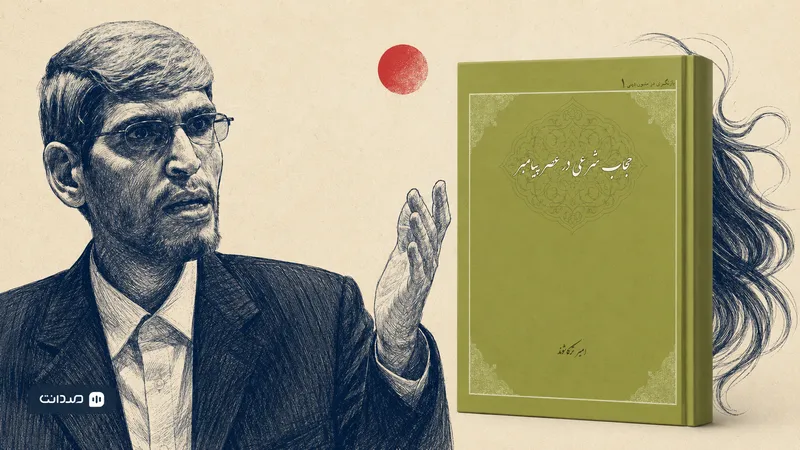

Discussion9 comments
جناب سوزنچی، شما عربی ۱۴۰۰ سال پیش رو بلد نیستی چرا مغالطه میکنی. من به شما ثابت میکنم که جیب اشاره شده در قرآن همان شکاف در مقعد و آلت جنسی زنان است. شما اگر فرصت داشتی یه صحبتهای استاد محمد شهرور که خود یک عرب است دقت کن. ایشان به روشنی میگوید که این جیب در قرآن همان شکاف جنسی است که باید با خمار که لنگی است پوشیده شود https://www.youtube.com/watch?v=dfAC1GtTFmk به علاوه کیریستوف لوکزامورگ که آشنا به زبانهای آرامی و سریانی است و کتاب خوانش آرامی/سریانی قرآن را نوشته https://en.wikipedia.org/wiki/The_Syro-Aramaic_Reading_of_the_Koran میگوید که منظور از آیه وليضربن بخمرهن على جيوبهن با در نظر گرفتن خمار در زبان سریانی/آرامی همان لنگ است (دقیقه ۹:۴۰) https://www.youtube.com/watch?v=EyDTnPYWc4U&t=602s
کلمه جیب در فارسی هم بمعنای شکاف آمده شکافی در کت یا شلوار یا پیراهن .
به نظر می آید راه مشترک ادیان و آیینهای مختلف در جهان برای رسیدن به آرامش و معنویت همان راه خودشناسی و معرفت نفس است. و مقاله خودشناسی آلدوس هاکسی، ترجمۀ استاد ملکیان در کتاب سیری در سپهر جان و نیز مقاله خود را بشناس در کتاب راهی به رهایی به قلم خود ایشان، مقالات خواندنی هستند و شاید استدلالی ترین نوشته درباه معرفت نفس در میان اندیشمندان اسلامی( در میان اندیشمندان غیر اسلامی اطلاعی ندارم) رساله الولایة علامه طباطبایی است. به ویژه ایشان در آخر فصل چهار هم طریقه ای برای تمرکز و نفی خواطر ذکر می کنند و هم به راه معرفت نفس که روش خودشان و استادانشان بود، اشاره می کنند و سربسته رد می شوند؛ البته در کتاب بررسی ها اسلامی ج 2 در توضیح معنای« فکر در عدم» در نامه میرزاجواد آقا ملکی تبریزی به این روششان صریحا ولی مختصر اشاره کرده اند. کتاب مثنوی مولوی به گفته استاد محمد رضا شفعیی کدکنی« بالاترین حماسه عرفانی بشریت» نیز از جمله کتابهایی که بهتر است بخوانیم.و به شروح مهم آن از جمله، شرح فروزان فر و دکتر شهیدی و نیز شرح کریم زمانی و درس گفتارهای دکتر سروش تحت عنوان آینه دوم و ... رجوع کنیم جدا از اینها به نظر بنده خداوند در درون هر انسانی قوانین اصلی اخلاق را نهاده است و نشانه آن تلنگرهایی است که از وجدان انسان گوشزد می شود. شاید خلاصه همه را در این متن بتوان دید که سخن یکی از اندیشمندان معاصر است:« هیچ کرداری نیست که به[تر] باشد از پرستش خدا و سپس پرستاری[ و نیکی] به بندگان خدا؛ از این رو هر کرداری آن گاه شایسته است که دراین مقوله بگنجد... .» خداوند حسّ پرستش و نیکی و خیرخواهی به بندگانش را در همه ما دم افزون کناد!
سلام جناب ترکاشوند ...باخواندن کتاب حضرتعالی وگوش کردن سخنرانیهای آیت الله جزایری وفتوای جناب جوادی آملی در مورد حقوق کارمندان بانک چنان باورها وارزشهای دینی من فرو ریخت که بی حجابی اطرافیان مرا آزار نمیدهد که بماند حتی خودم تصمیم به کنار گذاشتن چادر کرده ام وجالب اینکه احساس رهایی وآزادی میکنم وحس محبت ودوستی نسبت به همه دارم ...نمیدانم مسیر درستی انتخاب کرده ام یا نه ؟ ولی دیگر اعتمادی به فتاوای بسیاری از مراجع ندارم بااینکه سالها در حوزه درس خوانده ام وهر حدیث وکلامی از بزرگان را دربست قبول میکردم ، الان هر کلامی را تحلیل میکنم و ارزشهایی که قبلا جزیی از زندگی من بود رنگ باخته ...زیارتها مانند قبل از تقدس خاص برخوردار نیست چرا که احساس میکنم وقتی خدا هست نباید سراغ غیر او رفت وزیارت ادای احترامی ست به یک بنده خوب خدا که من وهمه انسانها میتوانند به درجه آنها برسند چرا که حتی پیامبر میفرماید انا بشر مثلکم ...دیگر احادیثی که خلقت پیامبر وامامان را از نور میدانند را باور نمیکنم ...حتی در وجود امام زمان شک دارم چرا که برای این سوالم جوابی پیدا نمیکنم که اگر قرار است امامی بیاید ودنیا را که پراز ظلم شده نجات دهد وقدرت فوق العاده ای در هدایت مردم دارد پس چرا همین کارها را امامان قبل او نکردند که بشر این همه سال اسیر جنگ وبدبختی نباشد مگر کلهم نور واحد نیستند ... از خودم گله مندم که چرا سالها پیرو کسانی بودم که اصلا به روز نیستند ...من علاوه بر حوزه ، فوق لیسانس مشاوره خانواده ام و چند وقت پیش وقتی فتوای جناب جوادی آملی را شنیدم که برای حل معضل رشوه اعلام کردند حقوق کارمندان بانک حرام است چنان باورهای مرا فرو ریخت که با خودم گفتم نکند دیگر فتاوای علما ومراجع همینقدر آبکی باشد ومن که عمری مبلغ دینی بوده ام کار عبث کرده ام ...کلاسهای دینی ام را تعطیل کردم چون به همه چیز مشکوکم ...نمیدانم حقیقت دین را باید از که وکجا بگیرم ...با کتاب قانون شفای کاترین پاندر آشنا شدم ...شاید باور نکنید بیست سال تفسیر قرآن میگفتم ولی امسال ماه رمضان این کتاب را در کنار قرآن تدریس کردم آنقدر تاثیر مثبتی در رفتار وزندگی حاضرین در جلسه قرآن گذاشت که در مدت بیست سال سابقه نداشت ...به حرم امام رضا رفتم وشکایت کردم که چرا باید یک نویسنده مسیحی ارتباط مرا با خدا نزدیک کند ؟!در حالیکه من حافظ تقریبا نصف قران هستم و خیلی باقران سرو کار داشتم ...شاید یک علتش این بود که همیشه دنبال ثواب بوده ام ودین معاملاتی داشته ام ...خلاصه خییییییلی متحیرم ونمیدانم چگونه ازین برزخ شک وتردید باید بیرون بیایم ...اگر میتوانید مرا به اطمینان برسانید لطفا کمکم کنید
سلام کتابهای آقای حیدر علی قلمداران و سید ابوالفضل برقعی و سید مصطفی حسینی طباطبایی را به شما خواهر محترم پیشنهاد می کنم.
پاسخ به فریبا یزدانی: 1- کسانی که نام برده اید معیار اسلام نیستند. مولا امیرالمومنین(ع) میفرمایند : " حق را بشناس تا اهل آنرا بشناسی". 2- معرفت خدا ایمان تقوا اخلاق و رفتار نیکو را باید از الگو هایی که خدا تعیین فرموده یاد گرفت. ملاک و معیار دین قرآن همراه باعترت است. باید به سراغ انان رفت. این فرمان خدا و پیامبر(ص) است. احترام و پیروی از بر گزیدگان خدا ضروری است. 3- برای یک شروع مناسب سعی کنید با دقت خطبه غدیر از فرمایشات پیامبر (ص) را مورد مطالعه با اندیشه قرار بدهید. 4- پیامبر(ص) انسان هستند ولی انسانهای غیر معصوم را نمی توان با آن حضرت مقایسه نمود همانطور که نور شمع قابل مقایسه با نور خورشید نیست. 5- دلیل انحراف جامعه ها تا کنون عدم پذیرش امامان در زمانهای قبل و عدم پذیرش امام زمان(ع) تا کنون بوده است وراه اصلاح پذیرش است.
سپاس اقاي تركاشوند گرامي كتاب شما براي مومناني است كه نو انديشند و بر خلاف نظر ايشون نظريه داروين همچنان ابطال ناپذير است اين نقد هم بر قدرت مطالب شما افزود وكلمه ساق هم مثل مو ودست و صورت نام يكي از اعضاء بدن است واهانتي در ان نيست موفق باشيد
اگر امروزه یک زن مسلمان بخواهد حد و اندازه ی حجاب شرعی را بداند میتواند از دیدگاه مرحوم احمد قابل هم استفاده کند و یقینا برای عمل کردن به وظیفه ی شرعی در مورد حجاب کسی از نظر آقای مهندس ترکاشوند استفاده نمیکند لذا کتاب ایشان نتیجه ی مطالعات و تحقیقشان در این مورد بوده و میتواند مورد نقد قرار گیرد اما مسئله ی میزان حجاب شرعی اگر بخواهد مورد مخالفت جدی قرار گیرد باید نقاد فتوای آقای احمد قابل را خدشه دار کند . خلاصه مطلب اینکه مخالفت با شخص که مطرح نیست بلکه مخالفت با این دیدگاه که حجاب شرعی شامل سر و گردن نمیشود مطرح است و برای اینکار قاعدتا باید نظر فرد متخصص و مجتهدی مثل آقای قابل را بتوان رد کرد و نقد تحقیق یک فرد غیر متخصص اگرچه بلامانع است اما فتوای عدم لزوم پوشش برای سر و گردن را خدشه دار نمیکند .در حالیکه هدف اصلی این است نه آن .
سلام علیکم به نظرم استدلالهای آقای دکتر کدیور از استدلالهای آقای قابل قویتر است. ایشان در مقالات خود استدلالات آقای قابل را رد کرده اند اما در عین حال همان موضع ایشان را دارند. بنده اولا نقدهای دکتر کدیور را بر آقای قابل وارد می دانم و ثانیا نشان داده ام که استدلالهای آقای کدیور هم دچار نقصهای فراوانی است و برخی از مقدمات آنها خودش دلیلی بر رد مدعای ایشان است. مقاله بنده در نقد دکتر کدیور در سایت بنده موجود است به آدرس http://www.souzanchi.ir/hejab-in-sureh-noor-critic-of-kadivars-opinion/