Religion
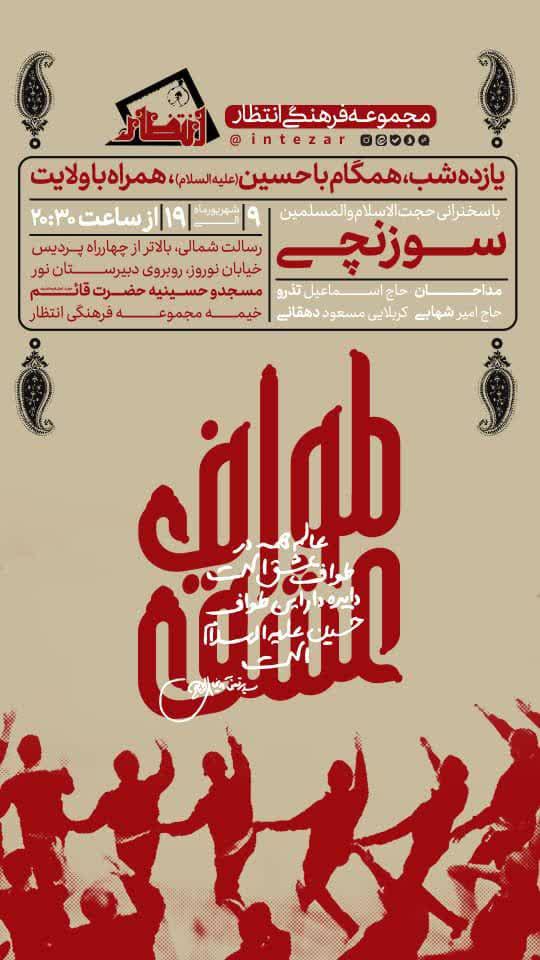
Lecture Series by Hossein Sozenchi: The Ashura-Inspired Family
In his 'Ashura-Inspired Family' lectures, Hossein Souzanchi argues that the purpose of marriage is human flourishing, not merely meeting economic needs. Critiquing capitalism and examining the status of women, he outlines strategies for strengthening the family institution based on the Ashura model.
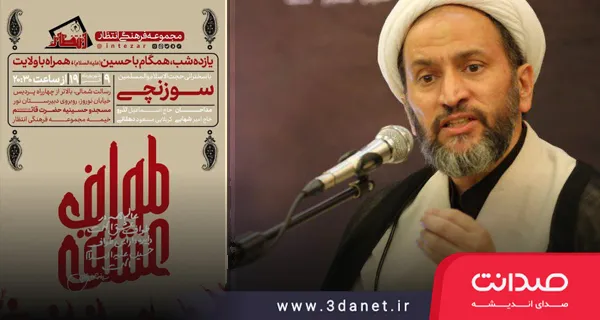
Hossein Sozenchi: This Muharram (1398/2019), at the Entezar Hey'at in Bandar Abbas, I held a discussion titled "The Ashura-Inspired Family," the subject of which was how to draw upon the event of Ashura to strengthen the institution of the family.
Summary of the discussions:
First Night of Muharram:
A human being must know their position in the world and time in order to truly be human.
In accordance with their self-knowledge and their decision for life, human beings choose three lifestyles and become three groups: the believer, the disbeliever, and the hypocrite.
One who wants to be secure themselves and for others to be secure from them (i.e., neither anxious nor destructive), and does not cover up the truth (= be a disbeliever), and whose stance with God is clear (= not be a hypocrite), becomes a believer: faith means believing in and taking seriously oneself, then believing in and taking seriously the divine message and leadership (prophethood and imamate).
Ashura is a path that Imam Hussein (AS) opened for those who were not guided by the Prophet's message and Ali's (AS) eloquence, so that the way might be made clear for us.
The family today is in crisis, and like every important issue of life, Ashura will have an answer for it.
Second Night of Muharram:
The formation of the family for humans (= marriage) was ordained in Paradise; therefore, the nature of the family in humans has a fundamental difference from the family in animals; just as clothing, housing, food, and the very essence of the human being were ordained in Paradise, and all of these are profoundly cultural matters in humans, and not merely an instinctual matter.
In the Western conception: family = relationships between individuals with three characteristics: they commit to one another, form an economic unit, and care for their children.
Does this level of family not exist in animals? In the Islamic view, the family is fundamentally for flourishing and perfection, not merely for fulfilling needs.
To clarify the difference, I turn to the issue of "work and occupation." The Industrial Revolution, with the division of labor, made it so that work and occupation are no longer a factor for flourishing, containing thought, creativity, and the realization of emotional connection between humans, but rather merely the performance of repetitive tasks where no creativity or flourishing is permitted; the goal is only the acquisition of capital. When the criterion for everything becomes the acquisition of wealth and profit, the family becomes the same, and the criterion for marriage becomes money and wealth instead of self-flourishing. Hurr's work was also only for income, so he did not take his position seriously and was willing to block the Imam's (AS) path; when he took his position seriously, he joined the Imam.
Third Night of Muharram:
With the previous session's depiction of work in the capitalist system, are individuals compelled, and do they have no way of escape?
There are at least four ways in Islam for human beings not to fall into alienation in this situation:
A. The importance of earning a lawful (halal) morsel; consequently, one must necessarily take their position seriously in any work, and earning money does not become the sole goal, and one cannot do just anything to earn money.
B. Be careful in choosing an occupation: there are still some jobs where the possibility of creativity and self-flourishing remains.
C. If your job is determined, the capitalist system itself has left openings for thought and creativity in its own path; use them. Also, if you properly fulfill your duty towards people, that itself brings flourishing.
D. Simply knowing that you are trapped in a prison, not a hotel, will help you find a way not to remain in the prison.
Note: The nature of our discussions is that of a nudge, not a categorized scientific discussion that is merely desirable for the mind but creates no change in us.
When the family is for fulfilling needs, expectations rise; and in the best case, a person sees themselves as the fulfiller of their family's needs and is not willing to defend the Imam;
But when the family is for one's own flourishing, instead of expectation, a sense of responsibility is elevated; instead of seeking comfort, one becomes ready to endure hardships and sees their own sustenance and that of their family as being in God's hands.
Fourth Night of Muharram:
When the family loses its standing, the position of women is also misunderstood. In the modern era, woman has become a “non-man.” In the West, the standard for woman has been man—specifically, the worldly, profit-seeking man; hence, it seeks to draw woman from the home into the street; but Islam seeks to bring man, too, from the street back into the home.
Is the human being within the horizon of profit-seeking, where their value lies in their possessions, or within the horizon of the Divine Spirit, where their value lies in self-flourishing? Is work for acquiring capital or for self-flourishing? Of course, a woman who merely stays at home becomes undiscerning and an obstacle to growth: just as the Kufan woman who prevents her man from jihad is not desirable in Islam; nor is the woman who defines herself in masculine terms desirable. In Islam, a woman correctly understands her duty: the bulk of her activity is in the home and family; but when a man is unable to perform a social action, the woman enters the scene: Lady Zaynab (peace be upon her) did something (propagating Islam in Damascus and preserving the message of Ashura) that men were incapable of doing: thus, although defending the life of the Imam was obligatory upon both men and women, she stayed to perform a greater task.
Fifth Night of Muharram:
Being and flourishing are different from having and being seen. The television series “Asr-e Jadid” (New Era) represented the values of the new era: those who are superior are precisely those whose work has no value or growth, neither for themselves nor even for society. Not even a scientist or a technician was deemed superior; rather, a painter, a stuntman, a singer, a magician, and an acrobatic troupe. Because only being seen matters!
When value becomes about having and being seen, woman’s entry is also with her specific capital (sexual capital) and the aim of self-display; under these conditions, one who observes hijab and chastity, in this fierce battle, is preferring self-flourishing over self-display. (Today, hijab has become a symbol; that is, it is the banner of religiosity; this is why it is under such assault; and bearing the standard is, of course, the most difficult task on the battlefield.)
It is true that society is formed to meet needs and based on the logic of transaction, and it is true that the first step out of animality is the demand for justice; but this is the first step, not the last; and what surpasses justice is love (affection and mercy), which first occurs in the family. Its beginning is from infancy itself: it is the experience of the parents’ unstinting affection that gives a human being the capacity for unstinting love and responsibility, and creates individuals like Abdullah ibn Hasan.
Sixth Night of Muharram
If a human being’s criterion becomes self-flourishing and not wealth and self-display, then they will choose modesty (haya): modesty is one of the distinguishing features between humans and animals. If you possess modesty and are yourself, not inclined toward self-display and fashion-worship, then the capitalist system can no longer exploit you; therefore, the capitalist system is an enemy of modesty and everything that strengthens the dignity of women, including hijab.
Women have been oppressed throughout history, but if we correctly understand woman’s position in the world, and that the primary difference between men and women relates to their role-playing in the family sphere, not a social competition, we understand that man’s oppression of woman is not of the same kind as an employer’s oppression of a worker; the root of this oppression lies in ignorance (jahalat), not profit-seeking; similar to a father’s oppression of his child or a wife beating her husband. And ignorance (jahalat) contains both lack of knowledge and unawareness (so to remedy this oppression, awareness must be raised: counseling, etc.) and, more importantly, ignorance means the domination of anger and lust over reason. The former is solved by raising awareness, but the main problem for humans is the latter (most marital conflicts stem from ignorance, and especially the dominance of anger in decision-making); and it is here that the revival of women’s rights also passes through the path of Husayn (peace be upon him); for Husayn came to eliminate ignorance: “li-yastanqidha ‘ibadaka min al-jahala” (to rescue Your servants from ignorance). To whatever extent a person’s spirit becomes Husayni, ignorance will not overcome them, and they will have the ability to control anger and so on.
Seventh Night of Muharram
Oppression of women is rooted in ignorance, not in the pursuit of self-interest; and if the position of women in the family is properly understood, her human status and the manner of securing her rights and standing, in a way that does not harm her, become clear: Innahunna yaghlibna al-ʿāqil wa yaghlibuhunna al-jāhil (Indeed, they overcome the wise man, and the ignorant man overcomes them); it is through her own style that a woman prevails even over the enemy in war: the proof of the victory of the followers of Husayn in Karbala itself was established by Lady Zaynab (peace be upon her) (I have previously elaborated on this: here and here)
If the emotional bond of the family is taken into consideration, we understand why the primary emphasis is on the rights of and respect for parents, and why the Western-style emphasis on children's rights and the disregard for the status of parents undermines the very foundation of the family; of course, the child has rights, but not of the Western kind: having a good name, being disciplined, having a helping hand extended for their marriage; and so on... (an explanation regarding the narration: the child is a master for the first seven years, and a servant for the next seven)
Eighth Night of Muharram
Continuation of the explanation of the narration: in the third seven years, he is a minister: a discussion about youth in the family and the issue of upbringing: is upbringing the responsibility of the family or the system? How is a sense of responsibility awakened in the child through the unconditional love of parents? How does involving the adolescent in decisions bring him to maturity; and so on...) Ali al-Akbar (peace be upon him) and the model of youth upbringing
Eve of Tasu'a
The concept of ikhwah (brotherhood/siblinghood) encompasses both brotherhood and sisterhood, and this is the most important relationship among believers, which is first formed within the family. This dimension of being a child is the second crucial human experience in social relations, neither entirely transactional and horizontal, nor entirely hierarchical. In fact, experiencing the brother-sister relationship under the guardianship-based (wilāʾī) relationship with parents prepares a person for living under the banner of the guardianship of the Imam (peace be upon him).
Night of Ashura
The position of the man of the family in the role of guardian (walī) and manager of the family can acquaint us with the role of guardianship (wilāyah). If justice is the floor and the main goal is affection and mercy (love), then the primary logic of family relations is not equality of rights; right means authority; and if someone bears more responsibility, they must have broader authority. The guardianship of the man in the home means his heavy responsibility, not only providing lawful livelihood, but also the upbringing of the child and... and any other responsibility is primarily upon the man; and of course, he seeks help from his wife and children and gives them roles: a manager does not do all the tasks himself, but he is responsible for all tasks. The Imam is the father of the community, even the father of wayward children; and he is greatly pained not only by the martyrdom of the righteous, but also by the deviation of the wayward.
Eleventh Night
A supplement on the manner of women's role-playing in society with regard to the model of the mother
The importance and pleasure of motherhood and its denial by second-wave feminism: To overcome values, the enemy's best method is to mobilize individuals themselves against their own values: Just as an army was gathered from the very people of Kufa against the Imam (peace be upon him) = they incited women themselves against motherhood and called it drudgery; the hijab of women today is the banner of Islam; and if the standard-bearer considers his banner a mere piece of cloth, woe to that people! The immense potential of motherhood for the growth of women's social role-playing: Umm Abīhā (Mother of her Father); Lady Zaynab (peace be upon her); and so on...
.
.
Audio recordings of the Ashura-Inspired Family sessions:
.
.
Lecture Series by Hossein Sozenchi Entitled "The Ashura-Inspired Family"
Hossein Sozenchi's Website | Hossein Sozenchi's Telegram Channel
.
.



Discussion2 comments
باریکلا آخوند باید روضه اش را بخواند.
این کامنت مایه تاسف هست. از انتشار یک کامنت غیرعلمی توسط صدانت تعجب میکنم.