Sociology
If Time Had a Master
Maryam Mirzakhani's father asked that, instead of myth-making and street-naming, we support the hidden talents that wither before they bloom; a story of a scientist's humility, the regret for gifted children who never got the chance to flourish, and the silent geniuses of the neighbourhood.
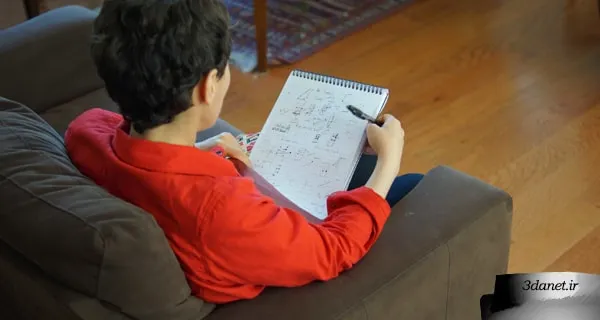
A few days ago I heard some pure words from the late father of “Maryam Mirzakhani,” that humble daughter of the land of Iran, which left me astonished (see here). I followed up further and saw that no, he tells stories that, even to the least observant eye, would make one’s “heart boil over”! (read here).
He emphasized two fundamental points: – Do not make a myth out of my daughter, for a myth is unattainable. Let her become a practical role model for the hundreds of girls and boys who are the hidden treasures of this land and can shine and radiate light even far better than she could. (One is reminded of Antoine de Saint-Exupéry, the author of The Little Prince, who said in Wind, Sand and Stars: I am anxious and concerned about the condemned Mozarts who are killed and wither away before they can blossom. The final chapter of the book shows us a peak in practical mysticism that I think few of my compatriots famed for mysticism have ever glimpsed. (The final section of Wind, Sand and Stars, translated by Soroush Habibi, Niloofar Publications, here)
– What is the use of naming a street after someone? Did naming a street after Amir Kabir make any difference for these people? How many Amir Kabirs did it produce for this nation? Do not name a street after this girl. We do not consent.
The father’s statement that there are children, teenagers, and young people more brilliant than Maryam who need to be nurtured is the absolute truth and the epitome of humility. Place this alongside those individuals who have accidentally “had their fill and reached somewhere,” and see what a hullabaloo and what businesses have sprung up around their names. They are not few. With a little attention, a considerable number can be found for our own social pathology.
This state is still different from those who were truly stars and through whom others found some sustenance, or those who were something in a field and from that very field attained name and sustenance.
Maryam Mirzakhani, had she given in, would have easily become the Turkish delight of the official media; media that lie in wait. But she did not give in. She was a committed human being and did not allow herself to become a plaything of games. As she passed through adolescence and youth, she set out on her own path. Her course was the humble path of “giving meaning to life through discovery and knowing,” while simultaneously maintaining a completely intelligent and political stance so as “not to become politicized!”
But her noble father points to a great wisdom: How numerous are the children greater than Maryam who, unblossomed, wither away in every corner of this soil and this earthly globe. He says it is better that we attend to these so they are not lost. In his words, the father does not even glance sideways at the esteemed authorities in charge; his address is to the people, that they must gird their loins to revive those definitively buried alive: with respect, but firmly, he tells the city council representative, you are in a position of power and are fully empowered in the matter of naming a street after Mirzakhani. But we, as the family, do not consent. The translation of his words is this: we do not want a business to be made of it, nor will we make one, for someone for whom, even during her time in Iran, they had wanted to name a street, for someone who humbly did not inform her family of her global successes, and the father heard of them from others.
How astonishing! The right thing is to compare many others with this valuable measure of Maryam Mirzakhani, and before everyone else, myself and ourselves.
It seems the most important discovery we can make about this phenomenon is precisely what has been said: the humility of a scholar. That she won several prizes means neither bread nor water for any of us, just as she herself was indifferent to them. Vast she was, and solitary, and humble, and hard, She came from the company of the sun. A proud mind and a humble heart of that sort, occupied with a discovery about which she said: I take the greatest pleasure when I solve a problem and feel that I am now standing on a height and can see my surroundings better than in the darkness before. My field of vision has become wider than before. Just that.
 Her magnanimity and the manifestation of mystical understanding in her were such that she did not think about the reflections of her work on others (fame). This kind of conduct requires a rare open-mindedness and demands a generous heart that many talk about, write books about, read books about, and pay lip service to, yet bear no trace of it in themselves (see here and here ).
Well! Father would say, reach out to those who need resources in order to flourish. Not everyone has a father like me. Be a father to them. Not everyone has a mother like Maryam's mother; be a mother to them so they do not wither.
 Mirzakhani grew up in a family that had the means to reflect on their child's moments and future, and how wonderful that is!
Hearing and reading these words, I would remember the people I had seen in childhood, adolescence, and youth in the neighborhood where I lived. I was an unpaid official worker in my father's shop. The tradespeople of the old days (40-50 years ago) would encounter fixed personages in the neighborhood, all of whom together made up the neighborhood.
Among them were Hossein Magasi (Hossein Mashtali = Mashhadi Ali) and Manouchehr… 42 years ago, in the mosque library, we were reading books to the children we had gathered: The Little Black Fish. The expectation was that during the question-and-answer session, everyone would show empathy with the Little Black Fish and choose his path. The turn came to Hossein, whose financial and family situation was very difficult compared to all the other children.
We asked, "Well, Hossein jan, what do you think?" Hossein said: "The Little Black Fish was really foolish to abandon his work and life and go off chasing other things. He should have stuck to his own work and not spun these irrelevant tales." Hossein gradually grew older, and later performed the first stand-up comedies on the spot, in the street, for the neighborhood kids, which I will never forget. He had created such a repertoire of behavioral and speech imitations for everyone in the neighborhood and performed them that one was left stunned, wondering what kind of prodigy this was! A critic of a self-taught artist, for whom I was already worried back then about what the ultimate fate of his destiny would be, at most.

Manouchehr… was of the same ilk. Just like request music programs, we would invite Manouchehr to tell us about so-and-so and then so-and-so and brighten our moments. And Manouchehr, in one breath, would not stop.
This example too (see here), of course regardless of its thematic misguidance and keeping a distance from them, demonstrates creativity, social inference power, and its translation into a skill we have all seen in eulogy ceremonies; elements that show him to be on par with a very sharp-witted person and a creative artist.

That same Hossein Magasi had a dear brother, three years older, named Mamad. I liked him much more than Hossein. It was early morning on the first day of Mehr, forty-one years ago. The kids were going to school. I suddenly noticed Mamad, who had put his head against the wall and was crying very forlornly (he was motherless). The late Mash’ali, God bless him, couldn’t send him to school. He had told him to go work. He was no more than 10 years old, with abundant intelligence and a love of study. His fate was that at the age of thirty, due to the loneliness stemming from untreated depression since childhood, he died quietly.
I have not seen few of these examples, and I still do not see few! Let me tell you about Khadijeh, who was still 5 years old, and when she died from a two-hour fever, she was 8. I used to see her in my grandfather’s village. Her mother tongue was Turkish, and the only person who spoke Persian was me, a passing guest. I noticed the peak of her language-learning ability with amazement, when I saw her trying to speak Persian with me, and how well she did! She had learned on the spot, and her immediate mental inference and generalization led her to prediction and invention in the foreign language, and sometimes how sweet and funny! I mean, from just one person and with very short-term interactions, very short! At that very time, I was thinking whether it was possible to bring her to Tehran and raise her. Would her family agree? About her, who was the epitome of the "passion for learning" and positive boldness and courage, I was at ease.

After I suddenly heard she had died from a febrile convulsion lasting a few hours, I am always, always reminded of empathetic verses that say: … A Javadiyeh must be built upon the bridge,
The bridge!
These shoulders of ours.
We must know suffering,
When Rahman’s daughter,
He dies with a two-hour fever.
…

Yes! It is our shoulders that must carry the burdens to their destination.
It wouldn't hurt to think a little: on this globe of dust, and of course in a land whose "soil and stones are surely better than gold!" and which is indeed "full of gems and jewels!", how many noble human beings out of every 10,000 have devoted a part of their freely-given existence, as a definite duty, to fathering and mothering these ownerless ones of the ages in these ownerless times? How many, nobler still, have devoted more of their existence? And how many, far nobler, have staked their entire existence on a task that, as long as the world endures, rests upon the shoulders of each and every one of us, unless the problem is completely resolved!
Of course, the free giving of existence's gifts and the root eradication of evil is not accomplished solely through genuine spiritual-psychological attention and caress, or with cash; what matters is the wise and calculated expenditure of our attention, time, life, resources, and possessions, drawing upon global, national, and local experiences.
There are thousands of ways, as many as the paths of the heavens!
It is enough to look intelligently at our surroundings and a little further afield, and not be indifferent.
And before it is too late, some reflection and... a rolling up of our own sleeves!
.
.
If Time Had a Master
Author: Gholamali Keshani
https://t.me/GahFerestGhKeshani
https://ghkeshani.com
.
.

Discussion0 comments
No comments yet; let yours be the first voice.